Page 2 of 2

Why the Enneagram? pt. 2


In the previous post, I pointed to three fundamental truths that lay the foundation for working with the Enneagram. They are:

  1. Every person is created in the Image of God.
  2. Our highest calling is to love God with our entire being – body, heart, & mind.
  3. Our love for God is fulfilled in loving others AND loving ourselves.

Before you begin to build, you need to have a good base. Some of us may need to do a bit more foundation work before we begin. I believe that once we’ve got this foundation set, then we can begin the real work.
OUR TASKS

In my understanding, there are four main tasks that the Enneagram invites us to undergo. They are related to and flow out of the three fundamental truths. So if you’re ready to get to work on the Enneagram, here is what you can expect the process to look like.
1. Find Yourself

This is closely tied to the first truth, that we are all made in the Image of God. Some of us struggle with understanding who God made us to be. When I say “find yourself,” we may think that’s a task for high school and college students. We should have it all figured out by the time we’re young adults.
But have you ever stopped to think about who you are? If I asked you to introduce yourself, could you come up with anything to say that wasn’t related to your occupation, your age, your family relations, etc.? We tend to find our identity in our relationships, our jobs, our political beliefs, our religious practices, our hobbies and interests. But these are all peripheral to who we actually are at the core.
Have you ever noticed how God has a tendency to change people’s name in the Bible? Abram becomes Abraham. Jacob becomes Israel. Simon becomes Peter. Saul becomes Paul. Names mean something. God would often give someone a new name, taking their life from one path onto another path, or revealing who they were truly made to be.
Henri Nouwen famously laid out three lies of identity that we tend to believe: 1) I am what I do. 2) I am what I have. 3) I am what others say I am. If we try to find our identity in these lies, we will forever be wandering. But if we want to truly find ourselves, we must come to know the truth. Look at what Nouwen says in his book Life of the Beloved.

The truth, even though I cannot feel it right now, is that I am the chosen child of God, precious in God’s eyes, called the Beloved from all eternity, and held safe in an everlasting belief.

You are the beloved, chosen child of God, created in his Image, loved and accepted, created to do good works which God had planned for you long ago.

The first task of Enneagram work is to be honest with yourself about where you are and who you have become. The Enneagram, to quote Suzanne Stabile, “doesn’t put you in a box. It reveals what box you’re already in, and it shows you the way out.” We all have defense mechanisms and patterns of behavior that we fall back into unconsciously. The Enneagram helps bring those things to our awareness so we can “put off the old man” and become a “new creation” in Christ.

2. Love Yourself

I spent quite a bit of time talking about this point in the previous post, so I won’t go back over everything. But I want to reiterate the fact that God loves you and created your inmost being. Christ loves you and gave up his life for you. The Spirit loves you and lives inside you, bringing life and gifts.

If the triune God loves you this much, then shouldn’t you find reason to love yourself? God knows all your faults, all your failures, all your sin and brokenness. God knows it better than you do. And God loves you despite all that.

I find Paul’s words in Romans 7 extremely relatable.

What a wretched man I am! Who will rescue me from this body that is subject to death? Thanks be to God, who delivers me through Jesus Christ our Lord!
(Romans 7:24-25)

You may look back at your shortcomings and screwups and think How could anyone love me? But God looks at all that and (see point 1) says, You are my beloved child. How could I not love you?

Love yourself. Accept yourself. Forgive yourself. God says you’re worth it. The Enneagram can help you see your own worth and value. Before you ever begin to make a change, you are worthy of love.

3. Deny Yourself

This may seem like a contradiction to the point above, but it’s really just what happens when we stop buying into the lies of identity that Nouwen pointed out. We deny ourselves when we begin to believe 1) I am NOT what I do. 2) I am NOT what I have. 3) I am NOT what others say I am. After all, weren’t the temptations of Jesus in the wilderness all about identity? If you are the Son of God…do this miracle…have these kingdoms…get people talking about you. That’s why Jesus could then turn around and say this:

Whoever wants to be my disciple must deny themselves and take up their cross daily and follow me. For whoever wants to save their life will lose it, but whoever loses their life for me will save it. What good is it for someone to gain the whole world, and yet lose or forfeit their very self?
(Luke 9:23-25)

Notice, he doesn’t say that you must deny yourself ______X_______. It’s not that you are denying yourself pleasures or wealth or power. Jesus doesn’t call you to deny yourself things. The call is to deny yourself, your very identity, what you believe makes you you.

This is where the mask comes off. This is where you realize that who you have been is not who you want to be. In psychological and Enneagram language this is called the “false self.” We all have this image we want others to see. We build up walls to keep people out and prevent them from getting too close. We’re afraid that if we unmask, then people won’t like what they see underneath.

This is probably the most painful part of the whole process. We must be willing to say, “I’m going to take off the mask and get rid of my false self – even if it kills me. Even if my whole little world begins to unravel, it’s worth it. Living into my true identity as God’s beloved child is better than living under the lies of a fake identity.”

4. Transform Yourself

The bad news about the transformation process is that no one can do it for you. Even God can’t force you to change. You can only do the work for yourself.

The good news is that you don’t have to go it alone. God will be with you every step of the way.

If you’ve ever read John Bunyan’s The Pilgrim’s Progress, you understand this idea. The Pilgrim had a guide leading him through all the challenges along the journey, but the Pilgrim had to complete and overcome the challenges on his own. So it is with Enneagram work. No one can do the work for you. No one can force you to change or cause transformation in your life.

Paul describes the process at the beginning of Romans 12.

Therefore, I urge you, brothers and sisters, in view of God’s mercy, to offer your bodies as a living sacrifice, holy and pleasing to God—this is your true and proper worship. Do not conform to the pattern of this world, but be transformed by the renewing of your mind. Then you will be able to test and approve what God’s will is—his good, pleasing and perfect will.
(Romans 12:1-2)

Self-denial leads to transformation. And notice how we are transformed – by the renewing of our minds. When we undergo these tasks – finding, loving, denying, and transforming – we will begin to think differently about ourselves, God, others, and the world.

Start Here

If you are ready to begin the journey of transformation via the Enneagram, please check out my list of resources. Whether you’re a complete beginner wanting to get started or you’ve been at it for a while and want to go deeper, these resources can help you along the way. They have personally helped me to get in tune with myself and God. I hope they will be a blessing to you, too.

11 Great Enneagram Resources

Why the Enneagram? pt. 1

I’ve shared some thoughts on the Enneagram recently. I know it’s growing in popularity, especially among certain Christian circles. I think it’s a helpful tool, and can give you a lot of insight into your own personality and that of others. But why even bother at all? Isn’t it just like any other personality quiz or horoscopes? Why should anyone be interested in the Enneagram unless all your friends are doing it and you want to talk about your number at the next dinner party?

First of all, if that’s all you want to get out of it, then seriously don’t bother.

However, if you’re ready to go on a serious journey of self-discovery and transformation, then the Enneagram (IMHO) is the best tool to help with that process.

You may be on the fence about it. So let me lay out what I believe the be the biblical foundation for this transformation process and why the Enneagram can help with it.

THREE BIG TRUTHS

Lets begin with three fundamental truths:

1. Every person is created in the Image of God.

Then God said, “Let us make mankind in our image, in our likeness, so that they may rule over the fish in the sea and the birds in the sky, over the livestock and all the wild animals, and over all the creatures that move along the ground.”
So God created mankind in his own image,
in the image of God he created them;
male and female he created them.
God blessed them and said to them, “Be fruitful and increase in number; fill the earth and subdue it. Rule over the fish in the sea and the birds in the sky and over every living creature that moves on the ground.” (Genesis 1:26-28)

Every single calorie-consuming, oxygen-processing, hemoglobin-pumping human is made in the Image of God the creator. Your new neighbors from some country in Central America you can never quite remember? Image of God. Your in-laws with whom you’d rather not spend more time with than necessary? Image of God. That awful customer who is berating you for something you had no control over? Image of God. Your boss who is placing unrealistic expectations on you? Image of God. The mass shooter? The corrupt politician? The strung-out hooker on the corner? Image. Of. God.

So what does this mean? Each person is worthy of respect. Each person needs to love and to be loved. Each person has the capacity for great things. Paul reminds us in Ephesians 6 that our battle is not against flesh and blood. In other words, if you can hit them and make them bleed, then they are not your enemy. They are a potential brother or sister in Christ.

Yes, some people are simply unbearable to be around. But so are you sometimes. The fact that we are created in God’s image and likeness means that each person has some amount of good in them that’s worth discovering.

But let’s be honest. Sometimes the hardest person to see the good within is…ourselves. It’s easy for us to lose sight of the God-Image within ourselves. That’s when we become fearful, worrisome, anxious, or angry. That’s when we become filled with shame or regret or envy. The Enneagram helps us to rediscover the Image of God within others and, more importantly, within ourselves.

2. Our highest calling is to love God with our entire being – body, heart, and mind.

Hear, O Israel: The Lord our God, the Lord is one. Love the Lord your God with all your heart and with all your soul and with all your strength. (Deuteronomy 6:4-5)

This passage is known as The Shema, from the Hebrew word “hear” or “listen.” When asked what the greatest command in Scripture is, Jesus quotes  The Shema. The greatest command, the highest calling in all the Bible is to love God with our entire being. We must love God with our heart (our emotional center), with all our soul (our intellect), and with all our strength (our physical bodies).

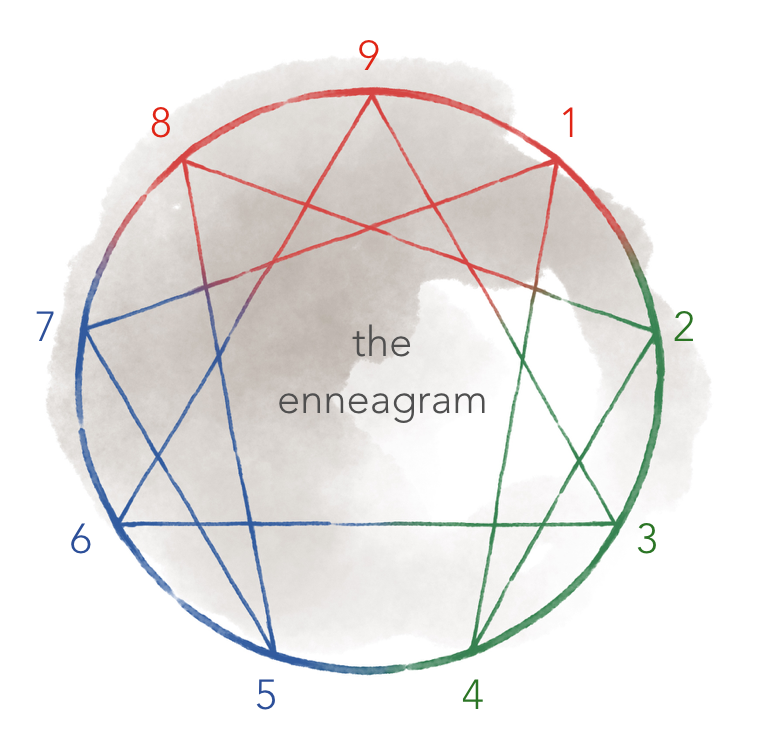
In Enneagram language we see this in the triads – Head, Heart, Body – or Feeling, Thinking, Doing. Each one of us is drawn to one of these expressions more than the others as our way of relating to God.

If we are head people, then we will be really into Bible studies. We will want to know and learn as much as possible about the Bible, history, theology, etc. We want our worship songs to be biblically accurate. We want the preaching to teach us something new. We want to sit and talk for hours about systematic theology.

If we are heart people, then we want worship to be passionate and full of emotions. We want to connect on a deep level with the music and the prayers. We will want more creative, artistic forms of expression in worship. Maybe tears. We want a preacher who is emotive and expressive and deeply moving. We want to be inspired deep in our souls.

If we’re body people, then we’re looking at the clock hoping the preacher doesn’t get too long winded because we’ve got things to do. We’d rather be out serving, helping, making a difference. We feel most connected with God when we’re actually doing the things we’ve heard about in church. We want to experience God in action. Enough studying. Enough sappy worship songs. Let’s get going!

Each of us will be drawn to one of these more than the other. We will be dominant in thinking, feeling, or doing, and we will also be regressive in one of the remaining areas. The Enneagram helps us understand which is our dominant center and which is our regressive center. The goal is to bring all three into balance or rhythm so that we can truly love God with all of our heart, soul, and strength.

3. Our love for God is fulfilled in loving others AND loving ourselves.

Do not seek revenge or bear a grudge against anyone among your people, but love your neighbor as yourself. I am the Lord. (Leviticus 19:18)

After stating the Shema as the “first and greatest” command, Jesus then said there was a second command like it. He then quotes from the passage above, “Love your neighbor as yourself.” It’s not even that this is the second place command and the Shema is first place. It’s more like “Command 1.A and Command 1.B.” We show our love for God by loving our neighbor as ourselves.

These verses back up this point:

No one has ever seen God; but if we love one another, God lives in us and his love is made complete in us. (1 John 4:12)

‘Truly I tell you, whatever you did for one of the least of these brothers and sisters of mine, you did for me.’ (Matthew 25:40)

If we claim to love God, then we must show it by loving others. It’s as plain as that. We get it. That’s what we’re taught. Love God. Love others. That’s the life of a disciple in a nutshell, right?

But we skip over the last part of Command 1.B – Love your neighbor as yourself. We don’t tend to emphasize self-love that much. Admittedly, we do run the risk of becoming self-absorbed if we emphasize self-love and self-care too much. But if we don’t emphasize it at all, then we can become self-loathing. We can become our own worst critics.

I can almost guarantee that you speak more harshly to yourself than you ever would to your best friend or your significant other. You would never call your girlfriend fat (at least I hope!). You would never call your spouse a worthless moron. You would never call your child a failure for missing a couple questions on their test. Yet we say these things and worse (!) to ourselves every day.

We need to develop a sense of love and compassion for ourselves, too. We need to show mercy and forgiveness to ourselves, too. We cannot pour from an empty vessel. We cannot truly love others if we are not loving and accepting of ourselves, who God made us to be.

Paul talks about the need for self-love in his instructions to husbands and wives:

In this same way, husbands ought to love their wives as their own bodies. He who loves his wife loves himself. After all, no one ever hated their own body, but they feed and care for their body, just as Christ does the church (Ephesians 5:28-29)

The Enneagram is a tool for developing empathy and compassion for others and for yourself. It will reveal the good, the bad, and the ugly about you. You will find things you never even knew were there. But the Enneagram will help you see that for every shadow there is a light, for every bit of ugliness there is beauty, for every fault there is a gift. The worst part about you and the best part about you are often two sides of the same coin. And that coin bears God’s image and likeness.

MORE ABOUT THE ENNEAGRAM:
11 Great Enneagram Resources
3 Benefits of the Enneagram

Jonah: Sorry, Not Sorry

Have you ever heard of the non-apology? Here’s the definition from Google.

Non-Apology: A statement that takes the form of an apology but does not constitute an acknowledgement of responsibility or regret for what has caused offense or upset.

We see the ALL. THE. TIME. in politics and the like. Some politicians are absolute masters at the non-apology. Common examples of the non-apology are statements like “I deeply regret…”, “Mistakes were made…”, “I’m sorry you feel that way…”, or even the prevalent “I’m sorry, but…”


These all take on the form of an apology without, as per the definition, acknowledging responsibility or remorse for one’s own actions.

This article from Cracked explains some of the most common forms of the non-apology and reveals why we fall for them so often. We want to give people the benefit of the doubt. We want to believe that people are sincere and that they are willing to acknowledge fault and move on. We want to see the best in people. That’s how relationships work. There can be no relationship without reconciliation*.

*reconciliation: the restoration of friendly relations


When people offer a non-apology, there is no true reconciliation. The offending party retains all their pride and dignity, often without addressing the very attitudes, words, or actions that caused the offense in the first place. We rely on non-apologies when we are afraid to humble ourselves in order to repair the relationship. Real apologies are seen as weak. The non-apology allows you to keep up the appearance of strength. But there can be no true relationship without humility.

This is all made harder by what I consider to be the worst quote from any book of movie ever. It’s from the novel Love Story, by Erich Segal, and popularized by the 1970s film adaptation by the same name. You may have heard it before. “Love means never having to say you’re sorry.”


What terrible relationship advice! If I truly love someone, I will apologize the instant I realize I hurt them. I’m not always the best at this – just ask my wife. But I’m trying. I’m not too proud to acknowledge fault or wrongdoing. Sometimes I’ll even apologize in order to make amends when I don’t think I’ve done anything particularly wrong. But I try to be humble enough to see things from the other person’s perspective.

THE NON-APOLOGETIC PROPHET

We are all greedy, self-centered creatures by nature. We all face this internal struggle between looking out for our own interests and wanting what’s best for our social group. We are both highly individualistic AND incredibly social creatures. Any human on his/her own will die. We need each other. Reconciliation should be our highest goal.

This is why I can’t stand the prayer in Jonah 2 – as it pertains to Jonah himself. I really love this prayer for anyone else. You can see in my last post, I recommend the prayer from Jonah 2 for anyone who is struggling emotionally, mentally, physically, or spiritually. It’s a great prayer for re-centering, for reorienting our lives around God. When we feel like we’re drowning and the world is closing in on us, this prayer helps remind us that we’re in God’s hands. God is with us even in the depths of despair.

But for Jonah to pray this prayer really grinds on me, not because of what he says but because of what he doesn’t say. He never once says, “I’m sorry.” This prayer is a non-apology!


Look at it again:

“In my distress I called to the Lord,
and he answered me.
From deep in the realm of the dead I called for help,
and you listened to my cry.
You hurled me into the depths,
into the very heart of the seas,
and the currents swirled about me;
all your waves and breakers
swept over me.
I said, ‘I have been banished
from your sight;
yet I will look again
toward your holy temple.’
The engulfing waters threatened me,
the deep surrounded me;
seaweed was wrapped around my head.
To the roots of the mountains I sank down;
the earth beneath barred me in forever.
But you, Lord my God,
brought my life up from the pit.
“When my life was ebbing away,
I remembered you, Lord,
and my prayer rose to you,
to your holy temple.
“Those who cling to worthless idols
turn away from God’s love for them.
But I, with shouts of grateful praise,
will sacrifice to you.
What I have vowed I will make good.
I will say, ‘Salvation comes from the Lord.’”
(Jonah 2:2-9)

What does Jonah do? He cries out to God. He acknowledges his helplessness and his distress. He praises God for saving him. He desires to worship and offer sacrifices to God. He pledges to make good on his vows to God.

All good things, but he never once says, “I’m sorry for disobeying and running from you. That was really foolish of me. Please forgive me.”

The argument could be made that the apology is implied, that Jonah really is repentant. One could assume that Jonah’s words own up to his fault, and that there would be no need for sacrifice if he weren’t acknowledging his sinfulness. We could maybe see that confession, forgiveness, and repentance are all implied by God’s salvation.

But I can’t go there. I don’t think Jonah is sorry for what he did. I don’t think he’s repentant. I don’t think he really sees the need for forgiveness, because in his view he didn’t do anything wrong! How do I know this? Because of the rest of the story, but we’ll get to that later.

THROWING SHADE AND #HUMBLEBRAG

What makes it worse is that Jonah even uses this prayer to throw shade at the pagan sailors who tossed him overboard. “Those who cling to worthless idols turn away from God’s love for them.” That’s a direct slam against those sailors who cried out to their little-g gods during the storm. Jonah doesn’t even know that the entire crew converted to becoming worshipers of YHWH while he’s drowning in the sea to avoid the very same God.

And no good non-apology is complete without a humblebrag at the end! “But I, with shouts of grateful praise, will sacrifice to you.” Yeah, sure Jonah. You’re assuming a lot. Guess what? While you’re in the bowels of a fish, the sailors you just slammed are actually making vows and sacrificing to YHWH.

I love the prayer in Jonah 2 for anyone except Jonah. Coming from Jonah, it’s like the pie from The Help, if you know what it mean…

Do you know what really turns people away from God’s love for them, Jonah? A calloused, unrepentant heart that denies the need for forgiveness. Those who cannot acknowledge their own sin are not only lying to themselves, but they are making God out to be a liar. Jesus had a word for people like you, Jonah – “Hypocrite.” You want the salvation from God without repentance. You want God’s mercy without showing mercy to others. You expect grace for yourself and judgment for others.

JONAH IS…ME

And you’ve got to know that when I address those issues to Jonah, I’m really talking to a mirror.

Because as much as I can’t stand Jonah, I see so much of him in myself. That’s the brilliance of this book. That’s why this shouldn’t just be relegated to the realm of children’s Bible stories. That’s why we need to take our time with this story and really dive into it. On a surface level reading of Jonah 2, it can seem like Jonah’s really turned a corner. But he hasn’t.

Jonah is that person who shows up to worship Sunday after Sunday, who sings the songs and takes communion, who leads prayers, who even preaches on occasion, but still struggles to have any empathy for those who aren’t just like him. Jonah sings “Oh, how I love Jesus,” but then badmouths immigrants. Jonah takes communion, the body and blood of Christ, but then scoffs at movements like Black Lives Matter. Jonah says a hearty “Amen!” when the preacher makes a point about God’s salvation, but refuses to tip the overworked waitress because service was a little too slow.

Jonah is a hypocrite. Jonah is a prophet of God who doesn’t understand God at all. Jonah is an unrepentant sinner. Jonah is a racist hyper-nationalist who thinks in stereotypes and 280 characters. Jonah is more concerned about being right than about reconciliation.

But before we get too harsh with Jonah, we’ve go to realize this story is like the story told by Nathan to King David. If we aren’t careful, we can get worked up and angry just to have it thrown back at us that “You are the man. You are Jonah!”

So I apologize if anyone was made uncomfortable by this. I regret any offense that may have been caused. And I’m sorry, but we’ve all got to take a good hard look at ourselves in the story of Jonah.

Messiah Is Coming, pt 2

God promised Abram that he would become a great nation. The only problem was that he and his wife, Sarai, didn’t have any children, and they were well past the child bearing age. God eventually made good on the promise and blessed the elderly couple with a son named Isaac, meaning laughter. God has a sense of humor.

Isaac became the father of Jacob. Jacob became the father of 12 sons whose own offspring would become the 12 Tribes of Israel. Before that, though, they all ended up in Egypt through a series of betrayals, backstabbing, double crossing, and famine. They never intended to stay in Egypt, but that’s just what happened. They never went back home. The subsequent generations, known as the Hebrews, continued to grow in numbers and in strength until a Pharaoh came along who didn’t know about these outsiders. They became enslaved by the Egyptian government, forced into years of hard labor under brutal conditions.

The people cried out for a deliverer, and God heard their cries. God raised up Moses to free his people and lead them to the promised land. They escaped Egypt through a series a plagues. They encamped at the base of Mount Sinai. They ate manna in the wilderness. They were made to live as nomads, wandering the Sinai peninsula for 40 years because they didn’t trust God.

Finally, they were on the edge of entering the Promised Land, the land they had left so many years ago when they were just a small family. Now they are a nation on the brink of seeing God’s promise fulfilled.

But Moses was old. He wasn’t going into the land with them. What would they do without this leader who has guided them for the last 40 years? Who would speak the words of God to them?

Moses gives them this promise:

The nations you’re going to displace seek guidance from people who practice divination and predicting. But the Eternal your God doesn’t want you to do that. He will raise up from among your own people a prophet who will be like me. Listen to him. This is just what you asked Him for on the day you gathered at Mount Horeb: “Don’t make me listen to the voice of the Eternal my God anymore! And don’t make me look at that blazing fire! I’ll die!” The Eternal told me, “They’re right. I’ll send them another prophet like you from among their own people. I’ll put My words in the mouth of this prophet who will tell them everything I command him to say.” (Deuteronomy 18:14-16 | The Voice)

The Prophet is coming.

Moses died and passed the torch on to Joshua who led the people into the land of Canaan. They divided the land and laid down roots. But there was no king, so central government, no true leader. So God raised up a series of Judges who led their tribes in military, religious, and legal matters.

But the people wanted a king. They wanted to be like all the other nations. God warned them what would happen. God wanted to be their King. But he relented and gave them what they wanted. God, through the prophet Samuel, anointed Saul to be the first great king over the united tribes of Israel.

Saul did well for a while, but would ultimately break God’s commands and end up losing his kingdom. Through Samuel again, God anointed a young shepherd boy named David to become the next king after Saul. David was from the town of Bethlehem, of the Tribe of Judah. David was a “man after God’s own heart.”

To David, God made this covenant:

“More importantly, I, the Eternal swear to you that I will raise up a dynasty from your family. When you come to the end of your days, and you leave this life to lie down with your fathers, I will raise up from you a descendant, your own flesh and blood, and I will make his kingdom and family sure. He will be the one to build a temple honoring My name, and I will establish the leadership of his kingdom for all time. I will be to him a father, and he will be to Me a son. When he crosses the line and acts badly, I will teach him with a rod used by people for correction and a lash for discipline. But I will not withdraw My love from him as I did from Saul, whom I set aside in favor of you. Your dynasty, your kingdom, will stand perpetually in My sight; your descendants will rule continually.” (2 Samuel 7:11-16 | The Voice)

The King is coming.

The people of Israel would spend the next thousand years awaiting the Prophet of Deuteronomy and the King, the Son of David, promised in 2 Samuel. The people thought they were looking for two different men. Little did they know this Prophet and King would be one and the same.

The Messiah is coming.