Meet the Teacher: What Ecclesiastes Has to Say About the Meaning of Life
Tell someone you’re preaching through Ecclesiastes, and you’ll usually get the same response: “Oh, that’s a downer.” Fair enough. But it’s also not that simple.
Here’s what I’ve come to see in this strange little book: where you stand determines what you see. Ecclesiastes is almost a mirror. If you’re wired toward pessimism, the eternal Debbie Downer, you’ll find plenty here to confirm it. If you’re wired toward optimism, always looking for the silver lining, you’ll find that here too. The book doesn’t hand you a worldview. It forces you to wrestle with the one you already have.
That wrestling matters because most of the Old Testament runs on promise. Follow God, keep the covenant, and life goes well. Your fields will produce. Your family will flourish. You’ll be blessed. Ecclesiastes asks the question underneath that promise: what if it doesn’t happen that way? What if I give everything I have, my job, my family, my best effort, and I still feel empty at the end of the day? What happens when I get the promotion, the dream job, the thing I’ve been chasing, and the ache is still there?
That’s the terrain we’re stepping into.
Meeting the Teacher
Ecclesiastes 1:1 introduces us to our narrator: “The words of the teacher, son of David, king in Jerusalem.” The word translated “teacher” is the Hebrew Qohelet, a title, not a name. It means one who gathers, either information or people, and probably both. That’s the job description of any teacher or preacher: gather what you’ve learned, then gather people to share it with.

A lot of us grew up assuming Solomon wrote this book. Maybe. But probably not, actually. And it shouldn’t shake your faith to hear that. The book is technically annonymous. Unlike Proverbs, unlike sections of the Psalms, nobody’s name is directly attached to Ecclesiastes. What we have instead are two voices: an unnamed narrator who opens and closes the book, and Qohelet, the teacher, whose words fill the middle.
This figure is clearly Solomon-like. He claims wisdom beyond anyone before him, echoing Solomon’s famous request to God for wisdom to lead well, a request God rewarded with wealth and long life on top of it. But in 1:16, Qohelet says he gained more wisdom than “all those who were over Jerusalem before me.” Solomon only had one predecessor in Jerusalem: his father David. Claiming to outstrip multiple kings doesn’t quite fit. So take this as a Solomon-shaped figure, almost a caricature, someone who went looking for the meaning of life and is about to tell us what he found.
The Word That Holds the Book Together
Verse 2 lands the thesis: “Absolute futility, says the teacher. Absolute futility. Everything is futile.” Other translations say vanity, meaningless, absurd. All of them are wrestling with one Hebrew word: hevel.

Literally, hevel means smoke, vapor, mist. It shows up around 38 times in these twelve chapters. Figuratively, it describes something you cannot hold onto, something real and tangible in the moment but gone before you can grasp it. Breath on a cold morning. Smoke from a candle. There and then not there.
Here’s the question worth sitting with: is hevel good or bad? Try this. Read the phrase “IAMNOWHERE.” Some of you read it as “I AM NOWHERE.” Others read “I AM NOW HERE.” Same letters. Different lens. One extra step separates the two, and that step is harder to take when you’re marinating in negativity all day. The pessimistic read comes easy. The hopeful read takes intention.
That’s why hevel can describe a corrupt person cruising through life in comfort while good people struggle, and it can just as easily describe your first kiss, your wedding day, watching your child take their first steps. All of it is fleeting. None of it can be preserved. That doesn’t make it meaningless. It might be exactly what makes it matter.
Worth noting: hevel is the same word behind the name Abel, from Cain and Abel. If hevel automatically meant “worthless,” Abel’s short life would mean nothing. But we’re still telling his story thousands of years later. Here for a moment, gone the next, and still meaningful.
The Big Question, and a Poem About Treadmills
Verse 3 asks the BIG question of the book: “What does a person gain for all his efforts that he labors at under the sun?” That word for labor isn’t ordinary work. It’s toil, the kind of job that drains you before you even clock in. Not every job is like that, but Qohelet is looking at all of human striving and asking whether any of it actually pays off.

Then comes the opening poem, verses 4 through 11: generations come and go, the sun rises and sets, the wind circles, rivers run to a sea that’s never full. Nothing new under the sun. No one remembers those who came before, and no one will remember us either.
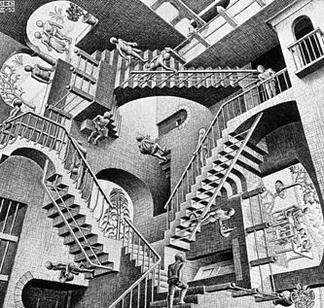
It reads like an Escher staircase. Every path looks like it’s going somewhere and somehow loops back to where you started. Ever notice how every new phone launches like it’s revolutionary, and none of it actually changes your life? There’s nothing new under the sun, and the fact that a 2,500 year old book still nails the human condition proves the point. Cultures, societies, and technologies change. People don’t.
What’s Missing
Read that poem again and notice what’s absent. God isn’t mentioned once.
That’s not an accident. A life lived apart from God can feel exactly like this poem: cyclical, wearisome, going nowhere. Kohelet is setting the table, drawing us in with something painfully relatable before he ever brings faith into the conversation. He’ll get there. But first he wants us to feel the weight.
Two Sons of David
Here’s where it gets interesting for us, standing on this side of the resurrection. Picture Qohelet and Jesus, both called sons of David, sitting down to talk.
Qohelet says the earth remains forever, locked in endless repetition. Jesus says the earth will pass away, but his word remains, and the whole of creation is headed somewhere on purpose.
Qohelet says everything is wearisome. Jesus says, “Come to me, all who are weary and burdened, and I will give you rest.”
Qohelet says nothing is ever new. Jesus says, “I am making all things new. If anyone is in me, they are a new creation.”
Qohelet says no one is remembered for long. Jesus says he will never erase your name from the book of life, and he will speak your name before the Father and the angels.
That’s the tension this whole series will sit inside. We can agree with a lot of what Qohelet observes. Life under the sun really can feel hollow. But we’re not reading this book from under the sun alone. We’re reading it knowing how the story ends.
“The grass withers, the flowers fade, but the word of our God remains forever” (Isaiah 40:8).
LISTEN TO or WATCH the full sermon at tulipstreet.com/sermons