Ramses II (AKA Ramses the Narcissist)
Nubia:


We just got back this evening from our trip to Southern Greece, called the Peloponnese. It was an amazing trip, and hopefully I will get caught up through the Egypt trip and the Peloponnese before we fly to Israel next Sunday.
So here we go, back to Egypt…
Temple of Philae:
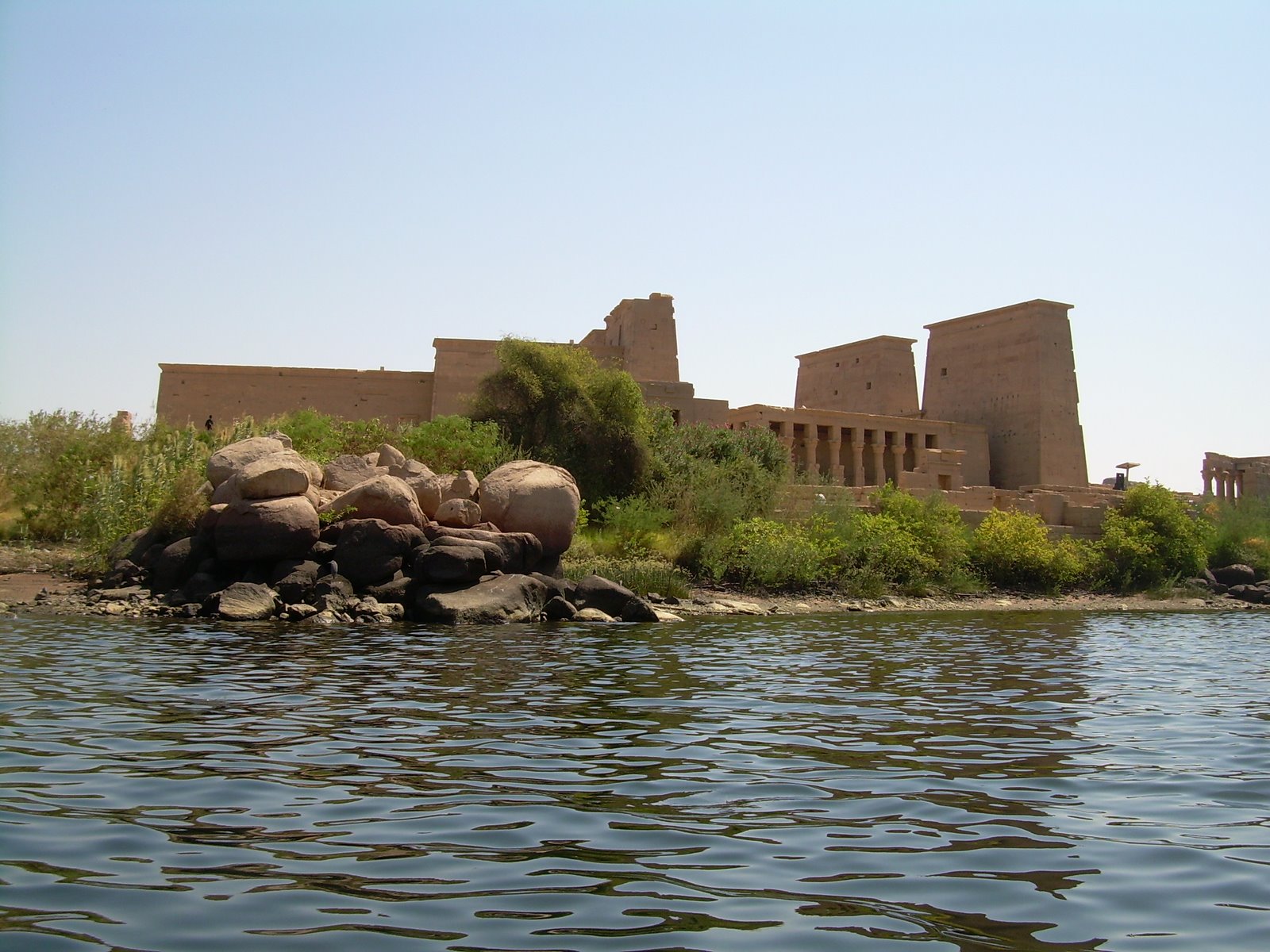
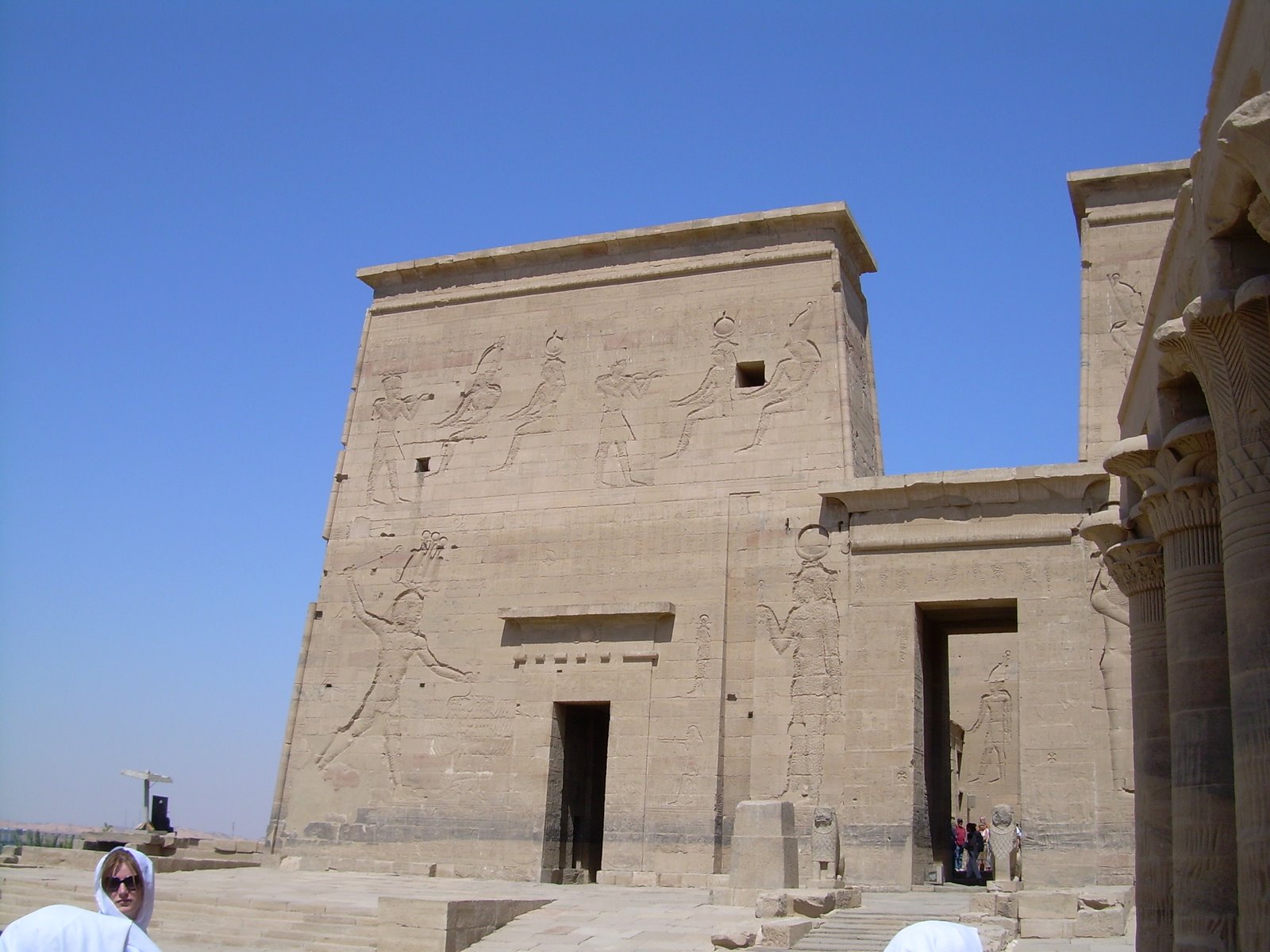
After a long trip South by way of scary night train, we arrived in the city of Aswan, which is located on the North side of the largest man-made lake in the world, Lake Nasser. The first temple we visited was the Temple of Philae (or “Love” in Eng.). It is named thus because the reliefs on the walls depict the love story between the goddess Isis and her lover Osiris. It’s a pretty gruesome story:
Set is the evil brother of Osiris, and he decides to kill Osiris and cut him up into tiny little pieces. This devastates Isis, who recovers all of Osiris’ body parts except for a certain, uh, “private” part. She reaches the simple solution for this problem by forging a new “member” our of gold. After this, Osiris is resurrected from the dead, and he and Isis give birth to Horus, whose eye gets ripped out by Set in a battle of revenge.
OK, enough with the sappy Egyptian love stories. Here’s the really neat thing about this temple: It is a very close replica to Solomon’s original Temple in Jerusalem. How do we know this? Because there are two other replicas that were built in Egypt after Judea was conquered by the Babylonians. Thousands of Jews fled to Egypt and, in light of the Temple being destroyed, the built a complete replica in Northern Egypt and another one in Southern Egypt on Elephantine Island (which is undergoing excavation as right now and is one of the possible locations for the Ark of the Covenant). When the Ptolemies took power, after Alexander’s kingdom was divided, one of the Ptolemies (the 3rd I think) built the Temple of Philae based off of the design of the two replicas of Solomon’s Temple.
Another cool thing about this temple: the entire structure had to be moved onto a nearby hill because it would have been under water after the Aswan High Dam was built.
So I can rightfully say that I have been inside a full size ancient replica of Solomon’s Temple. How cool is that?
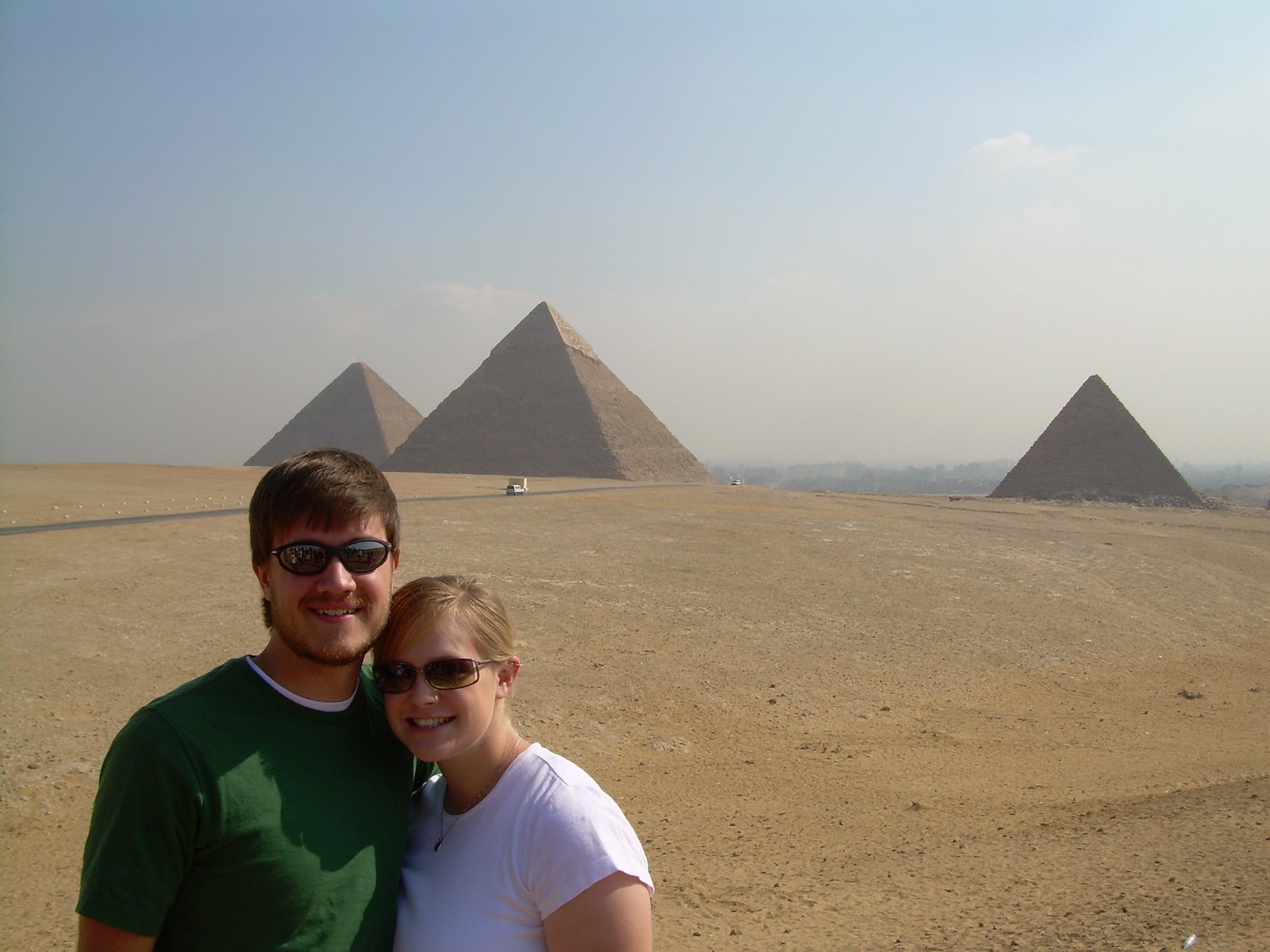
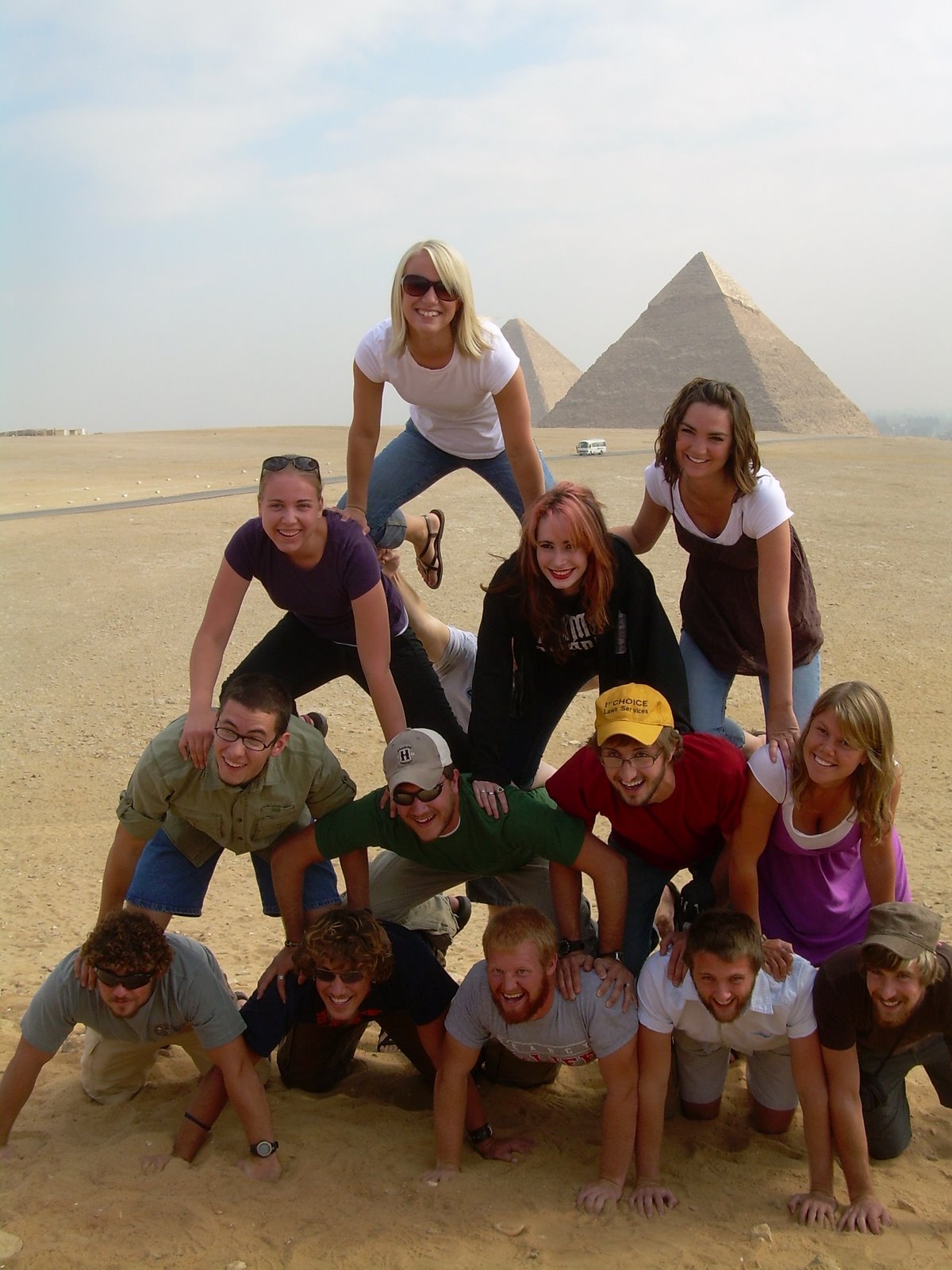
What’s the first thing that comes to mind when you think about Egypt? Pyramids, anyone? Yeah, I’ve been there, done that. And it was amazing.
You can’t really tell from the pictures, but these massive structures are just on the edge of the city Giza, home to roughly 4 million people. The largest of the pyramids, the one behind the Sphinx in the picture, contains enough blocks to build a 10×1 ft. wall around the entire country of France. These pyramids are too gigantic for words to sufficiently describe. I could just imagine in the days before cars and pollution these man-made mountains would be able to be seen for miles around. Their enormity can’t be entirely grasped until you are standing at the bottom look up, left, and right.
Some interesting I found out about the pyramids:
-They were built by hired workers, not slaves; yet it is still believed by some that they were, in fact, built by aliens.
-They were constructed before the Egyptians even invented the wheel.
-Abraham, Jacob, Joseph, Moses, and Jesus all saw the Great Pyramids.
-The inside of the Pyramid is hot, muggy, cramped, and smells like a football locker room in August.
-The kings that built the Pyramids also had smaller pyramids built for their 3 wives.
Strangely enough, the experience of seeing the Pyramids and the Sphinx isn’t great writing material. The pictures reveal just about as much as I personally experienced. But at least I can say I’ve been inside a Pyramid.

Alexandria was the first city we visited after flying into Cairo. The city was built along the coastline of the Mediterranean by the Greeks and named after, who else?, Alexander the Great. It was not technically part of “Egypt” when it was built because “Egypt” as a nation only consisted of “Black Soil Around the River Nile” as our tour guide, Osman, emphasized quite a bit.
Alexandria was once home to one of the 7 Wonders of the Ancient World – the Lighthouse of Alexandria. It’s not there anymore. It fell down a long time ago and a fortress was built over its foundation.
We also got to see (but didn’t go in) the new library. If you remember your world history, Alexandria was also home to the largest library in antiquity until some moron burned it down in some sort of protest- destroying much of the world’s compiled knowledge up to that point. I sure hope this new library is fireproof…just in case.
Also, since Alexandria was a Greco-Roman city, there are extensive catacombs below the street, comparable to Rome or Paris. Early Christians used these catacombs as secret meeting places during times of persecution. And I thought our church buildings were uninviting…
It’s incredible how much can happen in 8 days. The land of Egypt is so rich, so saturated with history and stories that it would be nearly impossible to take it all in, even with decades of study. Our tour guide, Osman, (who is one of the best men I have ever met) is by far also one of the best tour guides in all of Egypt. He is professional Egyptologist, tour guide, hieroglyphics teacher, and Biblical historian. Not only did he take us around to all the famous sites, but at each one he did his best to tie in all the geography, temples, etc. to the stories in the Bible. I never realized just how much Egypt had to do with the development of Judaism and ultimately Christianity.
I would like to start my summary of our trip by recording some of the things I learned that my Sunday school teachers never knew:
– The pyramids were seen by Abraham, Joseph (and his entire family), Moses, and Jesus
– There is technically more than one Temple. When Judea was overrun and many Jews taken captive and Solomon’s Temple was destroyed, many Jews escaped to Egypt and built a full-scale replica of the Temple, complete with priests and a sacrificial altar. In fact, a second full-scale replica was built on an island in the Nile called Elephantine Island (which archeologists are excavating right now). What’s more, the Egyptians built a temple of their own called the Temple of Philae which is based off of those other two replicas of Solomon’s Temple.
– The Ark of the Covenant probably wasn’t a big box. It would have been shaped like a small boat with a shrine area in the middle and two cheribum on either end. (I will post a picture later) How do we know this? Because in the Egyptian temples (which included a “Holy of Holies” where the god was and only the high priest could enter) the god was kept in an “Ark” which was a small boat with two long poles on either side which the priests used to carry the ark. Also, the 14 Commandments of Egypt were kept on display inside the ark. Moses, growing up around the main temple complex in Luxor, would have seen this ark taken out of the temple on many occasions.
– When the Israelites were encamped around Sinai and built a golden calf, it was most likely a representation of the goddess Hathor, one of the main goddesses worshiped in the time of their enslavement.
– The Egyptians had a god in their pantheon named Set, who was the god of chaos, evil, and the wilderness. From the name of Set, the Jews derived the name for Satan.
– The Egyptian priests made a practice of removing their sandals when they were inside the Temple, which was considered “holy ground”. God told Moses to remove his sandals, for he was standing on holy ground.
– The only exception to this practice of removing their sandals was during a time of war, when every man had to be prepared for fight of flight. God told the Israelites on the night of the Passover to keep their sandals on as they ate the meal, for they were getting ready to run. Paul told Christians in Ephesians 6 to keep our shoes on, which is the preparation of the gospel of peace, during a time of spiritual warfare.
– Early Christians made it a practice to use pagan symbols as their own symbols of the faith. For instance, they ancient Egyptians used a symbol called an ankh, which was the “key of life” carried by all the god, representing the Nile river. It looks like a cross with a circle on the top. Early Christians in Egypt used this symbol as their own to represent the life which we have in Christ.
OK, I’ll stop here for now. There’s more I could talk about, but I’ll leave that until the actual trip summary. I wanted to go ahead and write this stuff down before I forgot about it. All of this goes to show that God, in His infinite wisdom, has no problem with reaching people on their level. He used the things which the Israelites knew. He met them where they were and showed them the way to himself. Our God truly is an awesome God.