Page 40 of 70

Ghost Stories…from the Bible!

A long time ago in a far away land there was a king. He ruled absolutely. His word trumped that of God Himself. He was tall, strong, and charismatic. But as his life neared it’s end, he began to go through a very dark time. His spirits fell. Suspicion and fear compelled him to act irrationally and recklessly.

Some even say he had an evil spirit possess his soul.

Then one day all his enemies gathered their forces, determined to exact vengeance on this king for all the pain and suffering he had caused them. It was an army bent on destruction with one objective – kill this king.

On the eve of battle, the king and his entourage saw the enemy hordes marching to war. In former years this king would have been confident. He would have craved the opportunity to drive his opponents back once and for all. But these were darker times. His own soul had turned against him and against his God. His most trusted adviser, a wise old prophet, had recently died. The king had no one else he trusted enough to consult in this matter. His own madness would be the demise of his entire kingdom.

But then the evil spirit inside of him planted an idea in his mind. The prophet may be dead in body but not in spirit. There was a witch, a medium, a sorceress – call her what you will. She had the power to communicate with the dead.

The king and his men hurried to the old witch’s house. Smoke billowed from the chimney. The stink of death and putrescence filled the air.

To conceal his identity, the king had put on a disguise. Looking like just an ordinary commoner, the king stepped up to the eerie abode. Knock Knock Knock

The door creaked open just slightly. “Who’s there? What do you want?” inquired a raspy, aged voice from just inside the door.

“I wish to summon the spirit of a departed loved one, if you please,” replied the king, in a deeper, unfamiliar voice.

“Ha! Don’t you know the king himself banned me and all my sisters from the kingdom?! Why should I help you?” the witch responded suspiciously. “You’re probably just trying to trap me so you can through me in the king’s dungeon.”

“You will face no such punishment. I swear to God Almighty,” ensured the king.

The door slammed shut. The king was taken aback, but he could hear the sounds of chains and latches being unfastened. Again, the door opened inward against the complaint of tired hinges. Stooping down, the king entered after the witch. The one room house was small and untidy to the eye of a guest. Jars and containers strewn about on the shelves, cobwebs building in the corners, scrolls stuffed onto their racks, and a thin layer of dust lying throughout like fresh laid snow.

The witch sat down at the head of the large table in the center of the room – the largest piece of furniture in the place. She pulled the fine cloth away from a large, rounded glass object. The door shut behind the king and his men without the help of human or crosswind. The king pulled out a chair and sat down to the left of the witch. The other men remained standing.

“Whom shall I summon for you?” asked the witch when all was ready.

Hesitating, the king answered, “Samuel, the prophet.”

The witch began her incantation and her hand motions, when suddenly the whole house shook. The witch screamed the cry of death and shot backwards from her chair. She had seen the ghost of Samuel coming to her from the great beyond. Out of the darkness he came with the fury of God in his eyes. It was then the witch knew who really joined her at the table.

“Why have you deceived me?” she cried. “I know who you are! You’re the King.”

“Do not fear,” said the king in his stern, commanding voice. “Tell me what you see.”

The woman, trembling, slowly regained her place at the table. Looking again, she answered, “I see a ghostly figure coming up out of the earth.”

“What does he look like?” questioned the king.

“He’s an old man,” said the witch, looking ever more deeply. “And he’s wearing a robe.”

Fear, excitement, and shame collided within the king. He fell to the ground, shoving his chair against the wall with a bang. Shaking violently, the king dropped his head all the way to the dusty floor.
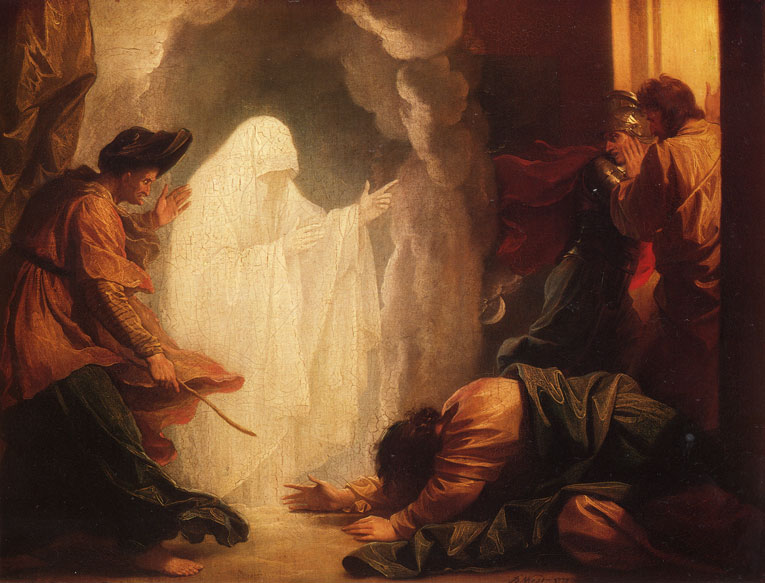
Just then the voice of the prophet began to speak in his ghostly, otherworldly voice. “Why have you disturbed me by bringing me up?” demanded the ghost with a violent anger in his words.

Weak and frightened, the king replied, “I’m greatly distressed. These are dark times. My enemies have marched their armies against me for war, and God has abandoned me. He no longer answers me, either by prophets or dreams. So I summoned you to tell me what to do.”

The ghostly voice boomed in reply, “Why do you consult me now that the Lord has left you and turned against you? The Lord has done just as he foretold through me while I was with you! He has torn the kingdom from your grip and had given it to your neighbors – to the shepherd boy. The Lord has done this because you refused to obey him, and you failed to carry out his wrath on your enemies. You are weak. You are frail. You are no KING!

“The armies of your enemies will be victorious. Your armies will fail. Your men will turn and flee. Your cities will be captured. And hear me – tomorrow, you and your sons will die.”

At this the king lost all control. Fear gripped him.

The witch rushed over to him, bringing him some concoction she had been boiling. “Your majesty, I’ve only done what you asked. I put my life in your hands. Now please, take this and regain your strength.”

But the king refused to eat or drink anything at first. Finally able to stand, the king rose and reclined on the couch. After some urging from the witch and his own men, the king agreed to dine before departing.

The witch at once went out and butchered a calf. Coming back in with blood stained robes, she baked some bread. That night the king and his men dined with the witch – the last meal the king would ever enjoy.

The next day, in the throes of battle, all happened as the ghost had foretold. The enemy hordes broke the king’s lines. The battle broke into chaos. In the heat of it all, the king looked down in time to see his son slain by the arrows of the enemy archers. Gripped with fear and uncontrollable anxiety, the king turned his own sword around and fell onto the blade.

Witchcraft, ghosts, death, and suicide. This is what became of the first king of Israel.

Who Wants to Live Forever?

That’s an easy question. I do! As long as that forever is spent in the presence of God.

I devoted a couple posts to breaking down some “favorite Bible verses” – giving a fresh, much needed look at what they might mean in context. Well, now it’s time for me to share some about my personal favorites.

Beginning with this one:

ROMANS 8:11
“And if the Spirit of Him who raised Jesus from the dead is living in you, He who raised Christ from the dead will also give life to your mortal bodies because of His Spirit who lives in you.”

Really, the entirety of Romans 8 is as epic as they come. Read the whole chapter in one setting and try not to get chills.

But this verse in particular stands out to me and has stuck with me over the last few years. There’s so much to this one sentence that it needs to be dissected a bit.

First of all, it was God’s Spirit that raised Jesus from the dead. Think about that – Jesus didn’t raise himself, as I used to think. He didn’t just will himself alive after three days. If fact, it wasn’t even of his own power that he raised Lazarus or the daughter of Jairus. Philippians 2 tells us that Jesus emptied himself of all his divine privileges. He had no inherent advantage over us in his own humanity. Hebrews 2 makes it clear that had to be made like us in every way. And after showing us how to do humanity like God intended, he was vindicated by God, defeating death – the final enemy. It was God’s Spirit that stayed with Jesus throughout his life, and it was the Spirit that breathed the resurrection breath back into Jesus’ body.

Then Paul says that it is this same miracle-working, death-slaying, life-bringing Spirit that is living…in us! Not in the rocks and trees, not in the heavens, not just in the corporate body – but in me, in you. We can talk about being a Spirit-filled people, but I don’t think we grasp the implications of what that means. The fruit of the Spirit is easy and safe to talk about – love, joy, peace, patience, kindness, goodness, faithfulness, gentleness, and self-control. These virtues are supposed to be evidence of the Spirit living in us. That’s all well and good, but what about the fierce passion with which Jesus lived his life? What about the righteous anger that drove him to clear the temple? What about the condemning words shouted to the religious establishment? That was all done by the Spirit, too. Life in the Spirit is not supposed to be one of placid serenity or non-confrontation. The Spirit is not a spirit of fear but of power (2 Tim 1:7)!

Finally, if this is the Spirit that lives in you, then this death killer will also give life to our mortal bodies. In other words, we will get to experience the exact same resurrection as Jesus. Here’s why I think this is significant: bodily resurrection means that this life matters. It means that life will ultimately become what it was intended to be – heaven and earth intersecting. If the Spirit is in us, then that process has already begun. We are a part of the revolution that proclaims “On earth as it is in heaven!” This flies in the face of the traditional escapism portrayed in many well-intentioned sentiments and death-bed hymns. Our final hope is not to “fly away” to some “celestial shore,” but to be raised again to life, never again to die. Our goal is not to “get to heaven,” but to bring heaven here, to experience eternal life now, and to ultimately participate in the same physical, bodily resurrection as that of Christ Jesus.

Going Up?

I’ve been doing a lot of reading and studying recently about heaven and hell. Our youth group kids had a lot of questions about the afterlife, so on Wednesday nights we’re diving into Scripture to find out what has been revealed to us.

I am by no means close to reaching any definitive conclusion for myself about what happens when we die, but I’m on that journey. I’m currently reading a book by N.T. Wright called Surprised by Hope: Rethinking Heaven, the Resurrection, and the Mission of the Church. So far, it’s very interesting. Wright has already touched on a lot of the questions I have, and I’m excited to see where he goes with all of this.

That being said, I want to simply put my own questions out there. Maybe you’ve wrestled with some of them yourself. If you have any good book suggestions or any other thoughts on the issue, I would be more than happy to hear from you.

My initial thoughts & questions:

  • Are heaven and hell only experienced after you die?
  • Is the whole point of heaven to be a place where disembodied souls go to rest on the clouds and get a good base tan in the constant sunlight?
  • Have we gotten our whole concept of heaven wrong, especially in our beloved hymns? I mean, is it even biblical to think that one day we’ll “fly away” to “God’s celestial shore”? Where did that idea come from?
  • Is the resurrection promised to believers the same as that experienced by Jesus – a full, bodily resurrection? Or is that resurrection merely the continuing existence of our spirits?
  • Is heaven really going to be a purely spiritual existence or is it going to be a continuation, a remaking, of the purified and redeemed physical universe?
  • Why can’t we, as a church collectively and as believers individually, come to some clear consensus about the afterlife?
  • If the only hope of eternal life and heaven is to be realized after we die, then what’s the point in praying that God’s will be done on earth as it is in heaven?
These are not new questions, and I will refrain from explicitly stating what I believe until I’ve done a bit more studying and reading. I just have a hard time blindly accepting the traditional view that I’ve heard my whole life, that heaven is somewhere else. I’m saddened that many people are baptized simply to avoid hell. That’s not the kind of hope I read about.
There’s got to be more to it than simple escapism, a hope that everything will be better…some day, in the sweet by and by. I think God’s hope is better than that.

Seeing the Unseen

A lesson by Patrick Mead and our weekly reading assignments at our church have got me thinking about Hagar lately. Hagar gets kind of a bad rap. She was the one that Abraham got pregnant (at the request of his own wife). She gave birth to Ishmael who has traditionally been regarded as the father of the Arabs. Muslims trace the history of their faith back to him. The descendants of Ishmael were violent, aggressive, and territorial. And to this day, many blame much of the unrest in the Middle East on this one son of a slave woman.

Disclaimer: I have no references for the above statements. I have not done the historical research. I am simply passing along what I have been taught, whether true or not.

Regardless of the historical implications of this…subsitutionary impregnation…the story of Hagar is both tragic and beautiful.

Hagar was an Egyptian woman. Kind of. She may not have been Egyptian in nationality, but she was probably one of the “gifts” given to Abraham and Sarah by Pharaoh. In an attempt to speed up the fulfillment of God’s promises to them, Sarah got the bright idea for Abraham to sleep with Hagar. That should have been the first red flag.

And then after Hagar conceives, Sarah gets jealous of Hagar and starts mistreating her. Couldn’t see that one coming. This is beginning to sound like a bad reality show.

Sarah’s hazing becomes so over the top that Hagar runs away. She’s gone. Done. Finished. But where would she go? She has no family, no friends, no support system, no home. Sarah doesn’t chase after her. Abraham doesn’t go searching. But God does.

   The angel of the Lord found Hagar near a spring in the desert; it was the spring that is beside the road to Shur. And he said, “Hagar, slave of Sarai, where have you come from, and where are you going?”
   “I’m running away from my mistress Sarai,” she answered.
   Then the angel of the Lord told her, “Go back to your mistress and submit to her.” The angel added, “I will increase your descendants so much that they will be too numerous to count.”
 (Genesis 16:7-10)

God went looking for her. Wow. God was concerned for her. God showed her love. God wasn’t interested in using her. For the first time in her life, someone wanted Hagar for her – not for what she could do for him. And what’s more, God made a covenant with her in the same vein as the covenant with Abraham – her descendants would be too numerous to count.
Now he doesn’t sugarcoat anything with her, either. He tells her straight up that Ishmael is gonna be a violent dude. It’s going to be him against the world. It’s not going to be an easy life for them. But God will hear them.
And then Hagar gives God one of the coolest names in all of Scripture:

   She gave this name to the Lord who spoke to her: “You are the God who sees me,” for she said, “I have now seen the One who sees me.”  (Genesis 16:13)

All her life people saw her as a slave, a piece of property, a sex-thing. But God saw her. That’s a beautiful love story.
But it doesn’t end there. Hagar returns to her masters. She gives birth to Ishmael, and all was well….Until Sarah gave birth to Isaac. Ishmael, living up to God’s predictions about him, began mocking, insulting, and picking on his younger half-brother. So Sarah, instead of acting rationally and thoughtfully, assumed the mama-bear role of protecting her young at all costs.
She cut off Ishmael from any inheritance and sent Hagar and her son packing with just a jug of water and some food. I would not want to be on Sarah’s bad side. Like ever. I can see why Abraham was such a pushover…
Again, Hagar finds herself alone with nowhere to go. She and her son are wandering in the desert with just one jug of water between them. They didn’t make it very long.

When the water in the skin was gone, she put the boy under one of the bushes. Then she went off and sat down about a bowshot away, for she thought, “I cannot watch the boy die.” And as she sat there, she began to sob. (Genesis 21:15-16)

No parent should have to be put in this situation. I can’t imagine the helplessness Hagar felt at that moment. I can’t imagine having an utter lack of hope.
But the God who see her and the God who hears her son shows up yet again.

God heard the boy crying, and the angel of God called to Hagar from heaven and said to her, “What is the matter, Hagar? Do not be afraid; God has heard the boy crying as he lies there. Lift the boy up and take him by the hand, for I will make him into a great nation.”
   Then God opened her eyes and she saw a well of water. So she went and filled the skin with water and gave the boy a drink.
   God was with the boy as he grew up. He lived in the desert and became an archer. While he was living in the Desert of Paran, his mother got a wife for him from Egypt.
 (Genesis 21:17-21)

God is the husband Hagar never had. God is the lover Hagar had always desired. God was more tender, compassionate, and loving toward Hagar than he ever was toward Sarah. God was the only one who ever gave something to Hagar without wanting something in return. He never made demands of her, never used her for anything. God loved her, pure and simple.
God hears those who no one else will listen to. God sees those who are invisible to others.
And that is a beautiful love story.

2012 Goal: Year to Date (mid-October)

I’m well on my way to completing and surpassing my goal for 2012 of reading 2 books per month or 24 books for the year. Here’s my list so far. I try to read one Spiritual/Religious/Ministry book and one fiction novel at a time.

  1. King’s Cross, by Timothy Keller
  2. Forgotten God, by Francis Chan
  3. Erasing Hell, by Francis Chan
  4. Catch-22, by Joseph Heller
  5. Of Mice and Men, by John Steinbeck
  6. Miracles, by C.S. Lewis
  7. The Princess Bride, by William Goldman
  8. Amusing Ourselves to Death, by Neil Postman
  9. The Hunger Games, by Susanne Collins
  10. Catching Fire   ”   “
  11. Mockingjay    ”    “
  12. Technopoly, by Neil Postman
  13. Dirk Gently’s Holistic Detective Agency, by Douglas Adams
  14. Long, Dark Tea Time of the Soul    ”   “
  15. Shattered, by Dean Koontz
  16. Beautiful Outlaw, by John Eldredge
  17. The Practice of the Presence of God, by brother Lawrence
  18. Timeline, by Michael Crichton
  19. Kingdom Come, by John Mark Hicks and Bobby Valentine
  20. Ender’s Game, by Orson Scott Card
  21. Speaker for the Dead  ”   “

Wibbly-Wobbly, Timey-Wimey Jesus Stuff

I’ve been reading through and thinking about the story Jesus tells in Luke 16:19-31. It’s commonly known as “The Rich Man and Lazarus.” It’s a story about…a rich man and a guy named Lazarus. Gotta work on better titles for Jesus’ stories.

Lazarus was a poor, disease ridden beggar who stationed himself right at the edge of the rich (unnamed) man’s driveway. In a strange turn of events, they both kick the bucket. Angels deliver Lazarus first-class into Abraham’s side (the word “bosom” makes me uncomfortable). But the rich man was simply “buried.” Guess he had to take a ride in coach for the first time ever. The rich guy wakes up in Hades.

Upon waking up, the rich guy set about doing one thing rich people do really well – he started complaining. It’s hot. I’m thirsty. Send someone to serve me right away.

It takes him some time, and a stern lecture from “Father” Abraham, but the rich man finally realizes his fate. He had enjoyed all the comforts of his earthly life by stepping all over people like Lazarus. Now it’s his turn to suffer. This realization hits him in waves.

Then he poses another request: “Send Lazarus back to my brothers to warn them not to do what I did.” Noble enough.

But Abraham’s response is the final burst of the bubble. “They have Moses and the Prophets to listen to. If they won’t believe them, then they won’t believe even if someone is raised from the dead.”

(Insert creepy Twilight Zone music here.)

But in a strange, roundabout way, the warning is made, the request fulfilled. Sure, it’s doubtful that the rich man’s brothers were in the audience when Jesus was telling this story, yet the warning was issued to all those who would listen. Jesus is playing the part of Lazarus, and we’re all brothers of the rich guy.

Hear the warning from beyond the grave: Don’t love the comforts of this world so much that you become blind to those who are perpetually uncomfortable.

Never Meet Your Heroes, Round 3

Can you believe this guy? He’s messing with John 3:16. Who does he think he is?


No doubt, if you went to Sunday school then you probably memorized this verse at one point or another. And it’s a great verse. I think it speaks volumes in only a few words – the summation of the entire gospel message.

Here’s how it reads in most translations:

For God so loved the world that he gave his one and only Son, that whoever believes in him shall not perish but have eternal life. (NIV 2011)

And here’s how some translations have rendered it:

God loved the world so very, very much that he gave his only Son. Because he did that, everyone who believes in him will not lose his life, but will live for ever. (Worldwide English Translation)

It’s an English idiom to use the word “so” as a qualifier. I love you soooo much. That soup is sooo gross. This blog post is sooo boring.

When we say “so” we mean “a lot” or “very.” This causes us to read this verse as saying, “God loved the world a whole lot. And because he so very much loved the world, he sent His Son to die for us.”
There is no denying the God loves the world. The thing is – His love is so whole, so complete, that it does not need qualifiers. And indeed, John does not try to do so. (In writing this post, I have come to realize how much I actually use the word “so.”)

In Greek, the word “so” would more accurately mean “thus” or “in this way.” John is trying to reveal the way in which God loved the world. God loves perfectly and completely, and this is how He has shown us that love.

For this is how God loved the world: he gave his one and only Son that everyone who believes in him should not perish but have eternal life. (Mounce Reverse-Interlinear New Testament)

For God loved the world in this way: He gave His One and Only Son, so that everyone who believes in Him will not perish but have eternal life. (Holman Christian Standard)

John is trying to show, not necessarily the degree to which God loved us, but the way in which He loved us, the extent to which He was willing to go for that love.
Here’s another bombshell: We’re not 100% sure that Jesus said this. The Greek shows no clear break or continuation of quotation. What follows from 16-21 could very well be the words of Jesus, or they could be the words of John added as commentary on the discussion that just took place.
Some versions will have these words in red, others in black. Does it make them any less true? Not at all.
Always remember: God loves you – perfectly, completely, and unconditionally. He has proven His love for you by sending is only child into this world and gave him as a sacrifice for your sin. If you believe in the Son, Jesus, then you will not have to suffer the fate of the unbelieving, evil world around you. Instead, you will have the promise of life everlasting, life to the ages, eternal life.

Never Meet Your Heroes, Round 2

We Christians, especially in the West, love to try and make Scripture speak favorably of the “American Dream.” We take verses like Philippians 4:13, as we saw yesterday, and shove them into a part of the puzzle where they just don’t quite fit. I want Paul to be saying that I can be whatever I want to be and do whatever I want to do as long as I’m keeping my eyes on Jesus. That sounds like a brilliant plan for successful “Christian living.” But that’s simply not what he says.

Another well known verse in a similar vein is Jeremiah 29:11. The unfortunate thing is that most people who claim this as their favorite Bible verse *probably* have never read the context, much less the rest of Jeremiah.

“For I know the plans I have for you,” declares the Lord, “plans to prosper you and not to harm you, plans to give you hope and a future.”

If there ever was a verse indicating that the American Dream is in line with Scripture, it’s this one. It’s like a pep talk before the big game. It’s the reassuring send off to a college freshman. It’s the hope that overcomes the butterflies as you begin a new career.

Or is it?

This is in the context of a letter written from Jeremiah to those carted away into exile in Babylon. Everything they have ever known has been taken with them. If they’re lucky, they might have some family members of friends around them.

Their country is in shambles. Their home is hundreds of miles away. People all around them have been killed. They have no money, no possessions. Their God has abandoned them. They are now forced to live in a pagan land among brutal people who worship false gods.

Complete and utter decimation of everything they had ever known.

And now they get this letter from a prophet back home telling them to get comfortable?! Are you kidding me?

Get married. Start a family. Buy a home. Plant a garden. Get settled and cozy because you’re going to be here a while. It’ll be your grandkids who make it back home, not you. And while you’re at it, go ahead and pray for the prosperity of the very country that ruined your life because if they prosper, you will prosper.

Wow.

When we’re in the midst of a crisis, the last thing we want to hear is that it’ll all be okay. Things will get better soon.

God doesn’t do that. He essentially says, “I warned you this would happen. I told you. But this is your new life now. Get used to it. See you in seventy years!”

You see, all their lives the people of Judah had been looking after themselves. If you trace your way back through Kings and Chronicles you will see that most of their decisions were extremely selfish and short sighted. But now, for the first time ever, God is challenging them to think about future generations. When God says, “I know the plans I have for you,” He’s not talking specifically about the recipients of that letter. He means their grand children.

The readers are stuck. They got themselves in a bind and now they can’t get out. Tough luck. But in seventy years, God would return, gather their grand children and great grand children, and lead them all back home. Or at least He would lead all those who wanted to leave Babylon, which by that time would become their home.

So when you read this verse, Jeremiah 29:11, it’s still a verse loaded with hope. But it’s not hope for you. It’s hope for your grand children if you do the right things today.

This is not a verse of hope and comfort, it’s a verse of challenge. Are you up to the challenge? Will your grand children be better off because of the choices you are making right now?

“When seventy years are completed for Babylon, I will come to you and fulfill my good promise to bring you back to this place. For I know the plans I have for you,” declares the Lord, “plans to prosper you and not to harm you, plans to give you hope and a future. Then you will call on me and come and pray to me, and I will listen to you. You will seek me and find me when you seek me with all your heart. I will be found by you,” declares the Lord, “and will bring you back from captivity. I will gather you from all the nations and places where I have banished you, “declares the Lord, “and will bring you back to the place from which I carried you into exile.” Jeremiah 29:10-14

Never Meet Your Heroes

According to the popular proverb, “You should never meet your hero.” The idea is that this person has become so idolized in your mind and your imagination that you are bound to be disappointed if you actually get to know them. They are human, after all. They will probably end up ruining your dreams and fantasies. You will never be able to watch their movies, read their books, or buy into their hype ever again.

Sometimes that can be a good thing, though.
There are a lot of athletes, pop stars, and movie stars that are brilliant at what they do, but I would NEVER want them to be a personal role model for my son.
And it got me thinking, in a weird “minister’s only” connection sort of way… Why do we claim certain Bible verses as our favorites? I’m not knocking the whole “favorite Bible verse” system. I’m just doing a double-take at some of the verses people choose as their faves. The ones they know by heart. The ones they post on Facebook and highlight in their Bibles. The ones they go to for comfort.
I think it’s time we got to know some of our heroes a little better.
One of the verses most commonly given as a favorite is Philippians 4:13, so let’s start with that one.
“I can do everything through Him who gives me strength.” (NIV 1984)
We Western, American Christians LOVE this verse! Who doesn’t love a good underdog story? This verse plays well to our individualism, our motivation, our desire for success. When things aren’t going our way, we look to Jesus who gives us the strength to make it through.

With the strength of Jesus I can get my degree and start my career.

With the strength of Jesus I can score the game winning touchdown.

With the strength of Jesus I can overcome this disease.

With the strength of Jesus I can repel down this glacier…?

We take the phrase translated “everything” or “all things” a bit too generally. We act as if Paul had been talking about fighting wild beasts, standing up to kings, surviving ship wrecks, driving out demons, all sorts of heroic and manly stuff (which he did, by the way). But that verse is taken HORRIBLY out of context.

Here’s how the NIV 2011 reads: “I can do all this through Him who gives me strength.”

That reading is a bit harder to take out of context and apply to just about anything. “All this” forces you to look back at what “this” really is. Look at the whole thought in context:

I rejoiced greatly in the Lord that at last you renewed your concern for me. Indeed, you were concerned, but you had no opportunity to show it. I am not saying this because I am in need, for I have learned to be content whatever the circumstances. I know what it is to be in need, and I know what it is to have plenty. I have learned the secret of being content in any and every situation, whether well fed or hungry, whether living in plenty or in want. I can do all this through him who gives me strength.

What Paul is claiming to be able to do in any and every situation through the strength of Jesus is to be content. I can be CONTENT through Him who gives me strength. Well that certainly changes things. He’s not talking about overcoming anything. He’s not talking about getting out of a jam. He’s not talking about doing heroic things for God. He’s talking about being content.

You see, this broader context does not mesh well with our Western worldview. Not at all. If you want something, go get it. If you need something, you have a right for it to be provided. No one should have to be poor. Everyone should be given an equal chance to become millionaires. Your life is not complete unless you have X, Y, and Z.

But we don’t even hear this sermon preached much in the church. When was the last time you heard a preacher talk about being content with what you have? Okay, but when was the last time you saw the church actually doing that?

You see, I think the true spirit of this passage speaks volumes to our society. We don’t need Scripture to tell us that we can accomplish anything, that we can be and do whatever we set our minds to. The world tells us that already! We need Scripture to tell us that no matter where we find ourselves, God is there to take care of us. We don’t have to have it all together. We don’t have to have the biggest house, the nicest cars, the trendiest clothes. It doesn’t matter what’s in our bank account. It doesn’t matter what’s in our wallets. God will take care of you!

This is what Paul says just after that:

Not that I desire your gifts; what I desire is that more be credited to your account. I have received full payment and have more than enough. I am amply supplied, now that I have received from Epaphroditus the gifts you sent. They are a fragrant offering, an acceptable sacrifice, pleasing to God. And my God will meet all your needs according to the riches of his glory in Christ Jesus.

I think it’s time for Christians, myself included, to take a look around and realize that we are amply supplied. If anyone has ever had more than enough, it’s us! But it’s time to stop relying on anyone but God to meet our needs.

Now that’ll preach.

Songs We Don’t Sing in Church

As a worship leader flipping through the song book week after week to get ready for Sunday morning, I am amazed at the vast array of songs we don’t know. Occasionally one will catch my eye, and I will do a quick search on YouTube to learn it.

That happened to me today. I came across song #93 in Songs of Faith and Praise. The tune was composed in the early 1800s and the lyrics were written in the mid-1960s.

It’s called “God, Who Stretched the Spangled Heavens.” Not the catchiest title, but check out the lyrics:

God, who stretched the spangled heavens
Infinite in time and place
Flung the suns in burning radiance
Thru the silent fields of space
We, Your children, in Your likeness
Share inventive powers with You
Great Creator, still creating
Show us what we yet may do
We have conquered worlds undreamed of
Since the childhood of our race
Known the ecstasy of winging
Thru uncharted realms of space
Probed the secrets of the atom
Wielding unimagined power
Facing us with life’s destruction
Or our most triumphant hour
As each far horizon beckons
May it challenge us anew
Children of creative purpose
Serving others, honoring You
May our dreams prove rich with promise
Each endeavor well begun
Great Creator, give us guidance
Till our goals and Yours are one

I wish we knew this song! I think I will try to teach it sometime soon. How cool would it be to sing in church about space travel and atom splitting?

But not only that. I think this song points out a fact that we don’t really acknowledge a lot. Humanity was created to share in the creative process. That’s why God gave us the cognitive skills to rule, subdue, and fill the earth. That’s why he allowed us to name and categorize the animals. He entrusted us with the power to create, to explore, to discover, to enjoy, to advance.

The debate between science and faith is not going away any time soon, as far as I can tell. As God’s children, we should not think that any scientific discovery could somehow “disprove” God. If we think the universe is too mysterious, too complex, too vast for it to be created by God, then our idea God is too small.

The author of this song also points out that our scientific and technological advancements have the potential for either great evil or great good, to heal or to kill, to create or destroy.

Read these lyrics again. Let the message really soak in deep. With this song in mind, go back and read Genesis 1-4.

And let us all pray that God will be the one to guide us in our scientific and technological advancements, that He will lead us as we join in the creative process with Him until our goals and His are one.