Page 42 of 70

Oh, My Goodness?

Faith.

It’s a little word with HUGE ramifications. Or at least, it should have.

Whenever Jesus’ followers wrote their letters (e.g. Paul, Peter, John, James, et al), they were written to other Jesus followers. That’s important to keep in mind. Knowing that the audience was already on board can really change how we read their letters. It becomes obvious that the earliest believers needed additional instruction on things like baptism, marriage, worship, Christology, etc. I think this means that you don’t have to know everything before you can know Jesus. All this other stuff seems, indeed, secondary to the life, ministry, and redemptive power of Jesus Christ.

That being said, faith is always assumed, at least at some level. But even faith itself has to be explained more in depth (see Galatians 3-5 and James 2:14ff). This also seems to be the case with 2 Peter. Faith is assumed and indeed present, but it’s an incomplete faith, lacking in something. It seems that the faith Peter is addressing is a simple, basic belief in Jesus and the power of God. In 1:3-4 he begins by reminding them that they have everything they need for life and godliness and that they have an opportunity to participate in the very divine nature of God. So what are you waiting for?!


Peter says, “For this very reason, make every effort to add to your faith goodness…” (2 Peter 1:5)

How many “good people” do you know? Now how many of those people have no faith?

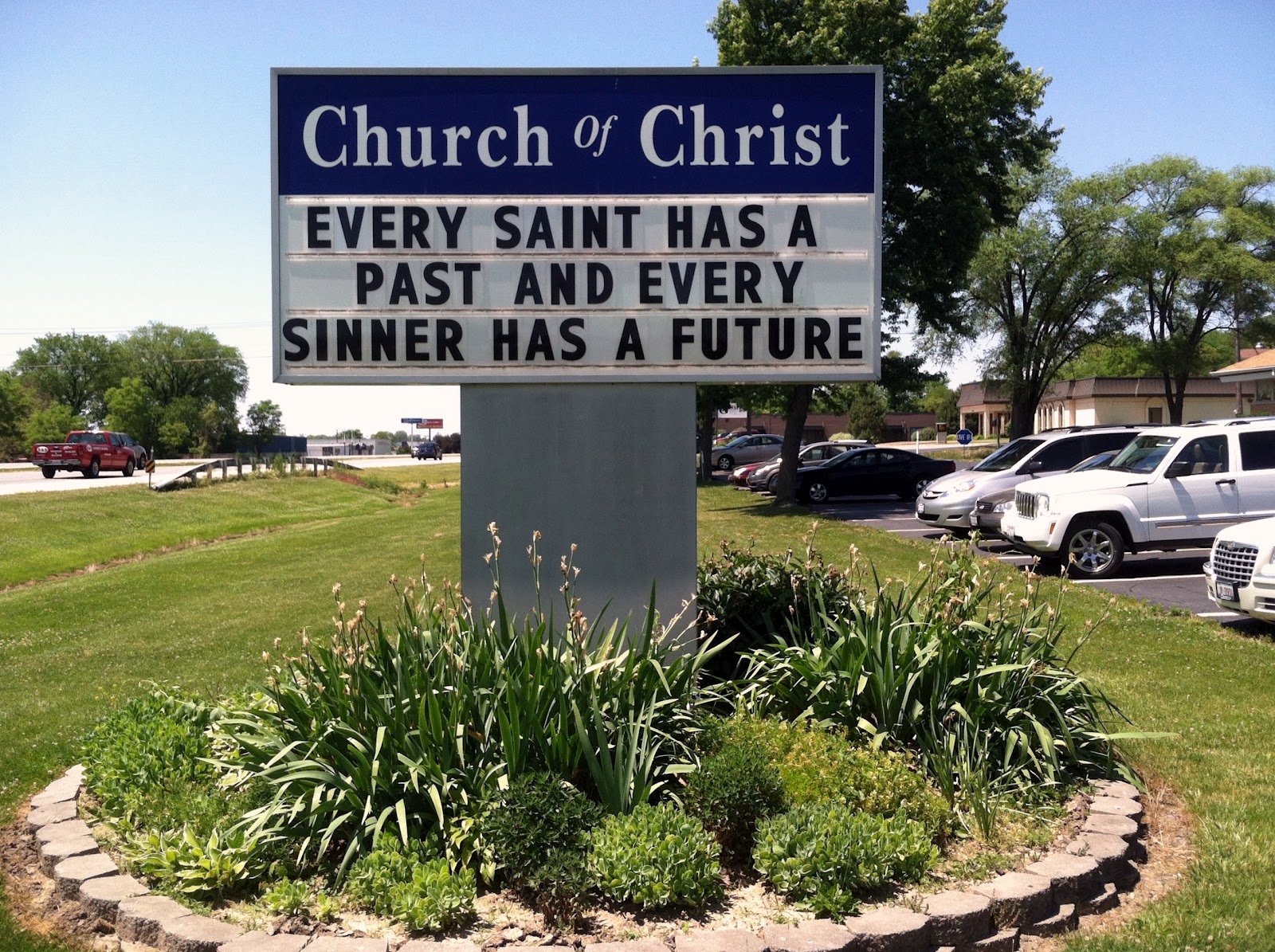
Someone shared this church sign on Facebook earlier today:

While I don’t necessarily agree with the theology, I can appreciate the sentiment. It was my experience as I was growing up that those who were not Christians were often more open, friendlier, and more forgiving/understanding than those who claimed to follow Christ.

And that experience is not unique to me. In the book UnChristian, the authors poll non-believers about their attitudes toward Christians. Most descriptors were negative – hypocritical, judgmental, homophobic, rigid, narrow minded, etc.

I think our great pitfall is a misunderstanding of what it means to be good. We often think that to be a “good Christian” means going to church, singing the songs, reading our Bibles, and never smoking, drinking, cussing, or having sex. But what does the New Testament actually say about being “good?”


First of all, goodness is a characteristic of God himself. 

As Jesus started on his way, a man ran up to him and fell on his knees before him. “Good teacher,” he asked, “what must I do to inherit eternal life?”

“Why do you call me good?” Jesus answered. “No one is good—except God alone.” (Mark 10:17-18)

If goodness is a trait that belongs first and foremost to God himself, then I daresay that “being good” has little to do with church-y stuff. It probably has more to do with people stuff – love, self-sacrifice, compassion, etc. To be good is to strive to attain the character of God for our own.

Follow God’s example, therefore, as dearly loved children and walk in the way of love, just as Christ loved us and gave himself up for us as a fragrant offering and sacrifice to God. (Ephesians 5:1-2)

Second, there seems to be a difference between righteousness and goodness.

Very rarely will anyone die for a righteous person, though for a good person someone might possibly dare to die. (Romans 5:7)

If I’m a car salesman and I sell you a car for the sticker price, which is a fair price, then I could be considered righteous. But if I knock $5000 off the price with free maintenance for the lifetime of the car so that a single mother can have a way to get her kids to school and herself to work, then I might be considered a good man.

I think we confuse righteousness and goodness. Yes, we are declared “righteous” before God when we rise from the waters of baptism, but that doesn’t necessarily mean we are striving to embrace the character of God in our own lives. Righteousness turns us in the direction of God. Goodness takes us closer to Him.

Make every effort to add to your faith goodness. The church needs more good people.

Faith: You’re Doing It Wrong

Have you ever felt that your faith, your walk with God, your prayer life, your whatever of an existence was ineffective and unproductive?

No?

Then you must not be a minister…

I think one of the biggest challenges, one of Satan’s greatest tools against ministers is self-doubt. Okay, so I can’t speak for all ministers, but I know this is definitely the case for me! I can’t tell you how many times I’ve laid awake at night with thoughts of self-doubt flying through my head like the Tasmanian Devil in Looney Tunes. Am I making any difference at all? Are my class lessons getting through? Am I leading worship like I should? Why were there only three kids in class last night? Am I spending enough time with my family? Am I devoting enough time to the ministry? Why did I eat so much pizza? Why did I drink that coffee at eight pm?

I just have to snap myself out of my funk, pray, and give all my worries and doubts to God.

Good thing for us is that God, in his infinite wisdom, inspired his apostle Peter to address the very issue that I (and probably many other Christians) struggle with on a daily basis. Peter, who had many times where he felt ineffective and unproductive, shared these words with us.

For this very reason, make every effort to add to your faith goodness; and to goodness, knowledge; and to knowledge, self-control; and to self-control, perseverance; and to perseverance, godliness; and to godliness, mutual affection; and to mutual affection, love. For if you possess these qualities in increasing measure, they will keep you from being ineffective and unproductive in your knowledge of our Lord Jesus Christ. But whoever does not have them is nearsighted and blind, forgetting that they have been cleansed from their past sins. 2 Peter 1:5-9

Notice that our faith journey is a process. We can’t just say, “Beam me up, Scotty,” and arrive all at once at a mature faith. It takes time. It takes discipline. And above all, it takes grace.

And I love that little jab Peter throws in there at the end. Whoever doesn’t go on this journey is nearsighted and blind. I’ve been in glasses since 2nd grade. My eyesight is horrible. Without glasses or contacts of a very strong prescription, I’m essentially flying blind. I can’t even let the dogs out at night without throwing on my glasses. Without some help from glasses or contacts, I will ineffective and unproductive all day – guaranteed.

So why are so many of us content to live out our faith like someone who refuses to go to the eye doctor? We’ve got our faith. We might even be good people. That should be enough, right? I can function. I can feel my way around the house.

But is that any way to live? Peter says that just having faith might allow you to survive, but you won’t really LIVE until you’ve added goodness, knowledge, self-control, perseverance, godliness, mutual affection, and love.

Let’s grab our glasses, put in our contacts, and go on this journey together. Just imagine if every Christian could consider their faith “effective” and “productive.” Now imagine if you could consider your own faith that way.

To Hell with Responsibility

Honestly, this is a story that I believe has no business in the national spotlight. BUT since it is, this might be a good time for all of us to step back and look at where we are as a nation.

Parents, talk to your teens about this. Teens, ask your parents what they think.

Let’s talk about that big, profane word: “Responsibility.”

It all started with a girl giving her valedictorian speech at her high school gradation in Oklahoma. She submitted her speech before hand, got it approved, and then decided to change the word “heck” to the word “hell.”

Read the full story and watch her interview with Matt Lauer on the Today Show to get caught up.

The principle is withholding her diploma until she issues an apology. But here she is on national television touting her first amendment right to free speech. She says she is going to stand her ground, and she doesn’t feel sorry for what she has done. What’s more, her own dad is right by her urging her to stand her ground and not to give in to the powers that be.

We love our rights in this country. Admittedly, I am thankful that I have the freedom of speech, freedom of religion, and freedom of the press. Otherwise, I could not type these words right now! But rights without responsibility lead to an unhealthy self-pride. We will fight for our rights all day long. We’ll shout and protest and go on national television. But no one wants to talk about having any type of responsibility to go along with those rights.

It’s an incredibly individualistic system, every man for himself, rights-driven system that we have developed in this nation. And it doesn’t matter how many people you offend or anger along the way, as long as you have the right to do whatever you’re doing.

So a few observations/talking points from this story out of Nowheresville, OK.

1. Yes, we are guaranteed the right to free speech. But she did not have the RIGHT to give the valedictorian speech. That was an honor and a privilege, and as such there is a certain level of regulation and protocol set in place.

2. She had to submit the speech in full in order for it to be approved. That means there are some things that would not have been approved beforehand. She knew full well that changing that one word would probably light some sparks. It wasn’t a simple slip of the tongue.

3. We don’t like it when school administrators do their jobs. People on a national level are demanding that this principle be fired. Really? By taking this story to the national level, this girl has virtually RUINED this man’s career. And it was her fault in the first place. This whole story is just saturated with selfishness.

4. The same people who go to bat for this girl will then turn around and jump all over someone who says something that in turn offends them. Oh, they’ll absolutely fight for the free speech of a sweet, innocent high school girl. But as soon as a politician or a preacher or another public figure says something they don’t agree with, it’s guns blazing. I smell a double-standard with a side of inconsistency. Don’t believe me? Just check out the comments section of the story link.

People say the Bible isn’t relevant to today’s world? Just check out what Paul tells the church in Corinth. I really love the way the 2011 NIV words it:

“I have the right to do anything,” you say – but not everything is beneficial. “I have the right to do anything” – but not everything is constructive. No one should seek their own good, but the good of others. (1 Corinthians 10:23-24)

Wow.

How would this story be different if Kaitlin Nootbaar, the smartest girl in her school, actually knew this passage? How would society look if all the Christians in America took this passage seriously?

Yes, Ms. Nootbaar had the right to say the word “hell.” But it was neither beneficial nor constructive. And in the aftermath, she is only seeking her own good, not the good of others (i.e. her principle).

So today, just remember that Christians are called to a higher standard. Is it beneficial, constructive, and in the best interest of others to fight for your own rights? Or are we all going to just say, “to hell with responsibility?”

Here’s Your Sign

What does your church sign say about you? Why did your church pick those colors? That font? That name? That marque? That slogan?

Why do you have a sign? Why do you have a name?

In the churches of Christ, capitalization and syntax speak volumes about who you are as a people. There’s Church of Christ – church of Christ – a church of Christ – The Church of Christ at…

You get the picture.

I’ve read a couple books recently by Neil Postman. His two most famous books are Amusing Ourselves to Death and Technopoly. In these books, which deal with how media and society interact, he plays off of a mantra used by Marshall McLuhan, “The medium is the message.” Postman tweaks it slightly, though. He insists that, “The medium is the metaphor.”

Applied at large in culture this can clearly been seen as the evolution of technology and the evolution (or devolution) of society parallel each other. From the printing press to the telegraph to the television to the computer, each new technology is but a metaphor of the culture in which that technology has developed and taken root.

The book, for instance, is a metaphor of a culture that is primarily word-driven. Public discourse was largely academic, systematic, linear, and reasonable. Information was mostly localized because information could only travel as fast as your quickest train. Rationality and scientific thought were the guiding principles of society at large.

Then came the television. Now society is primarily image-driven. And whereas written words play off your rational mind, images focus around your emotions and feelings. Information is no longer localized – we can watch live what is happening on the ground half-way around the world. Instant gratification is the name of the game.

There are more examples, and Postman does a much better job explaining it that I do. But it made me think – if the medium is the metaphor, how does that apply to the way we do church?

Signs are but another technology. It is just another medium through which we communicate a message. But if the medium is the metaphor, what do our church signs say about us?

They simply say, “Here we are! Now you come to us.” It takes the responsibility off of us as the people to go out, talk to people, and take the church to them. Instead, we can simply say, “Yeah, you’ve probably seen our sign off the main highway.”

Signs also distinguish one thing from another. Don’t get me wrong, signs are a very helpful technology. They let us know that this building is a bank, not a hospital. They let us know that this bottle is poison, not grape juice. Without signs, the only way to really tell what something is would be to experience it for yourself.

Your church sign does the exact same thing. Your sign distinguishes you. It separates. It divides. It draws lines in the sand for you. It delineates your beliefs and creeds – written or unwritten. It let’s people know that you are not Baptist, Methodist, Catholic, Presbyterian, etc. God forbid our church should ever be confused with another church.

Your church sign also tells people who you are and what you stand for so that they don’t have to experience it for themselves. Your sign says “The Church of Christ” – definite article and capital C. That tells me that you probably don’t use instruments, you won’t have a woman preacher, you take communion every Sunday, you think you are not a denomination, and you probably think you are the one true church and the only ones going to heaven.

What your sign can’t tell me is anything about your heart. Your sign is mute when it comes to God’s love for me. I will never be able to experience you as my church family just by reading your sign. It says nothing about my value, my purpose, or my Savior.

If the medium is the metaphor, what does your church sign actually say about your church?

The Voice

On Sunday mornings, I am beginning a new class series called “The Voice.” Yes, it is very much a play off of the hit singing competition show. But it’s all about 1) hearing God’s voice, and 2) finding your own voice.

I’ve been listening to a lot of messages recently about the history of the Restoration Movement, mainly through Patrick Mead and his podcast through the Eastside church of Christ. Patrick also has a blog on which he has been discussing the ins and outs of how we actually got the Bible. I’m also going to begin a Wednesday night series over Timothy Keller’s book “The Reason for God.” In preparing a little for that one, I watched on of his panel discussion with 6 atheists/agnostics. The topic was “Is the Bible a Myth?”

And boy, let me tell you. I am SO glad that the Bible doesn’t save me. Don’t get me wrong – I love the Bible. I love studying it, discussing it, wrestling with it, and teaching about it. But the Bible doesn’t love me back. It’s just some ink on paper encased in bonded leather.

Other religions place an exuberant amount of respect and adoration into their scriptures. The Muslims, for example, believe that the Qur’an was written by Allah before the creation of man, and that mankind’s highest goal is to follow the Qur’an. The Sikh religion (which has been in the news a lot recently, and my thoughts and prayers are with the victims and their families) reveres their holy book as the last and greatest teacher. They believe that the spirit of their “founder” (for lack of a better word) physically embodies their holy book. All the emphasis is placed on the book.

At a Sikh Temple during a class trip in college, I was actually gotten onto by one of the men worshiping there because I was sitting with the bottoms of my feet towards the book.

We commonly refer to the Bible as “The Word of God” which it is in many ways. But it is also the words of man about God. I have a hard time believing that God himself wrote, “My God, my God, why have you forsaken me?”. Those aren’t God’s words – those are David’s words. And I’m okay with that!

My faith does not stand or fall with the inerrancy of every word on every page of my NIV Study Bible.

Yes, the Bible contains the words of God – from Genesis to Isaiah to Acts to Revelation, God is speaking throughout the entire story. God spoke, men wrote. God told Moses to write down His words.

But as the inspired Psalmist said,

The voice of the Lord is over the waters;
    the God of glory thunders,
    the Lord thunders over the mighty waters.
The voice of the Lord is powerful;
    the voice of the Lord is majestic.
The voice of the Lord breaks the cedars;
    the Lord breaks in pieces the cedars of Lebanon.<sup class="crossreference" style="font-size: 0.65em; font-weight: bold; vertical-align: top;" value="(J)”>(J)
He makes Lebanon skip like a calf,
    Sirion like a young wild ox.
The voice of the Lord strikes
    with flashes of lightning.
The voice of the Lord shakes the desert;
    the Lord shakes the Desert of Kadesh.
The voice of the Lord twists the oaks
    and strips the forests bare.
And in his temple all cry, “Glory!”

 According to David in Psalm 29, the voice of the Lord is too big and powerful to be contained in the ink on the scrolls. God’s voice is over the waters. It’s ripping through forests and shaking deserts. God’s voice is all around us.

The greatest part of the story, and the part which separates Christianity from Judaism, Sikhism, Islam, and Hinduism, is that our Word did not stay as ink on the page. Our Word became flesh and lived among us. Jesus is the fullest revelation of God to the world. God’s voice is most clearly heard through the Red Letters.

You see, God’s voice is too living, too active, too powerful to remain an inanimate object.

I’m glad my faith is not in words on a page but in the Word made Flesh.

Are you hearing the Voice of God?

The Church of Benign Whatever-ism

Sometimes the truth hurts. It’s like a slap in the face or a punch in the gut. The truth can take knock wind right out of you.

In reading Almost Christian, by Kenda Creasy Dean, the question is asked: Do we practice the kind of faith we want our children to have?

I hope my answer is YES in relation to my son.

But think about your church as a whole and the children of the church. Alarmingly large numbers continue to walk away from the church after graduation. Even those still in it during high school don’t take it seriously. Faith plays little to no role in their Monday-Saturday life, and only does so partially on Sundays. They don’t have the vocabulary to talk about their faith. They think the ultimate purpose of Christianity is to be nice to others and to feel good about yourself.

They don’t reject religion, but they certainly do not commit themselves wholly to it, either. Very few of them even attempt to live radical lives driven by their love for God and their love for others.

But listen to the words of Professor Dean and prepare for some toe-stepping action:

The simple truth seems to be that young people practice an impostor faith because we do–and because this is the faith we want them to have. It’s that not-too-religious, “decent” kind of Christianity that allows our teenagers to do well while doing good, makes them successful adults without turning them into religious zealots, teaches them to notice others without actually laying their lives down for them. If this is the faith they see lived out by their parents, their pastors, and their churches, how would they know it’s a sham? In a world crazed with violence and intolerance, isn’t being “good enough” good enough? (39)

Want the kids in your youth group to develop the kind of faith to move mountains, walk on water, and turn the world upside down? Then you show them how.

But how many parents honestly want their kids to follow God’s calling NO MATTER WHAT?

Parents, do you really want your children moving to the other side of the globe to administer aid and spiritual guidance to lepers and orphans?

Grandparents, do you encourage your grandchildren to go all in with their faith even though it might mean imprisonment in a foreign land?

Church goers, do you really want the young people in your church to be so ON FIRE for God that they start asking the hard questions, rocking the boat, and pushing you out of your own personal comfort zone??

If you answered “not really” to any of these questions, then you are the one to blame for the lack of true, deeply rooted faith in the lives of our teenagers. Period.

You see, the kind of faith and life we peddle in our churches seldom looks anything like the kind of faith that Jesus and His apostles call us to. Listen to the words of Paul:

I’ve been crucified with Christ, and I no longer live, but Christ lives in me. The life I live in the body, I live by faith in the Son of God, who loved me and gave Himself for me. -Galatians 2:20

How quickly we forget. When we are baptized, we have died with Christ already. Our former wants, desires, dreams, accomplishments, and securities have been nailed to the cross and buried in a tomb. And they didn’t resurrect with us! From that point on, it’s Christ living inside of us. It’s not me with a hint of Christ. It’s all Him! The same is true for each one of us as we commit our lives to Christ.

So this life that we live – this getting up, brushing our teeth, combing our hair, going to work and school life – is lived solely by faith in Jesus. What he says to do, we do. Where he says to go, we go. Stifling the passion in our teens or selling them some bogus play-it-safe kind of faith is like trying to do that to Jesus Christ Himself.

So what is it going to take? I’ll leave you with what Professor Dean says about those teens who are the exception to the rule – those who are highly devoted followers of Christ:

They belonged to families and faith communities that shaped and supported their understanding of who God is, who they belong to, why they are here, and where they are going – support beams that helped them construct a religious framework for their lives. Their identities were grounded in an articulated “God-story” that, along with the support of their faith communities, filled their lives with purpose and hope. (42)

Are You a Belief-Driven Consumer?

Let me just start by saying I love me some Chick-Fil-A. Their food is better than any other fast food chain in my opinion, and their employees are most often pleasant and helpful. Good food – good service – so they get my money. The fact that they are a Christian owned and operated company honestly has little to nothing to do with it.

I applaud their values as a company and will stand behind them, but all this ado is about nothing in my opinion.

You see, as a Christian I have no issue purchasing products or services from companies that are not “Christian.” Just because a company issues a statement supporting the rights of homosexuals doesn’t mean I will pull all my support from them as a company. I don’t play that game. I don’t draw those lines. Because as soon as you start drawing a line, where do you stop?

For instance, if you don’t want to support Disney because of their support of gay rights, then you can’t watch ESPN. You can’t eat McDonald’s, drink Starbucks, or fly Southwest. That is a ridiculous game to play. It has no end.

And Jesus didn’t play that game. Jesus was not a line drawer. In fact, Jesus was a line destroyer. Sorry, but I have a hard time thinking that a first century Jewish man who ate with tax collectors, conversed with Roman soldiers, drank with Samaritans, and befriended prostitutes would then turn around and want us to boycott Disney.

That being said, I am saddened by the backlash Chick-Fil-A has received from the secular community. Not shocked, just saddened. Because just as I think it is ridiculous when Christians boycott companies based on their beliefs and not their products, so it is just as ridiculous when the secular community does the same.

If a person, Christian or not, feels so strongly about their beliefs that they are unwilling to support any company that differs with their views, that person will have a hard time in this society.

So how do I try to let my faith inform my consumption?

  1. Does the company turn out a high-quality, fairly priced product that meets my needs?
  2. Does the company place the customer’s interests above it’s own?
  3. Are the employees well treated?
  4. Are the employees kind, helpful, competent, and customer-oriented?
  5. Does the company knowingly exploit the poor anywhere along the way?
  6. Would my refusal to do business with a company possibly hinder my ability to share Jesus with someone?
There are more ways that faith can guide consumption, but I think these are some good first steps to becoming a belief-driven consumer.
Now let’s all get some waffle fries and a milkshake, chill out, and focus on the more important things in life!

Don’t Hit the Cat with the Spatula!

Seriously. Becoming a parent has had a bigger impact on my faith than any other event or situation in my life. Not only do I find myself praying more (“God, please let Aiden go back to sleep!”), but I’m understanding God’s relationship with mankind in whole new ways.

It’s funny. I find myself stringing words together in sentences that I never thought I would ever say. I never thought I would have to tell anyone not to hit a cat with a spatula. I never thought I would have to tell anyone not to feed his pancake to the dog. Leave it to Aiden to find whole new lists of do’s and don’ts!

Now he’s not even two. But if I had to keep telling him not to throw his drink down the stairs when he gets to be 13, then something would be seriously wrong.

And I think it’s the same way with God when he gave us the Law. He told them all the things they needed to know – and I mean everything. Don’t have sex with animals. Don’t touch a dead body. Take a day off during the week. Be nice to each other. You know – the basics.

613 commands in the Torah. That’s quite the list! I don’t think I had 613 rules in my house growing up.

But even with the rules I did have growing up, they were there for a reason. And now when I visit my parents they don’t have to hold me to all the former household rules. It’s not that the rules have been thrown out the window. Quite the opposite. Those rules and boundaries have become ingrained within me. They are part of who I am. And I know what kind of behavior my parents expect without having to be told.

Reading through Galatians has shown me that things are similar with God and the Law. It’s not that the Law has been completely scrapped. Rather, through Christ we have reached a certain level of maturity. We are no longer treated like little children. We are full grown sons – heirs of the Father and co-heirs with Christ. Through Christ we have the Spirit of God within us.

So do we need the Law anymore? No. But the Law has become part of us. It has taught us how God expects us to behave so that he no longer has to spell everything out for us. And the Law has taught us about God’s character so that we know what to expect from Him.

When Aiden gets older I won’t have to tell him not to hit the cats with a spatula. He will know that animals are to be treated with kindness and respect.

As we mature in our faith, God won’t have to tell us to love our neighbor as ourselves. We will just know that all people are to be loved with the sacrificial love shown first by Christ.

31 “The time is coming,” declares the Lord,
    “when I will make a new covenant <sup class="crossreference" style="font-size: 0.65em; font-weight: bold; vertical-align: top;" value="(CN)”>
with the house of Israel
    and with the house of Judah.
32 It will not be like the covenant <sup class="crossreference" style="font-size: 0.65em; font-weight: bold; vertical-align: top;" value="(CO)”>
    I made with their forefathers <sup class="crossreference" style="font-size: 0.65em; font-weight: bold; vertical-align: top;" value="(CP)”>
when I took them by the hand
    to lead them out of Egypt, <sup class="crossreference" style="font-size: 0.65em; font-weight: bold; vertical-align: top;" value="(CQ)”>
because they broke my covenant,
    though I was a husband <sup class="crossreference" style="font-size: 0.65em; font-weight: bold; vertical-align: top;" value="(CR)”>to them,”
declares the Lord.
33 “This is the covenant I will make with the house of Israel
    after that time,” declares the Lord.
“I will put my law in their minds <sup class="crossreference" style="font-size: 0.65em; font-weight: bold; vertical-align: top;" value="(CS)”>
    and write it on their hearts. <sup class="crossreference" style="font-size: 0.65em; font-weight: bold; vertical-align: top;" value="(CT)”>
I will be their God,
    and they will be my people. <sup class="crossreference" style="font-size: 0.65em; font-weight: bold; vertical-align: top;" value="(CU)”>
34 No longer will a man teach <sup class="crossreference" style="font-size: 0.65em; font-weight: bold; vertical-align: top;" value="(CV)”>his neighbor,
    or a man his brother, saying, ‘Know the Lord,’
because they will all know <sup class="crossreference" style="font-size: 0.65em; font-weight: bold; vertical-align: top;" value="(CW)”>me,
    from the least of them to the greatest,”
declares the Lord.

“For I will forgive <sup class="crossreference" style="font-size: 0.65em; font-weight: bold; vertical-align: top;" value="(CX)”>their wickedness
    and will remember their sins <sup class="crossreference" style="font-size: 0.65em; font-weight: bold; vertical-align: top;" value="(CY)”>no more.”


Jeremiah 31:31-34

The Not Top 10

I love watching ESPN SportsCenter on Fridays. Why? The Not-Top-10, that’s why. If you don’t know what I’m talking about, it’s where the folks at ESPN gather all the worst plays, the errors, and the epic fails from the past week of sports and highlight those. Now I really like watching those bloopers and mishaps for a couple reasons. First, some of them are just downright hilarious. Second, it reminds us that these professional athletes are still humans. They make mistakes. They don’t always catch the ball. The don’t always run the right plays. They don’t always have it all together.

When I’m reading through the Gospel of Mark, I feel like I’m watching a Not-Top-10 reel. The apostles are constantly made to look like idiots, and things don’t always go as you would expect.

In fact, here are three of the biggest reasons I believe in the historicity of the gospels, at least from a literary standpoint:


1. The embarrassing stories about the apostles. Much emphasis was placed on the apostles, especially Peter and John, during the first couple centuries of the church. So much so that one would expect a great deal of veneration and esteem in the sacred texts of the church. We Americans know all to well that history is not unbiased. American history is written to reflect well upon our founding fathers. Triumphs are highlighted. Failures and shortcomings are briefed over at best, totally ignored at worst. Not so with the gospels and the early leaders of the church. All their flaws and imperfections rise to the top throughout the gospels. They are portrayed as dimwitted, hot tempered, and immature. Not exactly the kind of people you would expect to carry on God’s mission in the world.


2. The value placed on outsiders. Throughout the gospels Jesus encounters gentiles – non-Jews and/or non-believers – who have a stronger faith than his own people. In fact, they often understand his mission better than his own disciples. The woman at the well. The Roman centurion. The Canaanite woman. Even those who were Jews but were treated as outcasts by society showed much greater faith than others. We’re talking about those with leprosy, those with paralysis, the prostitutes, the tax collectors. In fact, the greatest show of faith in the Gospel of Mark is made by the Roman Centurion in charge of Jesus’ crucifixion. He is the first human to acknowledge Jesus as “the Son of God.”


3. The importance of women in the life of Jesus. Women weren’t treated badly in Jewish society. They just weren’t treated all that well. They were still second class citizens. But that did not stop Jesus from incorporating them into his ministry. His financial support came from women. He stayed in the houses of women. He took the good news to entire cities through his conversations with certain women. When all his disciples had abandoned him at his crucifixion, women stood nearby. Women saw where they laid Jesus’ body. And women were the first to hear that Jesus had been resurrected – and they were then told to go tell the men.


It’s no surprise that Paul calls the story of Christ a “stumbling block to the Jews and foolishness to the gentiles.” To the first century mind, the entire story is complete madness. It’s utterly ridiculous. But that’s the beauty of it. Because even through our own idiocy, God can shine through all the more. If the story had been about the apostles or the gentiles or the women, this movement would have gone nowhere. But the story isn’t about us. It’s about God. It’s not about our failures – it’s about God’s triumph.

Free at Last!

On my jog this morning I was listening to a podcast from the Eastside Church of Christ in Colorado Springs. The sermon was about the scene in Acts 16 where Paul and Silas are thrown into prison on false charges while in Philippi. While in prison they were singing songs and praising God. Suddenly there was a big earthquake – the doors swung open and the chains fell free.

Paul, Silas, and all the other prisoners were free! God had loosed the chains of injustice. He had set the captive free. He had brought redemption to His people.

Only, this isn’t your typical Exodus story.

Paul and Silas don’t make a miraculous escape. None of the other prisoners makes a run for it. You see, even though God had broken their chains, they were not the ones who needed to be set free.

Because there was a jailer there, too, that night. In fact after the earthquake he was about to take his own life. According to the Roman code of honor, it was better to take one’s own life than to face execution for failing in your duties. He thought all the prisoners had escaped. Wouldn’t you?

But as he pulled his sword up to his torso to end it all, Paul stopped him – reminiscent of the angel staying Abraham’s knife. The jailer’s self-sacrifice was not necessary. No one had fled. All prisoners were accounted for.

You see, the prisoners did not need to be set free. The jailer did. He was enslaved to some obligatory code. He was shackled by the Roman way of life. He had only one way of seeing things. He probably didn’t know that he had even less freedom than the very men he was set to guard.

But that night God rocked his world. The prison bars around his heart were blown wide open. The chains pinning down his own mind were shattered. He was released from his bondage to his own government, his own occupation, and his own worldview. God freed him to see life in a whole new way.

That very night he displayed this change by taking Paul and Silas into his own home, cleansing their wounds, feeding them, and then listening to their message. Then and there he committed his life to God. He embraced the freedom that comes from a true self-sacrifice – not at the edge of a sword but through the waters of baptism.

The jailer was free at last. And so Paul and Silas would be the next day. It’s a pity we don’t know more about this man, where his life headed after this encounter. I can only assume that the Roman officials were impressed that he could maintain such order in a time of chaos so as not to lose a single prisoner. Whatever happened, I’m sure God blessed him and his family.

On this day we celebrate freedoms as a nation – but how free are we? Are we still enslaved to our worldview, to our code of ethics, to our government, to our televisions and computers?

God wants you to live a life of complete and utter freedom. Because only when God sets you free will you be free indeed.