Page 45 of 82

Sunday Best or Weekday Worst

There’s something I’ve been wrestling with for a while, and I didn’t even know it was an issue until lately.

I think we all agree that there is an alarming lack of genuineness in our churches. No matter what kind of week we’ve had, no matter how rushed we were just to make it on time, no matter how upset we got at our spouses that morning, no matter how insane our kids are driving us…we’re still expected to take a deep breath, throw on a smile, and enter the foyer like nothing is wrong. Everything is “fine.”

So we find ourselves adrift in a sea full of mask-wearing, Sunday-best-attired people.

And that’s a problem.

…Or is it?

I completely agree that the church needs to be a place, a gathering, a group where people can tear down their walls, remove their masks, share their sins and their struggles with each other. We need more of that. But is the corporate worship assembly the best time and place for this to take place?

There have been a few times over the last couple years where something will happen right before worship that gets me stressed out or angry. As a worship leader, how would it affect the rest of the congregation if I weren’t to shake it off and make like everything is okay? How effective would worship really be if everyone who was plagued by stress, hostility, anger, and heartache throughout the week were unable to cover over those wounds for a while?

You see, the church is bigger than just our worship assemblies. When we gather together on the first day of the week, the focus is not on ourselves and our own problems. Our focus should be on God, remembering Christ, and worshiping in the Spirit.

Paul says in Romans 8:18, “I consider that our present sufferings are not worth comparing with the glory that will be revealed in us.” Granted, he’s not talking specifically about our worship assemblies, but I think the point stands all the same. When we gather to worship, God’s glory is revealed to us – not as fully as it will be on the last day, but we get glimpses of it on earth. When we worship God, we are declaring his “worth-ship.” God is worthy of all our love, devotion, and attention. That means that nothing else on earth is.

We may have problems, but in worship we are setting those problems in their proper place. There’s a song we sing occasionally in worship that has this line: “Let’s forget about ourselves and magnify His name and worship Him.”

I would submit that when we are able to rid ourselves of all the stress, anxiety, anger, and sadness in our lives and truly give ourselves up in worship to God, that is not putting on a mask. This body is temporal. These problems are passing. When we worship we are embracing the eternal part of ourselves as God’s creation. We are, in fact, being more like who He intended us to be.

So maybe, when we are able to “throw off everything that hinders and the sin that so easily entangles…fixing our eyes on Jesus, the pioneer and perfecter of faith” (Hebrews 12:1-2), we are actually letting our true self through. Maybe we aren’t putting on a mask, maybe we’re taking it off. Maybe we’re saying, “It doesn’t matter what happens to me in life. What truly matters is that I can and will choose to worship God no matter what.”

So this Sunday, are you putting on your Sunday best or are you stripping off your weekday worst?

Who’s the Boss?

It doesn’t take an expert sociologist to realize that we live in a very reactionary society. We react, and often overreact, to just about everything. When someone does something to us, we react by taking revenge. They got us, we have to get them back. Just turn on any competition-based reality show and you will see exactly what I mean.

This type of action-reaction is pure entertainment to most people. Some of us out there love watching middle-aged women bicker and argue and fight like school girls. We love to watch people get into shouting matches and fist fights. It’s funny. It’s entertaining. It’s amusing to us.

Unless we encounter it in real life.

Now there are some out there (some females especially) who live for drama. If there’s not some catastrophe or crisis in their lives (real or imaginary) they begin to get bored and actually seek it out.

I don’t understand this.

Is it any wonder that self-control is listed as a fruit of the Spirit? We don’t live in a society that triumphs self-control, and we never have. Oh, individualism sure is a virtue. Our rights and freedoms to run our own lives are to be fought for in our society. But there’s a difference in controlling your life and having self-control. It’s the difference between freedom and responsibility. We want our freedom, but we cringe at the thought of using our freedom responsibly.

But can we really be in control of our own lives if we refuse to take that responsibility? Are we really in control if everything we do is simply a reaction to what other people have done to us?

In Jesus’ most famous sermon, found in Matthew 5-7, he gives us these instructions:

You have heard that it was said, ‘Eye for eye, and tooth for tooth.’ But I tell you, do not resist an evil person. If anyone slaps you on the right cheek, turn to them the other cheek also. And if anyone wants to sue you and take your shirt, hand over your coat as well. If anyone forces you to go one mile, go with them two miles. Give to the one who asks you, and do not turn away from the one who wants to borrow from you. (Matthew 5:38-42)

The idea of “eye for eye and tooth for tooth” is almost as ancient as human civilization. King Hammurabi of Babylon had a written code of laws and ethics for his people that included this very phrase. This type of justice is swift and clear. You hit me, I hit you back. You kill my goat, I kill yours. You knock out my tooth, I pull out one of yours. This is in the Bible (Exodus 21:24), but Hammurabi predated the writing of the Law by a few hundred years.

While this may be a clear-cut policy, it also encourages reaction and perpetuates a cycle of revenge. Jesus challenges that entire system which had been in place for nearly two thousand years. He wants his followers to develop real self-control rather than being controlled and manipulated by others. That’s the only way to break this vicious cycle.

Let’s break this down. If a right handed person slaps you on your right cheek, then they would be using the knuckle side of their own hand. That’s a slap of insult, not really meant to injure. If this were to happen to us, our reaction would be to strike back and defend our honor. Jesus says don’t do that. Instead, turn your left cheek to him, see if he has the guts to take things further.

To strike back instantly would mean that the offender has control over you. By not retaliating and then turning the other cheek toward him, you are now taking back control of the situation. You are showing that you are fully in control of your own actions. You have nothing to prove to anyone. You will not be controlled by the cycle of revenge.

Jesus then gives the example of what could very well be a frivolous lawsuit. Someone finds a reason to sue you for your shirt. You can either fight the case, lose the case, and then hand over the shirt kicking and screaming. Or you can take control of the situation by giving your shirt and your coat to the other person. The control shifts from the taker to the giver.

It’s like what Jesus said about his own life – no one can take his life from him, but he gives it up by his own power. The giver is in control, not the taker.

Next, Jesus pulls out an example that would make a lot of people roll their eyes in disgust. If anyone forces you to go one mile – that “anyone” would be a Roman soldier who could force a Jew to carry his gear for him down the road. The Jew could only be made to serve as a pack animal for one mile. It was to the point that many people has markers set up at exactly one mile from their property so that they would not be forced to walk one more yard than necessary.

Jesus says if that happens, don’t just stop at one mile. Go two miles. Or three. Or four. Now you’ve got the Roman soldier’s gear and it’s up to you when to stop. Once again, the control shifts from the soldier to the carrier.

Unfortunately, this would not make for very entertaining television. Next time on Real Housewives, watch three women try to outdo the others in showing honor and respect. I don’t think that would have many viewers…

But in real life, how much more empowering is this? Jesus is not simply telling us to roll over passively and defer all authority to the ones who want to take it. He’s not telling us to let people walk all over us. He’s challenging us to take control of our own actions. We can’t control how others will treat us, but we can control how we respond (not react).

Paul echoes Jesus’ teaching in his letter to the Romans:

Do not repay anyone evil for evil. Be careful to do what is right in the eyes of everyone. If it is possible, as far as it depends on you, live at peace with everyone. Do not take revenge, my dear friends, but leave room for God’s wrath, for it is written: “It is mine to avenge; I will repay,” says the Lord. On the contrary:
“If your enemy is hungry, feed him;
if he is thirsty, give him something to drink.
In doing this, you will heap burning coals on his head.”
Do not be overcome by evil, but overcome evil with good.
 (Romans 12:17-21)

As far as it depends on you, live at peace with everyone. Don’t get caught up in the cycle of revenge. Don’t react, but respond in love.

Who’s the boss?

Life Above the Sun

Why am I here?

What is God’s will for my life?

Does life have any meaning?

I wish God would just tell me what he wants from me!

Ever had these thoughts? Yeah, me too. Wouldn’t life be so much easier if God just told us everything we needed to know about our lives and the future? Maybe. Maybe not.

You see, I believe that the future is not set. I don’t believe in predestination. I don’t believe that God has only one path laid out for you that you will end up following no matter what. That’s not biblical. That’s not our God. Our God has chosen to limit himself in this regard. Is God omniscient (all knowing)? Yes! Is God omnipotent (all powerful)? Yes! But is God omni-controlling? No. He let’s us choose.

When God created the world and put mankind right in the middle of it, he gave us both freedom and responsibility. The universe is ours to fill, to explore, to shape, to cultivate. It is also our to care for and protect. But we are not automatons bound by Asimov’s three laws of robotics. We can choose for ourselves what to do, where to go, and how to treat others.

So if God has given us free will, then why even talk about his will for our lives? Just because the Bible doesn’t support the popular ideas of fate and/or destiny doesn’t mean that our lives have no meaning, no purpose, to direction.

When I was in school and it came time to write a research paper, I hated it when the teachers would allow us to choose any topic we wanted. Some kids loved it. I did not. There are an endless number of topics on which to write! How can I choose just one? I much preferred it when the teacher would either assign us a topic or at least give us a list from which to choose.

But in those classes where the teacher let us choose our own topics, they still had expectations about the paper. It had to be so long with this many references. Twelve-point, Times New Roman font. Double spaced. Title page. Bibliography. Correct spelling and grammar. The topics could vary from “How Tootsie Rolls Are Made” to “The Rise and Fall of Bell Bottom Jeans,” but the expectations for how the paper was formed would always stay the same.

God lets you choose the topic for the research project that is your life. He let’s you choose your college, your career, your spouse, how many kids you have, where you live, where you shop, etc. But the expectations of how you present the final research project remain the same.

Check out these verses:

Now all has been heard; here is the conclusion of the matter:Fear God and keep his commandments, for this is the duty of all mankind.For God will bring every deed into judgment, including every hidden thing, whether it is good or evil. (Ecclesiastes 12:13-14)

He has shown you, O mortal, what is good. And what does the Lord require of you?To act justly and to love mercyand to walk humbly with your God. (Micah 6:8)

“Teacher, which is the greatest commandment in the Law?”
Jesus replied: “‘Love the Lord your God with all your heart and with all your soul and with all your mind.’ This is the first and greatest commandment. And the second is like it: ‘Love your neighbor as yourself.’ All the Law and the Prophets hang on these two commandments.”
(Matthew 22:36-40)

For we are God’s handiwork, created in Christ Jesus to do good works, which God prepared in advance for us to do. (Ephesians 2:10)

And whatever you do, whether in word or deed, do it all in the name of the Lord Jesus, giving thanks to God the Father through him…Whatever you do, work at it with all your heart, as working for the Lord, not for human masters, since you know that you will receive an inheritance from the Lord as a reward. It is the Lord Christ you are serving. (Colossians 3:17, 23-24)

These are just a handful of passages that point to the bigger picture. Under the old covenant, God laid out everything for them. Everything was spelled out. Certain people were born to do certain jobs. Every requirement that God had was spelled out for his people.

But did it work? No. No it didn’t.

So now we have answers to our questions, but they are not necessarily the answers we want.

What is my purpose in life? You purpose is to fear God and keep his commandments.

What does God expect from me? To act justly, to love mercy, and to walk humbly with him.

Seriously, what am I supposed to do with my life? You are supposed to love God and love your neighbor.

What has God created me to do? You are created to do the good works that God has already prepared.

But what about my college major and future career? You can choose whatever you want as long as you do it in the name of the Lord, giving thanks to God for the opportunity. And when you land that job, remember that you are working for the Lord and not for man.

The journey of Ecclesiastes is very true to life. Qohelet goes on a wild ride, chasing after women and sex and drugs and parties. He goes off on business ventures, undertakes massive building projects, and gathers wealth beyond belief. And yet nothing gives him the fulfillment he is looking for. In the end Qohelet boils life down to three simple words: Remember Your Creator.

The narrator picks up at the end and spells out a little bit of how to go about remembering our creator. He says, “Fear God and keep His commandments, for this is the whole duty of man.” It’s very similar to what Jesus said in the Sermon on the Mount, “But seek first the kingdom of God and His righteousness and all these things will be added to you” (Matthew 6:33).

You want to know God’s will for you? His will is that you live your life above the sun. Ecclesiastes is a book about life under the sun. Life under the sun is vain, meaningless, a chasing after the wind. But when our focus shifts from the things of this world to the things of God, then we begin to live life above the sun.

Since, then, you have been raised with Christ, set your hearts on things above, where Christ is, seated at the right hand of God. Set your minds on things above, not on earthly things. (Colossians 3:1-2)

I don’t really think God cares what college you attend, what major you choose, what career you pursue, or what man/woman you marry. Because if you are living life under the sun, then each of those choices will be the wrong one. But if you are living life above the sun (with your heart seeking God’s kingdom, with your mind set on things above, loving God and others, fearing God and keeping his commandments), then each of those choices will be the right one.

Are you living your life under the sun or above the sun?

It Has to Drop

Take a couple minutes to watch this clip. It’s from the 1999 movie She’s All That, starring Freddie Prinze Jr. and Rachel Leigh Cook.

It may not be your Oscar-caliber film, but this one scene has stuck with me. For one, I loved playing hacky sack in high school. (Still do, actually. Whenever I’m at a youth event and see a group of guys circle up, I like to join in and be that cool “old” guy who can still pull off all the tricks.) I also like that scene because of the message. “Eventually, it has to drop.”

Why do bad things happen? Because eventually, it has to drop. This isn’t heaven yet. No matter how good we are at managing this hevel life, eventually the mist, the breath, the wind escapes our grasp.

Read what Qohelet has to tell us at the end of Ecclesiastes:

Remember your Creator
in the days of your youth,
before the days of trouble come
and the years approach when you will say,
“I find no pleasure in them”—
before the sun and the light
and the moon and the stars grow dark,
and the clouds return after the rain;
when the keepers of the house tremble,
and the strong men stoop,
when the grinders cease because they are few,
and those looking through the windows grow dim;
when the doors to the street are closed
and the sound of grinding fades;
when people rise up at the sound of birds,
but all their songs grow faint;
when people are afraid of heights
and of dangers in the streets;
when the almond tree blossoms
and the grasshopper drags itself along
and desire no longer is stirred.
Then people go to their eternal home
and mourners go about the streets.
Remember him—before the silver cord is severed,
and the golden bowl is broken;
before the pitcher is shattered at the spring,
and the wheel broken at the well,
and the dust returns to the ground it came from,
and the spirit returns to God who gave it.
 (Ecclesiastes 12:1-7)

Eventually, it has to drop. He paints a very gloom picture of what it looks like when, not if, it happens. The sun grows dim. The thriving city becomes a ghost town. Hope is lost. The streets are empty. People are growing old and senile. This sounds very much like a description of any of dozens of movies set in post-apocalyptic worlds. Think The Road or The Book of Eli.


Society is crumbling. The economy is crashing. The landscape is shifting. Creation itself if beginning to fall apart at the seams. Remember God before these things come.

Remember Him before you kick the bucket. Before you shuffle off this mortal coil. Before you push up daisies. Before (insert death euphemism here). Because eventually, it has to drop.

I find it fascinating that throughout most of the book, death is seen as an enemy, something to be feared, something to be avoided at all costs. Death sucks the meaning out of life. Death is what makes all of our pursuits vain and futile. Death is what laughs in the face of wisdom. Death is the character in the movie that you love to hate.

But not here. Not at the end. Qohelet has come to accept the reality of death. It’s no longer something to be avoided. Rather, it becomes the end of this hevel life and the beginning of life with God. Dust returns to dust, but the spirit returns to God. So remember Him.

Apart from God there is no way to come to grips with death. Without God, then life is indeed hopeless, meaningless, futile, vain, etc. Money, sex, power, followers, parties, and success – these things become our gods. But as we see in the verses above, money, power, pleasures, and even sex will not last forever. So what are you gonna do about it?

Because eventually, it has to drop.

What this tells me is that if I am one of God’s people, one of His children, then I don’t have to be afraid of death. If I belong to the giver of life, then what can death do to me? If I am devoted to the Creator of the universe, then when creation begins to deteriorate, I know who’s in charge.

Remember Him now.

Because eventually, it has to drop.

Follow Your Heart

There was a section of Ecclesiastes for which I haven’t written a blog post yet. That’s because I used it as the basis for my sermon this past Sunday. I think it’s definitely worth checking out.

Here’s the Scripture:

Light is sweet,
and it pleases the eyes to see the sun.
However many years anyone may live,
let them enjoy them all.
But let them remember the days of darkness,
for there will be many.
Everything to come is meaningless.
You who are young, be happy while you are young,
and let your heart give you joy in the days of your youth.
Follow the ways of your heart
and whatever your eyes see,
but know that for all these things
God will bring you into judgment.

So then, banish anxiety from your heart
and cast off the troubles of your body,
for youth and vigor are meaningless.
 (Ecclesiastes 11:7-10)

And here’s the sermon video:

Remember

If you could go back in time and tell your younger self one thing, what would it be? Think about it. How many times have you caught yourself saying, “If I had only known then what I know now”?

Seriously. What would your lying-on-your-deathbed self have to say to your just-graduating-college self? Would you tell yourself to spend more time at work? Would you tell yourself to blow off your friends and family in order to score that high-paying job? Get a bigger house? Drive a nicer car? Kiss a few more butts along the way?

Would you tell yourself to spend more time watching TV or playing video games?

Would you tell yourself not to spend so much time doing church stuff?

-OR- Would you tell yourself to make the most of every opportunity to spend time with God and those you love?

I found an interesting article expressing the top 5 regrets of those who are dying as recorded by a nurse in the UK. You can read the full article here, but here are the top 5 regrets:

  1. I wish I’d had the courage to live a life true to myself, not the life others expected of me.
  2. I wish I hadn’t worked so hard.
  3. I wish I’d had the courage to express my feelings.
  4. I wish I had stayed in touch with my friends.
  5. I wish that I had let myself be happier.
Take a moment to let those sink in. Just how many people live their lives doing what they hate just so they can go on living, that is to continue doing what they hate? Life is confusing enough as it is. Why make it more confusing and complicated by trying to wear masks all the time or by trying to go it alone?

In Ecclesiastes 12 we come face to face with an old man in his last days. Okay, it doesn’t say that directly, but the context fits. He’s looking back on his life, all the things he built, all the fortunes he gathered, all the parties and business ventures, all the quests to find meaning and fulfillment. He has spent the entire book wrestling with the enigmas of life – joy and happiness juxtaposed to death and heartache. How can we possibly begin to manage all the ups and downs of this roller coaster life?

If he could go back and tell one thing to his younger self it would be this:

Remember your Creator
in the days of your youth,
before the days of trouble come
and the years approach when you will say,
“I find no pleasure in them” (Ecclesiastes 12:1)

Remember:
To remember, in the Jewish context, implies action. It’s more than simply bringing something back to mind, recalling a memory. It’s an action done in response to that memory or to strengthen that memory. For example, when Jesus took the bread and the wine, he told his disciples to do this in remembrance of him. They weren’t to simply sit around sharing their favorite memories of Jesus. There was something specific to be done in his memory.

To remember our Creator is to do something. It’s a life-shaping remembrance. We act a certain way and do certain things because he is always at the forefront of our minds.

Your Creator:
The enigmas of life only begin to make sense when we remember that God is the one who created all things. God is still in control. Not only that, but when all the authority systems around us become corrupt and oppressive, we can know that there is an authority above all other authorities. He’s not just our boss, he is our Creator. And as Creator, he has the right and the ability to call all the corrupt and oppressive systems of the world into account.

Remembering our Creator is the very foundation of our lives as God’s people. We honor him not because he demands it but because he deserves it. We worship him not because he needs it but because we can’t help but proclaim his worthiness.

In the Days of Your Youth:
Beginning this early in life is the key. Sure, we can become children of God at any age, but the earlier we start, the more likely we are to become lifelong followers. But it’s more than just going to church and sitting through Sunday school and VBS. The key is to develop the disciplines necessary to cope with life even when creation begins to crumble around us.

It’s very much in line with another proverb: “Train up a child in the way he should go, and when he is old he will not depart from it.” That’s not a guarantee but it is a principle.

I’ll have more on this later, but I’ll leave you with one of my favorite scenes from one of my favorite movies:

On Soggy Bread and Risk Taking

I’m not that big of a risk taker.

Sure I like adventure just as much as the next guy, but only when my safety can be pretty well guaranteed. This is especially true now that I have a wife, a kid, and another on the way. Suddenly taking risks becomes a lot harder because there’s more to lose.

We live in a culture obsessed with safety and comfort. Have you ever noticed some of the ridiculous safety labels on your household appliances? Do I really need to be told not to iron my clothes while wearing them? There’s a difference between taking risks and being stupid. A risk promises some chance of reward, some return on investment. Stupidity only promises ending up on failblog.org.

Ship your grain across the sea;
after many days you may receive a return.
Invest in seven ventures, yes, in eight;
you do not know what disaster may come upon the land.
(Ecclesiastes 11:1)

Safety and comfort give us an illusion of control in a world full of uncertainty and chaos. Sometimes that can be a good thing. But other times our desire for control will leave us paralyzed to the point that we no longer act out on faith. How many churches are more concerned about maintaining the status quo to keep certain members happy than they are about taking risks, stepping out in faith, and truly transforming their community?

As you do not know the path of the wind,
or how the body is formed in a mother’s womb,
so you cannot understand the work of God,
the Maker of all things.
(Ecclesiastes 11:5)

The church, especially my tradition, likes to reduce everything down to a pattern. Churches of Christ emerged at the height of the modern era, a time where the scientific method and reasoning shaped the way we viewed the world. There is order, there is a design, there is a pattern to everything – including God and faith. But how much about God and life do we still not understand? How many things is science still unable to explain?

Another translation of the verse above is “As you do not know how the spirit enters the body as it is formed in a mother’s womb…” We still don’t understand that! And yet we have it in our minds that we can understand how God works? That’s just silly.

The point the Teacher is making, I think, is that there is a theological reason for risk taking. No one can know what kind of pay-off they will get for whatever venture they pursue. It is the nature of life that some things/ideas/businesses/people fail and others succeed. But that does not mean we should never take risks. Quite the opposite! If God is moving, I want to be a part of it. But he’s not going to put a flashing neon sign pointing me his direction. That’s why Jesus tells us to ask, to seek, and to knock. It’s not just going to be handed to us. We’ve got to look for it, and that involves risk.

Think about the parable of the servants who were given bags of gold (aka “talents”). Jesus says that a man was going away for a while and he entrusted his wealth to his servants. So what was expected of them? Did the master expect them to bury it in the ground and simply keep it safe until he got back? No! He expected them to act on his behalf – to do what he would do. The first two servants took risks and gain huge rewards. The third servant kept his gold safe and was reprimanded for it.

Through all this study I came to a conclusion. This world is not about comfort and safety. This world is about risk and danger and taking chances. The next world is about comfort.

God has entrusted us with his creation. He has blessed us beyond belief. But it’s not just so that we can sit back and have everything spoon fed to us. God blesses us so that we can be a blessing to others – and much of the time that means taking risks with what he has given us! To be a “good steward” is more than just protecting and keeping safe our material blessings and the people under our care. Being a good steward apparently means that God expects us to take the same kind of chances that he would.

This world is going to be full of risk and danger because this isn’t heaven yet.

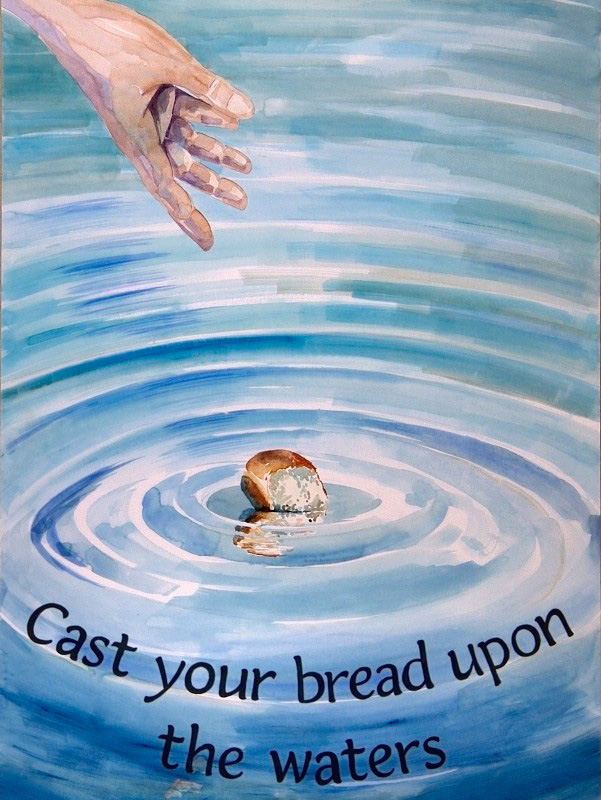
So go ahead and “cast thy bread upon the waters.” What do you have to lose?

"No King! No King! La-la-la-la-la-la"

Remember that classic scene from Disney’s The Lion King? Scar is singing malevolently about killing his brother, Mufasa, and his nephew, Simba. He’s got it all planned out to dethrone the current King and eliminate the successor to the throne. His half-witted posse of hyenas get so excited about the possibility of life without a king. They would prefer total anarchy. The next best thing, of course, is Scar reigning as king. So they go along with his plan.

In Ecclesiastes, the Teacher spends quite a bit of time reflecting on all the ways a government can go wrong. There are times when the people rebel against the current regime. There are other times when the officials are tyrants and oppressors. Sometimes the leaders are young hot shots. Sometimes they are old fools. It seems that there is no such thing as a perfect government.

And three thousand years later, we’re still not there. Shocked? Anybody?

I’m reminded of the scene in The Patriot when Mel Gibson’s character is in the assembly of men discussing whether or not to revolt against England. He stands up and asks the pointed question, “Why should I trade one tyrant three thousand miles away for three thousand tyrants one mile away?”

In the “Arab Spring” which began around this time last year, Egypt, Lybia, and various other nations around the Middle East ousted their current dictatorial regimes and elected new leaders…some of whom turned out to be worse than before! Egypt is still reeling from the switch in governments.

In Ecclesiastes 10 he draws our attention to two more ways a government can go all wrong:

There is an evil I have seen under the sun,
the sort of error that arises from a ruler:
Fools are put in many high positions,
while the rich occupy the low ones.
I have seen slaves on horseback,
while princes go on foot like slaves. (10:5-7)

Woe to the land whose king was a servant
and whose princes feast in the morning.
Blessed is the land whose king is of noble birth
and whose princes eat at a proper time—
for strength and not for drunkenness. (10:16-17)

In vv. 5-7 it seems that the whole structure of society has been upended. Fools are given positions of leadership while the rich (read “wise”) are made to be janitors and sanitation engineers. Slaves go on horseback while princes walk.

To which many in today’s society would think, “That’s a good thing! Equal rights for all! The poor should have the right to ride on horseback just like anyone else. And how dare that prince think he’s entitled to ride on horseback while everyone else has to walk!” (Occupy Wall Street, anyone?)

The evil in it, though, is from the complete disregard for authority and order. Without those clear guidelines the whole system dissolves into anarchy.

On the other hand, when kings and princes/governors are in such a position of authority, they should not use that title to their own advantage (i.e. feasting in the morning). The should eat at a proper time for proper reasons – strength to govern and guide the people.

I think the lesson for us all, even if we’re not in a position of authority, is that God has given us a task. We have a purpose on this earth. And I’m pretty sure that purpose is not to serve ourselves. We need to make sure that we’re doing the proper things at the proper times for the proper reasons. God created this world and humanity with a sense of order. When everyone is functioning in their God-given roles, everyone else benefits.

Ultimately, it doesn’t matter to us Christians what any leader, king, president, or prime minister does. We are answerable to a higher authority – the one true King. So let’s live like it.

"I’m Invincible!" "You’re a Loony."

One of my favorite scenes from Monty Python and the Holy Grail has to be the Black Knight. King Arthur is “riding” through the forest when he and his servant come across a night in black armor. He is guarding the only passage through the area. Arthur tries to carry on, but the Black Knight informs him, “None shall pass!”

One thing leads to another, swords are drawn, and a duel ensues. Arthur bests the Black Knight, severing limb after limb, the knight’s body spouting out fake blood. The whole battle is ridiculous. But the Black Knight exclaims, “I’m invincible!” To which Arthur replies, “You’re a loony,” and continues to hack away at the Black Knight.

Okay, so the scene isn’t as funny when it’s typed out… If you’ve seen the movie before, you’re probably chuckling. If you have no idea what I’m talking about, you’re probably ready to turn me in to a mental health facility.

But that scene reminds me of myself. I think I’m completely invincible – until I meet a formidable opponent. Then I am completely vincible. I can take every precaution to protect myself and my family. But bad things can still happen.

Solomon, in Ecclesiastes 10, reminds us that wisdom itself is not invincible. Wisdom and righteousness go hand in hand, and both can be corrupted more easily than we realize.

As dead flies give perfume a bad smell,
so a little folly outweighs wisdom and honor. (10:1)

Whoever digs a pit may fall into it;
whoever breaks through a wall may be bitten by a snake.
Whoever quarries stones may be injured by them;
whoever splits logs may be endangered by them. (10:8-9)

Through laziness, the rafters sag;
because of idle hands, the house leaks. (10:18)

These are proverbs about the vulnerability of wisdom. Sometimes wisdom is corrupted through no real fault of our own. Flies are drawn to the sweet smell of perfume, but once they’re in it they can’t fly off. The stink of the dead flies begins to overpower the fragrance of the oils. A little folly can end up overpowering much wisdom and honor simply because fools can be drawn to the wise.

Sometimes we overprotect our wisdom and righteousness to the point that we begin to feel arrogant. Think about it. In 10:8-9, ditch diggers, construction workers, quarry-men, and lumber jacks are all professionals. They may have been splitting logs their entire lives. One day they feel over confident, have a momentary lapse in judgment or safety, and BOOM, an accident leaves them crippled and helpless.

Even when we’re alert and keeping watch, Satan is just waiting for that one instance in which we let down our guard. He knows the weak point, and he is just waiting to exploit it.

And then there are times that we just stop caring or trying. There is a house at the end of the street that has been vacant for at least the last two years. It still looks okay from the outside, but who knows what kind of damage is being done inside the walls. Houses tend to deteriorate more quickly when there’s no one living in them.

How many of us have gotten to the point in our faith journey that we just feel like settling down and relaxing a bit? We feel like we’ve done enough for now. We’re pretty good people. We go to church. We sing the songs. We put our money in the plate. We look good on the outside. But is anybody home? Our bodies are supposed to house the Spirit of God, and yet in our laziness we’ve let the house go unattended. And now the roof is leaking, allowing Satan’s lies and schemes to seep in through every crack and crevasse. Eventually a leaking roof leads to a crumbling foundation. And once the foundation goes, the house can’t stand much longer.

Wisdom can be corrupted. Righteousness can be tainted. If there is anything that Solomon wants us to learn in Ecclesiastes it’s that we must protect our lives. Keep watch. Stay alert. Protect the house.

You’re not invincible.

The Art of Losing

Everybody loves a good underdog story. 

Much of the time when I’m watching a football game in which I have no real interest in either team (Yes, guys do that), I’ll root for the team considered the underdog. We love it when the little guy comes through. We love to see Rocky get up time and time again when fighting the behemoth Russian boxer. We love the three-point shot at the buzzer. We love it when the nerd gets the girl instead of the jock. And we love it when the Average Joe’s beats Globo Gym.

But what about when we get beat by the underdog? Shock. Frustration. Anger. Disappointment. We do not love being the Goliath taken down by David.

In life we have an expectation of how things are supposed to work. The bigger, faster, stronger, more experienced team is supposed to win. The Russians we supposed to win gold at the 1980 Olympics, not the Americans. But what is it like to be the bigger, faster, stronger, harder working, more devoted team that gets creamed by the rag-tag group?

What’s it like to put in all the hard work and creativity at your job only to be passed up for a promotion? What’s it like to do all the homework, all the study, all the research, only to have someone else named valedictorian who took all the lower level classes?

It makes us want to throw our hands up and shout, “What’s the point of it all?!”

I have seen something else under the sun:
The race is not to the swift
or the battle to the strong,
nor does food come to the wise
or wealth to the brilliant
or favor to the learned;
but time and chance happen to them all.
(Ecclesiastes 9:11)

Look at that description. Don’t we all want our kids to be athletic, strong, wise, brilliant, and learned? Those are all great goals, I think. But what happens when we pressure our kids in sports so much that they just get burnt out? What happens when our strength defines us only to have it ripped away in a car accident? What happens when our brilliant investments turn out to be a pyramid scheme? What happens when a split-second decision ruins our life-long reputation?

Things don’t always work out the way we expect. Time and chance happen to everyone. Notice, he doesn’t blame God, and neither should we. Fact is we live in a broken world. Everything is susceptible to corruption and decay. The favorite will not always win – sometimes the underdog wins. Sometimes we’re David, sometimes we’re Goliath.

This verse in Ecclesiastes sounds very similar to another familiar passage in Scripture:

Looking at his disciples, he said:

“Blessed are you who are poor,
for yours is the kingdom of God.
Blessed are you who hunger now,
for you will be satisfied.
Blessed are you who weep now,
for you will laugh.
Blessed are you when people hate you,
when they exclude you and insult you
and reject your name as evil,
because of the Son of Man.

“Rejoice in that day and leap for joy, because great is your reward in heaven. For that is how their ancestors treated the prophets.

“But woe to you who are rich,
for you have already received your comfort.
Woe to you who are well fed now,
for you will go hungry.
Woe to you who laugh now,
for you will mourn and weep.
Woe to you when everyone speaks well of you,
for that is how their ancestors treated the false prophets.”
 (Luke 6:20-26)

The kingdom of heaven belongs to the underdogs. The jocks have no advantage when it comes to the kingdom. The wealthy, the well fed, the wise, those with good reputation – the Goliaths need Jesus just as much as everyone else. It doesn’t matter if you seem blessed or successful by the world’s standards. God loves a good underdog story. Don’t believe me? Read the story of Gideon – of David – of Peter.

If you lost everything tomorrow, all the stuff that so easily defines us, would you still have enough? How good are you at losing? Would losing it all just completely decimate you? Or is your identity, your life, your very self in Christ enough?

I think it’s time we practice the art of losing.