Page 68 of 82

Holy Land Saga pt. 1

Day 1: Sun 11/16/08


Caesarea Maritime:

The first stop on our journey through the Holy Land was Caesarea Maritime, the famous port city established by King Herod the Great, as well as the location of Paul’s trial before being sent to Rome (Acts 25).


We learned a lot about Herod the Great. As far as his kingship goes, he was a very successful leader. He remodeled the Temple, he built great palaces and fortresses (e.g. Massada), and he also constructed the first and largest man-made port in ancient Rome in the city of Caesarea. Politically, he had a very successful run. Morally, however, he was a vicious man. After marrying his wife and bearing two sons with her, he decided that anyone in the bloodline of the previous royal family had to die because they were seen as threats to his throne. Thus, he had his wife and sons murdered. When Caesar Augustus heard this news, he is recorded as saying, “It is better to be one of Herod’s pigs than one of his sons.”


This is the same king, as you might recall, that had all the baby boys in the Bethlehem region killed when he heard that the new “King” of Israel had been born. He was both paranoid and power-hungry…not a good combination.


We also learned that he may have had leprosy (a conclusion reached based on the number of bathhouses in the areas he lived) and possibly even some sort of elephantitis (speculation drawn from the asymmetrical shape of his thrones).


Caesarea is a beautiful city located directly on the coast of the Mediterranean Sea. In fact, it was the largest coastal city in the Roman Empire. There are still remains of a Roman hippodrome, a good size theater, Herod’s palace, a Byzantium church, and a mosque, just to name a few of the highlights.


We were able to stand in the place where Paul gave his defense in front of Governor Felix and Herod Agrippa, after which he made use of his Roman citizenship and appealed his case to Caesar in Rome. He didn’t have to do this. In fact, Governor Felix would have set him free. But by appealing to Caesar, Paul got a free trip to Rome, by way of shipwreck in Malta, and was able to plant seeds of the gospel in the very heart of the largest empire the world has ever known.
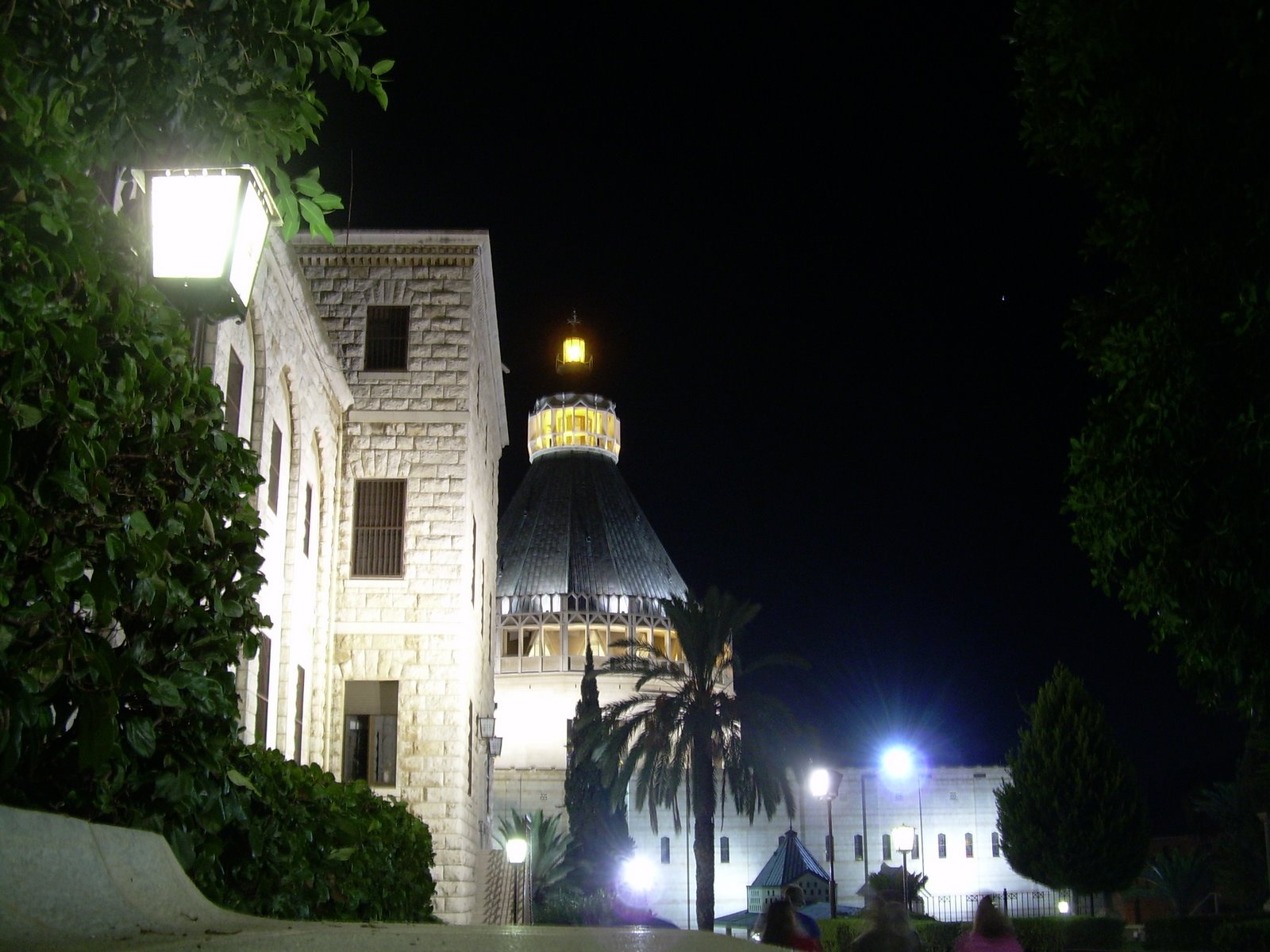
Nazareth:

By the time we actually got to Nazareth, it was already dark, and we were very pressed for time. But we did have a chance to walk quickly through the Church of Annunciation, at least one of them. The Greek Orthodox have one and the Catholics have another in a different location. I believe the one through which we walked belonged to the Greek Orthodox. It is a massive, beautiful structure built on top of the ruins of the supposed home of Mary where the angel Gabriel announced to her that she would conceive and give birth to the Messiah.


We didn’t get a chance to see many of the ruins of the ancient town, but from what our guide told us, there isn’t a whole lot to see anyway. The main remnants of the town consist of cisterns, wells, and storage rooms dug into the ground and into caves. Archaeologists suspect that there would have been no more than about 800 citizens of Nazareth in Jesus’ day – talk about a town where everyone knows everyone. This is the town where Jesus lived, played, worked, and built his first relationships. It’s no surprise that when he came back after the start of his ministry that his own people had a hard time accepting what he had to say. He was nothing special, at least in their minds. He was the son of a carpenter and a woman who, to the best of their knowledge, had an affair before she was officially married. His family wouldn’t have been the most well-respected, and he was the laughingstock of the community when he came back and tried to preach to them.


One thing I find amazing, though, is the fact that Jesus is from the lineage of King David. When Philip asked, “Can anything good come out of Nazareth?” he was unaware that the seed of King David had come from the small town in the middle of no where.


It’s not that Nazareth was a “bad” town, it just wasn’t strategically located, to say the least. There is no major trade route around, there is no great source of water nearby, and virtually none of the surrounding land is good, fertile soil for growing food. It couldn’t have supported a large population, and the only reason it has grown so much in recent years is due to the Christian influence in the city.


It was a great experience to be able to worship at the Church of Christ in Nazareth. The minister, Maurice, opened the building for us, prepared the Lord’s supper, gave a fifteen minute talk, and even had a Q&A session at the end. It was incredible to hear his testimony. When he converted from the Greek Orthodox Church, his entire family turned their backs on him. He lost his job, he was out on the streets, and the church took him in. He has a great passion for the scriptures, for God, and for Christ. It is his goal to reach out to his neighbors in the community, even in the face of persecution from many of the Muslims in Nazareth. (FYI: Nazareth has the largest Arab/Muslim population in the entire state of Israel)


As my friend, Jon, pointed out in his thoughts before the Lord’s Supper, it was incredible to be gathered in the very place where God became flesh and blood, and it is the very flesh and blood of which we partake that gives us spiritual life. Amazing.

Good Ol’ US of A

Well, 3 plane rides, 6 hours worth of layovers, and one 30-hour day later, I am back in the United States.

I must admit, I am going through a bit of reverse culture shock. America is so different than any place on earth if by nothing more than the fact that we have by far the most diverse population demographics. I was used to looking around Greece and seeing Greeks. I looked around Italy and saw Italians. I looks around Israel and saw Jews and Palestinians. Not a whole lot of diversity around, save the tourists (like us). But when I look around America, I see people of all descents, races, nationalities, ethnicities, religions, color, body build. So much diversity leads to a very unique way of doing things.

Here are some of the key differences I see between America and the rest of the world:

  • On the whole, Americans do not realize how much the US effects the rest of the world
  • Americans care way less about the environment than most of Europe
  • After being overseas for so long, it’s shocking to me how big the vehicles are that Americans drive
  • We take our plumbing system for granted
  • America has real bacon
  • Our language (English primarily) is not nearly as important to Americans as it is to the British, or as Italian is to Italians, or French is to the French, or Hebrew is to the Israelis
  • *This is in no way meant to offend anyone, it is merely an observation* – There really are far more overweight people in America than anywhere else I have been
  • Europeans walk a lot more than most Americans would even think about
  • American public transportation (nearly non-existent in most places) has some catching up to do
  • While I disagree that America is a “Christian Nation”, there definitely is a much higher emphasis on faith (not religion) in America than most parts of Europe…and yes, there is a HUGE difference between faith and religion
  • It’s sad to me that most people I met around Europe, Egypt, and Israel could speak well at least 2 languages – one being English – when many Americans can barely master one language
  • English really is the “common” language of the world
  • Americans and the British put more emphasis on lines (or queues) than the rest of the world
  • I find it odd that the British economy is so much better than America’s, yet Americans work something like 50% more man-hours on average than the British do

These are just a few observations I wanted to share from my time overseas. While it is difficult to make the transition back to the American way of life once again, I did get to have Sonic for dinner last night and Cracker Barrel for breakfast this morning. When you spend that much time away from your home country, you start missing some things very strongly. You also dread going back to the things you definitely did not miss.

  • Missed bacon/American breakfasts
  • Did not miss American fast food
  • Missed driving
  • Did not miss seeing behemoth vehicles carrying one person “just because”
  • Missed fellow English speakers
  • Did not miss Southern accents
  • Missed having a cell phone
  • Did not miss TV commercials

There is also a list of things I will miss from Europe and some things I’m glad to get away from:

  • Will miss efficient public transportation
  • Will not miss European drivers
  • Will miss proper gyros (amazing food from Greece)
  • Will not miss getting more than recommended daily allowance of second hand smoke
  • Will miss being able to bargain at shops
  • Will not miss European fashions
  • Will miss being able to walk nearly everywhere
  • Will not miss having to walk nearly everywhere
  • Will miss the beautiful Cathedrals and architecture
  • Will not miss Greek Orthodox v. Catholicism

I wouldn’t trade my experiences for anything in the world. I feel like this semester has been a turning point in my life – spiritually, politically, emotionally, mentally, etc. My eyes have been opened to another world outside the bubble that is America. I have been to the other side and back. I have walked through some of the most disputed land on the face of the earth. I have traveled deep into the Muslim world. I have wandered through the wilderness in the dark. I have traveled from the Middle East to the United Kingdom and have used 6 different types of currency. I have encountered 9 or 10 completely different cultures and have been shaped by each one. I feel that I am no longer bound by the short-sighted American lenses through which I viewed the world. I thank God for this experience and will definitely use it to the glory of his kingdom.

Good Ol’ US of A

Well, 3 plane rides, 6 hours worth of layovers, and one 30-hour day later, I am back in the United States.

I must admit, I am going through a bit of reverse culture shock. America is so different than any place on earth if by nothing more than the fact that we have by far the most diverse population demographics. I was used to looking around Greece and seeing Greeks. I looked around Italy and saw Italians. I looks around Israel and saw Jews and Palestinians. Not a whole lot of diversity around, save the tourists (like us). But when I look around America, I see people of all descents, races, nationalities, ethnicities, religions, color, body build. So much diversity leads to a very unique way of doing things.

Here are some of the key differences I see between America and the rest of the world:

  • On the whole, Americans do not realize how much the US effects the rest of the world
  • Americans care way less about the environment than most of Europe
  • After being overseas for so long, it’s shocking to me how big the vehicles are that Americans drive
  • We take our plumbing system for granted
  • America has real bacon
  • Our language (English primarily) is not nearly as important to Americans as it is to the British, or as Italian is to Italians, or French is to the French, or Hebrew is to the Israelis
  • *This is in no way meant to offend anyone, it is merely an observation* – There really are far more overweight people in America than anywhere else I have been
  • Europeans walk a lot more than most Americans would even think about
  • American public transportation (nearly non-existent in most places) has some catching up to do
  • While I disagree that America is a “Christian Nation”, there definitely is a much higher emphasis on faith (not religion) in America than most parts of Europe…and yes, there is a HUGE difference between faith and religion
  • It’s sad to me that most people I met around Europe, Egypt, and Israel could speak well at least 2 languages – one being English – when many Americans can barely master one language
  • English really is the “common” language of the world
  • Americans and the British put more emphasis on lines (or queues) than the rest of the world
  • I find it odd that the British economy is so much better than America’s, yet Americans work something like 50% more man-hours on average than the British do

These are just a few observations I wanted to share from my time overseas. While it is difficult to make the transition back to the American way of life once again, I did get to have Sonic for dinner last night and Cracker Barrel for breakfast this morning. When you spend that much time away from your home country, you start missing some things very strongly. You also dread going back to the things you definitely did not miss.

  • Missed bacon/American breakfasts
  • Did not miss American fast food
  • Missed driving
  • Did not miss seeing behemoth vehicles carrying one person “just because”
  • Missed fellow English speakers
  • Did not miss Southern accents
  • Missed having a cell phone
  • Did not miss TV commercials

There is also a list of things I will miss from Europe and some things I’m glad to get away from:

  • Will miss efficient public transportation
  • Will not miss European drivers
  • Will miss proper gyros (amazing food from Greece)
  • Will not miss getting more than recommended daily allowance of second hand smoke
  • Will miss being able to bargain at shops
  • Will not miss European fashions
  • Will miss being able to walk nearly everywhere
  • Will not miss having to walk nearly everywhere
  • Will miss the beautiful Cathedrals and architecture
  • Will not miss Greek Orthodox v. Catholicism

I wouldn’t trade my experiences for anything in the world. I feel like this semester has been a turning point in my life – spiritually, politically, emotionally, mentally, etc. My eyes have been opened to another world outside the bubble that is America. I have been to the other side and back. I have walked through some of the most disputed land on the face of the earth. I have traveled deep into the Muslim world. I have wandered through the wilderness in the dark. I have traveled from the Middle East to the United Kingdom and have used 6 different types of currency. I have encountered 9 or 10 completely different cultures and have been shaped by each one. I feel that I am no longer bound by the short-sighted American lenses through which I viewed the world. I thank God for this experience and will definitely use it to the glory of his kingdom.

The time has come

It’s hard to believe, but our time here in Greece is almost up. We leave tomorrow morning, flying out of Athens to Rome to begin 13 days of travel through Europe. Along the way we will see Rome, Florence, Pisa, Paris, Dublin, Edinburgh, Glasgow, and London. It’s going to be a lot of fun but very stressful at times. Please keep us in your prayers for the next two weeks until we get back home to Columbia.

I will try to update all about Israel and free travel when I get back home.

God bless.

PS – I added my calendar to the bottom of the blog page so you can see what’s coming up on the schedule and when we’ll be where.

The time has come

It’s hard to believe, but our time here in Greece is almost up. We leave tomorrow morning, flying out of Athens to Rome to begin 13 days of travel through Europe. Along the way we will see Rome, Florence, Pisa, Paris, Dublin, Edinburgh, Glasgow, and London. It’s going to be a lot of fun but very stressful at times. Please keep us in your prayers for the next two weeks until we get back home to Columbia.

I will try to update all about Israel and free travel when I get back home.

God bless.

PS – I added my calendar to the bottom of the blog page so you can see what’s coming up on the schedule and when we’ll be where.

Israel…go ahead and be jealous

I don’t have time right now to update much about Israel, and I can’t guarantee that I’ll get very far this week with finals and everything coming up. Just so you know what’s coming, here’s a list of all the places/sites we visited on our trip through the Holy Land:

  • Caesarea Maritime
  • Nazareth/Church of the Immaculate Conception
  • Bethsaida
  • Sea of Galilee boat ride
  • “Jesus Boat” Museum
  • Capernaum
  • Mt. Tiberias
  • Mount of the Beatitudes
  • Dan Nature Reserve
  • Tel-Dan
  • Banyas Falls in the Golan Heights
  • Caesarea Philippi
  • Fortress of Nimrod
  • Baptistery at the Jordan
  • Mt. Horeb/Springs of Harod (Gideon in Judges 7)
  • Valley of Jezreel
  • Qum’Ran
  • Ein Gedi
  • Dead Sea
  • Mt. Sodom
  • Masada
  • Bedouin camp
  • Be’er Sheva
  • Ha Ella Valley (David and Goliath)
  • Bet Guvrin
  • Bet Shemesh
  • Bethlehem/Church of the Nativity
  • Jerusalem
  • Mt. of Olives
  • Garden of Gethsemane
  • St. Anne’s Cathedral
  • Pools of Bethesda
  • Church of the Flagellation
  • Church of the Condemnation
  • Via Dolorosa
  • Church of the Holy Sepulchre
  • Temple Mount
  • Western Wall
  • Hezekiah’s Tunnel/Pool of Siloam
  • Southern Steps of the Temple Mount
  • Temple Mount Archaeological Park (w/ virtual tour)
  • Yad Vashem (Holocaust Museum)
  • Jerusalem Museum (Model of 1st Century Jerusalem & Shrine of the Book)
  • Traditional Upper Room
  • Tomb of David
  • Gordon’s Calvary/Garden Tomb

Yeah, we saw all these in only 9 days. It was one crazy trip. I can’t wait to share my experiences with you.

Israel…go ahead and be jealous

I don’t have time right now to update much about Israel, and I can’t guarantee that I’ll get very far this week with finals and everything coming up. Just so you know what’s coming, here’s a list of all the places/sites we visited on our trip through the Holy Land:

  • Caesarea Maritime
  • Nazareth/Church of the Immaculate Conception
  • Bethsaida
  • Sea of Galilee boat ride
  • “Jesus Boat” Museum
  • Capernaum
  • Mt. Tiberias
  • Mount of the Beatitudes
  • Dan Nature Reserve
  • Tel-Dan
  • Banyas Falls in the Golan Heights
  • Caesarea Philippi
  • Fortress of Nimrod
  • Baptistery at the Jordan
  • Mt. Horeb/Springs of Harod (Gideon in Judges 7)
  • Valley of Jezreel
  • Qum’Ran
  • Ein Gedi
  • Dead Sea
  • Mt. Sodom
  • Masada
  • Bedouin camp
  • Be’er Sheva
  • Ha Ella Valley (David and Goliath)
  • Bet Guvrin
  • Bet Shemesh
  • Bethlehem/Church of the Nativity
  • Jerusalem
  • Mt. of Olives
  • Garden of Gethsemane
  • St. Anne’s Cathedral
  • Pools of Bethesda
  • Church of the Flagellation
  • Church of the Condemnation
  • Via Dolorosa
  • Church of the Holy Sepulchre
  • Temple Mount
  • Western Wall
  • Hezekiah’s Tunnel/Pool of Siloam
  • Southern Steps of the Temple Mount
  • Temple Mount Archaeological Park (w/ virtual tour)
  • Yad Vashem (Holocaust Museum)
  • Jerusalem Museum (Model of 1st Century Jerusalem & Shrine of the Book)
  • Traditional Upper Room
  • Tomb of David
  • Gordon’s Calvary/Garden Tomb

Yeah, we saw all these in only 9 days. It was one crazy trip. I can’t wait to share my experiences with you.

Olympia – as in the Olympic Games

Olympia was definitely my favorite place on the Southern Greece trip. It was extremely beautiful, there were trees that were actually changing colors, and it was really the first time all semester that it actually felt like fall. I loved it there.

We started by going to a really cool museum where we got to see lots of amazing statues (Like Hermes, and Nike) and some really cool artifacts, like weapons and armor dedicated to Zeus. Speaking of Zeus, he was the patron god of Olympia (even though it is no where close to Mt. Olympus). The Olympic games, which were held every 4 years, were dedicated to Zeus. The Temple of Zeus, which is now mostly in ruins thanks to earthquakes, used to house the great statue of Zeus, one of the 7 wonders of the ancient world. Unfortunately, like all but one ancient wonder the Statue of Zeus is now destroyed. We got to see a really nice artist’s rendition of it, though…

The site of ancient Olympia was one of the prettiest places I have been in Greece. It was just a perfect day to tour the site. We saw a couple gymnasiums, the Temple of Zeus, an old basilica dating to the 4th Cent. AD, and the Temple of Hera (Zeus’ wife) where they light the Olympic Torch every 4 years.

At the end of our tour we came to the famous Olympic Stadium…more like dirt track/field. This was not the first Olympic track, technically. This one was built in order to accommodate larger crowds and more participants, but it’s close enough. We were able to race on the track, which was a lot of fun. We ran it like they would have back 2500 years ago…no, not naked…down and back one time – winner takes all. It’s 192 meters one way, and four of us, including myself, ran it in 60 seconds or less. I loved it.
____________

Well that pretty much wraps up the Peloponnese trip. Highlights: Acrocorinth, Citadel of Mycenae, Theater of Epidaurus, and the Olympic Track

Next on the agenda is a recap of our trip to Israel. I can’t wait to share my experiences with you.

Epidaurus Health Club and Resort

Epidaurus (Epidavros in Greek) is basically set up as an all-inclusive health club and resort. This is where wealthy Greeks would come for treatment of certain diseases or just to obtain better overall health. The patron god of this town was Asclepios, the healing god. His priests were also doctors at the resort. I call it a resort because it wasn’t really a town of its own. Very few people actually lived there. Most people only came for short periods of time (a few months at most) and lived in hotel rooms of sorts.

They had everything there – Roman-style baths, gymnasiums, a track, a theater for entertainment (the most well-preserved ancient theater in the world, I might add). The theater was a masterpiece, accoustic perfection. Our tour guide gave a demonstration to show us just how amazingly sound could be carried. I and several others went to the very top of the theater and could hear everything as if our guide were just a few feet away. We could hear him crumple and rip a piece of paper, whisper, even breathe. It was incredible.

If you were sick back in the day, this was definitely the place to be. You would be pampered, spoiled, and entertained until whatever ailed you eventually left.

I do find it interesting that the Greeks had a practice of making plaster molds or small sculptings of whatever body part wasn’t well and they presented that as an offering to the god Asclepios. They have found thousands of stone or plaster eyes, ears, noses, fingers, hands, feet, and certain other body parts which I will leave unnamed. I guess in the days of the early church, “miraculous” healings were promoted by the priests, but it was a big deal when Paul, Peter, and other apostles could actually do it.

Citadel of Mycenae

Yet another fortress on a hill. We see a lot of those in this part of the world, and don’t worry – there are plenty more to come.

Mycenae is one place I had been looking forward to seeing for a long time. Anyone familiar with the works of Homer or the movie Troy will recognize this as the home of the Greeks who waged war on Troy. They were very much a warrior society, with gigantic fortress walls, elaborate tombs full of votive weapons, not to mention being the victorious in one of the most famous battles in history that may not have happened…

Regardless of the accuracy of Homer as an historian, the Mycenaean civilization left behind a lot of good stuff for modern archaeologists to oogle at. The most impressive of which is definitely the Lion Gate in the “Cyclopean Wall”. It is called the Cyclopean Wall because when the classical Greeks first stumbled upon this citadel, they thought that there was no possible way humans could have built such a wall out of such large stones; therefore, it must have been built by the cyclopese (these are the same Greeks which said, “Man is the measure of all things.” How’s that for irony…). The famous Lion Gate is named such because for the two large bodies of lions carved into solid stone and placed above the lintel piece in the gate. I was impressed with this even after seeing the Great Pyramids.

The Mycenaeans also had interesting burial chambers. They were basically gigantic underground domes. The pressure of the soil above the dome actually held it in place. In fact, the dome of King Agamemnon’s Tomb (which actually pre-dates him by a couple centuries) was the largest dome ever built until I think the time of the Romans.

When all is said and done, I would not want to be on the side against the Mycenaeans in a battle. They ruled, and they ruled well. They were not afraid to raise up an army in a moment’s notice. They were also the main civilization ascribed as ancestors to the mainland Greeks, and were responsible to developing and passing on their religion and theology (mainly through the Homerian tradition). I really enjoyed walking around the citadel of this great civilization.