Page 7 of 7

Messiah Is Coming, pt. 3

God made a covenant with Abraham that all nations would be blessed through his offspring. God made a promise through Moses that he would send the people a Prophet like Moses to speak on behalf of God. God made a covenant with David that his heirs would be enthroned forever in the sight of God.

The reigns of King David and his son Solomon were a kind of golden era for the United Kingdom of Israel. During their rule, Israel grew in strength, in numbers, and in territory. They established a military, a government, and a religion. The capital was moved to Jerusalem, and the Temple was built on the very mountain on which Abraham was commanded to offer Isaac so many years before.

It was during this time that the Psalms became an integral part of Israel’s worship and national identity. The Psalms reminded them of their past and brought hope for their future.

The Second Psalm was written for and recited at the coronation ceremony of Israel’s new kings. Let’s look at it, and see if anything sounds familiar. Pay attention to the words in red.

“I am the One who appointed My king who reigns from Zion, My mount of holiness.
He is the one in charge.”
I am telling all of you the truth. I have heard the Eternal’s decree.
He said clearly to me, “You are My son.
Today I have become your Father.
The nations shall be yours for the asking,
and the entire earth will belong to you.”

(Psalm 2:6-8 | The Voice)

There was a special relationship between God and the kings of Israel. As the Jews awaited the Messiah, which literally means Anointed One, they were looking for an earthly king from the line of David who would be honored, not simply as the Son of David, but as God’s own Son.

But even David himself recognized that the one to come would be far greater than himself. Looking ahead to the future Anointed One, David writes these words:

The Eternal said to my lord,
“Sit here at My right hand,
in the place of honor and power,

And I will gather your enemies together,
lead them in on hands and knees;
you will rest your feet on their backs.”
The Eternal will extend your reach as you rule
from your throne on Zion.
You will be out in enemy lands, ruling.
Your people will come as volunteers that day; they will be a sight to see:
on that day, you will lead your army, noble in their holiness.
As the new day dawns and dew settles on the grass,
your young volunteers will make their way to you.
The Eternal has sworn an oath
and cannot change His mind:
“You are a priest forever—
in the honored order of Melchizedek.”

(Psalm 110:1-4 | The Voice)

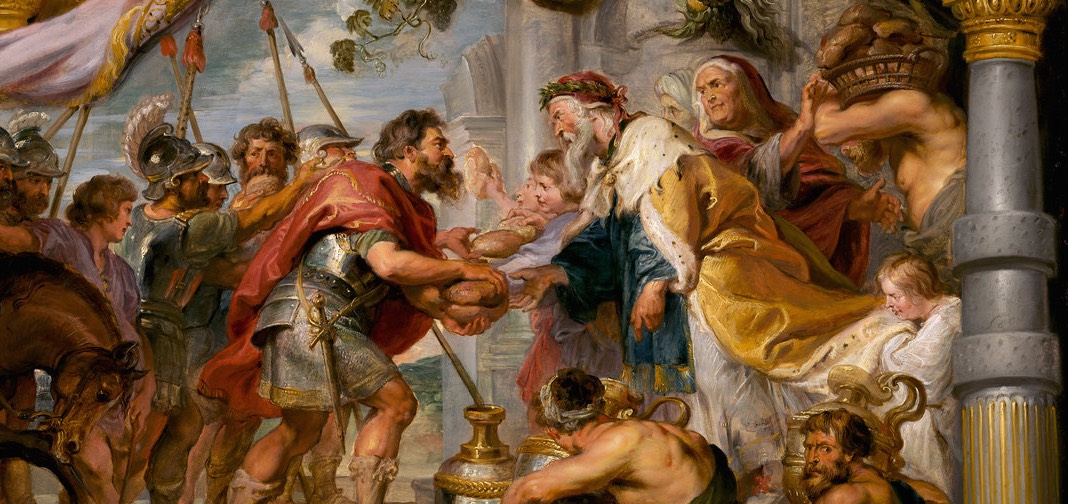
This coming King would be greater than David, would be honored as God’s Son, and would even take on the mantel of the priesthood in the order of Melchizedek, King and High Priest of Salem (see Genesis 14).
Prophet. Priest. King. Son of Abraham. Son of David. Son of God. Messiah. Anointed One. Christ.

This is who the Jews were waiting for, longing for, praying for. As their ancestors in Egyptian bondage, so they too were crying out to be released from the grip of Rome. The Messiah would do it. The Messiah would rally his followers, march on Jerusalem, and ascend the throne!

Little did they know or consider the prophetic words composed by David that would become the 22nd Psalm.

My God, my God,
why have You turned Your back on me?

Your ears are deaf to my groans…
My life is poured out like water,
and all my bones have slipped out of joint.
My heart melts like wax inside me.
My strength is gone, dried up like shards of pottery;
my dry tongue sticks to the roof of my mouth;
You lay me in the dust of death.
A throng of evil ones has surrounded me
like a pack of wild dogs;
They pierced my hands and ripped a hole in my feet.
I will speak Your Name to my brothers and sisters
when I praise You in the midst of the community…
He’s not put off
by the suffering of the suffering one;
He doesn’t pretend He hasn’t seen him;
when he pleaded for help, He listened…
They will tell the generations to come
of the righteousness of the Lord,
of what He has done.

The Messiah would be hailed as King of the Jews and Son of God – but only in his death. The Messiah would be pierced by men and forsaken by God. Yet God would not “let his holy one see decay.” The Messiah would be rescued and vindicated by God, beginning a whole new era of love and life and righteousness. The works of God through his Messiah would ripple out into the entire world, like waves in a lake.

The Messiah is Coming.
Messiah Is Coming, pt. 1

In the beginning God created the heavens and the earth. We know that story. We know its power, its beauty, its wonder. God simply spoke into being all the we see, hear, feel, taste, and smell. At God’s word, galaxies were formed and our planet burst to life with vegetation and wildlife. The crowning jewel of God creation in this opening song of Scripture is man and woman who were created in God’s own image and likeness.

And God saw all that he had made, and it was very good.
God planted a garden in Eden in which the man and woman could live out their calling to “be fruitful and multiply, fill the earth and subdue it.” God placed man in the garden to tend it and protect it. God gave the man a woman as a helper equal to and suitable for him.
And all was right and good and pure and innocent. For a while at least.
Because somehow, God’s good creation was yet susceptible to the influence of evil. The deceiver slithered into the scene, hissing lies and injecting doubts like venom in the bloodstream. The serpent fooled the humans into breaking God’s one rule by making them believe that God was holding out on them.

The woman ate the fruit and then gave it to her husband, and he ate, too. Their eyes were open to the realities of their sin, their nakedness, their shame. They hid from God. For the first time ever they felt unsafe in God’s presence.

Maybe you remember what that was like? The first time you felt like you hadn’t just done something bad but that you were bad? That’s shame.
Every sin has a consequence. From that point on we would be subject to broken relationships – with each other, with the earth, and with God. But God would not leave his children in this helpless state. He would not let that evil serpent win. He would set it all right one day through the woman’s own offspring.

God (to the serpent):
What you have done carries great consequences.
Now you are cursed more than cattle or wild beasts.
You will writhe on your belly forever,
consuming the dust out of which man was made.
I will make you and your brood enemies
of the woman and all her children;
The woman’s child will stomp your head,
and you will strike his heel. 
(Genesis 3:14-15 | The Voice)

God had a plan from the beginning. That last sentence is commonly known as the protoevangelion, “the first gospel.” God would not leave his children in the grasp of the serpent.
The Deliverer is coming.

Fast forward in the story, past the flood, past the tower of Babel, and we’re introduced to a man named Abram (later known as Abraham) who lived in the Mesopotamian city of Ur. Abram was married, childless, and very wealthy. God chose Abram to be an integral part of his great plan to rescue his children from the schemes of the serpent.

Abram, get up and go! Leave your country. Leave your relatives and your father’s home, and travel to the land I will show you. Don’t worry—I will guide you there. I have plans to make a great people from your descendants. And I am going to put a special blessing on you and cause your reputation to grow so that you will become a blessing and example to others. I will also bless those who bless you and further you in your journey, and I’ll trip up those who try to trip you along the way. Through your descendants, all of the families of the earth will find their blessing in you. (Genesis 12:1-3 | The Voice)

Abram would become the father of Isaac. Isaac would become the father of Jacob, who would later be named Israel. Jacob would become the father of Judah, from whose line would come the kings and the Messiah. From one family, all nations would be blessed, all peoples would be rescued from the power of evil. From one family God would work to create one new family, one new humanity.
The Messiah is coming.

Are You There, God?

[My wife and I had a conversation about this the other day. She had some really good thoughts that got me thinking more about the subject. She’s pretty amazing like that.]

Faith.

It seems simple enough. I can look around at the world and the universe and know in my gut that someone had to be behind it all. I can read the Bible and believe it’s claims that the Creator of the universe wants to have a relationship with me. My heart tells me that I am loved and that I am a part of something much greater than myself.

But what happens when the love I have for my Creator doesn’t feel requited.

What are we to do when everything around us is darkness and chaos, yet God is silent?

“If God would just speak to me like He used to speak to people, it would all be better. I would be able to fully trust and believe Him. Since I would know exactly what He wants me to do, I could better follow and serve Him. Just talk to me, God!”

I think most of God’s people think something like this sooner or later. It seems like a legit complaint. There are times when God seems distant and all we want is to hear His voice. If He would just speak to us, then everything would somehow get magically better.

But would it?

Humanity doesn’t have a very good track record when it comes to direct contact with our Creator.

Adam and Eve lived and walked with God in the garden. They still ate the fruit.

Noah was saved directly by the hand of God. He still passed out drunk and naked.

Abraham was God’s chosen man through whom He would bless all peoples of the earth. He still lied…twice.

Moses was in almost constant contact with YHWH for 40 years. He still had an anger problem.

David was anointed by God to be king. He still became a murderer, adulterer, and a liar.

Elijah was God’s chosen prophet by whom Ba’al was defeated. He still battled depression.

God told Jonah exactly what he was supposed to do. He still ran in the opposite direction.

Are you noticing a trend? Whether or not God speaks directly to you, that won’t make you any less human. It won’t make you any less angry, or afraid, or stubborn. It won’t magically make all your problems disappear.

Let’s look at one more example.

At the end of John’s gospel, we get to listen in on a conversation between Peter and the resurrected Christ.

Peter, do you love me unconditionally? [agapao]

Yes, Lord, I love you like a brother. [phileo]

Peter, do you love me unconditionally? [agapao]

Yes, Lord, I love you like a brother. [phileo]

Peter, do you [even] love me like a brother? [phileo]

Yes, Lord, you know I love you like a brother. [phileo] (John 21:15-17; my translation)

Peter was staring God in the face, looking into the very eyes of the Creator of the universe, and could not bring himself to say that he loved him unconditionally. He could only say that he loved him like a brother.

Fast forward a few decades. Peter is now writing a letter to Christians scattered across Asia minor. They were most likely 2nd generation Christians by now, far removed from Jerusalem and the time of Jesus. All they have to go on is the stories and testimonies of others. They haven’t seen Jesus or heard the voice of God. Look what Peter writes:

You love him unconditionally [agapao] though you have not seen him. And though not seeing him now, you believe in him and rejoice with inexpressible and glorious joy…” 1 Peter 1:8

Talk about swallowing your pride. I can bet that Peter never forgot that conversation with Jesus on the shoreline. He was looking right at the resurrected Christ and couldn’t say that he loved him unconditionally. But now he is commending these Christians on their faith. They love him unconditionally even though they never even saw Jesus.

I can imagine some tears welling up as he pens those words.

Peter would be the first to tell us that hearing God’s voice directly doesn’t make it all better. It doesn’t take away our faults and our frustrations. It doesn’t replace heartache with happiness.

Only full submission can do that.

Peter wrote a few verses earlier that through God’s power, we have already been given everything we need for life and godliness. We just have to listen.

Reflections on "Jesus Manifesto," pt. 3

CHAPTER 2


“You have been invited to share life with your Maker and Creator.

“And to top it all off, you have been made utterly, totally, fully complete in Him–here and now.

“Why, then, would you chase anything else? How can you be consumed with anything other than your Lord, Jesus Christ? And how can you graduate beyond Him?

“He is enough, even more than enough.

“Jesus Christ is like a vast ocean. He is too immense to fully explore, and too rich to fathom. You are like a bottle.

“The wonder of the gospel is that the bottle is in the ocean, and the ocean is in the bottle.”
____________
Imagine, the power and magnitude of the entire ocean contained inside a little glass bottle adrift in that very ocean. This chapter of Jesus Manifesto explores the letter to the Colossians. Paul explains to the church that the great mystery of the gospel is that we are in Christ and Christ is in us! His life is our life. It is too small a thing to offer a part of ourselves to Christ when He has given His entire being (His power, His life, His divine nature) to us. The only appropriate response is to let ourselves be fully consumed and immersed in the Spirit of our Savior. Praise, worship, service–this is all we know to do when hit by the reality that is Christ in us.

This has become one of my favorite songs on the radio. I think the message really hits home with this reality.

Reflections on "Jesus Manifesto," pt. 2

Chapter 1: The Occupation of All Things


Read over this passage slowly.

15 He is the image of the invisible God,

    the firstborn over ALL creation;
    16 because by Him EVERYTHING was created,
    in heaven and on earth, the visible and the invisible,
    whether thrones or dominions or rulers or authorities—
    ALL THINGS have been created through Him and for Him.
    17 He is before ALL THINGS, and by Him ALL THINGS hold together.
    18 He is also the head of the body, the church;
    He is the beginning, the firstborn from the dead,
    so that He might come to have first place in EVERYTHING.
    19 For God was pleased [to have] ALL His fullness dwell in Him,
    20 and through Him to reconcile EVERYTHING to Himself
    by making peace through the blood of His cross —
    whether things on earth or things in heaven.
Colossians 1:15-20, HCSB (emphasis added)

Notice a theme? These are some BOLD claims Paul is making. Everything we see, taste, touch, hear, and smell, AND everything we can’t see, taste, touch, hear, and smell has been created BY Jesus, THROUGH Jesus, and FOR Jesus. Not only that, all that stuff is held together by him! You may think that the laws of physics are holding this world, this solar system, this galaxy, and this universe together, but it’s Jesus. You may think that you are responsible for paying the bills, staying healthy, and providing for your family, but it’s Jesus who holds your life together. And you may think that Jesus died just for you and those you love, that human souls are the only part of creation that will enjoy redemption and reconciliation, but through Jesus’ blood, everything is reconciled to him–the whole of creation.

Viola and Sweet explore in this chapter how EVERYTHING is occupied with Jesus the Christ–the heavens, creation, the Old and New Testaments, the writings of Paul, etc. Jesus is given first place, top priority in everything. It all points towards the Christ.

With us, however, there is a different story. The created order extols, reflects, and points to Christ. That’s just the way it is. That is how the non-human creation was created. But we humans have the option to NOT put Christ in first place. We are actually given the ability to deny Christ his rightful place in our lives. Even in the church, ministers, teachers, and pastors continually deny Christ his rightful Lordship over EVERYTHING they do, say, or preach.

Viola and Sweet make this chilling statement:
“The tragedy of our time is that countless preachers, teachers, even healers are giving dozens of sermons, lectures, and messages, relegating Jesus to little more than a footnote or a flourish to some other subject. At best, he gets honorable mention. What is lacking is a groundbreaking revelation of Christ that boggles the mind and enraptures the heart.”

Read the passage from Colossians again. When you sit through Sunday morning services, does Christ take priority over ALL THINGS? Does EVERYTHING the preacher says point back to the awesomeness of Jesus? Are we, as Christ’s body, allowing ourselves to be held together by something other than Christ’s spirit? Are we proclaiming the reconciliation of everyone and everything and the peace that comes through the blood of Christ?

If you answered “No” to any of these questions, then something is wrong. If Christ is not head over everything, then something else is–whether it’s evangelism, church growth, theology, doctrine, social action, missions, worship, and the list goes on. What is occupying your time? Is it Jesus, or is it this list of other things?

“To our minds, there is one reason why a Christian would not be absolutely occupied and consumed with Christ. That person’s eyes have not been opened to see His greatness. The sad truth is that the Jesus who is preached so often today is so shallow, so small, and so uncaptivating that countless believers are enthralled with countless other things.”

Read the Colossians passage one more time. Does that Christ seem shallow, small, or uncaptivating? Absolutely not! The exact opposite is true. The Christ we serve is so deep, so big, and so captivating that the world and the cosmos get sucked into Him. Christ is the pre-occupation of all things.

Is He yours?

Reflections on "Jesus Manifesto"


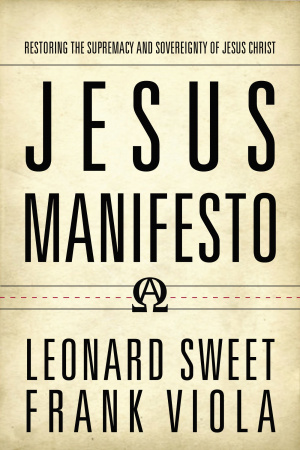
I recently finished reading an excellent book coauthored by Len Sweet (The Gospel According to Starbucks, Soul Tsunami) and Frank Viola (Pagan Christianity, Reimagining the Church). There have been throughout the centuries many pendulum swings of Christological thought. It seems that many theologians and scholars are content to take up arms in the debate between the “Jesus of History” and the “Christ of Faith.” Leaning too much to any one extreme, however, misses the richness and beauty of the God-Man that we worship. Sweet and Viola have done an outstanding job of refocusing the reader’s mind and heart onto the true awesomeness of Jesus the Christ. At the same time, they tackle the tough questions about living as the body of Christ on the earth. I thought I’d start back writing again with some reflections on various parts of the book.


Introduction:

I think this paragraph helps to set the stage for the rest of the book:
“So what is Christianity? It is Christ. Nothing more. Nothing less. Christianity is not an ideology or a philosophy. Neither is it a new type of morality, social ethic, or worldview. Christianity is the ‘good news’ that beauty, truth, and goodness are found in a person. And true humanity and community are founded on and experienced by connection to that person.”
Wow. What a statement. As I think back to my world religions class, I am still blown away by all the competing faiths, belief systems, moralities, and worldviews swirling around our culture today. It’s very easy to take a broad, sweeping view of all the religions and to think that Christianity has nothing unique to offer. It seems like all the major religions have their sacred texts, their god/gods/spirits, their earthly leaders/founders, their own code of ethics, their own belief about the afterlife, etc. It’s so easy to get caught up in the similarities blurring the lines that we lose focus on the truly unique nature of our faith.
Christ is what makes our faith as unique today as it was in first century Palestine. Yes, we believe in the Bible as the word of God, but the Word became flesh. Yes, we have a certain morality for which we strive, but all of that morality was fulfilled in Christ. Yes, we have a way of viewing the world around us, but we see the world as God sees the world. Yes, we believe in an afterlife, but we believe in eternal life here and now.
In Christ we find more than a list of rules and regulations. He gives us more than instructions on how to get to heaven. In Christ we find truth, beauty, community, acceptance, and a love that out-loves all other love that we could ever know. Christianity is Christ! When it becomes about “Christ and,” then we have lost our true focus. We have forgotten our first love.
I’ll leave you with this final quote:
“[W]e cannot properly love him if we haven’t caught sight of how incredibly glorious he is. But once we do–once we catch a sighting of Jesus Christ in all his glory–we will gladly exchange our dusty rites, Christian-speak, and pop-culture church-building tactics for the joy of becoming a walking, breathing ‘Jesus Manifesto.'”