Page 6 of 6

Jonah: Nope

Have you ever heard God speak directly to you? Odds are that you haven’t. I would say that most
people don’t.

If you did, how would you respond?

The closest I’ve come to hearing God speak to me happened when I was just out of my freshman year of high school. I was fifteen years old. We were at church camp that summer. It was one of those super emotional nights where a bunch of campers were thinking seriously about their lives. We ended each night with a time of singing. That night so many youth ministers and counselors were busy talking with teens in need that they turned over the song leading to some of us young guys. I got up in the middle of everyone and led a few songs. In that moment I could see and feel the Spirit of God at work in the lives of my peers. In that moment I felt/heard God tell me that this was what I was meant to do with my life.

From that moment on I began to pursue my calling to youth ministry and worship leading. I’ve been doing that full time for the last eight years. It hasn’t always been easy or fun or glamorous. But I can’t see myself doing anything else.

If God were to speak to you, how would you respond?

The Bible is littered with stories of men and women encountering the divine. The most common reaction is terror. They fall down in fear (Isaiah, Peter, Paul). Some of them choose to test and argue with the divine (Moses, Gideon). Others “gird up their loins” for a wrestling match (Jacob!). Still others willingly submit and obey (Samuel, Mary).

And then there’s Jonah.

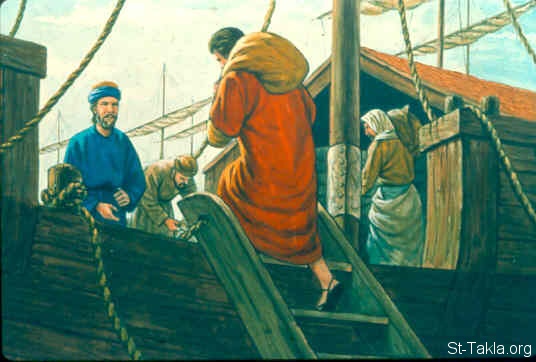
Now the word of the Lord came to Jonah the son of Amittai, saying, “Arise, go to Nineveh, that great city, and call out against it, for their evil has come up before me.” But Jonah rose to flee to Tarshish from the presence of the Lord. He went down to Joppa and found a ship going to Tarshish. So he paid the fare and went down into it, to go with them to Tarshish, away from the presence of the Lord. (Jonah 1:1-3)

Jonah quietly slips out the back door without saying a word. He doesn’t protest or argue. He doesn’t try to bargain with God or air his grievances. He simply makes like a tree and leaves.

Obviously, Jonah doesn’t want to go to Nineveh. But when does God ever call us to something we already want to do? I guarantee you that God will never call you to pursue a promotion, a bigger pay check, more exotic vacations, a larger home, a nicer car, a more respectable position.

NOPE!

As Dietrich Bonhoeffer put it, “When Christ calls a man, he bids him come and die.” God called Moses to confront his past and lead an unwilling slave population to freedom. God called Gideon to face down an enemy army with just 300 men carrying trumpets and torches. God called Isaiah to speak out against the evil kings and governments. God called Saul/Paul to take the gospel to the Gentiles, literally saying, “I will show him how much he must suffer for my name.”

God calls Jonah to go to Nineveh. Jonah thinks Nope! and runs the other direction. Jonah was totally cool with the stuff that benefitted his own people and his own standing among them. Jonah would prophesy all day long about how Israel would increase and their nation would become great again. But a mission trip to Nineveh? The enemy? No thanks, I’d rather not.

When I look at the state of the church in America, I am saddened to see so many people walking out the doors never to return. I’ve seen people leave our church without saying a word to anyone. They don’t want to have that confrontation, so they simply leave. They escape silently like Jonah rather than stick it out through a tough situation.

I also see certain churches thriving and growing at an unbelievable rate. Then I hear what their pastors are preaching and I’m sick to my stomach. They make it seem like following Jesus is always an easy and #blessed life. Follow Jesus and you’ll get that promotion. Follow Jesus and your family will be perfect. Follow Jesus and all that you want is within your reach.

Nothing could be further from the truth. We’re never guaranteed and easy life in the here and now. But we are guaranteed that God will be with us no matter what we go through.

God would have been with Jonah every step of the way on the 550 mile journey to Nineveh. But Jonah would rather go to Tarshish without God than to Nineveh with God.

Still Nope!

And here is one of the great ironies of the story. **Spoilers** The wind and the waves obey God. The gentile, pagan sailors obey God. The fish obeys God. The people and king of Nineveh obey God. The plant obeys God. The worm obeys God. The only player in the whole story who doesn’t obey God is the prophet of God!

If God were to speak to you and call you to a mission, what would you do? Creation has no choice but to obey the sovereign Word of the Lord. But humans have the ability to say Nope! and move on. God always gives his people a choice. You are always given a choice.

What’s your Nineveh that you might be avoiding?
What good but difficult thing might God be calling you to do that you would rather not bother with?
Are we really any better than Jonah?

Tell me, have you ever heard God speak to you? What did God say? How did you respond? Let me know in the comments, and subscribe for email notifications so you never miss a post.

Are You There, God?

[My wife and I had a conversation about this the other day. She had some really good thoughts that got me thinking more about the subject. She’s pretty amazing like that.]

Faith.

It seems simple enough. I can look around at the world and the universe and know in my gut that someone had to be behind it all. I can read the Bible and believe it’s claims that the Creator of the universe wants to have a relationship with me. My heart tells me that I am loved and that I am a part of something much greater than myself.

But what happens when the love I have for my Creator doesn’t feel requited.

What are we to do when everything around us is darkness and chaos, yet God is silent?

“If God would just speak to me like He used to speak to people, it would all be better. I would be able to fully trust and believe Him. Since I would know exactly what He wants me to do, I could better follow and serve Him. Just talk to me, God!”

I think most of God’s people think something like this sooner or later. It seems like a legit complaint. There are times when God seems distant and all we want is to hear His voice. If He would just speak to us, then everything would somehow get magically better.

But would it?

Humanity doesn’t have a very good track record when it comes to direct contact with our Creator.

Adam and Eve lived and walked with God in the garden. They still ate the fruit.

Noah was saved directly by the hand of God. He still passed out drunk and naked.

Abraham was God’s chosen man through whom He would bless all peoples of the earth. He still lied…twice.

Moses was in almost constant contact with YHWH for 40 years. He still had an anger problem.

David was anointed by God to be king. He still became a murderer, adulterer, and a liar.

Elijah was God’s chosen prophet by whom Ba’al was defeated. He still battled depression.

God told Jonah exactly what he was supposed to do. He still ran in the opposite direction.

Are you noticing a trend? Whether or not God speaks directly to you, that won’t make you any less human. It won’t make you any less angry, or afraid, or stubborn. It won’t magically make all your problems disappear.

Let’s look at one more example.

At the end of John’s gospel, we get to listen in on a conversation between Peter and the resurrected Christ.

Peter, do you love me unconditionally? [agapao]

Yes, Lord, I love you like a brother. [phileo]

Peter, do you love me unconditionally? [agapao]

Yes, Lord, I love you like a brother. [phileo]

Peter, do you [even] love me like a brother? [phileo]

Yes, Lord, you know I love you like a brother. [phileo] (John 21:15-17; my translation)

Peter was staring God in the face, looking into the very eyes of the Creator of the universe, and could not bring himself to say that he loved him unconditionally. He could only say that he loved him like a brother.

Fast forward a few decades. Peter is now writing a letter to Christians scattered across Asia minor. They were most likely 2nd generation Christians by now, far removed from Jerusalem and the time of Jesus. All they have to go on is the stories and testimonies of others. They haven’t seen Jesus or heard the voice of God. Look what Peter writes:

You love him unconditionally [agapao] though you have not seen him. And though not seeing him now, you believe in him and rejoice with inexpressible and glorious joy…” 1 Peter 1:8

Talk about swallowing your pride. I can bet that Peter never forgot that conversation with Jesus on the shoreline. He was looking right at the resurrected Christ and couldn’t say that he loved him unconditionally. But now he is commending these Christians on their faith. They love him unconditionally even though they never even saw Jesus.

I can imagine some tears welling up as he pens those words.

Peter would be the first to tell us that hearing God’s voice directly doesn’t make it all better. It doesn’t take away our faults and our frustrations. It doesn’t replace heartache with happiness.

Only full submission can do that.

Peter wrote a few verses earlier that through God’s power, we have already been given everything we need for life and godliness. We just have to listen.

Thoughts on Faith

In one of my classes, Advanced Intro to the Old Testament, we are assigned to read through the entire Old Testament in one semester. It’s going to be a challenge, but I hope to keep up with it.

In reading through the Pentateuch, Torah, Law, whatever you want to call it, I noticed something. Several things, actually, but I will only touch on one right now:

We live in an age of postmodernism, which is really just a pendulum swing away from modernism. During the age of modernism, the western world became obsessed with proof. Everything we could “know” for sure was that which the sciences could measure, test, observe, reproduce, record, i.e. “prove.” This was troublesome when it came to the existence of God. Since science could not “prove” God, He must not exist. Then we saw a response in the area of “Christian scientists” who pushed for the science of intelligent design to be added to the curriculum in schools across America. The idea is that if we could offer enough evidence for the existence of a Creator, then pagans everywhere would repent of their folly and turn to faith in Yahweh.

I don’t know how many times you, like I, have thought something along the lines of: If I could only have lived during the time of Jesus to see his miracles, then I would have no problem believing. If I could just see, then I would believe.

But is true, genuine belief really a product of sight? Just because something is observable by the senses, does that make it any more believable? Think about it.

Jesus was constantly asked for a “sign” to “prove” that He was who He claimed to be. John records seven of these signs, all of which were observed by multiple witnesses – they saw, smelled, felt, heard, and even tasted of these signs. But was this “proof” enough? Of course not. And it still isn’t.

And consider the post-exodus nation of Israel in the wilderness. Yahweh, the Creator, revealed His presence to the entire nation in the “grand theophany” at Sinai. But was that enough for them? No. Nothing was ever enough “proof,” at least not enough to convince them that they should follow Him completely. We see the constant pattern of God creating (the world, the nation of Israel, etc.), His creation falling away, His presence being taken away, then reconciling His creation to Himself. It’s an endless cycle. It happened in the beginning, it happened in the Exodus, during the Judges and prophets, during the time of Jesus, and it happens today.

So my question is, does sight really produce belief? My answer, and the answer found thorughout scriptures, is a resounding “NO!” There are some exceptions, of course, found in these stories. For “Doubting Thomas”, seeing and feeling were enough proof for Him. But the fact remains that no matter how much evidence, or “proof”, we offer for the existence and/or power of God, there are going to be some who simply do not, cannot, or will not believe.

“Because you have seen me, you have believed; blessed are those who have not seen and yet have believed.” -John 20:29

“Now faith is being sure of what we hope for and certain of what we do not see.” -Hebrews 11:1

Of Boats and Falcons


Edfu Temple:
I doubt you have ever heard of this temple before, yet it is one of the best-preserved of the ancient world’s temple. The temple is dedicated to the falcon-headed god Horus, who is the god of protection and healing. According to Egyptian mythology, Horus battled with Set, the evil brother of Osiris, (the name for “Satan” was derived from “Set”). During this epic grudge match, Set gouged out one of Horus’ eyes, and since then (for some reason), the “Eye of Horus” has been a symbol of protection and healing. Displaying the Eye was believed to safegaurd against evil spirits and the like. This temple is also home to one of the best-preserved statues of Horus in falcon form.

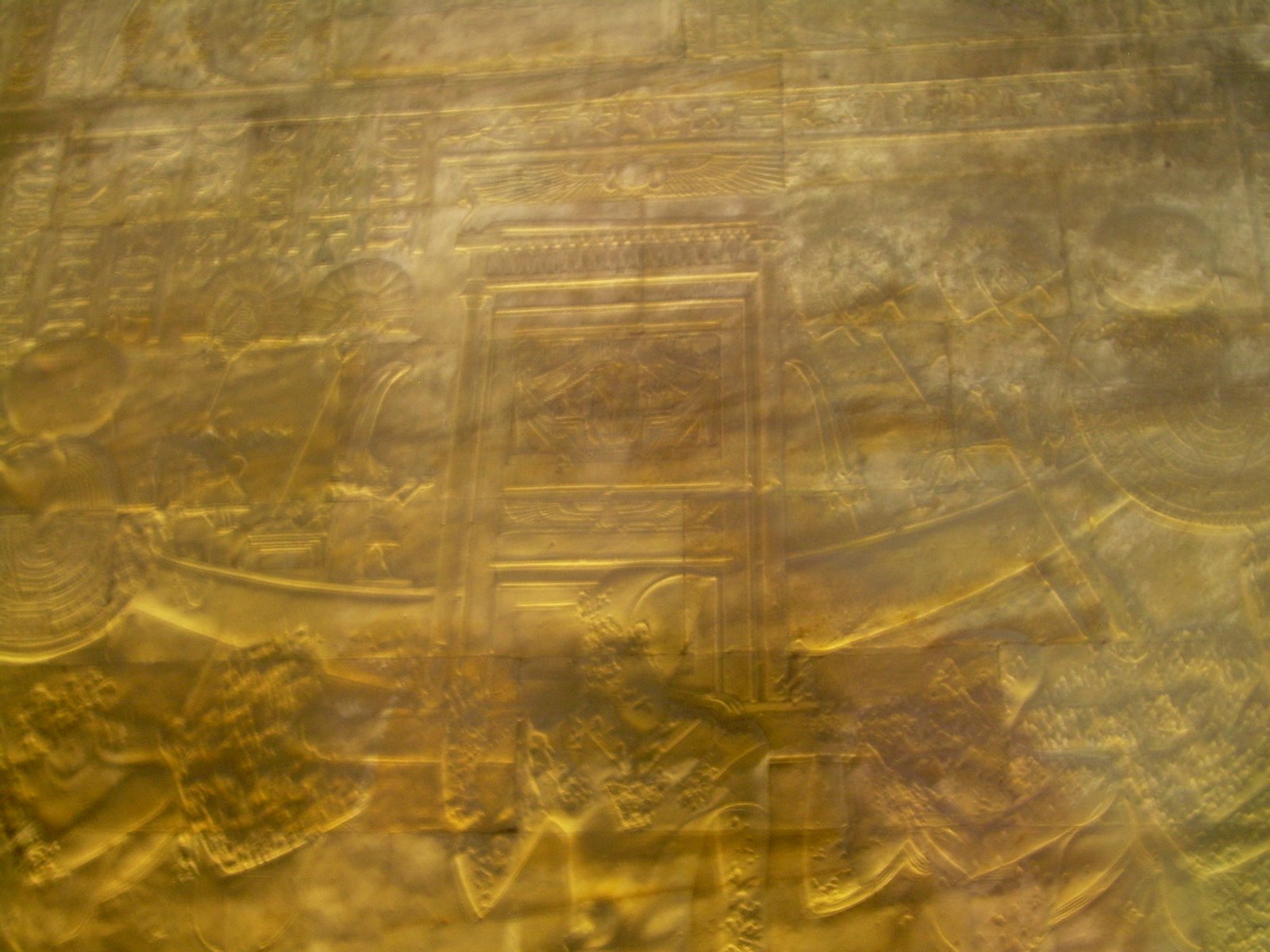
One of the most intriguing things about this temple is that archaeologists discovered the remains of an ancient Egyptian ark. There are also reliefs on the wall depicting the priests of Horus carrying the Ark in the same manner as the Levitical Priests were commanded: poles slid through rings on the sides of the ark, carried over the shoulders. This ark (and presumably all Egyptian gods had an ark) was designed like one of the Egyptian sun-boats, only scaled down. Its long, slender hull carried a shrine in the middle in which would be placed an idol of the god along with a set of the 14 Egyptian commandments (and possibly other “relics” of sorts). It would not be too far-fetched to assume that when God told Moses to build him an Ark of the Covenant for him and the 10 Commandments that Moses would have built something very similar to the Egyptian ark (and not some sort of box or treasure chest).

We also learned at Edfu that the Egytians believed the ground to be holy wherever their gods were. No one was alowed to wear sandals inside the temple, and the priests would transport the ark barefoot. The only exception to this was in times of war, when everyone needed to be prepared for fight or flight. This Egyptian practice manifests itself in the stories in Exodus as well. First, God told Moses to remove his sandals for he was standing on Holy Ground. Second, God commanded the Hebrews to partake of the Passover (a holy feast) with their sandals strapped so they would be ready to flee.

It was about this point in the trip that the entire story of Joseph through Moses started to really click. I began to realize just how much of a connection the Hebrews would have had to the culture and religion of Egypt. Regardless of this, God used what they knew in order to establish his covenant with them. He had no problem taking something from one culture and using it to his glory. This is one reason I know that God is awesome.

Faith building in the land of Egypt

It’s incredible how much can happen in 8 days. The land of Egypt is so rich, so saturated with history and stories that it would be nearly impossible to take it all in, even with decades of study. Our tour guide, Osman, (who is one of the best men I have ever met) is by far also one of the best tour guides in all of Egypt. He is professional Egyptologist, tour guide, hieroglyphics teacher, and Biblical historian. Not only did he take us around to all the famous sites, but at each one he did his best to tie in all the geography, temples, etc. to the stories in the Bible. I never realized just how much Egypt had to do with the development of Judaism and ultimately Christianity.

I would like to start my summary of our trip by recording some of the things I learned that my Sunday school teachers never knew:

– The pyramids were seen by Abraham, Joseph (and his entire family), Moses, and Jesus

– There is technically more than one Temple. When Judea was overrun and many Jews taken captive and Solomon’s Temple was destroyed, many Jews escaped to Egypt and built a full-scale replica of the Temple, complete with priests and a sacrificial altar. In fact, a second full-scale replica was built on an island in the Nile called Elephantine Island (which archeologists are excavating right now). What’s more, the Egyptians built a temple of their own called the Temple of Philae which is based off of those other two replicas of Solomon’s Temple.

– The Ark of the Covenant probably wasn’t a big box. It would have been shaped like a small boat with a shrine area in the middle and two cheribum on either end. (I will post a picture later) How do we know this? Because in the Egyptian temples (which included a “Holy of Holies” where the god was and only the high priest could enter) the god was kept in an “Ark” which was a small boat with two long poles on either side which the priests used to carry the ark. Also, the 14 Commandments of Egypt were kept on display inside the ark. Moses, growing up around the main temple complex in Luxor, would have seen this ark taken out of the temple on many occasions.

– When the Israelites were encamped around Sinai and built a golden calf, it was most likely a representation of the goddess Hathor, one of the main goddesses worshiped in the time of their enslavement.

– The Egyptians had a god in their pantheon named Set, who was the god of chaos, evil, and the wilderness. From the name of Set, the Jews derived the name for Satan.

– The Egyptian priests made a practice of removing their sandals when they were inside the Temple, which was considered “holy ground”. God told Moses to remove his sandals, for he was standing on holy ground.

– The only exception to this practice of removing their sandals was during a time of war, when every man had to be prepared for fight of flight. God told the Israelites on the night of the Passover to keep their sandals on as they ate the meal, for they were getting ready to run. Paul told Christians in Ephesians 6 to keep our shoes on, which is the preparation of the gospel of peace, during a time of spiritual warfare.

– Early Christians made it a practice to use pagan symbols as their own symbols of the faith. For instance, they ancient Egyptians used a symbol called an ankh, which was the “key of life” carried by all the god, representing the Nile river. It looks like a cross with a circle on the top. Early Christians in Egypt used this symbol as their own to represent the life which we have in Christ.

OK, I’ll stop here for now. There’s more I could talk about, but I’ll leave that until the actual trip summary. I wanted to go ahead and write this stuff down before I forgot about it. All of this goes to show that God, in His infinite wisdom, has no problem with reaching people on their level. He used the things which the Israelites knew. He met them where they were and showed them the way to himself. Our God truly is an awesome God.