Page 5 of 9

SABOTAGING MY BEST INTENTIONS: a Biblical Look at ADHD

In my 37 years of church attendance, I’ve never heard a sermon about ADHD. When I was growing up in the 90s, ADHD was just “that one weird kid who couldn’t control himself.” The kid interrupting the teacher, making everyone lose focus. The “bad kid” on “that weird pill.” Thankfully, we are beginning to break those stereotypes!

But ADHD isn’t new, and it’s not rare. About 11% of children ages 3-17 have been diagnosed with it. It has a strong genetic component, being an inherited disorder. And like depression and anxiety, it’s caused by over- or under-activation of certain brain structures and a decrease in specific neurotransmitters. The science of it all is just a Google-search away.

Continue reading → SABOTAGING MY BEST INTENTIONS: a Biblical Look at ADHD

HOPE AND ASSURANCE: Dinner at Cleopas’ House

In the aftermath of Jesus’ crucifixion, two discouraged disciples left Jerusalem for the village of Emmaus. Their hopes had been crushed. The man they believed would redeem Israel had been executed by Roman authorities, and now they were making the seven-mile journey home, processing their grief and confusion.

As they walked and discussed recent events, a stranger joined them – Jesus himself, though they were prevented from recognizing him. When he asked what they were discussing, they stopped in their tracks, astonished that anyone in Jerusalem could be unaware of what had transpired.

Continue reading → HOPE AND ASSURANCE: Dinner at Cleopas’ House

SALVATION AND BELONGING: Dinner at Zacchaeus’ House

Throughout the Gospels, Jesus was known for sharing meals with people – so much so that his critics labeled him a “drunkard and a glutton” and “a friend of all the wrong people.” Luke’s Gospel, in particular, records numerous instances of Jesus eating with others, showing how breaking bread together was central to his ministry.

In Luke 19:1-10, we encounter one of the most memorable meal-sharing stories: Jesus’ encounter with Zacchaeus. As Jesus was passing through Jericho (yes, that Jericho from Joshua’s famous battle), he met a man who would forever be remembered for two things: being short and climbing a tree. Poor guy – immortalized in a children’s song as “a wee little man,” Zacchaeus’s physical stature has overshadowed his bigger story of transformation.

Continue reading → SALVATION AND BELONGING: Dinner at Zacchaeus’ House

Characteristics of Christ | COMPASSION

A 40 Day Journey to Becoming Like the One We Follow

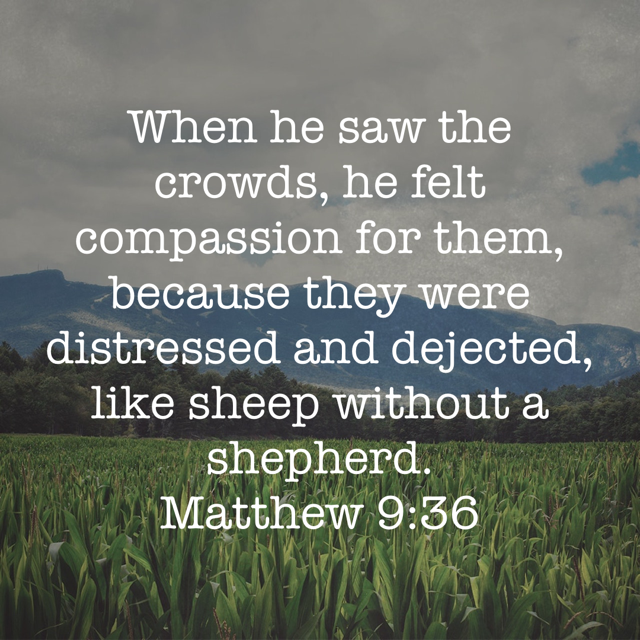
Day 24: Compassion (Matthew 9:36)

When was the last time you felt compassion for someone? I would venture to guess it’s not a feeling we experience very often. Maybe we should bring it back.

The word literally means “to suffer with/together” (com = with/together; passion = suffering). It’s closely related to pity, sympathy, or empathy. But it’s more than just pity.

Our word for compassion is translated from a really fun Greek word. Are you ready? It’s “splagchnizomai.” That’s the verb form, i.e. “to have pity/sympathy/compassion for.” The noun is “splagchnon.” This is the really interesting one because it literally means “intestines/entrails” – the inward parts of one’s body.

Have you ever been so emotionally moved you feel it in your gut? Have you ever had a sinking feeling in your stomach when you see injustice, poverty, or broken relationships? Have you ever felt love so deeply from someone that you feel a fire in your chest or butterflies in your stomach?

That’s the idea.

We’re told “The LORD is a gracious and compassionate God.” Jesus embodied that in his ministry. He felt compassion for the crowds because they were like sheep without a shepherd. He felt love for the rich young ruler because he knows what it’s like to give up everything. We’re told several times he was “moved with compassion.” Jesus felt these emotions deeply within himself.

But those deep feelings always moved him to action. We cannot truly experience compassion without acting on it. John says this very thing in 1 John 3:16-18. If we see someone in need, we shouldn’t withhold compassion (lit. close off our splangchnon). Love shouldn’t just be in words or speech, but in action.

God is gracious and compassionate. Jesus was moved with compassion. What stirs up feelings of compassion within you? How can you act on those feelings today or this week?

Characteristics of Christ | FRUIT-BEARING

A 40 Day Journey to Becoming Like the One We Follow

Day 24: Fruit-Bearing (John 15:5)

We’ve already seen how Jesus exemplified all the “Fruit of the Spirit” that Paul mentions in Galatians 5. But the idea of bearing fruit goes further than that.

How do we know if someone is a good person or not? How do we discern whether or not to trust them? or to confide in them? or if they would make a good leader? or a good spouse?

We look at the fruit of their lives.

This isn’t the same as being judgmental. Just a few sentences after telling us not to judge others, Jesus warns us about certain types of people to avoid – “You will know them by their fruit,” he says. This isn’t judging. It’s observing.

There are some people who bear the fruit of broken relationships in their lives. Some bear the fruit of burnt bridges, traumatic conflicts, or a line of bodies they’ve thrown under the bus.

But they aren’t able to see their own fruit. They can’t confidently say, “It’s me. Hi. I’m the problem, it’s me.”

The fruit Jesus bears is a 2000 year legacy of world-change. During his ministry he left healing and transformation in his wake. He welcomed the outcast, fed the hungry, preached to the poor, healed the sick, and spoke truth to power.

Now he calls his followers to do the same. He’s the Vine, we’re the branches. If we remain in him we’ll bear all this good fruit in our lives, too.

Take a moment and reflect on the fruit of your life. Or on the fruit of your church. Or your marriage. Or your business. What kind of fruit (if any) are you bearing? How do people see you and recognize you as a follower of Christ?

Characteristics of Christ | GIVING

A 40 Day Journey to Becoming Like the One We Follow

Day 23: Giving (Matthew 6:3-4)

What’s the point in having all this stuff? What good is money anyway? Everything you own will ultimately end up in a landfill one day. So focus on what really matters.

That’s pretty much a summary of Ecclesiastes.

Our God is a giving and gracious God. The Father loves to bless his children with good gifts. BUT (and this is a huge but!) there is a caveat. It all comes back to his initial covenant with Abram in Genesis 12. God tells Abram, “I will bless you and make you famous, and you will be a blessing to others…All the families on earth will be blessed through you.”

Did you catch that? God would bless Abram so that he could then be a blessing to others. Why would he expect any less from us? God never blesses us with anything – wealth, possessions, talents, abilities, etc. – without expecting us to use those blessings to bless others. God doesn’t give us “every good and perfect gift” just for us to hoard it all.

Jesus was as straightforward as he could be with the parable of “The Rich Fool.” This guy had an amazing harvest, so much that his barns couldn’t hold it all. So he decided to tear down his current barns and build bigger ones to hold all his stuff that he himself had earned. God called him a fool and demanded his life from him.

It’s a terrifying story.

Jesus talked a lot about money and possessions. We can’t serve God and wealth. Giving should become second nature (“don’t let your left hand know what your right hand is doing” implies habitual patterns of behavior that don’t take conscious thought or effort anymore). He commended the poor widow for giving out of her poverty rather than those who gave out of their surplus. He said it’s better to give than to receive (which science has proven true!).

Jesus would ultimately model this kind of giving by laying down his own life for our sake. He never held onto possessions, never hoarded wealth, never turned away anyone in need. His giving was second nature.

May it be so with us. God has blessed us so that we can be a blessing to others.

Characteristics of Christ | PRAYERFUL

A 40 Day Journey to Becoming Like the One We Follow

Day 22: Prayerful (Mark 1:35)

The Gospel of Mark is fast-paced and action-packed. It’s just the sort of story telling to keep readers and listeners hooked. Jesus was busy, and one of Mark’s favorite words is “immediately.” There is a sense of urgency. Not that Jesus was rushed or hurried or stressed. But there was much to do and not much time to do it in.

The key, I think, to the balance Jesus maintains in his ministry comes down to prayer. In the first chapter of Mark and elsewhere throughout the gospels, we read about Jesus taking time to go off by himself to pray.

Prayer isn’t one important thing to do in a list of other important things to do. Prayer is the thing by which all other tasks get done. Without that personal connection with the Father, the Son could do nothing. Simply stated, Jesus couldn’t not pray.

Some people have understood this about themselves, too. Martin Luther is quoted as saying, “I’m so busy now that if I did not spend three hours each day in prayer, I could not get through the day.”

Prayer permeated Jesus’ ministry. Not only did he find times to pray, but he taught about prayer and taught us how to pray. He modeled a prayerful life for his disciples, and he encouraged us to develop the same kind of relationship with the Father as he himself enjoyed.

Again, prayer isn’t just something we do. It’s the very thing through which everything else gets done. That’s why Paul could tell us to “pray without ceasing.”

Maybe some of us need to take a cue from the disciples and ask, “Lord, teach us to pray.” And then follow Jesus’ lead.

“Our Father, who art in heaven…”

Characteristics of Christ | OBEDIENCE

A 40 Day Journey to Becoming Like the One We Follow

Day 1: Obedience (John 5:19)

Growing up, we were all taught to obey our parents. What a drag, am I right? Why should I listen to them? Why do I have to clean my room? Why do I need to do all these chores? Why do I have to wear these uncomfortable shoes to my cousin’s wedding? Why do I have to be home by eleven when all my friends get to stay out until midnight?

But at some point there comes a turn. The guidelines and boundaries begin to make sense. We find ourselves becoming more like our own parents because we have picked up on their mannerisms, attitudes, and values. Obedience takes time to learn. Eventually we find that if we stop fighting back out of our own stubbornness we can begin to see how the rules do make sense.

Jesus was obedient to his Father. Even when he went missing as a young boy, his parents found him in the Temple because he “must be about [his] Father’s business.” He would obey his heavenly Father above even his earthly parents. His entire mission was predicated on what the Father was already up to. Jesus went where the Father sent him, did what the Father showed him, and spoke what the Father told him.

He became obedient even to the point of death on a cross. Jesus never tried to go rogue or do things on his own accord. Every step was in keeping with the Father’s will. Did he do things he didn’t want to do out of obedience to God? Yes! But Hebrews reminds us that Jesus learned obedience through the things he suffered.

There is a sense in which obedience brings us into oneness with God. “If you love me,” Jesus says, “you will keep my commands.” We show we love Christ not just by doing all the things he tells us to do as some rules-based religion. His command is to love God and love others as he has loved us.

May you walk in obedience to God the Father and Christ the Son and keep in step with the Spirit to experience oneness in relationship with God and others.

The Little Way

Colossians 3:23-24

Whatever you do, work at it with all your heart, as working for the Lord, not for human masters, since you know that you will receive an inheritance from the Lord as a reward. It is the Lord Christ you are serving.

I’ve got to keep it real. This passage is in the context of addressing slaves in the 1st Century Greco-Roman world. The amazing thing was slaves and masters worshiped in the same churches and shared a religion. The sad thing is that American slave owners abused this passage and others like it to keep African slaves in their place. These instructions were meant to revolutionize the slave-master relationship, leading to freedom and brotherhood. But like most things, if it can be used to oppress other people, we’ll find a way to do it.

Continue reading → The Little Way

Light the Way

Psalm 119:105

Your word is a lamp for my feet, a light on my path.

What is the Bible? If we’re honest, the Holy Bible can be a very intimidating book. Have you ever tried reading through it? If you got past Leviticus, congratulations! Keep going, it gets better.

Continue reading → Light the Way