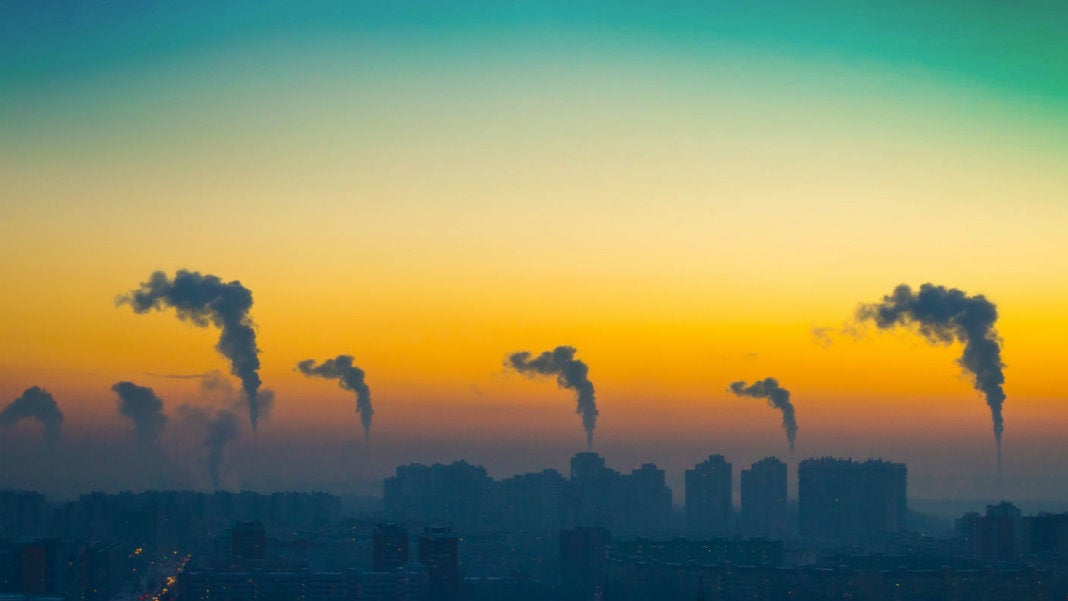
Recently the Intergovernmental Panel on Climate Change (IPCC) released its latest report on the state of global climate change. Things are not looking good to say the least. You can easily look up the report and read it for yourself. At the rate we’re going, we have about 12 years to come together as a global community and turn things around.
It’s almost time to hit the panic button.
Mike McHargue released an episode of his podcast “Ask Science Mike” this week discussing the report and what we can/should do about it. I highly recommend giving it a listen (begin at about the 5:38 mark). It’s upsetting to me that we could be experiencing the catastrophic effects of global warming within our lifetime. We’re not just talking about the distant future of our grandchildren’s grandchildren. We are talking about a couple of decades from now.
When I was younger I remember hearing people in the church shrug off the warnings of global warming. I would hear things like, “The climate has changed before. It’s a completely natural part of Earth’s cycles.” Or “who are we to think that humans could cause such a thing as this?” Or worse, “God said he would never destroy the Earth again, so there’s nothing we can do to destroy it.”
There are still climate change deniers, but I think it’s time we all got more serious about this. Caring for the environment should not be a partisan issue. Reducing our energy consumption and carbon footprint should not be viewed as a bad thing. Even if you don’t believe that human activity (eg. burning fossil fuels and stripping rainforests to make pasture land for livestock) is driving climate change, I still think there are plenty of reasons to start taking better care of our planet.
I’m no Captain Planet, but here are six key reasons I believe Christians should care about the environment.
1) We are created in the Image of God.
Our Scriptures begin with the story of creation (Genesis 1, 2). Genesis 1 is a beautiful song depicting God’s work in breathtaking poetic language. God creates light, then oceans and atmosphere, then dry land and vegetation, then birds and fish, then land animals. Last of all God created humans:
Then God said, “Let us make mankind in our image, in our likeness, so that they may rule over the fish in the sea and the birds in the sky, over the livestock and all the wild animals, and over all the creatures that move along the ground.”
So God created mankind in his own image,
in the image of God he created them;
male and female he created them. (Genesis 1:26-27)
Men and women – ALL homo sapiens – are created in the Image of God. This is one of the foundational truths of the Bible. If we don’t have that as our starting point, then nothing else really matters. The Image of God is a loaded term. We could write entire volumes of books on what the term means and its implications. But suffice it to say that human beings are God’s representatives to the rest of creation.
Humans were endowed with certain cognitive, physical, and social capabilities that (as far as we know) are unprecedented in the known universe. Humans have survived not because we are the most well evolved species on the planet, but because we have a language, fine motor skills, and social cooperation. A lone human will not survive for long. But get 20 or 30 of us together and we can create our own society.
As God’s image bearers, we have some of the divine spirit in us, too. We have the ability to show love and compassion, forgiveness and mercy. We share in God’s creative work, too. We see the world not just as it is but as it could be. Humans can help tame the chaos. Humans can help bring order and flourishing for all the codependent ecosystems.
Since humans are created in God’s image and likeness, then our first inclination should be to do the things God would do. That includes, but is certainly not limited to, caring for the rest of non-human creation on this planet.
2) God placed humans in charge of tending and caring for the Earth.
Closely connected with the first point is this: we bear the divine image and are given a divine vocation.
God blessed them and said to them, “Be fruitful and increase in number; fill the earth and subdue it. Rule over the fish in the sea and the birds in the sky and over every living creature that moves on the ground.” (Genesis 1:28)
This is where a lot of people have gotten tripped up over the centuries. What does it meant to “subdue” and “rule over”? I believe many men have taken that to mean the Earth is ours to do with as we please. Some think this means that the Earth and everything in it was made for humanity to use, to exploit, to take advantage of for our own personal gains.
But this is kingly language. Humanity is “ruling over” the Earth is God’s vassal governors. Yes, there are parts of this world that I am glad to have brought under our control. But what do we do once we have brought about order and submission? I don’t believe the answer is to run roughshod over creation. We should instead do everything within our power to make creation come alive and flourish to the glory of God. After all, creation itself is supposed to reveal something of God to us – namely God’s divine nature and eternal power (Romans 1:20).
Would nonhuman creation call us benevolent rulers or maniacal tyrants?
3) Our actions impact more than just ourselves.
What comes to mind when you think of the word “sin”? The Bible is littered with lists of sins – those actions and attitudes that are contrary to God’s way of life for his people. But take a look at one of those lists – any list. Think about anything we would consider to be a sin.
Is there a sin that affects only you and no one/nothing else in any way?
Any sin you can think of has an impact greater than the one committing the sin. That’s why it’s such a big deal to God. God is community and love within Godself. God creates out of communal love for the purpose of communal love. That’s why God said, “It is not good for the man to be alone. I will make a helper suitable for him” (Genesis 2:18).
 When the first humans sinned by eating the fruit from the “Tree of the Knowledge of Good and Evil” (Genesis 3), God plainly laid out the consequences to their action. They did not die immediately, but they were separated 1) from God, 2) from each other, and 3) from the rest of creation. Sin drove a wedge between all these relationships.
Hear this: our sin of greed has caused potentially irreparable harm to the rest of creation.
For the creation waits in eager expectation for the children of God to be revealed. For the creation was subjected to frustration, not by its own choice, but by the will of the one who subjected it, in hope that the creation itself will be liberated from its bondage to decay and brought into the freedom and glory of the children of God. (Romans 8:19-21)
Our sin of greed has made matters exponentially worse since the industrial revolution. Our desire for more – more money, more power, more things, more comfort, more convenience – has had devastating effects on the rest of creation. I can only imagine that creation is crying out more than ever, is more frustrated than ever at being subject to bondage.
We must be willing to take responsibility for our own actions and begin living in such a way as to reduce the harmful impacts of our own greed and evil desires.
4) It’s more economical.
Ok, so maybe you’re not convinced by the science or the theology. But everyone should be able to get behind the economics of sustainability. And no, I’m not talking about going out and buying a Prius. In fact, the more economical thing to do is to keep your vehicles as long as possible, keep them well maintained, and drive more efficiently.
Come on. Who wouldn’t want to pay less for gas? Who wouldn’t want to see a smaller electricity or water bill? Who wouldn’t want to support local farmers and merchants rather than gigantic, unsustainable mega-corporations?
We live in a consumeristic society. The real challenge is to consume less and create/contribute more. This is called stewardship. There’s a whole case for stewardship to be made in Scripture. Basically, everything belongs to God. The blessings we have come from God and are meant to be used to bless others.
Every good and perfect gift is from above, coming down from the Father of the heavenly lights, who does not change like shifting shadows. (James 1:17)
Honor the Lord with your wealth,
with the firstfruits of all your crops (Proverbs 3:9)
We have a say as consumers. We vote with our dollars. Companies pay attention to market trends. If we are spending more of our money on locally-sourced, sustainable, and/or fair trade products, then producers and manufacturers will take note. If we invest more into green companies who are working to develop more efficient forms of energy at lower costs, then we will all benefit in the long run.
Renewable energy and sustainable products just make more economic sense. We must be better stewards of the blessings God has given us.
5) It’s a justice thing.
This should be a really big wake-up call for Christians globally. According to all predictions that I’ve seen, those who are less well off are going to be the most impacted by climate change. Not everyone can afford to move. Not everyone can keep up with the predicted rise in food and energy costs. In extreme weather events, those with poorer housing and shelter are going to be the least able to survive. We must be preparing for a humanitarian crisis unlike anything we’ve ever seen. Climate change has the potential to produce more refugees globally than we could possibly support.
When economies collapse, it will be “the least of these” who suffer the most. When hurricanes gain unprecedented strength, it will be “the least of these” who are swallowed in the storm surge. When wild fires rage and crops fail and sea levels rise, it will be “the least of these” who will experience the greatest impact.
“Then he will say to those on his left, ‘Depart from me, you who are cursed, into the eternal fire prepared for the devil and his angels. For I was hungry and you gave me nothing to eat, I was thirsty and you gave me nothing to drink, I was a stranger and you did not invite me in, I needed clothes and you did not clothe me, I was sick and in prison and you did not look after me.’
“They also will answer, ‘Lord, when did we see you hungry or thirsty or a stranger or needing clothes or sick or in prison, and did not help you?’
“He will reply, ‘Truly I tell you, whatever you did not do for one of the least of these, you did not do for me.’” (Matthew 25:41-45)
Instead of preparing to help the countless numbers of refugees men and women God’s Image Bearers who will be negatively affected by climate change, we are severely cutting down on the number of refugees we will allow into this country. We are building a wall along our souther border with Mexico to prevent people from entering the US. We are scaling back the amount of global aide and support given to developing nations. We have pulled out of the Paris Climate Agreement. We have alienated our closest allies and buddied up with tyrannical dictators. We have beefed up our military spending while making cuts to social security and healthcare.
Remember – we will be judged by how we treated “the least of these.”
6) The Kingdom of God promotes flourishing of all people and all creation.
This isn’t heaven yet. Not by a long shot. But that shouldn’t stop us from trying to make this world a little more like heaven.
One of the key differentiators between the Kingdom of Heaven and the Kingdoms of the World is abundance versus scarcity. God’s kingdom is one of abundance. In God’s kingdom everyone has enough, everyone has clothes, food, shelter. Everyone’s needs are taken care of. Everyone is given the chance to flourish and thrive and reach their fullest potential.
The Kingdoms of this World live on a scarcity mindset. The fear is that there is not enough for everyone. There won’t be enough food or water or luxuries, so we have to forcibly take and/or protect what’s ours.
This will only get worse with climate change. Resources will become more scarce. Water sources will dry up. Fossil fuel reserves will become depleted. Useable farmland could all but vanish. Extinctions could occur on widespread scales along the entire food chain. Scarcity will be the new norm.
Jesus said, “The thief comes only to steal and kill and destroy; I have come that they may have life, and have it to the full” (John 10:10). Scarcity defines the kingdoms, empires, and nations of this world. Abundance defines the kingdom of heaven.
Think about everything Jesus did in order to prove this very point. He healed the sick, blind, lame, and deaf. He preached to the poor and outcasts. He caused a miraculous catch of fish – so much that it nearly sank the boats. He took a few loaves of bread and some fish and multiplied them into enough food to feed thousands.
Jesus came to preach a kingdom of abundance, not so that we could greedily hoard it all, but so that we could all share what we have and provide for each other out of that abundance.
This is exactly what the early Christians did:
All the believers were one in heart and mind. No one claimed that any of their possessions was their own, but they shared everything they had. With great power the apostles continued to testify to the resurrection of the Lord Jesus. And God’s grace was so powerfully at work in them all that there were no needy persons among them. For from time to time those who owned land or houses sold them, brought the money from the sales and put it at the apostles’ feet, and it was distributed to anyone who had need. (Acts 4:32-35)
In the coming decades it will be increasingly important that God’s people live out of a place of abundance – sharing what we have, giving to those in need, not taking more than we need. The fear of scarcity has no place in the kingdom of heaven. But if we want to prevent widespread scarcity of resources (necessities, not just luxuries), then we need to take this as seriously as the early church did. We must redefine “enough.” We must reprioritize our wants and our needs. We must celebrate and become good stewards of the blessings we have from God in Christ. And we must be willing to share with those in need.
I’m not perfect at any of this. In fact, I’ve gotten lazier about these things in the last few years. But it’s up to each one of us to make little changes that will make a big impact.
MARANATHA
That’s an ancient word/phrase meaning “Lord, come quickly.” It could mean we want Christ to return and for the kingdom of heaven to be fully realized as promised at the end of Revelation. Or it could mean that we need God to act in a big way, to show up and put everything to right.
As we proceed into a potentially ominous future, I believe this prayer is critical for God’s people. It reminds us who is ultimately in charge. It reminds us that this isn’t heaven yet. It reminds us of the hope we have in Christ Jesus that one day all will be made new.
Maranatha.




 Daniel N. Lee