
 by
by From our Kingdom Economics series on service and generosity
Remember playing Follow the Leader as a kid? The leader moves, everyone follows. In our faith journey, we’re called to follow Jesus – the ultimate leader who modeled radical kindness and service. Here are his instructions to us today:
Matthew 5:16 – In the same way, let your light shine before others, so that they may see your good works and give glory to your Father in heaven.
Matthew 10:8 – Heal the sick, raise the dead, cleanse those with leprosy, drive out demons. Freely you received, freely give.
Luke 14:13-14 – …when you host a banquet, invite those who are poor, maimed, lame, or blind. And you will be blessed, because they cannot repay you; for you will be repaid at the resurrection of the righteous.
The Science Behind Kindness
Research reveals something fascinating about kindness: it spreads exponentially through what scientists call “the ripple effect.” Here’s how it works:
Stage 1: You perform one act of kindness – holding a door, helping someone who dropped something, or lending a few dollars.
Stage 2: That act doesn’t just affect the recipient. It impacts everyone who witnesses it, making them more likely to pay it forward.
Stage 3: The cascade effect begins. Those people show kindness to even more people.
The result? Researchers estimate that one singular act of kindness has the potential to reach 125 people. Kindness truly is contagious at an exponential rate.
It reminds me of this older commercial from Liberty Mutual – you know, back when commercials used to inspire us?
When Kindness Goes Viral
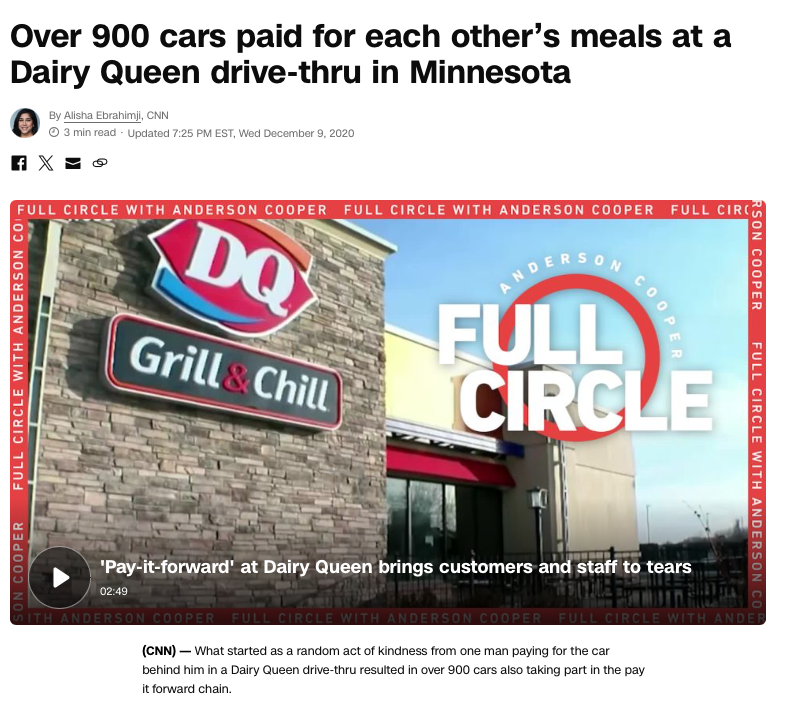
During COVID, when dining rooms were closed, a Dairy Queen in Minnesota experienced this ripple effect firsthand. One customer decided to pay for the car behind them. That simple gesture sparked a chain reaction lasting over 900 cars and generating $10,000 in “pay-it-forward” sales.
People locked down for months were hungry for connection, and they found it through anonymous acts of service. Even when the recipients couldn’t repay the kindness, the chain continued—because that wasn’t the point.
Then there is this story from the life of Dwight Moody, one of the most influential pastors of the 19th Century:
Moody hosted a large contingent of European pastors at one of his Northfield, Massachusetts, Bible conferences. The pastors were housed in a dormitory and, according to European custom, they all placed their shoes outside their rooms overnight anticipating that a servant boy would collect them, clean them, and shine them before morning. Except this was Massachusetts and not England. No servant boys would appear. But Moody noticed the shoes. He refused to embarrass the pastors for their cultural ignorance or rebuke them for their presumption. Instead, he quietly gathered the shoes, took them to his room, and shined them himself. The next morning, Moody’s pastor friends dutifully collected their shined shoes none the wiser for the humble service Moody had rendered on their behalf. But there’s more to the story. Servanthood is contagious. It turns out one of the pastors witnessed what Moody did in secret. The astonished pastor told a few of his friends. And from that night on a conspiracy of servanthood took charge of the shoe-shining detail. Pastors privately took turns shining their colleagues shoes throughout the remainder of the conference. (excerpt from A Church Called Tov, by Scot McKnight)
A “conspiracy of servanthood.” That’s how we change the world.
The Early Church: A Case Study in Contagious Kindness
The early church spread like wildfire throughout the Roman Empire. Why? Because the kingdom of God was radically different from earthly kingdoms. Their supernatural kindness was so countercultural that people couldn’t help but be drawn in.
In Acts 2 and 4, we see remarkable snapshots of this community:
“All the believers were together and held all things in common. They sold their possessions and property and distributed the proceeds to all, as any had need… there was not a needy person among them.”
These weren’t wealthy elites—they were blue-collar workers creating a grassroots movement of mutual care. Their kindness wasn’t just nice; it was transformational.
The Three Pillars of Supernatural Kindness
Like a three-legged stool, contagious kindness requires all three elements to remain stable:
1. The Holy Spirit
The driving power behind everything the early church accomplished. When the Spirit works in your life, you naturally become “others-oriented.” Love, joy, peace, patience, kindness—all the fruits of the Spirit focus on our relationships with others.
2. Commitment to the Mission
These early Christians weren’t Sunday-morning bench-warmers. They were all-in, understanding that how they lived was a stronger witness than any words they could speak. People might not care what you say or believe, but they will care about how you care.
3. Boldness
After facing persecution, the disciples didn’t pray for struggles to disappear. They prayed for boldness to face them head-on (Acts 4:23-31). It takes courage to step out in faith, to sell possessions for others’ benefit, to love radically in a world that often doesn’t.
Kindness That Changed the World
The early church’s commitment to supernatural kindness literally transformed society. Christians founded:
- Hospitals that treated anyone—royalty or slave
- Orphanages for abandoned children
- Hospice care for dignified death
- Adoption practices that rescued exposed infants
- Food banks for the hungry
- Public schools and universities open to all
When plagues struck Rome, the wealthy fled to the countryside. Who stayed to care for the sick? The Christians. Their love was so radical that even pagan observers noted: “See how they love one another, and how they are ready to die for each other.” (Tertullian, AD 160-220)
The Real Punk Rock
In the latest Superman movie (2025), Lois and Clark have a powerful exchange about how each of them views the world differently. Lois, a skeptical investigative journalist, says, “My point is I question everything. And everyone. You trust everyone and think everyone you’ve ever met is, like, beautiful.”
Superman replies, “Maybe that’s the real punk rock.”

Maybe radical kindness is the real counterculture our world needs. Maybe treating everyone as beautiful, worthy of love and dignity—regardless of their ability to repay us—is the most revolutionary act we can perform.
This isn’t possible through human effort alone. It flows from God’s kindness toward us, demonstrated on the cross. Jesus didn’t just die for some—He died for all. We don’t get to gatekeep who’s worthy of receiving kindness.
Your Kindness Challenge
Ready to start your own contagion of kindness? Here’s how:
- Keep in step with the Holy Spirit – Pay attention to those nudges to serve others
- Reaffirm your commitment – Would people know you’re a Christian just by watching your daily life?
- Pray for boldness – Ask God for courage to love radically
- Spread kindness – Actively look for opportunities to serve others this week
Remember: you’re not serving others to create debt or obligation. You’re serving because your debt has been paid through the immeasurable kindness God showed you.
One act of kindness can reach 125 people. Your simple gesture today might spark a chain reaction that transforms your community.
The question isn’t whether you have time for kindness. The question is: can you afford not to spread it?
Be kind. Follow the Leader.
LISTEN TO THE FULL SERMON HERE:
 Daniel N. Lee