Page 56 of 81

Father

For you did not receive a Spirit of slavery to fall back into fear, but you received the Spirit of adoption, by whom we cry out, “Abba, Father!” Romans 8:15

This has been one of my favorite verses for quite some time. I love the contrast between those who cry out “Abba, Father” in this verse as opposed to those who cry out “Lord, Lord” in Matthew 25.

But I have been a father for just over 6 months now. And let me tell you (just as any new parent would) that having a child of my own has illuminated this view of God. My son cries out, I come to the rescue. He hits his head, I comfort him. He smiles at me, and my heart melts.

This is how God is with us.

Jesus repeatedly refers to God as “Father,” not just in the sense that he was literally God’s Son, but in the sense that God is the Father of all those who would be his children.

I can empathize with some of the fears, doubts, and frustrations that a new Christian might face. But God is not looking to catch them red handed when they mess up. Instead, God is there to nurture them like a Father cares for his newborn son.

I know this is nothing new in thought. But it’s a completely new experience for me.

Easy Green Tip of the Week

Since having a kid, it seems our laundry has increased many times over. Which is fine now, but a few months ago, it was driving us crazy! Which leads me to this week’s eco-tip:

Clean Out Your Dryer Vent

Our dryer was broken. Or so we thought. It was taking close to 2 hours to dry a load of wet clothes! It was frustrating to no end.

Then one day I got the bright idea to check the hose. It was fine. But the vent was being choked up by about an inch thick layer of lint. Doh!

Long story short, it took about ten minutes to correct a problem that had been driving us crazy for months. We were just a couple laundry days from going all “Office Space” on that dryer.

Crisis averted. We are no longer wasting loads of energy and loads of time just to dry a load of laundry. You can have all the energy stars you want on your dryer, but if the vent is clogged, it won’t make a lick of difference.

Now that the weather is starting to warm up, take ten minutes to check your dryer vent. It’ll save you energy, time, and potential trips to a psychotherapist.

Presence

I’ve started reading the book God’s Pursuit of Man by A.W. Tozer. The first chapter is called “The Eternal Continuum.” In it, Tozer points out something that most Christians take for granted, really to our own spiritual demise.

We get that God is the eternal I AM, as he told Moses back in the day. He was and he will be. He is self-created, self-sustained, and all-powerful. He always has been, and he always will be.

This is easy for most of us to get. We can look into the past and see what he has done. We can see how he pulled us through that struggle or that hardship. He healed a grandparent, he protected our neighbor from the storm, he provided when there seemed to be zero resources. It’s easy for us to retroactively see how God works in our lives.

It’s also easy to have faith that he will work in our lives again. He will get me that job, he will bless that mission effort, he will take us where we want to ultimately end up. We have no problem dreaming up a future in which God is an active reality.

The trouble comes when we are unable to see what God is doing in the present.

Yes, God has always been and always will be. But more than that, he always IS. He’s the I AM. God is always a present reality.

It’s a good exercise to remember the ways in which God has worked in your life previously. And it’s highly commendable and appropriate to envision God’s work in your future plans. But it’s much more critical to be able to stop for a moment and live in the present.

This moment.

This breath.

This heartbeat.

This is the only true time we have in which to experience God. Right now.

Take some time throughout your day to reflect on how God is working in the present. Through that movie. Through that book. Through this friend. Through Facebook. Through your coworker. Through the words on this screen.

Why has God brought you to this place at this moment? What is God doing right now?

God is eternal. This life is not. But the kicker is that the present is the only point at which the eternal intersects this finite world.

What is the Great I AM doing in your present? This moment is the only time in which you are guaranteed to fully experience the power of God.

Jesus Called Them One By One

My wife and I were talking the other day about how to make the Bible more relatable to teenagers. The go-to Characters seem to be Joseph, David, and Timothy. These three started out their journey with God early in their teen years. But after awhile, these stories tend to lose their novelty and their impact.

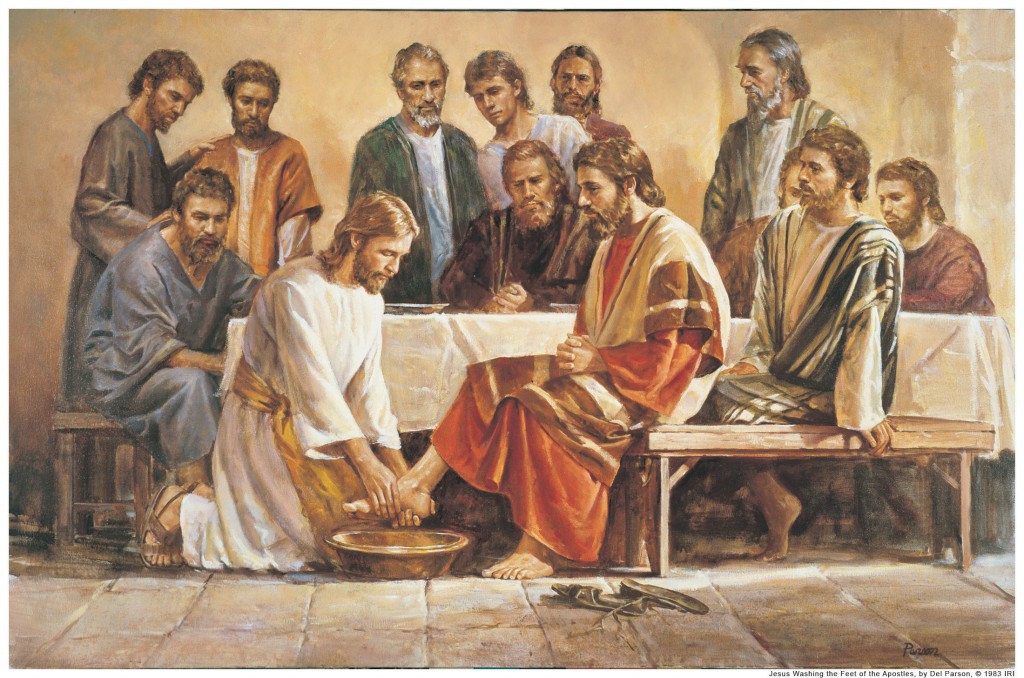
Then we got to thinking, what about the apostles? Most of our lives, we have viewed Jesus and his apostles like this:

Not only are they white (??), but they’re all old. Two even have gray beards!

But really, how old would the first disciples have been? Probably between 17-25. Barely old enough to have beards, much less gray ones!

Peter and Matthew were probably the oldest, given that Peter was married and Matthew was an established tax collector. But the others were probably not much older than high school seniors when Jesus called them. Jesus himself was only about 30. Why would he go calling disciples as old or older than he was?

Even Paul was probably not much older than 25 when he was called.

Granted, a 17 year old in 1st century Palestine was not exactly the same as a 17 year old in 21st century suburbia. But the simple realization that many of the disciples and many of Jesus’ friends (Lazarus, Mary, Martha, and others) would have been in their late teens or early twenties makes the story of Jesus that much more accessible.

Yes, Jesus said, “Let the little children come to me.” But he also called teenagers and young adults.

High Five Thursday!

APRIL FOOLS!

As many of you know, tomorrow is April 1st. This means that countless numbers of people will fall victim to some type of practical joke…and then become a hit on YouTube. I admit that I get a kick out of watching others become fodder for laughs and humiliation, but it’s no so fun when you’re the victim.

That’s the unfortunate thing about practical jokes. Someone is always singled out.

The guys at Improv Everywhere, however, are masters at the victimless practical joke. Wanna see what I mean?

Top 5 Improv Everywhere Missions

[You can click on the titles to see the whole setup and behind the scenes action or go to improveverywhere.com]

Best Buy

______________

Star Wars Subway Car

______________

Suicide Jumper

______________

Human Mirror

______________

Frozen Grand Central

Are You There, God?

[My wife and I had a conversation about this the other day. She had some really good thoughts that got me thinking more about the subject. She’s pretty amazing like that.]

Faith.

It seems simple enough. I can look around at the world and the universe and know in my gut that someone had to be behind it all. I can read the Bible and believe it’s claims that the Creator of the universe wants to have a relationship with me. My heart tells me that I am loved and that I am a part of something much greater than myself.

But what happens when the love I have for my Creator doesn’t feel requited.

What are we to do when everything around us is darkness and chaos, yet God is silent?

“If God would just speak to me like He used to speak to people, it would all be better. I would be able to fully trust and believe Him. Since I would know exactly what He wants me to do, I could better follow and serve Him. Just talk to me, God!”

I think most of God’s people think something like this sooner or later. It seems like a legit complaint. There are times when God seems distant and all we want is to hear His voice. If He would just speak to us, then everything would somehow get magically better.

But would it?

Humanity doesn’t have a very good track record when it comes to direct contact with our Creator.

Adam and Eve lived and walked with God in the garden. They still ate the fruit.

Noah was saved directly by the hand of God. He still passed out drunk and naked.

Abraham was God’s chosen man through whom He would bless all peoples of the earth. He still lied…twice.

Moses was in almost constant contact with YHWH for 40 years. He still had an anger problem.

David was anointed by God to be king. He still became a murderer, adulterer, and a liar.

Elijah was God’s chosen prophet by whom Ba’al was defeated. He still battled depression.

God told Jonah exactly what he was supposed to do. He still ran in the opposite direction.

Are you noticing a trend? Whether or not God speaks directly to you, that won’t make you any less human. It won’t make you any less angry, or afraid, or stubborn. It won’t magically make all your problems disappear.

Let’s look at one more example.

At the end of John’s gospel, we get to listen in on a conversation between Peter and the resurrected Christ.

Peter, do you love me unconditionally? [agapao]

Yes, Lord, I love you like a brother. [phileo]

Peter, do you love me unconditionally? [agapao]

Yes, Lord, I love you like a brother. [phileo]

Peter, do you [even] love me like a brother? [phileo]

Yes, Lord, you know I love you like a brother. [phileo] (John 21:15-17; my translation)

Peter was staring God in the face, looking into the very eyes of the Creator of the universe, and could not bring himself to say that he loved him unconditionally. He could only say that he loved him like a brother.

Fast forward a few decades. Peter is now writing a letter to Christians scattered across Asia minor. They were most likely 2nd generation Christians by now, far removed from Jerusalem and the time of Jesus. All they have to go on is the stories and testimonies of others. They haven’t seen Jesus or heard the voice of God. Look what Peter writes:

You love him unconditionally [agapao] though you have not seen him. And though not seeing him now, you believe in him and rejoice with inexpressible and glorious joy…” 1 Peter 1:8

Talk about swallowing your pride. I can bet that Peter never forgot that conversation with Jesus on the shoreline. He was looking right at the resurrected Christ and couldn’t say that he loved him unconditionally. But now he is commending these Christians on their faith. They love him unconditionally even though they never even saw Jesus.

I can imagine some tears welling up as he pens those words.

Peter would be the first to tell us that hearing God’s voice directly doesn’t make it all better. It doesn’t take away our faults and our frustrations. It doesn’t replace heartache with happiness.

Only full submission can do that.

Peter wrote a few verses earlier that through God’s power, we have already been given everything we need for life and godliness. We just have to listen.

Merciful Punishment: Reflections on the Good Judge

It’s sad but true. To the average person, even the average Christian, YHWH of the Old Testament and Theos of the New seem to be two completely different persons. Most associate the God of the OT with rules and regulations who dished out wrath and punishment if disobeyed. Meanwhile, they view the God of the NT as a God of love and forgiveness who tosses grace and mercy like candy flung from a float in the Independence Day Parade.

I will grant that God’s dealings with humans seems to be a bit more direct and immediate in the days of Moses and Elijah. But is His character really that different? Some of His punishments do seem a bit harsh, but is there more to them than just the surface level understanding?

The teacher of the adult class on Sunday morning briefly mentioned the infamous Bathsheba incident. David rapes and impregnates the wife of his friend and officer. To cover it up, he has him sent to the front lines and killed, thus freeing himself to take Bathsheba as his own wife. Adultery, murder, lies–doesn’t he know the Big 10?

Anyway, God calls David out through Nathan the prophet. Caught red handed. Nowhere to run; nowhere to hide. David said it himself that he deserves to die. So God strikes him dead then and there.

Wait…no he doesn’t. The punishment is carried out on the child. This is enough to get most people stirring in their seats. Is God really a baby killer? Egyptians, sure. King Herod, of course. But God?

This bothered me. It still bothers me. But God is God and I am not. His ways are higher than my ways.

Let’s take a deeper look into this punishment. Is there any mercy in it?

Yes.

If God had killed David instead of the baby:

  • Israel would be without a leader. Division would run rampant and would certainly tear the country to pieces. That happens later, but Israel wouldn’t come close to the golden era of Solomon.
  • Bathsheba would be a widowed single mother. She would have nothing. Begging or prostitution would likely be her only options to support herself and her child.
  • The child would have grown up with the label of the king’s bastard child and the son of a whore. Any hope of having a normal childhood and making any sort of living for himself would be a long shot to say the least.
But God, in His infinite wisdom, chose to spare David’s life and take the child. So the baby got to go directly to heaven (I believe baby’s are innocent, so when they die, their souls are automatically taken to be with God). Bathsheba became a queen instead of a widow. The nation of Israel continued thrive under their greatest king to date. Bathsheba gave David even more sons, one of whom became heir to the throne and ushered in Israel’s golden age.
Okay, so this is one example in which God’s punishment is also infused with mercy. But there are many, many more.
  • God could have struck Adam and Eve dead on the spot and started all over. But He killed animals in their place to make proper clothing to cover their shame and nakedness. They still lived a long life outside of the garden, started a family, and still remained close to God.
  • Cain killed his brother in cold blood. Rather than taking a life for a life, God put a mark on Cain and sent him away. But further reading reveals that Cain eventually got married, started a family, and established his own city.
  • When Israel began its conquest into the promised land, God was essentially using them as a tool for carrying out His punishment against the Canaanites. Yet if the land’s inhabitants would simply believe in the power of YHWH and repent, God was more than willing to spare their lives. Hence, Rahab and her family were the only Jericho survivors.
God is called the righteous judge because His sentences, His punishments, are naturally infused with mercy. Next time you read through the Law and the Prophets, look for the mercy within the narratives of wrath and punishment. You’ll be surprised by what you find.

Easy Green Tip of the Week

Bottled Water? Really?

In my opinion, there is no greater testament to the convenience-oriented, consumeristic society in which we live than bottled water. It’s easy, it’s cheap, it’s disposable, and it’s much better for you than sodas, right?

It’s water, folks!

I will admit, before I give the wrong impression, that if I am out and I get thirsty, I will buy the occasional bottle. But you won’t see my wife and me at the grocery store lugging 24 packs into our cart. Most of the time, the water from your tap is just as clean and filtered, if not more so, than your average bottle of water. In fact, many times it is bottled straight from municipal water sources! These companies are charging literally thousands of times the cost of tap water, for the same product.

Don’t even get me started on the damage done to the water table and the amount of plastic that winds up in the ocean because of the bottled water craze….

In the documentary Tapped, a spokesman for Dasani is interviewed. Coke pumps its water for Dasani straight out of the Atlanta municipal water supply, by the way. This guy is trying to make Coke’s product look better than tap by calling it a “healthy alternative.” I think the average person would interpret that to mean tap water is unhealthy, wouldn’t you?

Long story short: Buy a bottle. Fill up at home. You’ll save $$$$, and you will make less of an impact on the environment.

But what if your tap water does taste weird? Ours does here in Searcy. So we simply bought a Pur water filter that fits right on the faucet. One filter lasts close to three months and costs under about $7. In that same three months, we could have bought a 24 pack of bottled water every week and wasted roughly $50.

It’s a no brainer in my opinion.

High Five Thursday!

A bit of a twist this week. This is a shout out to all you English teachers out there, including my own parents, who helped turn me into a grammar-Nazi.

Top 5 Grammatical Pet Peeves:


Less and Fewer

It pains me every time I go to the express checkout line to see the phrase “10 Items or Less.” Everyone knows it should be “10 Items or Fewer,” right? It’s simple, really. Less is used with singular nouns; fewer is used with plural nouns.

“John has less money than I do.”
“John has fewer quarters than I do.”

“There is less of a crowd than I expected.”
“There are fewer people than I expected.”

It’s not that hard, people. Maybe someone should write a letter informing these department stores of their grammatical mishaps…
____________________

I and Me

It baffles me. I know English teachers spent months of class time on this one concept alone. Yet I still see rampant misuse of the first person pronouns from Facebook posts to political speeches. “I” is subjective; “me” is objective. End of story.

That means whenever you are using a preposition, “me” is the only appropriate first person singular pronoun. It should always be “between you and me,” or “for him and me.” I think people are trying to sound smart by using “you and I” in every situation. I don’t know why, though. To me, it just shows that you don’t know proper English.

The simple rule of thumb is to remove the conjunction. Would anybody say, “He did that for I?” No! Then don’t say, “He did that for you and I.”

The only misuse of “I” and “me” on which I will cut some slack is when a linking verb is in use. The proper use in this case would be, “It is I.” But if someone says, “It is me,” I’ll let that one slide because it’s a bit more confusing to understand.
____________________

The Plural “You”

We English speakers cannot help this. Whoever created modern English apparently forgot to include a second person plural pronoun. Thus we are left to develop our own ways of differentiating between singular and plural, which often gives away our region of origin: “You guys” vs. “Y’all.”

Honestly, I’m in favor of “y’all” simply because it is a legitimate contraction…and it’s gender inclusive. Take that, Northerners!

In normal conversation and writing, it’s really not that bad. Usually there are context clues about which form is being used. Where this gets really annoying is in biblical studies. Greek and Hebrew both have a second person plural pronoun which makes it easy to tell whether the author is addressing a crowd or an individual. However, that often important indicator is lost in translation when we read it in English.

I guess we’ll just have to make due until some form of the plural “you” takes over.
____________________

Overuse of Similes

My generation is like obsessed with like similes and stuff. It’s like we don’t even to how to like form a complete like coherent thought without like reverting to like similes and like comparisons.

Okay, it’s annoying to even type that way. I guess most people have their filler words, but I know some people who cannot speak an entire sentence without the word “like.” It has become the replacement for nearly every verb in their vocabulary. “I was like…then he was like…and it was all like…” Ugh. How is that any easier than saying, “I said…then he said…and it all rocked my face off?”

Use verbs, people.

Not everything is like something else. Was it like awesome? Or was it awesome?
____________________

Possessive vs. Contractions

Their–They’re
Your–You’re
Its–It’s

I know they are homophones, and they are spelled similarly, but there is really no excuse to get this consistently wrong. If it’s that much trouble, then stop using the contractions! It is as simple as that. You won’t sound any less smart, and it will keep you from sounding less intelligent. Just take some time when you’re typing to make sure your pronouns are correct.
____________________

I’m not perfect, either. There are words and rules with which I still struggle, especially punctuation rules. You may have found some grammatical errors in this post for all I know. I just wanted to bring these to your attention.

The more I read Facebook and the more conversations I overhear, the more despair I have for the future of my generation.

English teachers, thank you. Keep drilling these rules into our heads. Keep on assigning books to read and essays to write. Hold on to traditional grammar and writing styles as long as we can before we are completely consumed by txt spk.

God hates….?

I’m sure most of you have heard of the Westoboro Baptist Church, unless you’ve been living under a rock for the last decade or so. In which case, stop it! There are much more comfortable places to live.

This small group of mostly relatives “worships” in Topeka, Kansas, and protests, well, just about everywhere else. There is a documentary I watched recently, Fall From Grace, which follows and interviews members of this church. The travel around the country protesting and picketing at different events (including military funerals) and places (including synagogues and other churches). One of their most common three-word-signs is “God Hates Fags.” And I hate using that word. It pains me to type it.

That’s a strong accusation. They blame homosexuality for most of the catastrophes and hardships that befall the US, such as Katrina and 9/11.

The most unfortunate thing is that these people are not the only so-called Christians who have bought into the lie that God hates homosexuals. I have heard the same rhetoric from televangelists, evangelical pastors, even some of my own brothers in Christ.

But does God really hate homosexuals? In fact, does God hate anybody?

Not according to the Bible.

I did a search for any passage in which God specifically says that He hates something/someone. I could only find the phrase “I hate” spoken by God in the prophets. And who are the prophets mostly railing against? The corrupt religious leaders and complacent followers.

Most of the things God hates include festivals, worship assemblies, and sacrifices which are carried out by people who mistreat, oppress, and exploit their fellow man. One thing we can be sure of is that God hates the worship of those who practice injustice.

The only other thing I could find that God specifically says that he hates is…divorce. God hates divorce (Malachi 2:16). He hates it when men mistreat their wives. They are unpleased by their wives, so they dump them on the side of the road without a penny to their name and no way of making a living. God hates divorce.

He doesn’t hate people who are divorced. He simply hates to see His covenant taken lightly and then broken.

If the Westboro Baptist Church wanted to picket and protest divorce court, I think they would have a more biblical basis for their actions. But only if they preached and worshiped while practicing justice and righteousness, which I don’t see them doing any time soon.

God loves covenental relationships. Marriage is the first covenant established between God and man. And God hates to see his covenants tossed aside as if they didn’t matter.