
Page 15 of 70
LEVEL UP

There comes a point in your life of faith when you begin to wonder… Is this all there is?
My brother-in-law gave my sons a Playstation for Christmas. It’s really cool because it comes with the motion controllers. We’ve been playing the typical sports game with each other quite a bit lately. It’s cool, but pretty basic. It has disc golf, table tennis, volleyball, archery, and a few others.
Like with most games, when it is your first time playing it offers you a chance to learn the basic skills of the game. It will give you a walkthrough of the controls and motions needed to perform the basic tasks. But after a few minutes of learning, it’s time to move on to the actual game.

Most video games begin at a very simple, easy to follow level with basic tasks to complete before moving onto the next level or challenge. The difficulty increases as you play through the game, as it should. If all you could do was the basic gameplay tutorials, that would be a really crappy game. You would demand your money back! Is that all there is? Where’s the challenge?
There comes a point in your life of faith when you begin to wonder… Is this all there is?
I’ve been in the church and in ministry long enough to realize that a large percentage of our members are stuck in the gameplay tutorial. They’re content to keep repeating the walkthrough, never actually challenging themselves or leveling up. I’m not discounting the fundamentals. We begin there for a reason. Even professionals have to practice shooting and dribbling drills. But once you’ve been a follower of Jesus for a while, there comes a point when you either need to level up or quit playing.
I’m not alone in feeling this way. Look at what it says in the book of Hebrews:
So let us stop going over the basic teachings about Christ again and again. Let us go on instead and become mature in our understanding. Surely we don’t need to start again with the fundamental importance of repenting from evil deeds[a] and placing our faith in God. You don’t need further instruction about baptisms, the laying on of hands, the resurrection of the dead, and eternal judgment. And so, God willing, we will move forward to further understanding.
(Hebrews 6:1-3 | NLT)
IT’S TIME TO LEVEL UP

We’ve got the basics covered. In last week’s post I talked about the fundamental virtues of the Christian life: Faith, Hope, and Love. Those are the biggies that Paul begins with in his letter to the Colossians. But he doesn’t stop there. He challenges them – nay, he PRAYS for them to take things to the next level.
So we have not stopped praying for you since we first heard about you. We ask God to give you complete knowledge of his will and to give you spiritual wisdom and understanding. Then the way you live will always honor and please the Lord, and your lives will produce every kind of good fruit. All the while, you will grow as you learn to know God better and better.
We also pray that you will be strengthened with all his glorious power so you will have all the endurance and patience you need. May you be filled with joy, always thanking the Father. He has enabled you to share in the inheritance that belongs to his people, who live in the light. For he has rescued us from the kingdom of darkness and transferred us into the Kingdom of his dear Son, who purchased our freedom and forgave our sins.
(Colossians 1:9-14 | NLT)
Wow, there’s a lot to unpack there. The training wheels are coming off.
9 KEYS TO TAKING YOUR FAITH TO THE NEXT LEVEL
So what are we going to need along the way if we’re going to go full-in with our life of faith?

I think we’ve all wondered what God’s will for our life is. We want specifics – Should I go to this college or that college? Should I major in X or Z? What job should I take? Who should I marry? But I don’t think that’s the kind of thing Paul wants for the Colossian Christians. I believe God’s will for our lives can be summed up this way: Love God with your entire being, and love your neighbor as yourself. It might help to measure your big life decisions against that standard.
2) SPIRITUAL WISDOM AND UNDERSTANDING
Put this on the list of most underrated gifts. Especially in the age of Google, in a world where we have virtually all the collected knowledge in the known universe at our fingertips, wisdom and understanding are critical. I think it’s a little more than common sense, but it’s related. Knowledge and information are great, but wisdom and understanding tell us what to do with that knowledge and how to interpret or apply that information. I think DISCERNMENT is a forgotten virtue that needs to come back in vogue.
3) LIVING TO HONOR GOD
How we live matters. What we do matters. The things we choose NOT to do matter. So many Christians (myself often included) live no differently than the world most days. If the only difference between you and a nonbeliever is what happens on Sunday morning, then guess what… Paul would say in 1 Corinthians 13 that if he has all knowledge and insight but doesn’t have love, then it’s of no benefit. Knowing God’s will and developing spiritual wisdom and insight should then lead to a life that honors God. If it doesn’t, then you’re probably still in the gameplay tutorial.
4) GROWING IN RELATIONSHIP WITH GOD
It took me a while to figure out that there is a difference between knowing about God and actually knowing God. I might be the biggest Andrew Luck fan on the planet. I might know his shoe size, his preferred shampoo, his pets names, and his high school GPA. But if I’ve never actually met Andrew Luck, then I can never say I know him. Facts and trivia do not equal a relationship. So how do we grow to know God? By spending time with God in prayer. By spending time with God’s people. By meditating on God’s word. By opening our eyes to see God at work in the world around us. By living a life that honors God.
5) STRENGTH, ENDURANCE, AND PATIENCE
I like to think of faith as a muscle. It must be stressed. It must be challenged. It must be utilized. If we exercise our faith, it will grow stronger and we will find more endurance to make it through any challenges or suffering. But if we don’t utilize our faith, like a muscle it will begin to atrophy. I’m currently working through a strength training program that focuses on the main barbell lifts – deadlifts, squats, bench press, etc. It sucks! But patient endurance, getting under the bar time and time again even when I don’t feel like it, is the key to building muscle strength. If the only time we exercise our faith is for an hour on Sundays, then that’s never going to produce the results we want! Our strength comes from God’s own power. Let’s use that!

It’s hard to be a snob when you’re joyful and grateful. Entitlement is a cancer that will eat away at your relationships, your attitude, and your faith. The most joyful people I know are the ones who don’t take their life blessings for granted. “Happiness” is based on the same root as the word “happenstance.” When things are going well, we feel happy. It’s very circumstantial. But if we are grateful, even in the midst of tragedy or suffering, then we can experience joy no matter what. Paul urges us to be “always thanking the Father.” And remember…Paul is writing this letter from prison! And yet he was full of joy. May our churches and our families, our schools and our workplaces be filled with joy and gratitude.
7) COMMUNITY
We in the post-enlightenment, Western church have individualized our faith to the extent that it often bears little resemblance to the faith of those in Scripture. There is no such thing as an individual Christian. When you follow Christ, you join a family. One of the early church fathers said, “A solo Christian is no Christian.” The journey of discipleship is one we take together. And the end goal is not for my individual soul to get to my personalized version of heaven. The end goal is to share the inheritance of God’s kingdom with all his people! Let’s stop using all this individualized language. Christ did not die to save you, the individual. Christ died to save us, the collective. We don’t have to go it alone.
8) RESCUE
Let’s go back to the video game analogy again. I was a big fan of cheat codes when I was younger. There would be levels I simply could not beat no matter how hard I tried. So I’d enter a code, and suddenly I would be dominating where once I had been getting crushed. Paul reminds us that God has rescued us from the kingdom of darkness. We are in a battle we cannot win on our own. We need the power of God to rescue us. And he says that God has transferred us into the Kingdom of his Son. It’s like entering the cheat code for “God mode.” Or as David put it:
The Lord is for me, so I will have no fear.
What can mere mortals do to me?
(Psalm 118:6)
9) FREEDOM AND FORGIVENESS
I think freedom and forgiveness go hand in hand. Once we have been rescued we are now freed from the cycle of sin and death. All those curses of sin (see Genesis 3) are being eradicated. But don’t get this wrong – we are not forgiven because of anything good that we’ve done. We are able to experience all of the above (knowledge, wisdom, strength, a God-honoring life) because of our freedom and forgiveness. This is how we level up. When we still view religion as a way to earn God’s favor based on our own good deeds, that means we still haven’t learned the basics of how to play the game. We need to go back and do the walkthrough one more time.
Paul’s prayer for the Colossians continues to challenge us today. I don’t think any of us should be content to simply fill a pew on Sundays as the full extent of our faith. But maybe we just don’t know what to do next. Explore these levels and these different challenges. Add some of these things to your inventory. Develop your skills and see how living out your faith can actually make a real world impact.
There comes a point in your life of faith when you begin to wonder… Is this all there is?
It’s time to level up.
The Fruit of the Spirit Is…Mediocrity?

Have you ever wondered if you’re good enough?
I believe all the hands in the room would be up. Deep down I think we all wonder if we really measure up, if we’re successful, if we’re doing ok.
I love these alien cartoons by Nathan Pyle. I’m sure you’ve seen them, but this one is great:

Graduation is a time when authority figures publicly acknowledge our sufficiency. “My knowledge suffices!” We don’t often get that in life outside of school or sports. Maybe your boss will let you know you’re doing a good job. Maybe you’ll get that promotion or a pay raise. But when we’re out on our own, we don’t have the same level of feedback and/or course correction like we get in school.
This is even true in regards to our faith. How do we know if we’re on the right track? Are we faithful enough? Are we loving enough? Have we done enough good? Have we committed too many sins? It doesn’t really help to have a preacher get up every Sunday and simply reaffirm us all the time – “I’m ok. You’re ok. We’re all ok. Everything is fine!”
What if we want better than fine and ok? What if “sufficient” isn’t what we’re after?
A good coach is not chasing after that .500 season. A good teacher isn’t pleased with every student maintaining a C-average. And I don’t think preachers, pastors, teachers, and church leaders should be content with mediocre Christians filling the pews every Sunday.
HOW TO KNOW THAT YOU’RE MORE THAN OK
I started thinking about all this as I read through the first part of Colossians. Paul begins nearly every letter with a prayer of thanks and a word of encouragement (except for Galatians – he’d had about enough of them). Check out his opening prayer for the church in Colossae:
We always thank God, the Father of our Lord Jesus Christ, when we pray for you, because we have heard of your faith in Christ Jesus and of the love you have for all God’s people—the faith and love that spring from the hope stored up for you in heaven and about which you have already heard in the true message of the gospel that has come to you. In the same way, the gospel is bearing fruit and growing throughout the whole world—just as it has been doing among you since the day you heard it and truly understood God’s grace. You learned it from Epaphras, our dear fellow servant, who is a faithful minister of Christ on our behalf, and who also told us of your love in the Spirit.
(Colossians 1:3-8)
Paul had never been to Colossae, but he had heard all about them from a guy named Onesimus (who has a fascinating story of his own, but we don’t have time right now). While imprisoned in Rome around AD 60-62, Paul wrote this letter to a church that was doing well but had some trouble on the horizon.
Interesting side note: Paul never felt threatened by other church planters, and he cared just as deeply for churches he had never been to (like Colossae or Rome) as he did for churches that he started himself (like Philippi). They were all on the same team with the same mission. Others might have felt in competition with Paul, but Paul never played their game. I think the church would have a much stronger witness in the world if Christians and churches would stop competing against each other and find a way to work together.
Paul thanks God for the Colossian church, specifically for 1) their FAITH in Christ, 2) their LOVE for all of God’s people, and 3) their HOPE in heaven, which is the source of their faith and love. They heard the truth of the Gospel, and their lives reflect it.
In other words, “You’re doing ok. You’re on the right track. Keep it up.”
A LITTLE FRUITY
But how can we know? Paul says that the gospel is “bearing fruit.” This is a favorite metaphor of Jesus and the other New Testament writers. Jesus said that a good tree cannot bear bad fruit, and vice versa. In other words, if you want to know whether you’re on the right track with faith, hope, and love, just take a look around.
We can tell that our study habits are good because of the “fruit” of good grades. We can see that our diet or exercise program is paying off because of the “fruit” of weight loss or stronger muscles. We can know that our hours of practice on the court are worth it when it comes game time. But we rarely think about the “fruit” of our faith in the gospel in these terms.

Whenever I ask the teenagers in the youth group what they think the church expects of them, the two most common answers are to show up and be good. I believe most adults would answer the same way. Fill a space on the pew most Sundays. Do your best to be good. That’s about it. But where’s the fruit in that? That’s not the same as accepting the Good News. This is more like accepting the Good Advice. Good advice might change your Sunday morning routine. Good news changes your entire life. I think we need to ask ourselves some hard questions:
- Is my community a better place to live because of the role the church fills?
- Is my work/school a better place because of my presence?
- Does my family work through conflict more effectively and with empathy?
- Am I becoming more patient in traffic?
- Do the latest news headlines keep me anxious, afraid, or outraged?
To God’s holy people in Colossae, the faithful brothers and sisters in Christ:
Grace and peace to you from God our Father.
(Colossians 1:2)

Why You Might Be Wrong About the Bible
Getting back into the YouTube game. Enjoy.
Harry Potter and the Ancient Enneagram
What’s the number one rule of the Enneagram?
Everybody say it with me now: “I will not type other people.”
Learning the Enneagram is a journey of self-discovery. No one can tell you your number. Only you can know your own motivations, fears, and desires. It’s not some party trick, Oooh, let me guess everyone’s number and tell me if I’m right! You can make assumptions, but you’re better off keeping them to yourself. If you tell someone what you think their number is, you are robbing them of a valuable part of the experience.
But while I won’t sit here and tell others what I think their type is, it can be a lot of fun to discuss the types of fictional characters. You can’t really be “wrong,” and even if you are you aren’t hurting anyone in the process. When it comes to literary figures, we are often given a glimpse into their inner thoughts, motivations, fears, and desires. We can make certain conclusions about them that we can’t for our friends and family.
So let’s start with the Wizarding World of Harry Potter, shall we?

I’m currently re-reading the entire series. I’m about midway through book 6, Harry Potter and the Half-Blood Prince. If you’ve never read the series, then what are you waiting for, ya Muggle?!
The characters in Harry Potter are incredibly well-written and developed. JK Rowling makes you fall in love with these characters. You genuinely care about what happens to them. By the end of the series, they feel like close personal friends. She also brilliantly writes some positively unlikeable characters apart from the main antagonist.
Her characters are so great and relatable because they are consistent within themselves. They grow and develop in a believable way. They respond to situations in ways that are in line with what we already know about them. And this makes the characters a good case study for Enneagram Types.

Some of them are rather easy to pin. Let’s begin with those.
- Hermione Granger – a textbook ONE if there ever was one
- Hagrid – a TWO all the way
- Severus Snape – most likely a FIVE with a dominant FOUR wing
- Professor McGonnagal – most certainly a ONE
- Luna Lovegood – almost stereotypically a FOUR
- Gilderoy Lockhart – a very unhealthy THREE
- Draco Malfoy – also an unhealthy THREE with a strong FOUR wing
- The Weasley Family…
- Ginny – EIGHT
- Fred & George – SEVEN, do you really need to ask?
- Percy – ONE
- Mrs. Weasley – TWO
- Mr. Weasley – probably a FIVE with a strong SIX wing
- Ron – phobic SIX
- Neville Longbottom – most likely a NINE
- Sirius Black – SEVEN with an EIGHT wing or vice versa, it’s difficult to say
- Albus Dumbledore – many lists like this have him as a FIVE, but I think he’s most certainly a NINE
- Tom Riddle/Lord Voldemort – learning his back story makes me believe he is an unhealthy FOUR with a dominant THREE wing
To compensate for insecurities, they become sarcastic and belligerent, blaming others for their problems, taking a tough stance toward “outsiders.” Highly reactive and defensive, dividing people into friends and enemies, while looking for threats to their own security. Authoritarian while fearful of authority, highly suspicious, yet, conspiratorial, and fear-instilling to silence their own fears.
I believe that description fits Harry perfectly, especially throughout book 5, The Order of the Phoenix. And that is the description of a Low-Average type SIX.
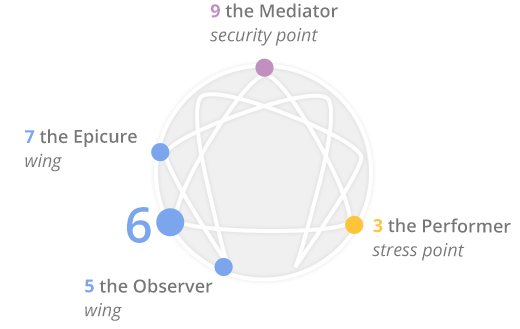
Enneagram SIXES can be split into two subtypes: Phobic and Counter-phobic. SIXES are driven by fear and a need to feel secure. The subtypes are split based on how they react to fear. Phobic SIXES exhibit a flight-response (like Ron). Counter-Phobic SIXES instinctually exhibit the fight-response. They are more openly aggressive and confrontational. These SIXES can often be mis-typed as EIGHTS, but there are key differences.
Let’s start with the Loyalty aspect of SIXES. Harry is fiercely loyal once you have earned his trust. He is loyal almost to a fault. Think about his devotion to his friends – Ron, Hermione, Neville, Luna, Ginny. But even more so, think about his devotion to the trusted authority figures in his life – Dumbledore, Sirius, Hagrid, McGonnagal. He’s even over-the-top loyal to the very institution of Hogwarts.

But he is also inherently distrustful of most people until they have earned his trust. And those who have not earned it or have broken it, they are almost certainly viewed as his arch-enemies. This is particularly evident in his relationship with Snape. It doesn’t matter how much Dumbledore trusts Snape; Harry won’t give Snape one ounce of trust – not until the very end at least.
When Harry is afraid, his instinct is to fight. He fights against Malfoy and Voldemort and Umbridge and all his general critics and nay-sayers. He even fights against his own friends and mentors when he feels threatened. Here’s another description of Counter-Phobic SIXES from the Enneagram Institute:
Sixes become aggressive because they do not want to be pushed around anymore; Eights become aggressive to push others even more.
The essential difference is that Sixes eventually will yield and their defenses will crumble if enough pressure is applied to them, whereas opposition to Eights only encourages them to remain defiant and to meet their adversary with renewed aggression.
Harry’s opposition to Dumbledore and others ultimately crumbles. He finally yields and lets Dumbledore take more of a leadership role in his life. Even though he felt like his trust had been betrayed, he is eager to mend those broken relationships for the sake of his devotion and loyalty. An EIGHT wouldn’t do that so easily.
Also, we must look at the paths of Stress and Security. In stress, SIXES go to the unhealthy side of THREE. We see this play out in Harry’s life, especially book Five. He takes it upon himself to lead the D.A. (Dumbledore’s Army) in response to the oppressive Umbridge regime. More than that, Voldemort takes advantage of 1) Harry’s loyalty and 2) Harry’s arrogance to trick him into going to the Ministry of Magic. When Harry is a state of stress or “disorientation,” he responds by doubling down on his own self-worth and arrogance. He begins to think of himself as more important and more capable than he really is. He develops a sort of “Messiah complex,” believing that he is the only one who could save Sirius. He stops relying on the help of others. He begins to believe himself to be more skilled and more qualified than others. He becomes more self-focused and less group oriented.
But in times of security, SIXES go to the healthy side of NINE. We often do see Harry in a peacemaker role, bridging the gap between Ron and Hermione or bringing together different groups of people who would otherwise never work together. As I read through book six again, I’m reminded of how important it is to the story that Harry find out more about Voldemort’s past. Harry needs to understand Voldemort, and he can do so in a way that most people can’t. Harry feels most secure when he is in the presence of Dumbledore, who himself is a NINE. Dumbledore helps Harry to develop empathy even for his greatest enemy.
I don’t think Harry is a NINE, but he does move towards NINE. I don’t believe Harry is an EIGHT, although he does display a lot of the same aggression and fighting spirit of an EIGHT. The type that makes most sense to me is that Harry is a Counter-Phobic SIX.
What do you think? Would you argue that Harry is a different type? What about the other characters? Let me know in the comments below!
PERSECUTED | 40 Days of Focus, Day 25
Blessed are those who are persecuted because of righteousness,
for theirs is the kingdom of heaven.
(Matthew 5:10 | NIV)
You’re blessed when your commitment to God provokes persecution. The persecution drives you even deeper into God’s kingdom.
(Matthew 5:10 | The Message)
Most of us have no idea what it really looks like to be persecuted. We’ve all experienced bullies and jerks. We’ve all face insults and passive aggressiveness. But real persecution is deeper than that. Persecution arises out of fear and a lack of understanding. We fear that which we don’t understand. We cannot love that which we fear.
One of the most misunderstood types on the Enneagram is Type 5 – the Observer or Investigator. Fives have a deep inner commitment to truth and knowledge. They would rather sit back and people watch than actually engage in social interactions. They read the Encyclopedia for fun as kids. They are typically the type of people who know a little bit about everything and everything about something. The pursuit of knowledge and insight takes a high priority in their lives, to the point that they can seem aloof or standoffish. They tend to act more introverted than most other Types.

As such, they can be hard to relate to. They may be able to talk your ear off about differentials or automatic transmissions, but might not be up to date on the latest Marvel movies.
They are passionate about getting things right and doing things right. When they gain interest in a subject, they tend to go all in. They can be some of the best researchers, scientists, and engineers. But they might not be the “best” spouse, friend, or coworker. This can lead to ostracism and misunderstanding.
And we fear that which we don’t understand. We cannot love that which we fear. We mistreat that which we do not love.
Fives can feel persecuted because of their beliefs, values, and hoard of knowledge. They can feel left out, excluded, and unwelcome. That is…if they ever admit to these feelings.
An example of a Five in Scripture facing some level of persecution is Nicodemus. He appears three times in John’s Gospel. First he has a nighttime conversation with Jesus in which Jesus challenged everything he thought he knew about God. The second time we see him, Nicodemus is standing up for Jesus, pointing out that their own law prohibits the leaders from arresting Jesus without cause. They all turn on him and begin to ridicule him – even though he was simply stating facts, using his knowledge of the law to defend Jesus.
People don’t really like know-it-alls. That’s the boat most Fives find themselves in more often than we realize.

It’s important for all of us to do a better job getting to know one another. You cannot love your neighbor if you are afraid of them. You cannot overcome your fear of them if you don’t take the time to know and understand them. That’s what we all want, really – to know and to be known; to love and to be loved. And that’s what the kingdom of heaven is all about.
_____________________________
Do you know any Fives in your life? How might their knowledge come into conflict with their relationships?
What is our typical response when someone else points out where we’ve gone wrong? Even though they’re right, why do we react negatively?
Is there a person or group of people you’re afraid to get to know? Why? What steps can you take this week to reach out to them?
PEACEMAKER | 40 Days of Focus, Day 24

Blessed are the peacemakers,
for they will be called children of God.
(Matthew 5:9 | NIV)
You’re blessed when you can show people how to cooperate instead of compete or fight. That’s when you discover who you really are, and your place in God’s family.
(Matthew 5:9 | The Message)
Everyone who would rather avoid conflict, let me know by making a passive aggressive comment under your breath!
There are very few people who appreciate conflict and arguments. Type Eights aside, most people would rather avoid those hard, painful conversations. But I think we are all aware that absence of conflict does not equal peace. In fact, it can be quite the opposite. Whenever a family never fights or argues, it’s probably because nobody is talking to each other, they’re all just avoiding the tough topics that need to be addressed. Anger and resentment bubble and simmer just below the surface. From the outside everything might look ok. But unless there is some conflict, there can never be real growth or healing.
Some of the Beatitudes have a more obvious Enneagram connection than others. This is one of those. Enneagram Type Nines are commonly known as Peacemakers. When they are unhealthy, Nines tend to avoid all conflict and uncomfortable situations. They can physically leave or mentally check out – or worse, use numbing behaviors – in order to preserve their inward tranquility. But when Nines are healthy they can become expert negotiators, mediators, and peacemakers.

There is a difference between a peace-lover, a peace-keeper, and a peacemaker. Peacemaking is the hard work of entering into the conflict and the chaos in order to get both sides to agree to a ceasefire. Nines are especially equipped for this task because they can easily step into other people’s shoes. They have an easier time than most seeing the world from other people’s perspective. They can easily see both sides of a conflict and determine a middle-ground on which to compromise.
Healthy Nines make really good pastors, church elders, teachers, and even politicians.
I love how Eugene Peterson words this Beatitude in The Message. He describes these people as those who “can show people how to cooperate instead of compete or fight.” Nines are not inherently competitive (for the most part). Nines just want everyone to have a good time playing the game. Unfortunately we live in a world full of competition. We compete for jobs, for online attention, for resources, for followers, for the promotion, for the corner office, for the spot in that graduate program. We’ve turned singing, dancing, modeling, and cupcake baking into major competition shows. Peacemakers are those who step in and remind us that not everything is a competition. Life is a team sport. Ministry is a team sport. Business and government and baking are team sports.

But Nines tend to struggle finding their place in life, or going through the process of individuation. They tend to define their identity based on their relationship to others. As kids, Nines picked up on the message that their own desires and ideas and opinions – even their presence – didn’t matter much. So they defer to others who are more assertive and would often prefer to fade into the background. But when Nines step into their role as Peacemakers, then they can truly become who they were meant to be. Or as Peterson words it, “That’s when you discover who you really are, and your place in God’s family.”
________________________
What’s the difference between peace-lovers, peace-keepers, and peacemakers?
If peace is not simply the absence of conflict, then what is it? How would you define it?
How is peacemaking connected to our identity as children of God? What does he expect from us? What is our place in the kingdom? In the world?
PURE | 40 Days of Focus, Day 23

Blessed are the pure in heart,
for they will see God.
(Matthew 5:8 | NIV)
You’re blessed when you get your inside world—your mind and heart—put right. Then you can see God in the outside world.
(Matthew 5:8 | The Message)
Pure in heart. Now that’s a phrase we don’t use a lot. We don’t tend to talk about purity that often. We want our water to be pure. We want essential oils to be a certain degree of purity. We like pure gold and Purity Milk. But our hearts? Is it even possible to be “pure in heart?”
When I think of this phrase I think of innocence. Deep down we all know that we adults are anything but pure and innocent. In fact, if we meet someone in their late teens or early twenties who actually is “pure,” we feel uncomfortable around them. We call them sheltered or socially awkward. There’s something unsettling about an adult who is “too” innocent or pure hearted. They’re just a little too childlike.

But isn’t that the point? Jesus said that we must become like little children if we want to enter the kingdom of heaven. Jesus pointed out children as an example of the kind of faith it takes to follow him. Children who haven’t become jaded or cynical yet are refreshing and even inspiring. They don’t get the innuendoes. They don’t automatically distrust people. They don’t carry around emotional baggage. There is freedom that comes from purity.
Care-free. Joyful. Optimistic. Does this sound like a certain Enneagram type? If you know the Enneagram, I’m sure you’re thinking of Sevens, also known as Enthusiasts.
Sevens are fun to be around, because they’re always up for the next adventure. They bring joy and excitement to their work and whatever else they find to do. Healthy Sevens have an innocence about them that draws people in. Think Bob Goff or “Joy” from Disney/Pixar’s Inside Out.

Sevens are always concerned about what comes next. They want to see all the things. They want to do all the things. Most of the time the expectation of the thing is better than the thing itself. Planning the trip can be more fun than actually going on the trip. Ordering the new product is better than that product arriving. Mapping out the project is better than executing the project.
But what’s the best thing you can imagine? Can you imagine actually seeing God? Being in God’s presence? As exciting as it may be to anticipate that moment, it’s nothing compare to experiencing heaven.
Sevens can be some of the most hesitant Type to actually do the hard inner work required of them. They enjoy being themselves, why would they want to change?! But Enthusiasts must align their inner world with their outer world to become fully present in the moment. They’re always looking to the future, but God is always now.

Bring your inner and outer world into alignment. Pursue your dreams from a pure motivation. Become fully present in the moment. Then you will be able to take a look around and see God at work all around you.
____________________________
What do purity, joy, and productivity have to do with each other?
What do you think it means to “see God?” What do you imagine that will be like?
What does it look like for an adult to be “pure in heart” or innocent without being completely awkward about it?
MERCIFUL | 40 Days of Focus, Day 22

Blessed are the merciful,
for they will be shown mercy.
(Matthew 5:7 | NIV)
You’re blessed when you care. At the moment of being ‘care-full,’ you find yourselves cared for.
(Matthew 5:7 | The Message)
A word about mercy. The word is closely related to the concepts of justice and grace. Here’s an easy way to keep them all straight.
- Justice: I get what I deserve (positive or negative)
- Grace: I get what I don’t deserve (positive)
- Mercy: I don’t get what I deserve (negative)

Speak and act as those who are going to be judged by the law that gives freedom, 13 because judgment without mercy will be shown to anyone who has not been merciful. Mercy triumphs over judgment.
(James 2:12-13)
When Eights move to a place of health and security, they can offer not just justice but also mercy and grace. In opening themselves up to the vulnerability of mercy, they will find themselves on the receiving end of all they ever wanted.

__________________________________
Why is mercy often thought of as a sign of weakness?
What does society tend to value more: justice, grace, or mercy?
What do you think about James’ statement that “mercy triumphs over judgment?” How can that make sense in the real world?
 Daniel N. Lee