Page 43 of 82

Hot Topic: Is the Death Penalty Right or Wrong According to Scripture?

So far this year 29 people have been executed by the State. Those 29 “victims” of capital punishment were responsible for the murders of (at least) 49 people. Last year there were 42 men executed who were responsible for (at least) 70 murders. [http://deathpenaltyusa.org/]

Is it right or wrong for the State to sentence someone to death? That question is so loaded that I’m not really going to go there. Are there some crimes and some criminals that deserve the ultimate sentence? I think so. There must be consequences for our actions. The more violent the crime, the harsher the consequence should be so that, in theory, people are deterred from committing such crimes. In practice, however, human history has shown that no matter how severe the punishment, crimes will still be committed. People will break human (and divine) laws regardless of the consequences.

Back in the very beginning, God created Adam in the Garden. God had ONE RULE. That’s it. Don’t eat from this one tree. The consequence for breaking that rule? Death (Genesis 2:16-17).

After Adam and Eve broke that ONE RULE, God had no choice but to carry out his punishment. From that day on they were banned from eating from the Tree of Life, thus they began the process of dying (Genesis 3:22-24).

Things escalate quickly and violently. In the course of two chapters we are taken from the very first time sin entered the world all the way to a brother killing his own brother in cold blood. We would call it first degree, or premeditated, murder. The penalty for which, in many states, is death. God, however, does not strike down Cain for killing Able. Instead he sends Cain into exile to live out his life as a nomad, a wanderer. God even protected Cain from anyone seeking revenge (Genesis 4:8-15).

But, as humans are wont to do, we took advantage of God’s grace toward Cain and twisted it to mean there are to consequences.

Lamech said to his wives,
“Adah and Zillah, listen to me;
wives of Lamech, hear my words.
I have killed a man for wounding me,
a young man for injuring me.
If Cain is avenged seven times,
then Lamech seventy-seven times.” (Genesis 4:23-24)

This began the downward spiral into rampant evil and widespread violence without fear of consequences. When society has no rules, especially no punishments for crimes against our fellow man, then everything begins to fall apart. It got to the point that “every inclination of the thoughts of the human heart was only evil all the time” (Genesis 6:5).

God had had enough. He dished out the ultimate punishment upon the entire evil human race, save for Noah and his family. The evil was purged beneath the cleansing flood waters. On the dry side of the flood, God made a covenant with Noah and mankind never to destroy the earth with a flood. But some things had to change. There had to be rules, boundaries, and consequences for breaking them.

And for your lifeblood I will surely demand an accounting. I will demand an accounting from every animal. And from each human being, too, I will demand an accounting for the life of another human being.
“Whoever sheds human blood,
by humans shall their blood be shed;
for in the image of God
has God made mankind.” (Genesis 9:5-6)

The point: God takes human life SERIOUSLY. We are not just some happy accidents of evolution. We are created and fashioned in the very image of God himself. Every human being on the planet, all 7 billion of us, carry within us the express image of our Creator. To snuff out another person’s life is to snuff out the image of God.

God continues to drive home this point in Exodus after he has freed the nation of Israel from Egyptian captivity. The crossed the Red Sea and made camp at the base of Mt Sinai where God gave them the 10 Commandments and the rest of the Law. Look at what some of the very first laws have to say about human life.

“Anyone who strikes a person with a fatal blow is to be put to death. However, if it is not done intentionally, but God lets it happen, they are to flee to a place I will designate. But if anyone schemes and kills someone deliberately, that person is to be taken from my altar and put to death.
“Anyone who attacks their father or mother is to be put to death.
“Anyone who kidnaps someone is to be put to death, whether the victim has been sold or is still in the kidnapper’s possession.
“Anyone who curses their father or mother is to be put to death.
“If people quarrel and one person hits another with a stone or with their fist and the victim does not die but is confined to bed, the one who struck the blow will not be held liable if the other can get up and walk around outside with a staff; however, the guilty party must pay the injured person for any loss of time and see that the victim is completely healed.
“Anyone who beats their male or female slave with a rod must be punished if the slave dies as a direct result,  but they are not to be punished if the slave recovers after a day or two, since the slave is their property.
“If people are fighting and hit a pregnant woman and she gives birth prematurely but there is no serious injury, the offender must be fined whatever the woman’s husband demands and the court allows. But if there is serious injury, you are to take life for life, eye for eye, tooth for tooth, hand for hand, foot for foot, burn for burn, wound for wound, bruise for bruise.” (Exodus 21:12-25, emphasis added)

 Get the point?

There are some problems with this, however. First of all, it is possible to devalue human life and damage the image of God without actually hurting or killing someone. Check out what Jesus says:

“You have heard that it was said to the people long ago, ‘You shall not murder, and anyone who murders will be subject to judgment.’ But I tell you that anyone who is angry with a brother or sister will be subject to judgment. Again, anyone who says to a brother or sister, ‘Raca,’ is answerable to the court. And anyone who says, ‘You fool!’ will be in danger of the fire of hell.” (Matthew 5:21-22)

Secondly, just as humans have a tendency to take advantage of God’s mercy, we are also prone to twist God’s laws in ways he never intended. The idea of life for life, eye for eye, tooth for tooth, etc., was supposed to be a deterrent. God intended the consequence to prevent violent crimes. Mankind, however, took these punishments as hard and fast rules. You hit me, I hit you back – it’s the law! It was used as justification for continuing the cycle of violence and revenge.

Again, Jesus has something to say about this:

“You have heard that it was said, ‘Eye for eye, and tooth for tooth.’ But I tell you, do not resist an evil person. If anyone slaps you on the right cheek, turn to them the other cheek also. And if anyone wants to sue you and take your shirt, hand over your coat as well. If anyone forces you to go one mile, go with them two miles. Give to the one who asks you, and do not turn away from the one who wants to borrow from you.” (Matthew 5:38-42)

In other words, we don’t HAVE to take an eye for an eye or return blow for blow. We have the power to put a stop to the cycle of revenge and payback.

Lastly, we are not under the Law of Moses anymore, we are under the Law of Grace. God gave Israel laws concerning reaction when someone acts violently towards another person. Under the new Law and the new Covenant, we have instructions on how to be proactive in dealing with difficult people.

Do not repay anyone evil for evil. Be careful to do what is right in the eyes of everyone. If it is possible, as far as it depends on you, live at peace with everyone. Do not take revenge, my dear friends, but leave room for God’s wrath, for it is written: “It is mine to avenge; I will repay,” says the Lord. On the contrary:
“If your enemy is hungry, feed him;
if he is thirsty, give him something to drink.
In doing this, you will heap burning coals on his head.”
Do not be overcome by evil, but overcome evil with good. (Romans 12:17-21)

ONE FINAL THOUGHT
I would be remiss if I failed to mention this fact: We ALL deserve the death penalty. We are all guilty of sin, and all sin leads to death. This is pretty much step one in preaching/receiving the gospel message. Every single one of us deserves to die the death that Jesus Christ died for us.

There is no difference between Jew and Gentile, for all have sinned and fall short of the glory of God… (Romans 3:22-23)

For the wages of sin is death, but the gift of God is eternal life in Christ Jesus our Lord. (Romans 6:23)

God made him who had no sin to be sin for us, so that in him we might become the righteousness of God. (2 Corinthians 5:21)

We are all guilty. We all deserve the penalty of death. But through Christ not only have we received a stay of execution, we have been set free from prison and given a place in the Family as adopted sons and daughters and co-heirs with Jesus!

Can I get an amen?

I can’t tell you to believe one way or the other about the ethics and morals surrounding capital punishment. What I CAN tell you is that God values life so much that he will demand an accounting of every time we have devalued life. But more than that, God sent his only Son to die in our stead so that we might be set free from the bonds of sin and death and might have life eternal with him.

Model Minister #1: Preaching Boldly

[A 10 Part Series based on Paul’s Ministry as recorded in 1 Thessalonians 2:1-12]

You know, brothers and sisters, that our visit to you was not without results. We had previously suffered and been treated outrageously in Philippi, as you know, but with the help of our God we dared to tell you his gospel in the face of strong opposition. 1 Thessalonians 2:1-2

As a minister, one of the hardest obstacles to overcome is the fear of offending someone. This is true inside the walls of the church building as much as it is outside. It takes guts to preach the gospel to nonbelievers, but it takes real boldness to remind believers about the gospel they claim to believe.
(I’m going to focus on the kind of boldness needed within the church, since it is mostly my fellow Christians who read this blog anyway.)
It’s a sad reality that there are “church members” who believe complaints and criticisms are gifts of the Holy Spirit. Even though they are willing to pay professional ministers who have gone through the schooling and done all the studying, these members have it in their minds that what they heard someone say thirty years ago is right on par with Scripture. There are certain issues in the church that must be preached boldly, because it is often the most “religious” folks who give preachers the most trouble (as was the case with Paul and the opposition he faced from the Jews).
You may be wondering what about the gospel message could possibly be offensive to church members. The answers may surprise you. Here is just a sampling.
FORGIVENESS
Yes, something as foundational as forgiveness can ruffle many feathers in a church. It should be as simple as – Christ forgave us, so we ought to forgive others. Jesus even warns us that “If you do not forgive others their sins, then your heavenly Father will not forgive your sins.” Yet there are people who claim to follow Christ who flat out refuse to forgive anyone who will not ask for it. There are some “Christians” who believe they are well in the right to hold grudges and harbor negative feelings toward others.
UNITY
Paul could not have been more clear. There is one Lord, one Faith, one Baptism, one God and Father who is above all, through all, and in all (Ephesians 4). Numerous times Paul pleads with churches to be of one heart and mind (see Philippians 2 and 4 as examples). And most telling on this point is Jesus’ prayer concerning his followers that they (we) might be one as he and the Father are one (John 17). Yet preachers come under fire for preaching about the need to tear down walls and break through lines of division. Uniting with and “extending fellowship” to other churches/believers is important to Jesus and Paul and even the early founders of the Restoration Movement. But we have allowed our minute disagreements on obscure Scriptures to get in the way of achieving Jesus’ and Paul’s goal for the church. And yet it seems like the petty issues that divide take greater precedent than the grand story that unites.
THE HOLY SPIRIT
If you have studied much about the Holy Spirit, the irony you encounter is that the Holy Spirit does not seek his own attention. He points to Jesus and the Father. He doesn’t reveal just a whole lot about himself to us, yet how many arguments have been made concerning him? The Spirit is meant to be a common uniting factor among all believers (Acts 2:38). Instead we have brilliantly made our misunderstandings and disagreements about the Holy Spirit cause for division and separation.
I could go on.
The gospel, when preached fully, will probably generate opposition even among believers. I think it’s because we have taken the gospel message and forced it into something we can grasp a bit better. Forgiveness and unity doesn’t make sense. The Holy Spirit is confusing. Baptism is messy. Salvation – is it by works or faith? We have a hard time wrapping our minds around these issues. So we would rather divide (the easy thing to do) than to unite in humility as we figure these things out together.
The gospel will always encounter opposition. May God bless our preachers and ministers with an extra measure of boldness to preach the deep things of Scripture even if some may be upset or offended by the Truth of the Gospel. 

Hot Topic: Bad Language


Does the language we use matter?

I’m not talking about improper grammar and syntax. I’m talking about the actual words, phrases, and sentences that come out of our mouths. Curse words, lies, gossip, rumors, dirty jokes, insults – these are all heard within the first fifteen minutes of powering on our televisions. And if you pay attention, these are all heard throughout the day coming out of the mouths of those who claim to be Christians.

There are some out there who simply refuse to believe that words have any power or hold any sway on the state of our souls. But while “THE WORDS” might change over time, it’s more of a heart issue than anything else. So I will not sit here and tell you which words not to say (and neither does Scripture), but I think we are all smart enough to figure that one out.

What I do want to do with this post is to simply string together quotations from Scripture and from modern times without my added commentary. I don’t think I need to add my own voice in this discussion much at all. I’ll let wiser men and biblical authors (and JESUS!) do the talking for me.
____________________________________

“The foolish and wicked practice of profane cursing and swearing is a vice so mean and low that every person of sense and character detests and despises it.” – George Washington


“You have heard that it was said to the people long ago, ‘You shall not murder, and anyone who murders will be subject to judgment.’ But I tell you that anyone who is angry with a brother or sister will be subject to judgment. Again, anyone who says to a brother or sister, ‘Raca,’ is answerable to the court. And anyone who says, ‘You fool!’ will be in danger of the fire of hell.” – Jesus, Matthew 5:21-22


“Therefore each of you must put off falsehood and speak truthfully to your neighbor, for we are all members of one body.” – Paul, Ephesians 4:25


“Profanity is the effort of a feeble brain to express itself forcefully.” – Spencer Kimball


“But I tell you that everyone will have to give account on the day of judgment for every empty word they have spoken. For by your words you will be acquitted, and by your words you will be condemned.” – Jesus, Matthew 12:36-37

“A single profane expression betrays a person’s low upbringing.” – Joseph Cook

“The tongue also is a fire, a world of evil among the parts of the body. It corrupts the whole body, sets the whole course of one’s life on fire, and is itself set on fire by hell.” – James 3:6


“Do not let any unwholesome talk come out of your mouths, but only what is helpful for building others up according to their needs, that it may benefit those who listen.” – Paul, Ephesians 4:29


“To swear is neither brave, polite, nor wise.” – Alexander Pope

“Don’t you see that whatever enters the mouth goes into the stomach and then out of the body? But the things that come out of a person’s mouth come from the heart,and these defile them. For out of the heart come evil thoughts—murder, adultery, sexual immorality, theft, false testimony, slander. These are what defile a person; but eating with unwashed hands does not defile them.” – Jesus, Matthew 15:17-20


“If you wouldn’t write it and sign it, don’t say it.” – Earl Wilson

“Nor should there be obscenity, foolish talk or coarse joking, which are out of place, but rather thanksgiving.” – Paul, Ephesians 5:4

“With the tongue we praise our Lord and Father, and with it we curse human beings, who have been made in God’s likeness. Out of the same mouth come praise and cursing. My brothers and sisters, this should not be.” – James 3:9-10
____________________________________

So how should we talk? I’ll leave you with these Scriptures and let them speak for themselves again.

“Don’t let anyone look down on you because you are young, but set an example for the believers in speech, in conduct, in love, in faith and in purity.” – Paul, 1 Timothy 4:12


“Let your conversation be always full of grace, seasoned with salt, so that you may know how to answer everyone.” – Paul, Colossians 4:6


May these words of my mouth and this meditation of my heart
be pleasing in your sight,
Lord, my Rock and my Redeemer. – David, Psalm 19:14

Hot Topic: How do dinosaurs fit into the Bible timeline?

Some questions are simple. Some questions are complex. Some questions seem simple until you begin to pursue the answer. The question about dinosaurs is that third kind of question in my opinion.

I do NOT claim to be any sort of expert or definitive voice on this issue, and there are a lot of matters that need to be addressed in answering this question. The dinosaur dilemma involves everything from age of the earth to evolution to ancient history and pre-history of mankind.

I think the following videos from Apologetics Press are very helpful in answering the dinosaur dilemma in both a biblical and a scientific/historic way.

While I may not be an expert, here are some things I know (and many of them were covered in these videos).

1. God created the heavens and the earth and everything in them. God created gigantic lizard creatures just like he created the blue whale. His power and might are on display through what he has created.

2. Evolution, especially as Darwin suggested it, cannot be proven. Evolution is more of a worldview and belief system than it is a scientific observation. And the one thing we know from the history of science is that theories are made to be disproved. The more we discover about the way the universe works, the more we realize how little we actually know. Why hang your hat on scientific theories that can change in an instant while disregarding God and his word which never change and are consistently proven true?

3. As far as dinosaurs go, you won’t find them mentioned in Scripture because the term “dinosaur” is only 150 years old! But you do see descriptions in Job 40 and 41 of the behemoth and the leviathan which do not match any known creature alive today. But they DO match descriptions of known dinosaurs…

4. We simply cannot explain away universally held beliefs. For instance, why would the Aztecs, the Chinese, and the Celts from prehistoric times ALL have dragon stories and depictions? That doesn’t just happen. All of these cultures from millennia  past MUST have had some encounter with these type of creatures – and they all depict creatures very similar to what we call dinosaurs.

I’m not saying that in order to be a Christian you must believe in that dinosaurs and mankind shared this planet at some point in the past. In the grand scheme of things, this issue is not that important. What is important, however, is that we never doubt the creative power of our God. I believe that as our scientific study progresses our own human errors in observation and data collection (aka, manipulation) will come to light.

Hot Topic: Keeping Faith in God

In our teen class we have a discussion question box. This fall we are taking the topics and questions submitted by the students and using them as our class discussion on Sunday mornings.

One of the cards (and the one we began the series with) simply said, “Keeping faith in God.”

As a parent and a youth minister, it scares me a little that teenagers don’t know how to stay faithful. I read article after article and look at research upon research concerning teenagers and faith. Most of it is negative. Depending on what statistics you listen to, between 40% and 70% of teenagers will leave their faith after graduating.

Dropping out of church while in college it the new normal. The fact that one of my students submitted this discussion topic tells me two things: 1) We have not done a good job of equipping our students to be lifelong disciples of Jesus, and 2) our teenagers want to know how!

So what does it take to keep faith in God?

WHAT WOULD IT TAKE…
I think the first place to start is by wrestling with the question, What would it take for me to lose my faith? I don’t think we consider that one enough. Would it take definitive proof that God does not exist? Would you lose your faith over the death of a close family member? Peer pressure? Addiction? Tragedy? Bad experiences with other Christians? Discovery of alien life?

Know your weak areas, those stumbling blocks with which you find yourself wrestling in the wee hours of the morning. Know your weaknesses and then shore them up. Because even though you may not know your weak spots, Satan certainly does.

What would it take for me to lose my faith? Until the answer to that question is Nothing, we’ve got work to do.

“The Lord gave, and the Lord has taken away; blessed be the name of the Lord.” (Job 1:21)

IN, NOT OF
From Jesus’ prayer recorded in John 17 we have coined the phrase, “In the world but not of the world.” The idea is that this world is a corrupt, evil, dangerous place, but we’ve still got to live here. Jesus’ prayer is that his disciples (including us) may be in the world but not become conformed to the world’s mold. That means we don’t put our stock into the world’s systems and securities. We don’t buy into the world’s goals and morals and values. Our citizenship is in heaven, and we are strangers and foreigners in this place.

Easy peasy, right?

Unfortunately when I look around the church, especially our younger members (myself included), we look a whole lot more like the world than we should. We look, talk, act, and think like people of the world. And why is it so hard to be in the world but not of the world? Maybe it’s because we are in the church but not of the church. (Not my own idea. I heard it from a preacher not to long ago, but I can’t remember his name.)

KEEP ON RUNNING
An article came out not too long ago on churchleaders.com entitled “3 Common Traits of Youth Who Don’t Leave the Church.” It’s a fantastic little article that has gotten me rethinking some things. Here’s the gist of the article:

  1. They are converted.
  2. They have been equipped, not just entertained.
  3. Their parents preached the gospel to them.
The students who end up sticking around realize that there is actually something to this whole faith thing. It’s not just something they do, it’s who they are. They have been changed. They have been given the tools necessary to keep on truckin’. And they have a support system of family and friends.
Wow. Who would have thought that following the biblical example of discipleship could actually work?!
Fact is we’ve been dishonest to our teens about what faith really is. We present it as a 100 meter dash that ends in the waters of baptism. Hurry up and be baptized! What are you waiting for? Splash, dunk, and done. And then we don’t see them again. Why? Because they think their race is done.
Almost anyone can run a 100 meter dash. But not everyone can run a 26.2 mile marathon. But that’s what we are trying to prepare our young people for. It’s a long, grueling fight to the distant finish line. It’s a race that lasts our entire lives.

Therefore, since we are surrounded by so great a cloud of witnesses, let us also lay aside every weight, and sin which clings so closely, and let us run with endurance the race that is set before us, looking to Jesus, the founder and perfecter of our faith, who for the joy that was set before him endured the cross, despising the shame, and is seated at the right hand of the throne of God.
Consider him who endured from sinners such hostility against himself, so that you may not grow weary or fainthearted. (Hebrews 12:1-3)

For I am already being poured out as a drink offering, and the time of my departure has come. I have fought the good fight, I have finished the race, I have kept the faith. Henceforth there is laid up for me the crown of righteousness, which the Lord, the righteous judge, will award to me on that Day, and not only to me but also to all who have loved his appearing. (2 Timothy 4:6-8)

Keep running. It’s worth it.

The Marks of Wisdom

Who is the wisest person you know?

We’re not used to that question, are we. We could probably have an easier time answering questions like, Who’s the smartest person you know? Or Who’s the most spiritual person you know? I think true wisdom, especially as defined by God, is lacking in today’s world (to say the least).

Think about it. Where do you go to learn wisdom? There aren’t many wise people on reality shows. Textbooks can’t teach wisdom. Schools focus so much on standardized testing that character development (a springboard for wisdom) gets shoved out of the way. Besides, there is no standardized test (and thus no extra funding) for the gaining of wisdom in schools.

Since true wisdom is so difficult to find these days (and all throughout human history if we’re honest), a wise person can slip right past us without our ever knowing. We don’t know what to look for when seeking wisdom. And if we can’t see it in others, then how would we ever recognize it within ourselves?

Proverbs 3 gives us a good starting point when it comes to developing wisdom within ourselves and spotting it within others. These six markers can help us out when we seem to be playing Where’s Waldo with Lady Wisdom.

A wise person is someone who is…
1. Wise by God’s Standards

Do not be wise in your own eyes;
fear the Lord and shun evil.
This will bring health to your body
and nourishment to your bones. (Proverbs 3:7-8)

Who gets to define wisdom – God or society? Our world offers us cheap, easy, fortune cookie wisdom. The world tells us things like “If it feels good, do it,” and “You’ve got your truth, I’ve got mine.” Truth is truth and wisdom is wisdom no matter where you find them. All Truth is God’s truth and all Wisdom is God’s wisdom. But it’s so easy to counterfeit truth and wisdom. And our world is full of counterfeiters.

So how do we know if “wisdom” is God’s or the world’s? James 3:17 tells us that wisdom from above “is first of all pure; then peace-loving, considerate, submissive, full of mercy and good fruits, impartial, and sincere.” When someone offers you what sounds like wisdom, always hold it up against this framework.

To a wise person…
2. Intimate Relationships Are Important

Let love and faithfulness never leave you;
bind them around your neck,
write them on the tablet of your heart.
Then you will win favor and a good name
in the sight of God and man. (Proverbs 3:3-4)

Is “love and faithfulness” talking about our relationship with God or with each other? Yes.

It’s a tragedy that relationships today are so disposable. We can “hide,” “unfriend,” and “block” people with the click of a button. It seems like most of our relationships last only as long as we get something our of them. If there is no longer any benefit to us then we end the relationship and move on. And that goes with God and the church, too.

It’s not that we necessarily hate these people. In fact I believe that the opposite of love is not hate. The opposite of love is apathy. We just stop caring. When you stop caring you stop loving. But Christians are called to a higher standard when it comes to relationships both with God and each other. We are called to love – unconditionally and without expecting anything in return. We love God because He first loved us. We love each other because God is love (1 John 4). People are not commodities. They are not disposable. A wise person understands that.

A wise person is someone who…
3. Shares Wealth

Honor the Lord with your wealth,
with the firstfruits of all your crops;
then your barns will be filled to overflowing,
and your vats will brim over with new wine. (Proverbs 3:9-10)

To honor the Lord with your wealth is, again, something directed both toward God and others. We honor God when we give to the Lord’s work in the church. And we honor God when we use our blessings to bless others directly. A wise person does not get sucked into the trap of materialism, i.e. “Buying things you don’t need with money you don’t have to impress people you don’t like.”

A wise person does not care about keeping up with the Jones; he cares about blessing the Jones. He’s not concerned with impressing people with his possessions; He’s concerned with impressing upon people the love of God. Everything we have is from God. It’s not ours in the first place. Who are we to hoard our wealth and possessions to the neglect of God and others?

A wise person is someone who is…
4. Disciplined

My son, do not despise the Lord’s discipline,
and do not resent his rebuke,
because the Lord disciplines those he loves,
as a father the son he delights in. (Proverbs 3:11-12)

 Oh boy. How much does the “wisdom” of the world attempt to speak to parenting, especially in the area of discipline. It seems that people don’t realize the difference between discipline and punishment. Punishment may be a part of discipline, but it’s not the whole story. But now we’ve got a whole generation of parents who are too afraid to discipline their children because they think it will cause some sort of emotional trauma down the road.

A wise person understands that discipline is a part of love. To discipline simply means to teach or train. And when a child is learning something new they often need a good strong rebuke. [For example, “DO NOT through your hat on the stove while daddy is cooking!] Discipline, when done right and consistently, is exactly what children and teenagers need in order to reach their full potential. No one is ever going to be a world-changer without self-discipline.

A wise person is someone who is…
5. Obedient

My son, do not forget my teaching,
but keep my commands in your heart,
for they will prolong your life many years
and bring you peace and prosperity. (Proverbs 3:1-2)

Obedience is far more complex than just following a set of rules. Dogs and monkeys can do that. The kind of obedience modeled by a wise person involves obedience to God even when the situation is unclear. They are obedient even when it doesn’t make sense to them. They don’t get caught up in the particular details of God’s commands, as the legalistic Pharisees would do. They don’t turn life into one big checklist of do’s and don’ts.

A wise person is able to keep God’s teachings and commands in his heart so that no matter what kind of situation arises he has a foundation established upon which to make his decisions. A wise person is also able to take the advice and instruction of others and weigh it against what he knows of God’s will.

A wise person is…
6. Motivated by Faith

Trust in the Lord with all your heart
and lean not on your own understanding;
in all your ways submit to him,
and he will make your paths straight. (Proverbs 3:5-6)

The wisdom of this world tells us to follow our hearts, chase our dreams, and trust our instincts. We try to navigate life relying on our own senses and feelings. The only problem with that is our senses can be easily tricked and our emotions can be manipulated. Before we know it the world begins to look like a fun house maze lined with mirrors doing nothing but distorting our view and keeping us from our true goal.

That’s why we’re told to walk by faith and not by sight. That’s why we are to trust in God and not our own understanding. That’s why with every fork in the road we submit to God and his will. Faith is the only motivation for the wise person. He is not swayed by emotional appeals or his own self-promotion. He has his eyes fixed on Jesus, not the winds and the waves. He knows that God knows more than he does, so he defers to the one holding the map.
_____________

When searching for wisdom, it’s easy to get bogged down in everything the world shoves in front of us offering up as “wisdom.” So it’s extremely important to remember the Marks of True Wisdom.

W-ise by God’s standards
I-ntimate relationships are important
S-hares wealth
D-isciplined
O-bedient
M-otivated by faith


Another way to sum it up – If it looks like Jesus, then it’s probably wisdom. Jesus is the very embodiment of wisdom. He lived out this lifestyle of wisdom in a way that no one ever had and no one ever will again. He came to model wisdom for us.

So when we are looking for wisdom, look no further than Jesus Christ himself.

How (Not) To "Twerk" (Or why we need more Vashtis)

This is not a post about you-know-who. She has gotten so much press and publicity that I don’t think I need to promote her by even saying her name.

This is a post about culture. Not youth culture. Not pop culture. But human culture. Other blogs I have read have pointed to the phrase in Ecclesiastes 1:9, “There is nothing new under the sun.” We’re still the same old humans living in the same old world promoting the same old sins.

Don’t believe me? Just compare the MTV Video Music Awards (and many other awards shows) to some of the parties thrown in the Bible.

Take the party of King Herod for instance. Mark 6:14-29 tells us a sad story that began with perverted, lustful entertainment and ended in the death of an innocent man. Herod had married his brother’s ex-wife, which would be taboo even today. John the Baptist called him out on his sin and was promptly thrown in prison. Fast forward to Herod’s birthday when he decided to host a huge banquet in honor of himself (not unlike many celebrities and pop stars today…). All the “celebrities” of the day were there – high officials, military commanders. and the leading men of Galilee.

And then there’s this: “When [his step-daughter] came in and danced, she pleased Herod and his dinner guests” (Mark 6:22). [Next time on Dr. Phil…] She “pleased” him so much that he made an extravagant offer – “Whatever you ask I will give you, up to half my kingdom.”

She didn’t want half the kingdom. She wanted the head of John the Baptist on a silver platter.

Unfortunately, I think we live in a world with far too many “step-daughters of Herod,” women who are more than willing to use their bodies as sexual objects to manipulate men into doing what they want. We have men who want to treat women like a piece of meat, and we have women who are more than happy to oblige. And it almost always ends in a downward spiral of sex and violence.

We don’t need any more of Herod’s step-daughters. We need more Queen Vashtis.

The book of Esther begins with a party lasting half a year. (And we have songs talking about parties that just won’t stop. Sheesh…) And of course once the party is over, the only way to end a six month festival is with a week long drinking party, right? Check out what happens.

On the seventh day, when King Xerxes was in high spirits from wine, he commanded the seven eunuchs who served him…to bring before him Queen Vashti, wearing her royal crown, in order to display her beauty to the people and nobles, for she was lovely to look at. But when the attendants delivered the king’s command, Queen Vashti refused to come. Then the king became furious and burned with anger. (Esther 1:10-12)

According to some, when it says she was summoned to come before them “wearing her royal crown,” the implication is “and not much else.” Vashti could very well have taken the road of self-promotion and paraded herself in front of a room full of drunken frat boys. But she would have had to toss out all her dignity and self-worth in the process.

Her dignity, confidence, and self-worth were more important that that royal crown. And she didn’t get her self-image was not based on what a room full of drunken idiots thought of her. Her husband knew the full extent of her beauty, and that was good enough for her. She didn’t take the attitude of, “If you got it, flaunt it.” She valued herself more than that.

I appreciate this video that my sister shared the other day. I was hesitant to watch it at first, but I figured my sister (a married mother of three) wouldn’t share anything inappropriate. It’s really worth watching, and it speaks to the great need for more Vashtis and fewer step-daughters of Herod.

[And men, I haven’t even gotten started on OUR issues. That would take many, many blog posts. If we were to treat women as human beings full of value and honor, we wouldn’t have these kinds of stories in the first place!]

To What Are You Listening?

I’m weird.

There, I said it.

One of the things that makes me weird, even among Christians is what I listen to. When I’m running in the mornings, mowing the lawn or doing the dishes you will most often find me with my ear buds in my ears connected to the iPhone in my pocket. But I’m not listening to “secular” music. I’m not even listening to “Christian” music.

I’m listening to sermons.

Some people have their audio books. I have my sermon podcasts.

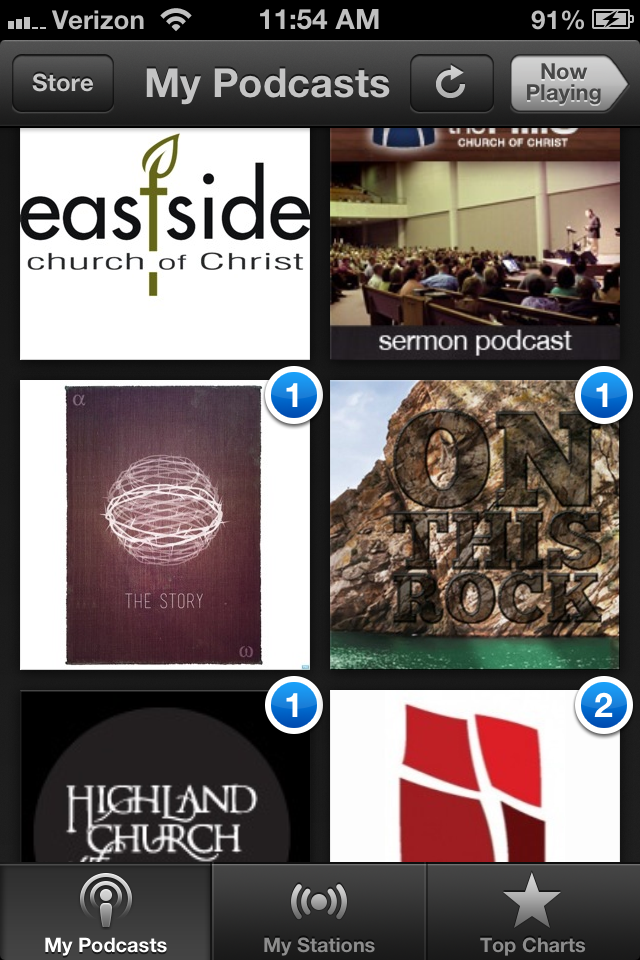
I have six churches, specifically Churches of Christ, to whose podcasts I subsccibe, and I listen to their sermons on a weekly basis. Some people can hardly suffer through one sermon a week – I enjoy listening to about 8 sermons throughout the week (including two from my own congregation of course).

These sermon podcasts have been incredibly helpful to me in my own spiritual development, especially as a young minister just starting out. I would like to pass these along to you if you are interested.

I hope you find these helpful. If you know of any other good ones, let me know!

2013 Reading List So Far

I said on Facebook last night, and I’m not ashamed to admit that I am a slow reader. I read at about or a little faster than conversational pace. I think it’s due to the fact that we didn’t find out I needed glasses until the summer after my first grade year. At the time I was leaning to read and write I couldn’t see. Somehow I managed to baffle my teachers and parents with the fact that I couldn’t see the board yet I was still doing well in school.

I envy you speed readers out there. I tried a speed reading course in high school – that was a bust.

Anyway, more for my personal satisfaction than for your pleasure I keep a running log of the books I read each year. I am currently working on numbers 21 and 22 on the year. I hope to keep up this pace and lifestyle of reading. It makes life so much more interesting.

  1. Jesus: A Theography, by Len Sweet and Frank Viola
  2. Whispers, by Dean Koontz
  3. Wild at Heart, by John Eldredge
  4. Pirate Latitudes, by Michael Crichton
  5. Watchers, by Dean Koontz
  6. Pilgrim Heart, by Darryl Tippens
  7. Pathfinder, by Orson Scott Card
  8. Ruins, by Orson Scott Card
  9. Magic Kingdom for Sale – Sold!, by Terry Brooks
  10. The Black Unicorn, by Terry Brooks
  11. After You Believe, by N.T. Wright
  12. A Game of Thrones, by George R.R. Martin
  13. Prey, by Michael Crichton
  14. A Clash of Kings, by George R.R. Martin
  15. Where Is God When It Hurts?, by Philip Yancey
  16. Scarred Faith, by Josh Ross
  17. The Hole in Our Gospel, by Richard Stearns
  18. A Storm of Swords, by George R.R. Martin
  19. Just Like Jesus, by Max Lucado
  20. The Door to December, by Dean Koontz
  21. Ender in Exile, by Orson Scott Card
  22. From Eternity to Here, by Frank Viola

Are Christians Stupid? Part Deux

If you haven’t read the first post on this issue, please do so now.

If you haven’t read the original Huffington Post article that inspired this and the previous blog, do that, too!

ARE CHRISTIANS LESS INTELLIGENT THAN NON-BELIEVERS?
The answer is yes.

Hold your horses. Hear me out. The answer is Yes, Christians are less intelligent than non-believers IF…


Think about what Paul says in 1 Corinthians 15:12-19

But if it is preached that Christ has been raised from the dead, how can some of you say that there is no resurrection of the dead? If there is no resurrection of the dead, then not even Christ has been raised. And if Christ has not been raised, our preaching is useless and so is your faith.  More than that, we are then found to be false witnesses about God, for we have testified about God that he raised Christ from the dead. But he did not raise him if in fact the dead are not raised. For if the dead are not raised, then Christ has not been raised either. And if Christ has not been raised, your faith is futile; you are still in your sins. Then those also who have fallen asleep in Christ are lost. If only for this life we have hope in Christ, we are of all people most to be pitied.

That’s seven “ifs” in 8 verses. What it basically boils down to is this: Christians are less intelligent than atheists IF there is no resurrection. It’s plain and simple. If Christ was not resurrected than our entire faith crumbles and we are “of all people most to be pitied.”

There is SO MUCH riding on whether or not Jesus of Nazareth really was not found in the tomb on that third day. My entire worldview, my whole support system, my entire career and faith system stands or crashes with the resurrection.

If there is no resurrection, then nothing matters. If there is a resurrection, then everything matters. So it’s up to each and every person to choose – am I going to live like the resurrection happened? As for me and my house, we choose the path of faith, hope, and love based on the resurrection of Jesus Christ.

DOES IT MATTER?
One thing I appreciate about the HuffPost article is right there in the headline: Does It Matter…

While I disagree that belief in a Higher Intelligence is the cause of lower intelligence, there does seem to be an underlying issue within the article as a whole. How much of a priority should “intelligence” (as defined by the “intelligence community”) be in the life of the average world citizen? Does a child in sub-Saharan Africa orphaned because of AIDS and on the brink of starvation need a lesson in quantum physics or microbiology? Does it take an astrophysicist or a brain surgeon to provide food, water, shelter, and education for this child?

How many orphanages have been opened by theoretical physicists? When people are on their death beds, do they call on all their atheist friends to remind them that the end of existence is coming and that there is nothing worth hoping for in that moment? Is work done in a chemistry lab more important than work done in a soup kitchen?

Is intelligence the highest goal for humanity?

See, intelligence is probably easier to measure and quantify than other aspects of human life. But how would we measure wisdom? What formula can be applied to predict love? How do we calculate compassion or analyze altruism?

THE HIGHER GOAL
I realize that if someone doesn’t believe in God, the Scriptures, or the resurrection, then increased education and intelligence may be the highest goal they may hope to achieve. To that person they have become their own god. Self-advancement is the only logical course of life.

However, the resurrection shows us that there is a better way. There is a higher goal. I’m not just talking about “getting to heaven when you die.” I’m talking about life in the here and now on planet earth. So what exactly might be a higher goal than mere intelligence?

Whoever pursues righteousness and love
finds life, prosperity and honor. (Proverbs 21:21)

He has shown you, O mortal, what is good.
And what does the Lord require of you?
To act justly and to love mercy
and to walk humbly with your God. (Micah 6:8)

But seek first his kingdom and his righteousness, and all these things will be given to you as well. (Matthew 6:33)

Therefore, I urge you, brothers and sisters, in view of God’s mercy, to offer your bodies as a living sacrifice, holy and pleasing to God—this is your true and proper worship. Do not conform to the pattern of this world, but be transformed by the renewing of your mind. Then you will be able to test and approve what God’s will is—his good, pleasing and perfect will. (Romans 12:1-2)

When the perishable has been clothed with the imperishable, and the mortal with immortality, then the saying that is written will come true: “Death has been swallowed up in victory.”
“Where, O death, is your victory?
Where, O death, is your sting?”
The sting of death is sin, and the power of sin is the law. But thanks be to God! He gives us the victory through our Lord Jesus Christ.
Therefore, my dear brothers and sisters, stand firm. Let nothing move you. Always give yourselves fully to the work of the Lord, because you know that your labor in the Lord is not in vain. (1 Corinthians 15:54-58)

I’ll say it again as I close. If there is no resurrection, then nothing matters. But if there IS a resurrection, the EVERYTHING matters. (Including intelligence.)