
 by
by Lessons from the First Christian Martyr
For the next few weeks we will be examining influential characters throughout the Book of Acts – people who impacted those around them, shaped the early church, and influenced the Apostle Paul. In Acts 17, city officials make a remarkable accusation against these early Christians: “These men who have turned the world upside down have come here too.” Today, we focus on Stephen, whom one commentator aptly called “The Winsome Radical.”
Who Was Stephen?
Stephen holds the distinction of being the first Christian martyr – the first to be executed for his faith in Christ. The term “martyr” comes from the Greek word for “witness,” and Stephen truly witnessed to Christ’s power through his life and death.
We first meet Stephen in Acts 6, where he’s selected to solve a logistics problem. The early church needed men “of good reputation, full of the Spirit and wisdom” to ensure all widows were properly cared for in the daily distribution of food. Stephen fit the bill perfectly – he was devoted to his faith, had an excellent reputation, and was described as “full of grace and power.”
But Stephen didn’t just serve tables. Acts 6:8 tells us he “was performing great wonders and signs among the people.” He was preaching with such wisdom and spiritual power that opposition quickly arose. Unable to refute his message, opponents secretly persuaded men to falsely accuse him of blasphemy against Moses and God, claiming, “This man never stops speaking against this holy place and the law.”
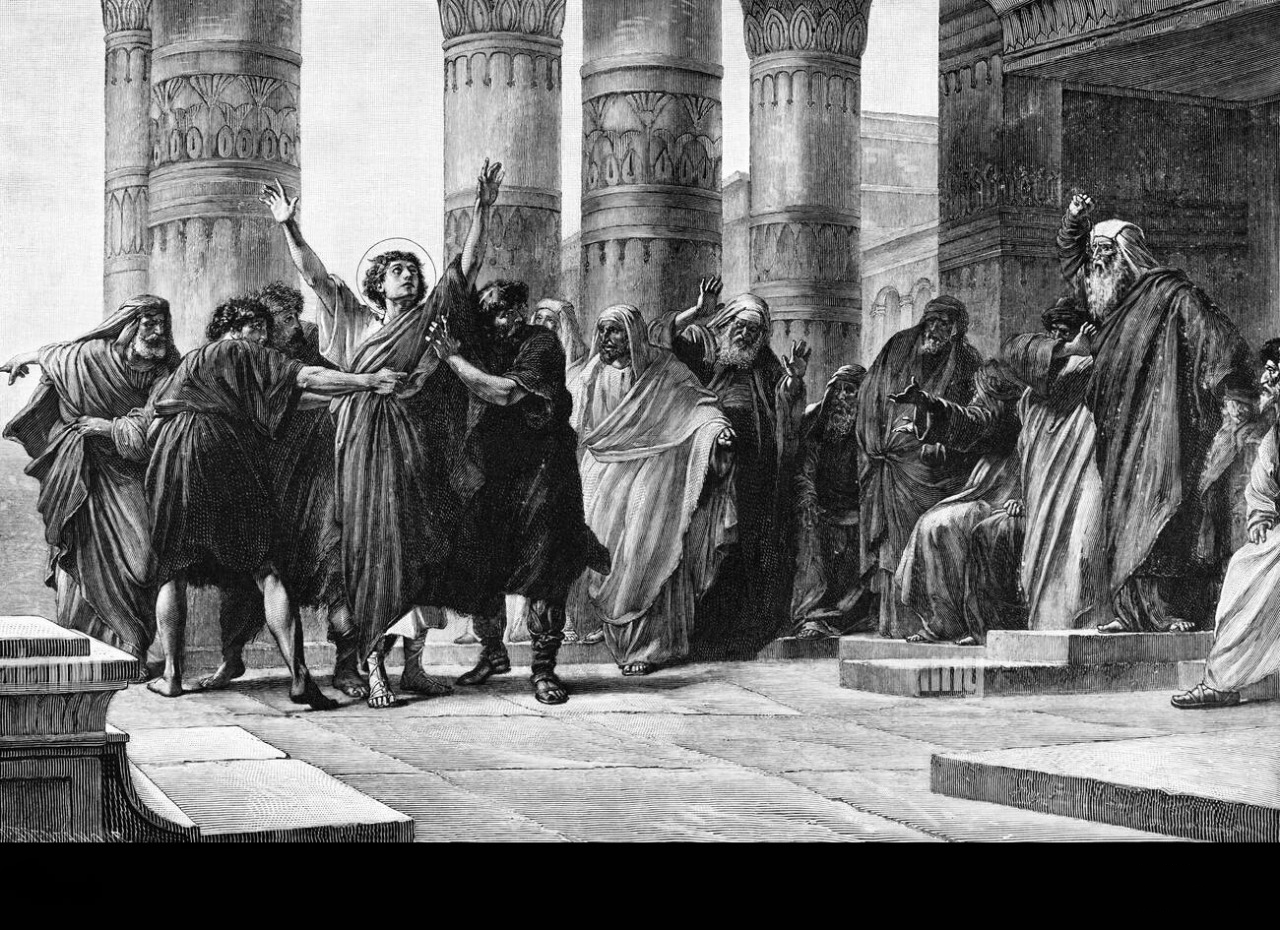
The Defense and Death of Stephen
In Acts 7, Stephen delivers the longest recorded sermon in Acts. He recaps Israel’s history to make two essential points:
- God isn’t tied to a geographical location (the temple). Abraham worshipped God in Mesopotamia, on his journey to Canaan, and in Egypt. Moses encountered God at the burning bush in Sinai. For centuries before Solomon’s temple, God dwelt in a mobile tabernacle.
- The religious leaders were no better than their ancestors who rejected God’s prophets. The patriarchs rejected Joseph. The Israelites rejected Moses and God’s commandments. The people repeatedly persecuted the prophets.
Stephen’s decisive moment comes when he declares, “Look, I see the heavens opened and the Son of Man standing at the right hand of God!” This enrages his audience, who drag him outside the city gates and stone him to death.
In his final moments, Stephen emulates Jesus. As stones rain down on him, he prays, “Lord Jesus, receive my spirit,” and with his dying breath, “Lord, do not hold this sin against them” – echoing Jesus’ words from the cross.
The Impact of Stephen’s Death
Stephen’s martyrdom catalyzed the spread of the gospel. Acts 8:1-4 tells us that “a severe persecution broke out against the church in Jerusalem, and all except the apostles were scattered throughout Judea and Samaria.” Those scattered believers “went on their way preaching the word.”
Until this point, the Jesus movement had been largely contained to Jerusalem. The persecution following Stephen’s death scattered believers throughout the region, fulfilling Jesus’ command that they would be witnesses “in Jerusalem, in Judea and Samaria, and to the ends of the earth.”
Stephen’s death also likely impacted a young man named Saul (later Paul), who witnessed and approved of his execution. Saul would later encounter Jesus on the Damascus Road and become the apostle who wrote, “For me, to live is Christ and to die is gain.”
Lessons from Stephen’s Life
If Stephen were speaking to us today, what might he say?
- Live filled with the Spirit, faith, and wisdom. Don’t rely on your own power but on God’s Spirit working through you.
- Seek a good reputation and serve others in love. Service was where Stephen’s ministry began. Not everyone is called to preach, but everyone can serve others.
- Be bold in sharing the gospel and stand firm against opposition. Sometimes our greatest opposition comes from within – our own fear and insecurity.
- Learn the Scriptures deeply. Stephen knew God’s story thoroughly. Scripture wasn’t just information to him but had transformed him into Christlikeness.
The Blood of Martyrs
Stephen wasn’t killed because he was wrong, but because he was right – and his opponents couldn’t prove otherwise. His teaching threatened their power structure.
Jesus promised in Luke 21, “I will give you such words and wisdom that none of your adversaries will be able to resist or contradict.” Stephen had that Spirit-given wisdom, and he spoke truth to power regardless of the consequences.
His story reminds us that persecution cannot stop the church. As Tertullian famously said, “The blood of the martyrs is the seed of the church.” Stephen’s death didn’t end the movement – it helped it spread.
Stephen exemplifies what discipleship truly means. When Jesus said, “If anyone wants to follow after me, let him deny himself, take up his cross daily and follow me,” Stephen embraced this call completely. He didn’t value his own life and comfort above others. He put others first in service, and he put Christ above all.
The question for us today is simple: What drives us? Could we stand like Stephen in the face of opposition? Are we fully committed to Christ, or are we half-hearted in our faith?
Stephen shows us what it means to be a winsome radical – someone whose message challenges the status quo while drawing people to the grace of Jesus Christ.
LISTEN TO OR WATCH THE FULL SERMON:

