Page 21 of 81

America: Love It Or…
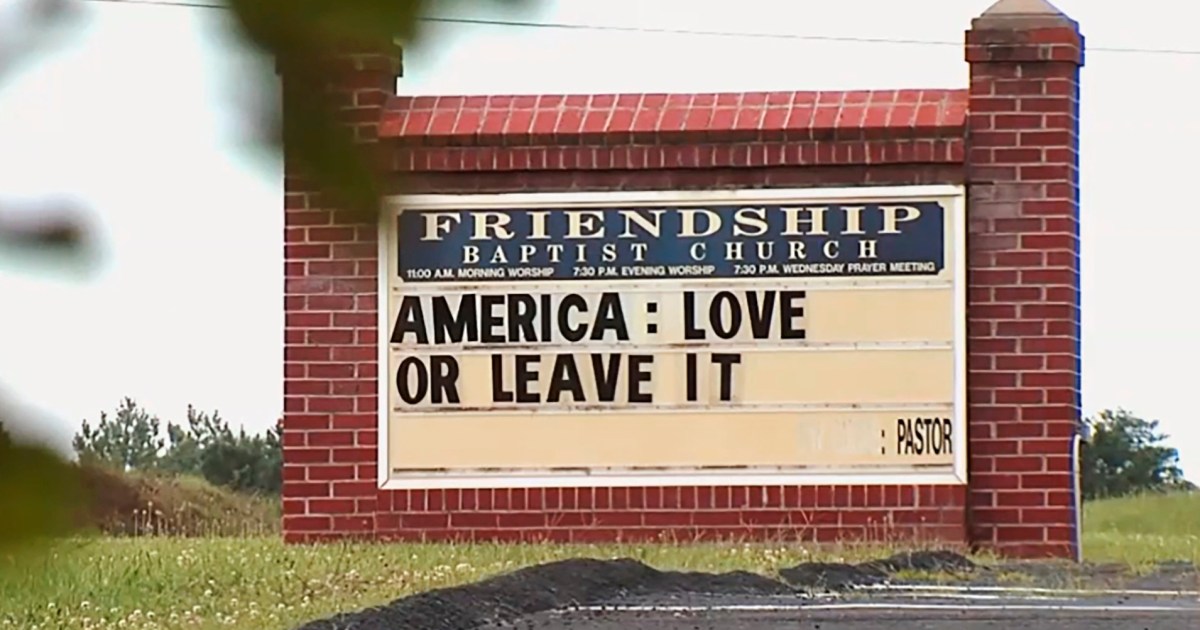
Maybe it’s just me, but I’ve seen an uptick in heated rhetoric like this:

America: Love It or Leave It 

If you don’t like our country, then you can just leave.

This bothers me, and it always has. I remember when people said they would leave if Obama was elected president. Others said it about Hilary and Trump. It’s nothing new, really. But making the empty threat to leave the country if you don’t get your way is one thing. What’s happening now more than I’ve seen in the past is more of a threat against others. If you don’t like it, then just leave. You better love this country…or else. Why don’t you just go back to your own country.


Side note – it did make me chuckle when people said they would move to Canada or Europe if Obama was elected because he was too socialist… Um…should someone tell them?


Telling someone to leave the US if they don’t like it bothers me on many levels, both as a US citizen and as a Christian. Let’s see if I can put my thoughts and feelings into words.

IT’S AN INCREDIBLY PRIVILEGED IDEA
Americans in general are becoming less mobile than they once were. The internet and communications advancements have reduced the need to move across country for work. But when you factor in the rising cost of living in most areas, general economic insecurity, and the threat of unemployment with no guarantee of a job, moving locations within the country is cost-prohibitive to a large percentage of the population. In other words: Moving is expensive!

And that’s just within the country. How much more so to move out of the country. Not only is there an increased economic cost, but there is also the social and cultural cost of learning a new system of laws, new customs, even a new language. Let’s be realistic – leaving the country is not an option for the vast majority of citizens. Only those who move with their work and have expenses paid are able to do so. It’s a very privileged thing to assume that people CAN move in the first place.

IT’S A CALL FOR UNIFORMITY, NOT UNITY
Every single person has a different idea of how this country should be run. Not everybody is going to be happy all the time. That’s just the way life works. The question is: how do we respond when we are faced with a diversity of opinions?

If someone wants to challenge capitalism or the electoral college or the justice system, they are well within their rights to do so. We should hear them out. It’s funny how most of the people who use this “Love it or leave it” language are also the ones advocating for a “free marketplace of ideas.” The whole idea of a free market is competition that leads to innovation. If everyone only ever had all the same thoughts, opinions, and ideas, we would never be innovative or creative. We need unity through diversity – not uniformity.

THERE’S NO ROOM FOR EMPATHY
Imagine yourself as an asylum seeker in another country. You’ve never been there. You don’t know the language or the culture. You don’t know the laws. You are learning as you go. Imagine you’re able to enter the country and live there for a couple decades. You may find yourself missing home. You may find yourself wishing that some things were more like they were in your former country. You may even begin to suggest those changes or advocate for certain changes that you may think would benefit your current country. That doesn’t mean you want to go back home – this is your home now. It just means you care enough about your current country that you want to try and help make it better – according to your own opinion.

If you’ve never traveled outside the US, especially overseas, then you may have no idea what it’s like to be immersed in a foreign culture with different languages and customs. You have no idea what it’s like to be that kind of homesick. “Love it or leave it” leaves no room for empathizing with foreigners and immigrants. We can practice empathy without changing all of our values and customs. Other perspectives and worldview are not necessarily a threat.

NATION STATES ARE NOT RESTAURANTS
“If you don’t like it, then leave and go somewhere else” works when it comes to restaurants and other businesses. That’s part of capitalism and the free market. Consumer choice plays a pivotal role in our economy. If I want a chicken sandwich, I can choose Popeyes, Chick-Fil-A, Wendy’s, or a whole host of other establishments. If there is a restaurant I frequent that changes management and suffers a decline in quality and service, then YES I will be going elsewhere. We can shop around. We can be picky. We have a choice.

That’s great when it comes to businesses, but nations don’t really work that way. Yes, you can technically leave, but it’s complicated and not feasible for most people. This perspective makes citizens into consumers and nations into businesses. When that’s the case, money is the only language that matters and those without it lose their voice.

WHAT ABOUT THE PROPHETS?
Switching to a biblical perspective here, a large chunk of Scripture is composed of prophetic writings. Have you ever read the prophets? You can’t tell me those men didn’t love their nation. You can’t tell me that Isaiah didn’t love Israel or that Jeremiah didn’t love Judah. Those men loved their God and their nations so much that they couldn’t HELP but speak out on the injustices and immorality they saw. To say nothing was not an option. They spoke out against the political rulers and the religious elites. They spoke out against war, violence, bloodshed, and the horrible treatment of the poor, widows, orphans, and foreigners.

The prophets spoke out against injustice and economic power imbalances not because they hated their country, but because they wanted the country they loved to be better. They could see the trajectory of their nations and knew it could only end in disaster. They didn’t hate their country any more than a coach hates his players or a lifeguard hates young swimmers. Jesus himself wept over Jerusalem and predicted the disaster that would befall them. Does that mean he hated Jerusalem? NO! He died to save it.

THIS IS BABYLON, NOT JERUSALEM
Closely tied to my previous point, Christians often believe that the US is the world’s savior, that we are that “shining city on a hill.” Maybe we have that potential, but we aren’t there right now, folks. And if we profess to follow Christ, our allegiance is to the kingdom of God above all nations. We are “strangers and foreigners.” We are looking for “a better country, a heavenly one.” So maybe we should take a page out of Daniel and Jeremiah’s playbook.

Through Jeremiah, God wrote a letter to the Israelites in exile in Babylon. You can read it in Jeremiah 29. Basically, God tells them to get comfortable and settle down. Build houses, plant gardens, get married and have kids, and work for peace in Babylon, because if it prospers, then they would prosper. At one point Daniel read that letter. Daniel took it seriously, because he made himself indispensable to the kings and rulers of Babylon and Persia. He was a foreigner working for the prosperity of his enemy nations in an attempt to change it for the better.

America is Babylon. America is Rome. We are in exile. As foreigners and strangers, we should work for the prosperity of whatever nation we find ourselves in. So let’s stop it with all the “love it or leave it” rhetoric, and let’s work together for the peace and prosperity of our nation. Let’s work for change. Let’s seek the kingdom of heaven here. Let’s stop trying to “Make America Great Again” and start bringing about God’s will “on earth as it is in heaven.” In God’s kingdom there is room for everyone. In God’s kingdom there are people of “every nation, tribe, people, and language.”

America: If you don’t love it….then let’s work together to make a little more like heaven.

Learn Everything. Know Nothing.

I love to learn.

My oldest son gets it from me. When he was a toddler, he asked my mother-in-law, his “Nana,” to make a “little case q” out of play dough. Most kids would ask for animals or other shapes. Aiden asked for letters. He learned to read at age 3. He already knew all the sight words they would be learning before he ever set foot in his kindergarten classroom.

When I was younger my mom couldn’t bring home enough non-fiction books for me to read. Among my favorite shows were Magic School Bus and Bill Nye the Science Guy. I was a star student on our Bible Bowl team at church. When we would visit other churches, I answered questions in Bible class that the regulars didn’t know.

One time I was sent out into the hallway at school for correcting my English teacher too much.

Both of my parents have been educators their whole lives, so I guess you could say it’s in my DNA.

My interest in the Bible, Christianity, and Religion in general is a HUGE part of who I am. I love to learn. I love to be challenged. I love to see things from new and different perspectives. I love learning about and discussing religion, faith, Christianity, science, sociology, politics, etc.

This makes my task as a minister both awesome and frustrating.

On the one hand, I get paid to do what I love and what I am called to do. The church supports me and gives me the space to study, learn, grow, develop, and then teach what I’ve learned to others. I can’t see myself doing anything else. One of the best feelings in the world is to see someone finally get it.

On the other hand, it can be incredibly frustrating – like can’t fall asleep, high blood pressure, bad mood all day frustrating. Because as a minister, it’s my daily task to study and grow. I take seriously the charge Paul makes to Timothy, “Study to show yourself approved…rightly handling the Word of God.” And my job is one of the only ones to come with a warning in Scripture when James tells us that not many of us should become teachers, because we’ll receive a stricter judgment.

**WARNING** Here’s where I get preachy and soap-box-y.

The frustrating bit comes when members of the church pour water on the fire. They’ve been taught one thing when they were kids and haven’t grown or pivoted one inch in many decades. They have a very limited understanding of Scripture and are truly unwilling to be taught. They approach Scripture with the mindset of “The Bible says it. I believe it. That settles it.” They’re unwilling to do the hard work, the noble work (Acts 17) of examining the Scriptures to see if what they have been taught and are currently being taught is true.

I resonate with these words from Hebrews:

About this we have much to say that is hard to explain, since you have become dull in understanding. For though by this time you ought to be teachers, you need someone to teach you again the basic elements of the oracles of God. You need milk, not solid food; for everyone who lives on milk, being still an infant, is unskilled in the word of righteousness. But solid food is for the mature, for those whose faculties have been trained by practice to distinguish good from evil.
(Hebrews 5:11-14, NRSV)

I’m not even talking about knowing basic Bible facts. I don’t care if you know all the facts about a story if you miss the big-picture truth within that story. For instance, you may know all the details about the messy business between Abraham, Sarah, and Hagar. You may be able to tell me that Sarah put Hagar up to it. You may be able to tell me that Sarah began to get super jealous of Hagar after she had Ishmael. You may be able to tell me that Sarah made Hagar’s life a living hell until she ran away into the desert.

But you can miss the significance of a dark-skinned, African, fugitive sex-slave being the first person in all of Scripture to give God a name. God pursues Hagar and reassures her, comforts her, and she responds, “I have seen the God who sees me.” God is the God Who Sees – the minorities, the slaves, the poor, the runaways, the sex workers, the marginalized, the oppressed.

There is no one right way to read the Bible. That kind of thinking would be completely foreign to the Jewish Rabbis. They talked about “turning the diamond” of Scripture in order to see the beauty in every angle. They learned through debate and argument in community. The name “Israel” means those who wrestle with God, and that’s what the Hebrew Scriptures are – a collection of writings arguing about and wrestling with God.

Jesus comes along and settles those arguments. That doesn’t mean we’re free from the wrestling today. Each generation must do the hard work for themselves to discover the depths of Truth for their own time and place.

Can the story of the Ethiopian Eunuch inform how the church treats members of the LGBTQ community?

Can Jesus’ answer about taxes transform our political allegiances today?

Can the story of the Good Samaritan shape our understanding of social justice, civil rights, and racism?

Can the minor prophets speak to the way we view the Second Amendment?

When it’s all said and done, I want to be a part of a church where you walk through the parking lot and see a jacked-up diesel truck with a Confederate flag license plate parked next to a Prius with Pride stickers – and both owners are welcomed, both owners are challenged, and both owners meet with Jesus.

I’m tired of the church spinning its wheels. I’m tired of people who haven’t done any serious study in decades throwing water on the fire of those who are passionate about building the Kingdom in the 21st Century. I’m tired of Christians who are more informed by cable news than by the Gospels.

We need the wisdom to know what’s biblical and what’s cultural. We need the wisdom to know when to act and when to wait. But we also need the wisdom to follow the Spirit’s guidance into deeper understanding and insight. We must be willing to be made uncomfortable for the sake of the kingdom.

When I was in high school I remember getting into a discussion/debate with some of my friends. I grew up in a really conservative part of the Bible belt in very traditional churches of Christ. I raised the hypothetical to them: If a man is a faithful baptized believer who loves Jesus, serves others, and does all the Christian-y things, and he attends a church that is active and faithful except they use instruments in their worship – will that man go to hell because of it?

Because of the way we were taught and raised, my friends said yes.

That’s when I knew this was a journey I was going to have to make without them. I’m not interested in assigning people to hell. I’m not interested in a branch of Christianity that is known for what we’re against. I’m not interested in playing those Pharisee games.

I’m interested in doing the hard work, to learn, to grow, to discover, to be inspired, to dive deep. And I’m interested in holding all things loosely except for Christ.

For I decided to know nothing among you except Jesus Christ, and him crucified.
(1 Corinthians 2:2)

I want to learn everything….but know nothing….except Christ. 

LEVEL UP

There comes a point in your life of faith when you begin to wonder… Is this all there is?

My brother-in-law gave my sons a Playstation for Christmas. It’s really cool because it comes with the motion controllers. We’ve been playing the typical sports game with each other quite a bit lately. It’s cool, but pretty basic. It has disc golf, table tennis, volleyball, archery, and a few others.

Like with most games, when it is your first time playing it offers you a chance to learn the basic skills of the game. It will give you a walkthrough of the controls and motions needed to perform the basic tasks. But after a few minutes of learning, it’s time to move on to the actual game.

Most video games begin at a very simple, easy to follow level with basic tasks to complete before moving onto the next level or challenge. The difficulty increases as you play through the game, as it should. If all you could do was the basic gameplay tutorials, that would be a really crappy game. You would demand your money back! Is that all there is? Where’s the challenge?

There comes a point in your life of faith when you begin to wonder… Is this all there is?

I’ve been in the church and in ministry long enough to realize that a large percentage of our members are stuck in the gameplay tutorial. They’re content to keep repeating the walkthrough, never actually challenging themselves or leveling up. I’m not discounting the fundamentals. We begin there for a reason. Even professionals have to practice shooting and dribbling drills. But once you’ve been a follower of Jesus for a while, there comes a point when you either need to level up or quit playing.

I’m not alone in feeling this way. Look at what it says in the book of Hebrews:

So let us stop going over the basic teachings about Christ again and again. Let us go on instead and become mature in our understanding. Surely we don’t need to start again with the fundamental importance of repenting from evil deeds[a] and placing our faith in God. You don’t need further instruction about baptisms, the laying on of hands, the resurrection of the dead, and eternal judgment. And so, God willing, we will move forward to further understanding.
(Hebrews 6:1-3 | NLT)

IT’S TIME TO LEVEL UP

We’ve got the basics covered. In last week’s post I talked about the fundamental virtues of the Christian life: Faith, Hope, and Love. Those are the biggies that Paul begins with in his letter to the Colossians. But he doesn’t stop there. He challenges them – nay, he PRAYS for them to take things to the next level.

So we have not stopped praying for you since we first heard about you. We ask God to give you complete knowledge of his will and to give you spiritual wisdom and understanding. Then the way you live will always honor and please the Lord, and your lives will produce every kind of good fruit. All the while, you will grow as you learn to know God better and better.
We also pray that you will be strengthened with all his glorious power so you will have all the endurance and patience you need. May you be filled with joy, always thanking the Father. He has enabled you to share in the inheritance that belongs to his people, who live in the light. For he has rescued us from the kingdom of darkness and transferred us into the Kingdom of his dear Son, who purchased our freedom and forgave our sins.
(Colossians 1:9-14 | NLT)

Wow, there’s a lot to unpack there. The training wheels are coming off.

9 KEYS TO TAKING YOUR FAITH TO THE NEXT LEVEL

So what are we going to need along the way if we’re going to go full-in with our life of faith?

1) KNOWLEDGE OF GOD’S WILL
I think we’ve all wondered what God’s will for our life is. We want specifics – Should I go to this college or that college? Should I major in X or Z? What job should I take? Who should I marry? But I don’t think that’s the kind of thing Paul wants for the Colossian Christians. I believe God’s will for our lives can be summed up this way: Love God with your entire being, and love your neighbor as yourself. It might help to measure your big life decisions against that standard.

2) SPIRITUAL WISDOM AND UNDERSTANDING
Put this on the list of most underrated gifts. Especially in the age of Google, in a world where we have virtually all the collected knowledge in the known universe at our fingertips, wisdom and understanding are critical. I think it’s a little more than common sense, but it’s related. Knowledge and information are great, but wisdom and understanding tell us what to do with that knowledge and how to interpret or apply that information. I think DISCERNMENT is a forgotten virtue that needs to come back in vogue.

3) LIVING TO HONOR GOD
How we live matters. What we do matters. The things we choose NOT to do matter. So many Christians (myself often included) live no differently than the world most days. If the only difference between you and a nonbeliever is what happens on Sunday morning, then guess what… Paul would say in 1 Corinthians 13 that if he has all knowledge and insight but doesn’t have love, then it’s of no benefit. Knowing God’s will and developing spiritual wisdom and insight should then lead to a life that honors God. If it doesn’t, then you’re probably still in the gameplay tutorial.

4) GROWING IN RELATIONSHIP WITH GOD
It took me a while to figure out that there is a difference between knowing about God and actually knowing God. I might be the biggest Andrew Luck fan on the planet. I might know his shoe size, his preferred shampoo, his pets names, and his high school GPA. But if I’ve never actually met Andrew Luck, then I can never say I know him. Facts and trivia do not equal a relationship. So how do we grow to know God? By spending time with God in prayer. By spending time with God’s people. By meditating on God’s word. By opening our eyes to see God at work in the world around us. By living a life that honors God.

5) STRENGTH, ENDURANCE, AND PATIENCE
I like to think of faith as a muscle. It must be stressed. It must be challenged. It must be utilized. If we exercise our faith, it will grow stronger and we will find more endurance to make it through any challenges or suffering. But if we don’t utilize our faith, like a muscle it will begin to atrophy. I’m currently working through a strength training program that focuses on the main barbell lifts – deadlifts, squats, bench press, etc. It sucks! But patient endurance, getting under the bar time and time again even when I don’t feel like it, is the key to building muscle strength. If the only time we exercise our faith is for an hour on Sundays, then that’s never going to produce the results we want! Our strength comes from God’s own power. Let’s use that!

6) JOY AND GRATITUDE
It’s hard to be a snob when you’re joyful and grateful. Entitlement is a cancer that will eat away at your relationships, your attitude, and your faith. The most joyful people I know are the ones who don’t take their life blessings for granted. “Happiness” is based on the same root as the word “happenstance.” When things are going well, we feel happy. It’s very circumstantial. But if we are grateful, even in the midst of tragedy or suffering, then we can experience joy no matter what. Paul urges us to be “always thanking the Father.” And remember…Paul is writing this letter from prison! And yet he was full of joy. May our churches and our families, our schools and our workplaces be filled with joy and gratitude.

7) COMMUNITY
We in the post-enlightenment, Western church have individualized our faith to the extent that it often bears little resemblance to the faith of those in Scripture. There is no such thing as an individual Christian. When you follow Christ, you join a family. One of the early church fathers said, “A solo Christian is no Christian.” The journey of discipleship is one we take together. And the end goal is not for my individual soul to get to my personalized version of heaven. The end goal is to share the inheritance of God’s kingdom with all his people! Let’s stop using all this individualized language. Christ did not die to save you, the individual. Christ died to save us, the collective. We don’t have to go it alone.

8) RESCUE
Let’s go back to the video game analogy again. I was a big fan of cheat codes when I was younger. There would be levels I simply could not beat no matter how hard I tried. So I’d enter a code, and suddenly I would be dominating where once I had been getting crushed. Paul reminds us that God has rescued us from the kingdom of darkness. We are in a battle we cannot win on our own. We need the power of God to rescue us. And he says that God has transferred us into the Kingdom of his Son. It’s like entering the cheat code for “God mode.” Or as David put it:

The Lord is for me, so I will have no fear.
What can mere mortals do to me?
(Psalm 118:6)

9) FREEDOM AND FORGIVENESS
I think freedom and forgiveness go hand in hand. Once we have been rescued we are now freed from the cycle of sin and death. All those curses of sin (see Genesis 3) are being eradicated. But don’t get this wrong – we are not forgiven because of anything good that we’ve done. We are able to experience all of the above (knowledge, wisdom, strength, a God-honoring life) because of our freedom and forgiveness. This is how we level up. When we still view religion as a way to earn God’s favor based on our own good deeds, that means we still haven’t learned the basics of how to play the game. We need to go back and do the walkthrough one more time.

Paul’s prayer for the Colossians continues to challenge us today. I don’t think any of us should be content to simply fill a pew on Sundays as the full extent of our faith. But maybe we just don’t know what to do next. Explore these levels and these different challenges. Add some of these things to your inventory. Develop your skills and see how living out your faith can actually make a real world impact.

There comes a point in your life of faith when you begin to wonder… Is this all there is?


It’s time to level up.