Page 66 of 81

My first speed-dating experience…will hopefully get me a job.

So today at school, we had what Harding likes to call “C-Harmony”, a spin-off of eHarmony, where churches from all over the country send ministers, elders, and whomever else they want to in order to interview a flood of Harding students wanting youth ministry internships.

There were about 37 churches represented and over 200 interviewees from Harding. Each interview lasted 30 minutes – 2 rounds per hour from 1 to 5 pm. I interviewed with 4 congregations and have mixed feelings about all the interviews. A 30 minute interview is not nearly enough time in my opinion, but hopefully I made a good enough impression on the ministers in order to get some offers.

Pray for me that God will guide me to the congregation where he wants me and that my own will and desires don’t stand in the way of his.

PS: If any of you reading this know of any place that is looking for interns this summer, put in a good word for me…

My first speed-dating experience…will hopefully get me a job.

So today at school, we had what Harding likes to call “C-Harmony”, a spin-off of eHarmony, where churches from all over the country send ministers, elders, and whomever else they want to in order to interview a flood of Harding students wanting youth ministry internships.

There were about 37 churches represented and over 200 interviewees from Harding. Each interview lasted 30 minutes – 2 rounds per hour from 1 to 5 pm. I interviewed with 4 congregations and have mixed feelings about all the interviews. A 30 minute interview is not nearly enough time in my opinion, but hopefully I made a good enough impression on the ministers in order to get some offers.

Pray for me that God will guide me to the congregation where he wants me and that my own will and desires don’t stand in the way of his.

PS: If any of you reading this know of any place that is looking for interns this summer, put in a good word for me…

Back in the Swing of It

A few weeks have passed since my last update. Sorry about that. It’s been busy to say the least. Katelyn and I had an awesome Christmas with her family in Indiana. When we got back to Columbia we had much to do before our big move. Then the day finally came – we moved into our apartment here in Searcy last Monday and have spent the last week unpacking, setting things up, reassembling, rearranging, customizing, improving, etc. All the fun of moving. The two greatest things about this move are 1) we’re finally able to call somewhere “home” and 2) we finally get to use all the cool wedding presents we got 8 months ago.

A new semester of school started today, and I am stretching myself to the limit…just to see what that limit is. I am taking 17 credit hours (which translates into 21 hours of class time) and working about 20 hours per week. So if you don’t here from me for a while, I’m most likely either studying my Greek or reading for Advanced Intro to Old Testament.

I also wanted to briefly tell about a short book I just read: Letter to a Christian Nation by Sam Harris. This book is written by an atheist, discussing why he feels that Christianity, and religion in general, is a thing of the past, illogical, unreasonable, and a hindrance to the progression of society and the human race. It was a very challenging read, and much of what he wrote made me squirm in my seat or shake my head in shock. But he also raised many complaints against Christians in general with which I am inclined to agree. He really made me think about the way I think about the world around me and how Christians have been and continue to be responsible for some of the most atrocious crimes against humanity, e.g. the Inquisition, the Crusades, antisemitism which ultimately lead to the holocaust, and so on. He complains about Christians, as Jesus complained about the Pharisees, that we tend to strain the gnat and leave the camel. We look for the speck and ignore the plank. We raise such a fuss about abortion, embryonic stem cell research, or homosexual rights, and we turn a blind eye to poverty, suffering, genocide, and horrific diseases which ravage entire nations. We are more concerned about the potential life of an embryo than we are about the actual, miserable life of a fellow human suffering from a disorder which could be remedied by that embryo. I’m not saying he’s right. I’m not saying we’re right. He raised many key points which, right or wrong, founded or not, we as Christians must take to heart and think long and hard about. This book is not for those who are weak or young in the faith. I would only recommend it to those who would consider themselves ready to face head-on the atheistic world-view which is ever-growing in Western society.

Back in the Swing of It

A few weeks have passed since my last update. Sorry about that. It’s been busy to say the least. Katelyn and I had an awesome Christmas with her family in Indiana. When we got back to Columbia we had much to do before our big move. Then the day finally came – we moved into our apartment here in Searcy last Monday and have spent the last week unpacking, setting things up, reassembling, rearranging, customizing, improving, etc. All the fun of moving. The two greatest things about this move are 1) we’re finally able to call somewhere “home” and 2) we finally get to use all the cool wedding presents we got 8 months ago.

A new semester of school started today, and I am stretching myself to the limit…just to see what that limit is. I am taking 17 credit hours (which translates into 21 hours of class time) and working about 20 hours per week. So if you don’t here from me for a while, I’m most likely either studying my Greek or reading for Advanced Intro to Old Testament.

I also wanted to briefly tell about a short book I just read: Letter to a Christian Nation by Sam Harris. This book is written by an atheist, discussing why he feels that Christianity, and religion in general, is a thing of the past, illogical, unreasonable, and a hindrance to the progression of society and the human race. It was a very challenging read, and much of what he wrote made me squirm in my seat or shake my head in shock. But he also raised many complaints against Christians in general with which I am inclined to agree. He really made me think about the way I think about the world around me and how Christians have been and continue to be responsible for some of the most atrocious crimes against humanity, e.g. the Inquisition, the Crusades, antisemitism which ultimately lead to the holocaust, and so on. He complains about Christians, as Jesus complained about the Pharisees, that we tend to strain the gnat and leave the camel. We look for the speck and ignore the plank. We raise such a fuss about abortion, embryonic stem cell research, or homosexual rights, and we turn a blind eye to poverty, suffering, genocide, and horrific diseases which ravage entire nations. We are more concerned about the potential life of an embryo than we are about the actual, miserable life of a fellow human suffering from a disorder which could be remedied by that embryo. I’m not saying he’s right. I’m not saying we’re right. He raised many key points which, right or wrong, founded or not, we as Christians must take to heart and think long and hard about. This book is not for those who are weak or young in the faith. I would only recommend it to those who would consider themselves ready to face head-on the atheistic world-view which is ever-growing in Western society.

Oh Little Town of Bethlehem…

A Merry Christmas to all and a Happy New Year. Or as they say in Greece, “Kala Christougianna!”

As millions of people across the globe pause this day to reflect on the birth of Jesus the Anointed One by Mary, the elect, chosen one of God, I felt it appropriate to skip ahead in the Israel recap and tell of our experience in the Little Town of Bet Lekhem.

Bet Lekhem, or as we say “Bethlehem”, is one of the most hotly disputed cities on the face of the planet. It’s only 10km south of Jerusalem and is located within the West Bank. No Israeli citizen, whether Jew, Christian, Muslim, or atheist, is allowed to enter the city limits. We had to unload the bus and get on another one with a Palestinian driver and a Palestinian Christian tour-guide. The entire city is surrounded by cement walls about 15ft high with barbed wire across the top. After passing through the checkpoints it was as if we had entered another world, and in a way we did. Bethlehem is a Muslim city. It’s poorer, dirtier, and more third-world than the rest of Israel.

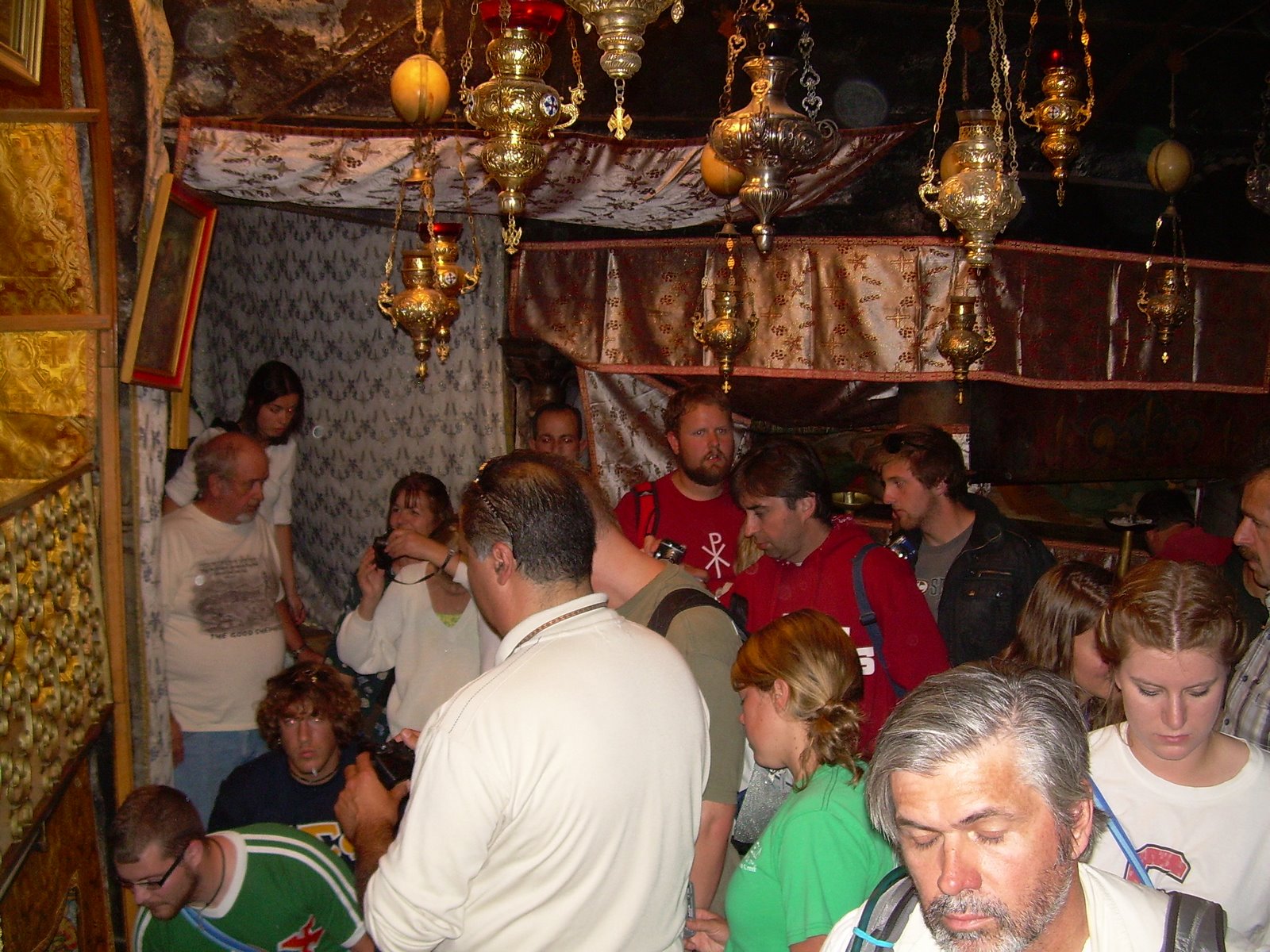
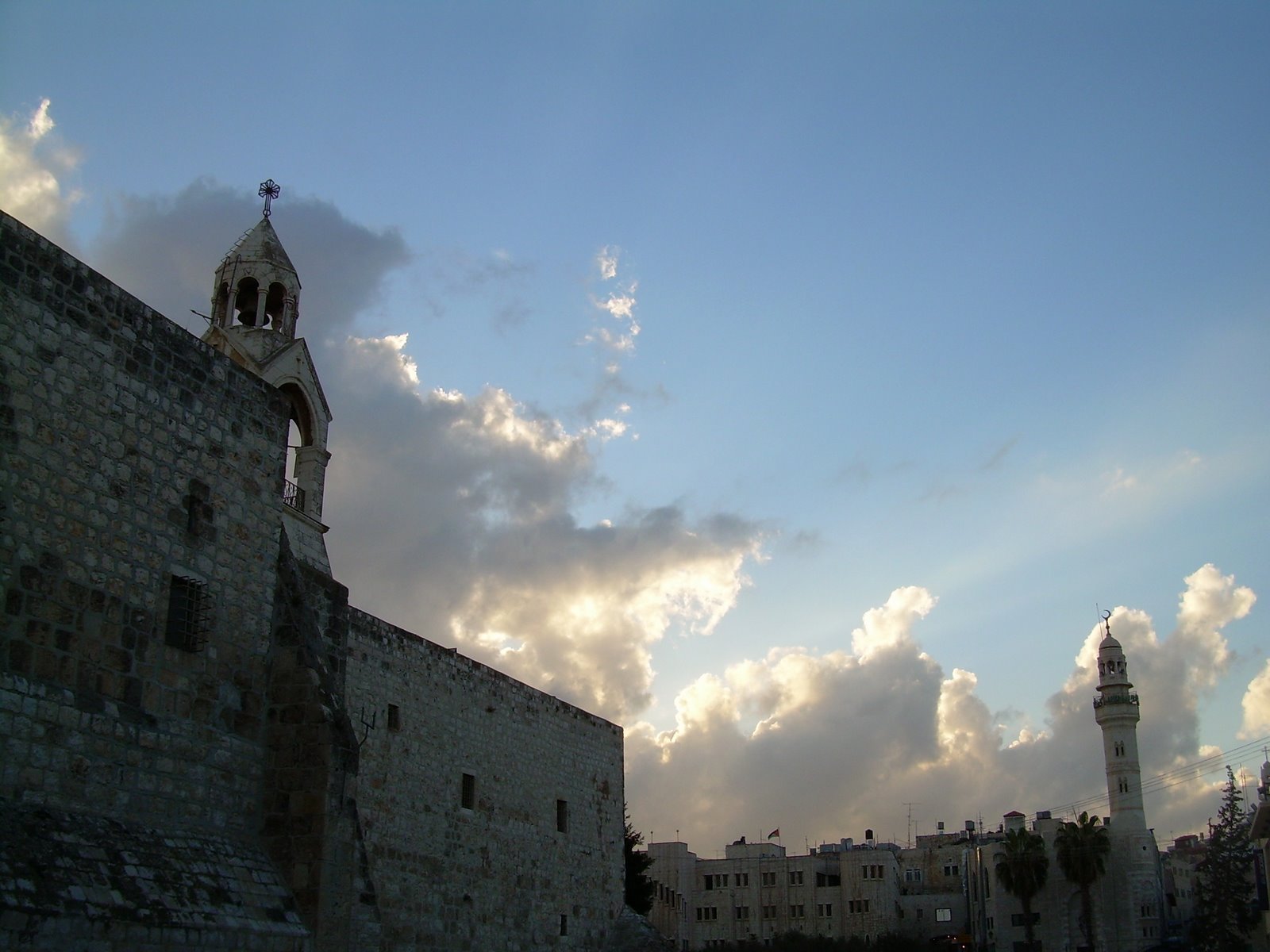
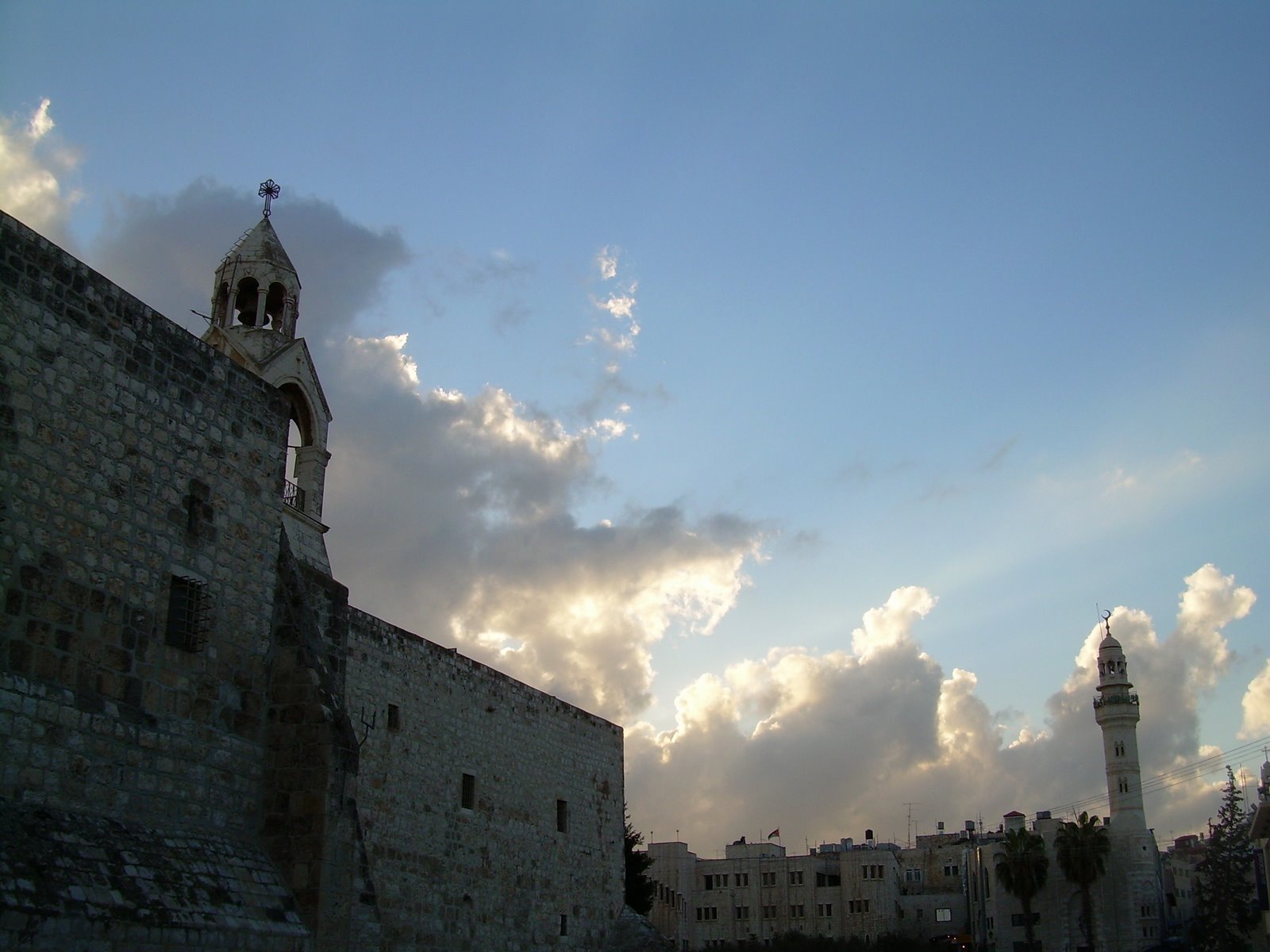
The main place we went in Bethlehem was the church of the Nativity, which is actually shared by 4 or 5 different Christian denominations. It’s a large cathedral built over the supposed birth place of Jesus, which was really the back of a small cave system. When Joseph took Mary to Bethlehem for the census there was no room in the inn, but really the inn wasn’t where they would have stayed anyway, at least not an inn like we think of. They really would have stayed in a deeper cave system which was set up for temporary housing of all the travelers. The “stable” was in the very back of the cave where the livestock and pack animals were kept. There was no room in the rest of the cave, so Mary and Joseph were forced to go all the way to the back of the cave to the stable. It is here that the Virgin Mary gave birth the the Messiah, the King of the Jews.

The church itself was built shortly after the conversion of the Roman Empire to Christianity and stood longer than any of its contemporaries. When the Muslims were marching through the holy land to take it back from the crusaders, they were destroying all the cathedrals along the way. But when they came to the Church of the Nativity, they saw a portrait of the Magi from the East and left the building standing because their people had already been there.

Below the building, beneath the altar area is the traditional location of the birth of Jesus and where he was laid in the manger. We were able to go down there and were hurried through the line, not giving us much time to take it all in. It was neat to say that we have been there, but it’s not the location itself that affects me, it’s the event and the people. I don’t worship the place; I, like the magi, worship the King who was born in that place on that day 2ooo years ago.

From the city of David, the great king of Israel, came Jesus, the Great King over all the earth. From the “House of Bread” (lit. translation of Bet Lekhem), came the Bread of Life. From one of the most disputed cities in modern history came one of the most disputed historical figures.

As we celebrate this day as a remembrance of the birth of our Savior, let us not fall into the trap of celebrating the day itself, or traditions, or materialism for that matter. Let us continually celebrate the coming of God to His creation in the form of a helpless, vulnerable baby. He grew up, matured, and lived a perfect life during a time of hostility, political upheaval, and concern about the future. I would say that life hasn’t changed much since those days, just a different context. It’s amazing that the story of Jesus, from his miraculous birth to his sacrificial death, continues to have the same impact on the world as it did 2000 years ago.

Merry Christmas to all, and let us all be thankful for the birth of our Lord and Savior Jesus Christ.

Oh Little Town of Bethlehem…

A Merry Christmas to all and a Happy New Year. Or as they say in Greece, “Kala Christougianna!”

As millions of people across the globe pause this day to reflect on the birth of Jesus the Anointed One by Mary, the elect, chosen one of God, I felt it appropriate to skip ahead in the Israel recap and tell of our experience in the Little Town of Bet Lekhem.

Bet Lekhem, or as we say “Bethlehem”, is one of the most hotly disputed cities on the face of the planet. It’s only 10km south of Jerusalem and is located within the West Bank. No Israeli citizen, whether Jew, Christian, Muslim, or atheist, is allowed to enter the city limits. We had to unload the bus and get on another one with a Palestinian driver and a Palestinian Christian tour-guide. The entire city is surrounded by cement walls about 15ft high with barbed wire across the top. After passing through the checkpoints it was as if we had entered another world, and in a way we did. Bethlehem is a Muslim city. It’s poorer, dirtier, and more third-world than the rest of Israel.

The main place we went in Bethlehem was the church of the Nativity, which is actually shared by 4 or 5 different Christian denominations. It’s a large cathedral built over the supposed birth place of Jesus, which was really the back of a small cave system. When Joseph took Mary to Bethlehem for the census there was no room in the inn, but really the inn wasn’t where they would have stayed anyway, at least not an inn like we think of. They really would have stayed in a deeper cave system which was set up for temporary housing of all the travelers. The “stable” was in the very back of the cave where the livestock and pack animals were kept. There was no room in the rest of the cave, so Mary and Joseph were forced to go all the way to the back of the cave to the stable. It is here that the Virgin Mary gave birth the the Messiah, the King of the Jews.

The church itself was built shortly after the conversion of the Roman Empire to Christianity and stood longer than any of its contemporaries. When the Muslims were marching through the holy land to take it back from the crusaders, they were destroying all the cathedrals along the way. But when they came to the Church of the Nativity, they saw a portrait of the Magi from the East and left the building standing because their people had already been there.

Below the building, beneath the altar area is the traditional location of the birth of Jesus and where he was laid in the manger. We were able to go down there and were hurried through the line, not giving us much time to take it all in. It was neat to say that we have been there, but it’s not the location itself that affects me, it’s the event and the people. I don’t worship the place; I, like the magi, worship the King who was born in that place on that day 2ooo years ago.

From the city of David, the great king of Israel, came Jesus, the Great King over all the earth. From the “House of Bread” (lit. translation of Bet Lekhem), came the Bread of Life. From one of the most disputed cities in modern history came one of the most disputed historical figures.

As we celebrate this day as a remembrance of the birth of our Savior, let us not fall into the trap of celebrating the day itself, or traditions, or materialism for that matter. Let us continually celebrate the coming of God to His creation in the form of a helpless, vulnerable baby. He grew up, matured, and lived a perfect life during a time of hostility, political upheaval, and concern about the future. I would say that life hasn’t changed much since those days, just a different context. It’s amazing that the story of Jesus, from his miraculous birth to his sacrificial death, continues to have the same impact on the world as it did 2000 years ago.

Merry Christmas to all, and let us all be thankful for the birth of our Lord and Savior Jesus Christ.
12 Days of Christmas

Some of you may have heard it already, but Straight No Chaser has a Christmas album out that has my favorite version of “12 Days of Christmas.” Here it is if you want to hear it.

Holy Land Saga, pt. 2.1

Day 3: Tue 11/18/08


Tel-Dan:

When thinking about historically/biblically important cities and/or archaeological sites, the ancient city of Dan might not make the top of your list. However, as I found out today, it is actually very important for several reasons.


First, from the archaeological evidence in the layers of the city, we can tell that there were three distinct times when the city was completely destroyed and then rebuilt. The first dates back to the time of the Exodus/ Conquest of Canaan (ca. 13th Cent. BC). The second dates back to the 11th Cent. BC, which lines up perfectly with the biblical account of the tribe of Dan’s moving from southern Israel to the northernmost territory and destroying the city of Lashish. The third destruction layer dates to the approximate time of the Assyrian invasion of Israel.


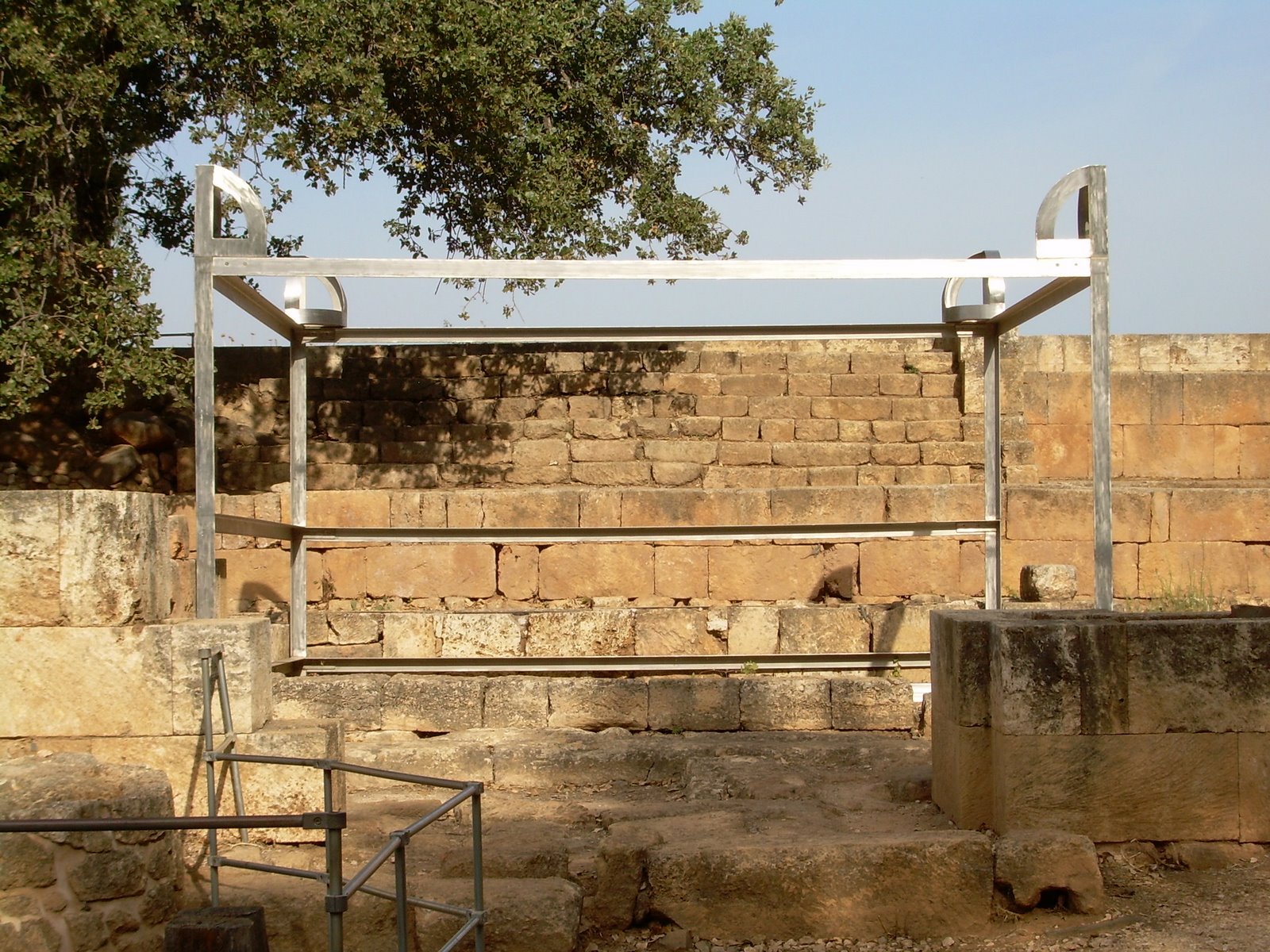
Secondly, it confirms the account in the Old Testament of King Jeroboam’s construction of two cult centers for Israel, one of which was right here in Dan. The remains of the foundation for a large altar have been discovered, along with the foundation of what could have been a replica of Solomon’s Temple in Jerusalem. This is where the inhabitants of the Northern Kingdom would come and make sacrifices to an image of a golden calf, similar to the one built by Aaron at Mt. Sinai.

Thirdly, this city gives insight into the strategy involved in developing an ancient city. Three key ingredients to insuring the life of a city are water, fertile land surrounding the city, and a major trade/ travel route nearby. The location of Tel-Dan has all three. The city was built along the larger of the two tributaries which make up the Jordan River, flowing down from Mt. Hermon. The land surrounding the city is some of the most fertile land in Galilee. Also, there is a major trade route which was used to carry goods from the Mediterranean Sea all the way in to Damascus in order to avoid the mountainous region to the north.

The Nature Reserve around the city is one of the more beautiful places in all of Israel. There are trees and shrubs, vines and wildflowers, all flourishing around the rushing waters which flow into the Jordan.


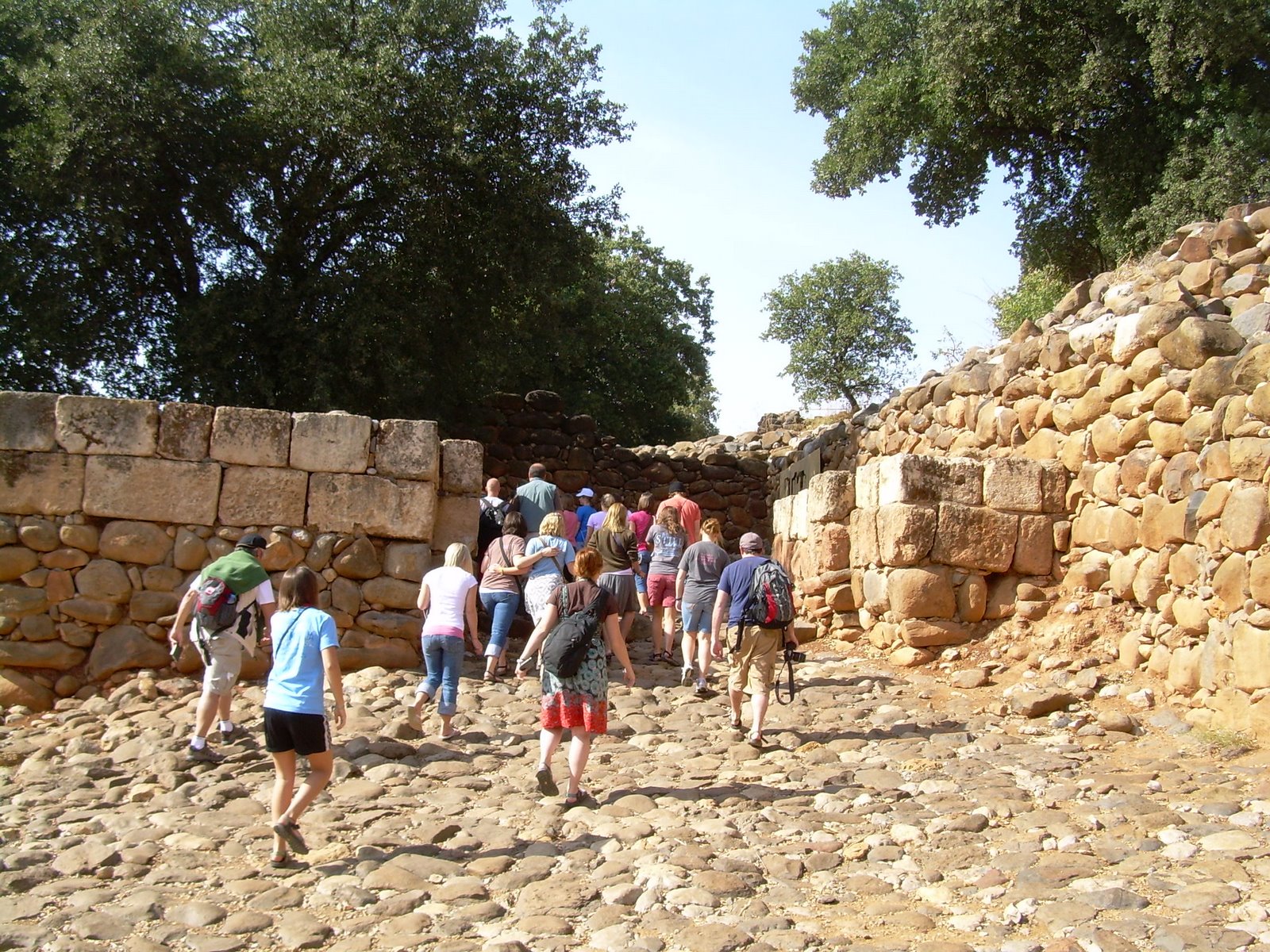
Another amazing discovery near Tel-Dan is part of a wall from the time of Abraham. In fact, Abraham most likely saw and walked through the gate in the wall which has been preserved for nearly 4000 years. This section of the wall/ gate also contains one of the oldest arches in the world.


Tel-Dan has been one of my favorite historical sites thus far simply because it has shed so much light on some stories of the Bible. It has really brought life to the Old Testament.

12 Days of Christmas

Some of you may have heard it already, but Straight No Chaser has a Christmas album out that has my favorite version of “12 Days of Christmas.” Here it is if you want to hear it.

Holy Land Saga, pt. 2.1

Day 3: Tue 11/18/08


Tel-Dan:

When thinking about historically/biblically important cities and/or archaeological sites, the ancient city of Dan might not make the top of your list. However, as I found out today, it is actually very important for several reasons.


First, from the archaeological evidence in the layers of the city, we can tell that there were three distinct times when the city was completely destroyed and then rebuilt. The first dates back to the time of the Exodus/ Conquest of Canaan (ca. 13th Cent. BC). The second dates back to the 11th Cent. BC, which lines up perfectly with the biblical account of the tribe of Dan’s moving from southern Israel to the northernmost territory and destroying the city of Lashish. The third destruction layer dates to the approximate time of the Assyrian invasion of Israel.


Secondly, it confirms the account in the Old Testament of King Jeroboam’s construction of two cult centers for Israel, one of which was right here in Dan. The remains of the foundation for a large altar have been discovered, along with the foundation of what could have been a replica of Solomon’s Temple in Jerusalem. This is where the inhabitants of the Northern Kingdom would come and make sacrifices to an image of a golden calf, similar to the one built by Aaron at Mt. Sinai.


Thirdly, this city gives insight into the strategy involved in developing an ancient city. Three key ingredients to insuring the life of a city are water, fertile land surrounding the city, and a major trade/ travel route nearby. The location of Tel-Dan has all three. The city was built along the larger of the two tributaries which make up the Jordan River, flowing down from Mt. Hermon. The land surrounding the city is some of the most fertile land in Galilee. Also, there is a major trade route which was used to carry goods from the Mediterranean Sea all the way in to Damascus in order to avoid the mountainous region to the north.


The Nature Reserve around the city is one of the more beautiful places in all of Israel. There are trees and shrubs, vines and wildflowers, all flourishing around the rushing waters which flow into the Jordan.


Another amazing discovery near Tel-Dan is part of a wall from the time of Abraham. In fact, Abraham most likely saw and walked through the gate in the wall which has been preserved for nearly 4000 years. This section of the wall/ gate also contains one of the oldest arches in the world.


Tel-Dan has been one of my favorite historical sites thus far simply because it has shed so much light on some stories of the Bible. It has really brought life to the Old Testament.