Page 13 of 70

Male and Female: Rockstar Women of the Early Church

…….

Just as you can’t help but notice all the women featured prominently in the gospels, so it is with Acts and the accounts of the early church.

Stop trying to force me to deal with Paul. We’re not there yet. We’ll get there when we get there! Haha

AS IT WAS, SO IT WILL BE
Right from the beginning, the women are fully included with the disciples. Check it out:

They all joined together constantly in prayer, along with the women and Mary the mother of Jesus, and with his brothers. (Acts 1:14)

Who are these women? We know Mary the mother of Jesus. We can safely assume that also included at least Mary Magdalene, Salome, Joanna, and perhaps Mary and Martha along with others.

Multiple women and men joined the remaining eleven apostles in constant prayer. Then Peter addresses the group and the group appoints a man to replace Judas. That’s right. The text leads us to presume that women were involved in the selection process alongside the men.

That leads into chapter 2 and the Day of Pentecost. Luke tells us that they were all together in one room. Who were they? The same aforementioned group of 120 disciples and apostles, men and women. The Holy Spirit filled the room. It would have been an amazing scene to witness. But don’t skip over this:

All of them were filled with the Holy Spirit and began to speak in other tongues as the Spirit enabled them. (Acts 2:4)

All of them – men and women. Filled with the Spirit. Prophesying. Speaking in tongues. All of them. Men and women.

What other evidence is there that these sisters were included in this miraculous outpouring of the Spirit right alongside their brothers? Because that’s exactly what we are told would happen! Again, don’t skip over the quotation in Peter’s sermon from the book of Joel. The significance of this cannot be stressed enough.

No, this is what was spoken by the prophet Joel:
“‘In the last days, God says,
I will pour out my Spirit on all people.
Your sons and daughters will prophesy,
your young men will see visions,
your old men will dream dreams.
Even on my servants, both men and women,
I will pour out my Spirit in those days,
and they will prophesy.
I will show wonders in the heavens above
and signs on the earth below,
blood and fire and billows of smoke.
The sun will be turned to darkness
and the moon to blood
before the coming of the great and glorious day of the Lord.
And everyone who calls
on the name of the Lord will be saved.’
(Acts 2:16-21, quoting Joel 2:28-32)

Sons AND daughters. Men AND women. They will ALL be filled with the Spirit and empowered to prophesy, i.e. communicate publicly the Word of God to the people of God. Women were preaching right alongside Peter on that day.

This message from Joel fits right in line with the messages of the other prophets and the ministry of Jesus. Joel (and thus Peter) is looking back at how God intended creation to be and looking forward to a day when that creation would be restored. Peter is saying that day is now.

I’m getting myself worked up. I’m literally shaking as I write this because – how could we have missed this for so long?! It’s right there!

But what about what Paul said in…? Stop it. We’ll deal with that later. We must root Paul’s words firmly within the context of what was actually happening in the early church specifically and in the Greco-Roman world more generally. Either the Bible contradicts itself in the most severe way OR we’ve been misinterpreting and misapplying two verses of Scripture to the detriment of women for centuries.

Ok, I got a little side tracked. Let’s keep going. What else is there precedence for women to do in the context of ministry, evangelism, and “church work?”

THREATENED BY WOMEN?
If we look at Acts 9, we notice something very telling about the role women played in the early church. This wouldn’t raise too many eyebrows for our cultural context, but this was huge in that day – and still to this day in that part of the world. Let me explain.

Even today in the Middle East, the men may be fighting, there may be a war going on outside, but the women are still able to go about their business running errands, taking the children to school, picking things up at the market. Women are not seen as a threat. They are not the leaders or key participants in the conflict, so they are largely left alone. So it was at the end of the gospels. The male disciples were all hiding behind locked doors that resurrection Sunday. It was the women who felt free to go about the business of finishing Jesus’ burial preparations. The men all feared for their lives. The women could walk the streets freely.

That is until Acts 9. By this time apparently the authorities had caught on that women were also involved in the leadership of this new sect, so they gave Saul of Tarsus the go-ahead to arrest any female disciples, too. Women were just as big a threat as the men!

ROCKSTAR WOMEN
Acts 9 also introduces us to a disciple named Tabitha who had died. She was known for “always doing good and helping the poor.” Apparently she was so vital to the church in her town that they sent a special envoy to bring Peter to help. He miraculously raised her from the dead and presented her alive to all the believers – especially the widows.

In Acts 10 we find out that Mary, John Mark’s mother, hosted a church gathering at her house in Jerusalem. You can actually still visit that spot today. It was not uncommon for women to be named as the host for house churches.

The first convert to Christianity on Greek soil was a woman named Lydia. She was a business owner and apparently the leader of their makeshift outdoor synagogue in Philippi (Acts 16). The story treats her as the head of the household, just as it does Cornelius in Acts 10.

Priscilla and Aquila were a married couple from Rome. They were Jewish Christians who had been expelled from Rome in the early 50s by order of Emperor Claudius. They met up with Paul and became his coworkers in the faith – a term that pretty much always included church-planting, preaching, teaching, evangelizing, and encouraging and guiding the churches. Priscilla is nearly always mentioned first, a fact that leads most scholars to believe she was the main teacher out of the two. Priscilla and Aquila teamed up to correct the theological teachings of a man named Apollos – who graciously submitted to their instruction in the faith and went on the accomplish amazing things for the Kingdom.

Going back to Philippi for a moment — in the letter to Philippi Paul specifically calls out two women – Euodia and Syntyche – who were having some sort of disagreement. He urges them to be of one mind, to reach a truce for the sake of the gospel. He then acknowledges them as his coworkers who have contended with him in the faith. I doubt their argument was about which color the church carpet should be.

Most people would probably disregard the final chapter of Romans as just a list of names of people Paul sends his greetings to. And that’s kind of what it is, but it’s so much more. Romans 16 gives us a glimpse into the day-to-day life of Christians in the early church. For our purposes, just look at how many women Paul names.

  • Priscilla, a coworker who risked her life for Paul and who hosted the church in her and Aquila’s house (they had moved back to Rome by this point)
  • Mary, who worked hard for the church in Rome
  • Junia, who – along with her husband Andronicus – was imprisoned with Paul and was considered “outstanding among the apostles.”

***YES – Junia is regarded by Paul to be an apostle, an outstanding one at that! This is what the early church father Chrysostom said about her:
“To be an apostle is something great. But to be outstanding among the apostles — just think what a wonderful song of praise that is! They were outstanding on the basis of their works and virtuous actions. Indeed, how great the wisdom of this woman must have been that she was even deemed worthy of the title of apostle.”

  • Tryphena and Tryphosa, two women who work hard in the Lord
  • Persis, another woman who worked hard in the Lord
  • The mother of Rufus, who was like a mother to Paul
  • Julia and the sister of Nereus

But I skipped over another important woman in Romans 16 – Phoebe. She is the only person in the Bible specifically named as a deacon. You can try to explain it away (deacon simply means “servant,” after all), but then you must be consistent and strip away the “authority” given to the deacons in the church – after all, they’re just servants.

Phoebe is regarded by Paul (who wrote the “qualifications” for deacons, by the way) as a deacon – not “deaconess” as some try to translate it. More than that, she played a key role in the church of Cenchrea and was the wealthy benefactor for Paul’s missionary journeys (and those of others). The way she is “commended” leads us to understand that Phoebe was actually the one to deliver and probably read aloud the letter to the Roman church. She was deserving a warm welcome and hospitality. As one in close contact with Paul, she would have likely been the one to answer the miriad questions that would have arisen from the letter. How many commentaries have been written on the book of Romans? Phoebe was the first.

Finally, a brief mention goes out to Chloe, a leader and close confidant of Paul’s in the Corinthian church. And let’s not forget to call out Lois and Eunice, Timothy’s own mother and grandmother who instilled within him a love for Scripture and a firm faith that would stick with him for the rest of his life.

Good grief, that’s a long list. There were SO MANY women working in the churches of the First Century. They were deacons and apostles and teachers and house-church leaders. They were coworkers with Paul who were considered a threat by the authorities and spent time in prison. They spoke in tongues and prophesied.

There is precedence for all these things – full leadership and equal authority to serve alongside the men.

Just.
Like.
Eden.

What is there no precedent for? VBS, children’s ministry, meal trains, casseroles, women’s ministry,  pot lucks, women’s retreats, classroom design, women’s classes, bulletins, secretaries, nursery attendants, and literally every other role we relegate women to in our churches.

These women in the Bible kicked butt and took names for the sake of the kingdom. They were rockstars. They weren’t thrown in prison for making casseroles, that’s for sure. The world had never seen anything quite like it before.

So what happened?

Male and Female: Creation 2.0

The discussion so far:
…….

Now it’s time to get down to business. I still think I lost some of you by focusing so much on the Old Testament.  But I can’t – and I can’t emphasize this enough – emphasize this enough. We simply cannot disregard the Hebrew Scriptures. That’s the only Bible Jesus and the apostles had. That’s the only Bible the church had for hundreds of years of its existence. If we don’t examine the bulk of Scripture, we miss out on the amazing Story that unfolds – Creation, Fall, New Creation.

Jesus’ whole mission was to inaugurate the New Creation. It’s right there at his baptism – the voice of God, the light, the Spirit hovering over the waters. It’s there in the prayer Jesus taught his disciples – Your kingdom come. Your will be done on earth as it is in heaven. It’s there in all the miracles and signs Jesus performed. It’s there most fully in the resurrection.

The apostles remind us about this, too. Paul tells us that if anyone is in Christ, they are a new creation. The old has gone, the new has come. Paul goes so far as to say, “The only thing that matters is the new creation.” John tells us that the whole reason Jesus came was to undo the work of the devil, i.e. the fallen creation. Peter reminds us that we are all now a new nation, a kingdom of priests.

Through Jesus, God is initiating his ultimate plan to restore Creation as it was intended to be.

From his very first sermon, Jesus calls attention to this fact. He reads Isaiah 61, tells the people that Isaiah is talking about him, and sits down. He reassures John the Baptist that he is in fact the one to come – the Servant of Isaiah 61, the son of Eve who would deal the death blow to the serpent – by pointing to all the ways he has begun to set things right again.

So what does this mean for the purposes of this discussion?

Jesus breaks all the social norms and taboos for male/female platonic relationships of his day. He restores dignity and value and honor to those most oppressed and sidelined by society – including women, children, foreigners, and the disabled. Let’s just take a quick bullet-point journey through the gospels to see how Jesus does this particularly with women.

-Jesus performs his first miracle at the behest of his mother. (John 2)

-The first person to hear the news that Jesus is the Messiah is the Samaritan woman he meets at Jacob’s Well. After a deep theological conversation with her (which stands in sharp contrast to the conversation he has with Nicodemus), he entrusts her with this news and she takes the message back to her whole community. (John 4)

-One of the few people Jesus commends for exhibiting great faith and understanding was the Syrophoenecian woman in Mark 7. She is also one of the only people to ever “get” one of Jesus’ parables in real time.

-In John 8 Jesus calls attention to the double-standard of sexual ethics of men and women. They want to stone a woman for committing adultery. Jesus points out that they are all sinners, too. And it’s glaringly obvious that they are holding this woman to a different standard because there is no man on trial. Jesus preserves her life and her dignity while calling out the hypocrisy of the men around them.

-Jesus allows a woman of questionable repute to anoint him with oil (Luke 7). This whole scene is shocking. But we often miss the point that this kind of anointing was typically only done by the priests. Jesus allowed her to worship however she chose without being silenced by the men at the table.

-When asked about the question of divorce, Jesus appeals to Genesis 1 and 2 (which is where I get my hermeneutical inspiration). God created male and female in his own image. Jesus reaffirms that it is the man who leaves his father and mother to be joined to his wife – counter to the patriarchal practices of the day. And he goes further to say that what God has joined should not be separated by man – the only one who could legally file for divorce.

-The woman with the bleeding issue had the guts to touch Jesus. She was healed because of her faith, and Jesus even called her “daughter” – the only woman to receive that kind of welcome from him.

-When Jesus was at the home of Mary and Martha, Martha assumed the traditional expectations of women by staying in the back of the house and preparing the meal for Jesus and his disciples (there were NO female rabbis or disciples in that day). But where was Mary? She was learning at the feet of Jesus. That’s why Martha was so upset. Mary wasn’t just skipping out on meal prep. She was breaking all sorts of norms by taking her place as a disciple among the men! And Jesus was totally cool with it. In fact, he got on to Martha for being so upset by it. Mary had made the right choice. She was fully welcome in a place that was reserved for men.

-Throughout Jesus’ ministry he and his disciples received financial support from wealthy women.

-Finally, let’s not forget that on the first day of the week it was the women who got to the empty tomb first. It was the women who were sent on the mission to report the good news of the resurrection to the men. Mary Magdalene was the first person to encounter, touch, and speak to the resurrected Christ.

I could go on. You cannot read through the gospels without noticing how prominently women are featured in the life and ministry of Jesus. And every time, Jesus is subverting some sort of cultural norm in a way that brings healing or respect or dignity to these women. There is a place at the table. Women are welcome in the kingdom as fully equal citizens alongside men – as it was at the garden, so it will be in the kingdom.

Male and Female: Women in the Old Testament, part 2

The discussion so far:
…….

So let’s take a quick look at what specific women actually did in the Old Testament.

Before we begin, I want to address a couple potential objections. First, the Old Testament was written for our learning (Romans 15:4). I believe it is entirely relevant to consider the bulk of Scriptures in our discussion of gender roles within the Kingdom of God. After all, whenever you read about “the Scriptures” in the New Testament, it only ever meant the Hebrew Bible, i.e. the Old Testament. Second, nowhere in the text does it say or even imply that these women were the exceptions. They may have been exceptional women, but the Bible does not attempt to portray these women as somehow working outside the norm. They aren’t so much exceptions to the rule as they are exceptions that prove the rule – the rule of equal standing before God.

What did women do? What precedent is there? I will list the women along with the Scriptural reference so you can read the full story if you want.

…….

HAGAR (Genesis 16)
Hagar, we are told, was an African slave woman. Sarah picked her up as her maidservant presumably while they were down in Egypt. You may know the story. God promised that Abraham would be the father of many nations, but he and Sarah were old and childless. Sarah came up with the plan to bear a child through her handmaid – a kind of forced surrogate situation. We don’t have time to get into the problematic behavior here, but there is a key point to note about Hagar.

After Hagar became pregnant, Sarah became bitterly jealous of her and started treating her poorly. Hagar fled into the wilderness. It’s there that God sought her out and reassured her that she was indeed blessed.

And Hagar – a runaway, pregnant, dark-skinned, African slave woman – became the first person in the Bible to give God a name – El Roi, the God who sees. Adam gave Eve her name, but now Hagar gives God a name. Let that sink in.

…….

SARAH
Now, I won’t lie. I’m not a huge fan of Sarah. If we met at a party, I don’t think we’d be friends. However, it’s worth noting that she is one of the women mentioned in the “Hall of Faith,” Hebrews 11 – “And by faith even Sarah, who was past childbearing age, was enabled to bear children because she considered him faithful who had made the promise.”

…….

HERBEW MIDWIVES and JOCHEBED (Exodus 1-2)
These women in the opening chapters of Exodus stood up to the corrupt, oppressive government. They lied to Pharaoh. They disobeyed direct orders. They acted with extreme courage in the face of incredible danger in order to save innocent lives – and ultimately worked toward the deliverance of their enslaved people.

…….

MIRIAM (Exodus 15 & Numbers 12)
Miriam was one of the triumvirate leaders of the Hebrews as they exited Egyptian bondage – alongside her two brothers Moses and Aaron. Moses was the political leader. Aaron was the priestly leader. And Miriam, with no asterisk or qualifier, was a prophetic leader. The great song of triumph in Exodus 15 is attributed to Miriam as she led the people in worship. Numbers 12 recounts the instance where Miriam and Aaron confront Moses about his choice of wife. She was wrong, and she was punished for it. But she was wrong because of her own pride and prejudice so to speak, not because she was a woman. We must note, though, that she had the confidence to confront Moses, a man who most people would have considered her “superior.”

…….

RAHAB (Joshua 2 & 6)
Rahab, a Canaanite prostitute and inn owner in Jericho, was blessed by God for saving the Hebrew spies. She hid, them, lied to the authorities on their behalf, and sent them on their way. She would later marry into the nation of Israel and become the great-great-grandmother to the greatest king Israel had ever known. AND she was in the lineage of Jesus (Matthew 1). AND she is another woman mentioned in Hebrews 11 – “By faith the prostitute Rahab, because she welcomed the spies, was not killed with those who were disobedient.”

…….

DEBORAH (Judges 4-5)
With no qualifier, asterisk, or explanation, we are introduced to Deborah in Judges 4. She is a prophet and Judge. Full stop. She was appointed by God, not because no other man could be found, but because she had the characteristics of a leader – strength, empathy, decisiveness, and courage. She was gifted as a leader and was called by God to use those gifts to deliver her people. She is also, like Miriam, the composer of an amazing song of victory. Side note, the Song of Deborah in Judges 5 is widely regarded by scholars to be among the earliest written pieces of the Hebrew Scriptures.

…….

RUTH and NAOMI (Ruth)
These women put everything on the line. They were desperate and impoverished. Yet because they remained faithful to God, Ruth – a Moabite woman – became the daughter-in-law to Rahab AND the great-grandmother of King David AND an ancestor in the lineage of Jesus.

…….

ABIGAIL (1 Samuel 25)
Abigail is one of my favorite people in the Old Testament. She’s a strong woman who knows how to keep her head when all the men around her go crazy. She knows her husband is an idiot and calls him out on it. She knows exactly how to deescalate the hostile situation between her husband and David. She was not afraid to stand up for what she knew was right. I love her story.

…….

HULDAH (2 Chronicles 34)
A little context for this one. Long after David and Solomon, the kingdom was divided and the religious world of the Judahites fell into disarray. The Temple went unused and was in major needs of repair and renovation. The whole priestly system needed revitalization. That’s where King Josiah came in. He discovered the lost scroll of the Law of Moses. No one really knew what to make of it or what to do with it. King Josiah and the priest Hilkiah sought out the guidance of a prophet. No, not Jeremiah or Hosea or Micah or a number of other male prophets. They went to Huldah, a female prophet, who relayed to them the word of the Lord and sparked a nation-wide religious reform.

…….

This list is not exhaustive. I’m sure I may have missed a few. And for every example of a woman doing amazing things in the service of God, there is at least one other story of women who led men astray and lived in conflict to what God had commanded (like Jezebel, Delilah, etc.). Women did both amazing things and terrible things – just like men. It’s almost as if God calls people on the basis of their character and faithfulness not on the basis of gender.

To sum up, we have examples of women giving names to God, prophesying, leading worship, composing songs, speaking truth to power, stepping out in faith, engaging in civil disobedience, speaking wisdom into the lives of angry men, acting as commander-in-chief of Israel’s armies, sparking religious revival, and much more. Their acts of faith and courage are recorded for us to learn from and be inspired by thousands of years later. All this took place in an overwhelmingly male-dominated culture. These women were the exceptions that prove the rule that God’s giftedness and calling does not discriminate on the basis of gender.

Can women teach men and exercise authority over men? Maybe we should ask Deborah and Huldah for their perspective on it.

Male and Female: Women in the Old Testament, part 1

The discussion so far:
…….

I think it has been pretty strongly established that the Bible was written by men in a patriarchal culture. Men ruled the scene. Men were the kings and priests and business owners. Men made the decisions. Men had full ownership rights. Men could be educated and literate. Men made the laws.

But was all of this God’s will?

I think from our discussion of Genesis 3, it’s clear that this hierarchy is a result of the fall. Broken trust leads to broken relationships. Broken relationships lead to inequality and a power imbalance. We see that if men can oppress women without repercussions, then men will oppress women.

This comes to its most vile expression in Genesis 6. There’s a really strange passage at the beginning of the Noah story. We read that the “sons of God” were taking the “daughters of men” to be their wives. Ok…what?

One way of interpreting that passage (the one I think makes most sense) is that the “sons of God” were not angels or divine spiritual beings. Rather, they were men in a place of power and privilege. It was not uncommon at all for kings and chieftains of city-states in the ancient world to consider themselves divine, or at least sons of the gods. So we have men in a position of power and authority taking advantage of the “common” women, making them their wives by force.

We don’t actually read about any other explicitly evil act – no violence or theft or murder. But there is oppression and mistreatment of women by men in power. I’m sure violence, aggression, and revenge were part of it – those things always seem to go hand in hand with the mistreatment of women. But whatever the case, we know that God saw his corrupted creation and wept.

The next time we even meet a woman in the story doesn’t occur until Genesis 12 when we are introduced to Abram and his (barren) wife Sarai. In that ancient culture, infertility was just about the worst thing that could happen to a woman. When her only real value was in bearing children, a woman whose womb wouldn’t produce was more of a liability than an asset. Infertile women were often the source of contempt and ridicule. The ancients didn’t know how fertility worked. They didn’t really know that a man could have slow or weak swimmers. Today we look with sympathy and compassion on couples who have fertility issues. Not so in the ancient world. If a couple couldn’t have kids, it was the woman’s fault. She was defective.

God has a heart for barren women.

Sarah. Rachel. Hannah. Samson’s mother. Elizabeth.

Each of these women received vindication, blessing, and honor from God. This seems to be just another blow to the idea that the Bible condones patriarchal structures. Each of these women had value. They were each still loved by their husbands. God heard their prayers. God knew their heartache and pain. And God blessed them.

Coming up, we will take a TL;DR look at all the significant women in the Old Testament –  their roles in society and religion, how God used them to lead, teach, protect, deliver, and inspire the people of Israel.

Male and Female: Partners in Sin

Part 1) Male and Female: In the Beginning
Part 2) Male and Female: A Suitable Helper

…….

You know what’s really interesting to do? Try reading Genesis 3 through the lens of developing civilizations. Think about the transition humans made from hunter-gatherer societies to agrarian societies and see how it lines up with the transition we see take place through Genesis 2, 3, and 4.

The man and woman are in the garden. God has given them one rule – don’t eat from the tree of the knowledge of good and evil. I don’t want to dive into the whole question of why God placed that tree there or why it was so bad for them to do it. That’s a whole other discussion.

The point is that they disobeyed God, sin and death entered the world, and there were major repercussions. One key consequence of their action was a rift in the relationship between the man and the woman.

So let’s take some time to see how the story plays out and how it changes everything.

When the woman saw that the fruit of the tree was good for food and pleasing to the eye, and also desirable for gaining wisdom, she took some and ate it. She also gave some to her husband, who was with her, and he ate it. Then the eyes of both of them were opened, and they realized they were naked; so they sewed fig leaves together and made coverings for themselves.
(Genesis 3:6-7)

A few things to note from these verses:

The woman was deceived. I’m not arguing that point. But I wonder why she was deceived? When the serpent asked her, “Did God really say you must not eat from any tree in the garden?” the woman responded with a different take on the command than from what God has said in the previous chapter. That command, by the way, was only given to the man. Some have taken that to mean that only the men should be entrusted with the words and commands of God because women are too easily deceived. OK…but let’s try out another line of reasoning.

Shouldn’t women get access to the same information about God as the men? Shouldn’t a woman be able to study and learn for herself instead some man acting as the intermediary between her and God? The woman seemingly had to rely on the information given to her by the man. Yes, she succumbed to the temptation – but so did the man! Which leads us to the next point…

The man knew it was wrong. He was given the directive from God himself. And he still did it anyway. That wording indicates that the man was there with her, not that she had to go off and find him. The man was just as easily swayed as the woman. This is not a passage about the religious superiority of men over women. This is a passage about how men and women both have a propensity toward sin and wanting to find shortcuts around what God has planned for them. At some level, even though they both had everything they could ever want or need, they were convinced that God was holding out on them. They were partners in life, and now they were partners in sin.

And that’s where it all went wrong. They tried to cover it up and hide it all from God – a fantastically unsuccessful plan. When God came calling, they had no choice but to fess up and take full responsibility for their actions…

I’m just kidding.

They did what we all do – they played the blame game. The man blamed the woman “who you gave me!” The woman blamed the serpent. Everyone was pointing fingers, and nothing would ever be the same.

To the woman he said,
“I will make your pains in childbearing very severe;
with painful labor you will give birth to children.
Your desire will be for your husband,
and he will rule over you.”
To Adam he said, “Because you listened to your wife and ate fruit from the tree about which I commanded you, ‘You must not eat from it,’
“Cursed is the ground because of you;
through painful toil you will eat food from it
all the days of your life.
It will produce thorns and thistles for you,
and you will eat the plants of the field.
By the sweat of your brow
you will eat your food
until you return to the ground,
since from it you were taken;
for dust you are
and to dust you will return.”
(Genesis 3:16-19)

Suddenly there is a rift – between God and humanity, between humanity and creation, and between the man and the woman.

This is where it might be helpful to take an anthropological view of the story. From what we can tell, hunter-gatherer societies were much more egalitarian than agrarian civilizations. It makes sense if you think about it. In hunter-gatherer communities, both roles are important to sustaining the life of the community. Men hunt and bring home the prey maybe a few times a month. The women forage and gather berries, roots, nuts, fruits, vegetables, etc. that are needed for the daily functioning of the family and village. Both contribute, both play to their strengths.

But when people started planting and harvesting crops and domesticating animals, there was no longer a place for the women to make an equal contribution. Men did all the hard labor (see Genesis 3:17-19 above). Men worked the land. Men ran the farms and businesses. Men herded the cattle. Men built the infrastructure necessary to sustain it all. And in a society where men are the major producers, women become commoditized. Women were vital for rearing children and keeping them alive until the children could work to support the father’s business. Thus, women had a price on them. And the more wives the better, because more wives equalled more children and more children equalled more hands to work the farm.

In these societies men owned the land and the business. They owned their wives and their kids and their slaves. There was a hierarchy to it. The man was the head of the household, the pater familias, the king of his castle. Women were relegated to the home, and maybe the marketplace, sometimes the place of worship. Women had no legal rights or rights of ownership.

The question, then, is – Did God intend for it to be this way? Let me put it this way… Did God really say that men should be the sole leaders of the household and civil society and religion? Did God say that women should be bought and sold and treated as property? Did God ordain the patriarchy?

Or, perhaps, maybe… the patriarchy is a flawed system that was a result of the fall and sin entering the world. Maybe God foresaw the consequences of this power imbalance. Maybe what God told the woman (Your desire will be for your husband, and he will rule over you) was not so much his punishment as it was a warning about what would happen if this was the kind of life they chose for themselves. The wording is nearly the same as the warning God gave Cain in the next chapter (sin is crouching at your door; it desires to have you, but you must rule over it).

God knew that if everyone was only out for themselves – as we see happen with the whole sin narrative of Genesis 3 – then that would ultimately lead to a power struggle between the sexes. Women were going to be fighting an uphill battle to reclaim their place as equals alongside the men. The men, being biologically stronger and more aggressive, were going to see that desire for equality as a threat to their own position and exert their rule by force over the women.

All because of a stupid piece of fruit.

But there would come one – a promised descendent of the woman – who would deal the death blow to the deceiver and set things right again.
…….

I know you’re probably thinking, “Well what about what Paul says in 1 Timothy 2?” The fact that you want to rush there is part of the problem in having these conversations. We must work our way to it, so that we will be ready to really wrestle with the two most problematic passages in Paul’s letters. We can’t ignore or skip over 93% of the Bible. That’s something Paul never would have done.

Male and Female: A Suitable Helper

Read part one of this series here >> Male and Female: In the Beginning

…….

If you aren’t aware, the Bible contains not one but two creation accounts. (Maybe even three if you count the first two verses of Genesis as a separate account entirely like some scholars do.) Genesis 1:1 – 2:3 is the great creation song, the epic poem of God creating something out of nothing. Well, not out of nothing per se, but rather out of his self-loving community and divine omnipresence.

Genesis 2:4 begins another account, zooming in on the creation of one man, one woman, and one garden. I appreciate that the Jews never tried to form a “reconciled” or “harmonized” version of the accounts by forcing them into one another. They are distinct. They are separate. And they are both telling a very particular story.

The Creation Song ends with God declaring his creation is “very good” and then taking a Sabbath rest (the 7th day doesn’t “end,” by the way). The next creation narrative zooms into an (unknown) area of the world that sounds very much like what we would come to call “the cradle of civilization.” God plants a garden, called Eden. God then forms man (adam) out of the dust of the earth (adama), breathes the breath of life into him, and places him within the garden. It’s then that we hear the first thing declared to be “not good” – being alone.

So God brings all the wild creatures to the man, and he names them – a sign of authority and power over someone/something. But there was “no suitable helper” for him among the animals.

Here’s where things get interesting. I mentioned in the previous post that I am unaware of any other Ancient Near East creation story that includes the creation of women specifically as equals to men. So that raises the question – is Genesis 2 undoing what Genesis 1 established, that male and female were created as equals in the Image of God?

Let’s look more closely at the language in the narrative.

A SUITABLE HELPER

God said, “It is not good for the man to be alone. I will make a helper suitable for him.” Some have read back into this passage the patriarchal hierarchy that views women as subordinate to men. They see that word “helper” along the lines of servant, maid, assistant, etc. In our understanding, the “helper” is lower down the ladder from the one they are “helping.” But is that the case here?

I know this is somewhat tricky to do because of translations, but if you simply search the Bible (the Old Testament especially) for the word “helper,” what are the results?

“My father’s God was my helper; he saved me from the sword of Pharaoh.” (Exodus 18:4) 

Who is like you, a people saved by the Lord? He is your shield and helper and your glorious sword. (Deuteronomy 33:29) 

you are the helper of the fatherless. (Psalm 10:14) 

you have been my helper. Do not reject me or forsake me, God my Savior. (Psalm 27:9) 

The Lord is with me; he is my helper. I look in triumph on my enemies. (Psalm 118:7) 

You are destroyed, Israel, because you are against me, against your helper. (Hosea 13:9) 

So we say with confidence, “The Lord is my helper; I will not be afraid. What can mere mortals do to me?” (Hebrews 13:6)

That’s very interesting. I’m doing the search on Bible Gateway using the NIV to be consistent. But the only Old Testament occurrences of the word “helper” that don’t refer to God are here in Genesis 2 and once in Nehemiah 4. Every other instance of the word “helper” is in reference to God and his role among the people of Israel.

When the woman is created as a “helper” compatible or suitable for the man, that is not a place of subjugation but of power and ability. In many ways the man is incomplete without the woman, just as the people of Israel are incomplete without the Lord their God.

SIDE BY SIDE

Another thing to notice in the narrative of Genesis 2 is how much detail we get in God’s creation of the woman. The story uses the same language to describe the creation of man and the animals – formed out of the dust, given the breath of God. But the description of woman’s creation is like that of a master artist crafting his masterpiece.

So the Lord God caused the man to fall into a deep sleep; and while he was sleeping, he took one of the man’s ribs and then closed up the place with flesh. Then the Lord God made a woman from the rib he had taken out of the man, and he brought her to the man.
(Genesis 2:21-22)

It is significant that God created woman out of the man’s side. Even the rabbis of old noted the importance of this. Woman was not taken out of man’s foot that she should be underneath him. Nor was she taken out of man’s head that she should be above him. But she was formed out of man’s side, so that she may walk alongside him as equals, side-by-side partners in life.

So you can see, if we just slow down a bit, question our assumptions, and do a little more digging, Genesis 2 is not at all undoing what was already established in Genesis 1. Yes, man was created first, but are you forgetting how the rest of Genesis goes? It’s nearly always the youngest who gets the blessing from God: Isaac over Ishmael, Jacob over Esau, Joseph over his brothers, etc.

1 + 1 = 1

We’re not done yet. Finally, pay attention to what the man and the narrative have to say about the partnership of male and female:

The man said,
“This is now bone of my bones
and flesh of my flesh;
she shall be called ‘woman,’
for she was taken out of man.”
That is why a man leaves his father and mother and is united to his wife, and they become one flesh.
Adam and his wife were both naked, and they felt no shame.
(Genesis 2:23-25)

A few final thoughts on this chapter. You can almost feel the relief and excitement in the man’s words. I picture the look on his face is just like that of a groom seeing his bride walk in for the first time. Bone of my bone. Flesh of my flesh. She is like me – but unlike me in all the right ways. Yes, he “names” her, but that naming is based on his own title. He takes what is his and gives it to her as her own. What else did the man have to give?

Notice also that the text says a man will leave his father and mother to be united with his wife. That’s the exact opposite of the way things work in a patriarchal society. We see countless stories in the Bible of the woman leaving her family to be joined to her husbands family. The wife leaves her home to join the man in his home. But it was set up for the man to do the leaving.

Finally, they were both naked but they felt no shame. Think about the double standard of how society treats men’s and women’s bodies. Have you ever read The Scarlet Letter? Have you heard the numerous stories of women who were victims of revenge porn and forced to leave their jobs because of it? We treat women’s bodies as objects to be exploited. We have such a damaged view of sex, intimacy, and vulnerability that good Christian women can’t have sex with their own husband without an overwhelming sense of shame.

There can be no intimacy without vulnerability. There can be no vulnerability without trust. And there can be no trust where there is fear of shame.

…….

To sum up: Woman was hand-crafted by God out of the side of the man to be his “helper,” a title elsewhere reserved for God himself. The man recognized their equality. The man gave the woman the only thing he had to give – his name. The two became one (reflecting the loving oneness of God’s own nature). They lived in a relationship based on trust, vulnerability, and intimacy.

And all was good… for a while. More on this next time.

Male and Female: In the Beginning

In the beginning…

As often as possible I try to do two things when studying the Scriptures. 1) Look back at the beginning for how God intended to world to be, and 2) Look forward to the world as Jesus set it in motion to become. One of my favorite hymns is This Is My Father’s World. That song does exactly that – it looks around to the awesomeness of God’s creation, but it also looks forward to the day when “earth and heaven” become “one” again. And Jesus is at the center of it all.

That’s my hermeneutic. That’s my modus operandi for discovering what the Scriptures are all about. Obviously, there’s more to it than that, but this is as simple as I can make it.

Too often, discussions about the role of women in the church are too quick to jump to the passages in Paul (all two of them) that seem to issue an eternal ban on all female leadership in the church. And if we do that, then we run the risk of thinking Paul is saying something I don’t believe he ever intended us to apply universally.

Ok, so…in the beginning…

What is the very first thing the Bible is trying to tell us about the relationship between men, women, God, and creation?

Then God said, “Let us make mankind in our image, in our likeness, so that they may rule over the fish in the sea and the birds in the sky, over the livestock and all the wild animals, and over all the creatures that move along the ground.”
So God created mankind in his own image,
in the image of God he created them;
male and female he created them.
God blessed them and said to them, “Be fruitful and increase in number; fill the earth and subdue it. Rule over the fish in the sea and the birds in the sky and over every living creature that moves on the ground.”
Genesis 1:26-28

A few key things to notice:
1) Both male AND female are created in the image of God. This is more revolutionary than we realize. I am unaware of a single other ancient creation myth/legend/story that includes the creation of women on the same level as men. The ancient world was very patriarchal. The man was the head of the house, the head of the city-state, the head of the nation, the head of religion, and so on. Men were always featured in the creation narratives, but women almost never were. And if/when they were, they were treated as creations made for the express purpose of being used by the men. What Genesis 1 is trying to establish is the fact that from the very beginning women were on equal created status as men. They both bore the divine image (meaning God is neither male nor female, but includes both within Godself).

2) Both male AND female are given the divine vocation within creation to participate with God in the creative process – tending to and improving upon what has already been made. They are both given special status among living creatures as rulers over the animal kingdom. They are both commissioned to tend the earth, to subdue it, to co-rule with God as his “ambassadors.”

3) Both male AND female are blessed to be fruitful and multiply. It’s not just up to the man to govern the size or location of the family. Women are given a measure of say as equal partners in the relationship.

Male and female he created them. God blessed them and said to them

Again, it’s important to start at the very beginning. Most men are too quick to jump to Genesis 2 (we’ll get there next time) and point out – like Paul seems to do in 1 Timothy 2 – that man was created first and then the woman. They emphasize that woman was created as man’s “helper.” They seem to think that Genesis 2 undoes everything Genesis 1 establishes. But I really don’t think that’s the case.

If we start at the beginning as God intended creation to be, we see “male and female” created as equals in the Image of God. We see male and female as co-regents, joining God in the creative process and co-ruling creation with God.

Even though the Bible was written from within a society dominated by the patriarchy, much of Scripture seems to be written counter to that system, critiquing the ubiquity of male dominance and female oppression – like this insight from the creation poem.

How did we lose sight of that so quickly?

GOD IS LIGHT: John is more right than he knows

How do you think about God? What image comes to mind?

Maybe you think of God as some cosmic grandfather, an elderly white man with a long, flowing beard reminiscent of Santa Claus.

Maybe God is some kind of universal policeman always on the lookout for people to mess up so he can zap them with lightning.

Maybe nothing in particular comes to mind.

John makes an interesting illustration for God in 1 John 1:5

This is the message we have heard from him and declare to you: God is light; in him there is no darkness at all.

We’re probably all familiar with what John says later in the letter: God is love. But here at the beginning, John says that God is light.

One of John’s favorite binaries is light and darkness. It’s all throughout his gospel, his letters, and Revelation. The opening paragraph of John’s gospel concludes this way:

In him was life, and that life was the light of all mankind. The light shines in the darkness, and the darkness has not overcome it.

I think Light can be a powerful metaphor in understanding God’s nature and character. Remember, John is writing in the pre-scientific era. The properties of light that we know today weren’t even part of John’s thought process. But the more we understand about light, the more we can come to understand about God.

LIGHT IS BRIGHT
Ok, let’s start out with the simplest one. It’s bright. Light illuminates everything around it. And you don’t even need very much light to see in the darkness. We’ve probably all be on one of those cave tours where the guide turns off all the lights and you can’t see your hand in front of your face. You lose all sense of direction, your surroundings quickly become unknowable, and even time begins to feel different the longer you’re in that sort of darkness. But then a simple pen light or match is lit, and the whole cavern becomes visible once more.

Darkness cannot snuff out the light. It only works one way.

Taking it another step, though, think about what it’s like in the morning. Your room is dark. You’ve just started waking up. Then someone turns on the lights full blast. How do you react? It’s miserable. It hurts. You want to throw the blankets over your head and retreat to the comfort of the darkness again. We get used to the darkness. The darkness is comfortable. But then the lights come on.

This is a great analogy for God’s holiness. Whenever God appears in his glory to people throughout the Bible, they cannot look directly at him. “No one can see me and live,” God says. We cannot enter God’s presence because we are sinful. We’ve gotten used to the darkness. It’s painful to enter the light of God’s holiness. But just like with Isaiah and Moses and Jacob and Peter and Paul – God’s holiness cleanses our sin and purifies us so that we are actually able to stand in his presence. It may take time. It may hurt. But we can adjust to the light.

(Another related aspect of light is it’s cleansing abilities. You can disinfect items by placing them in direct UV light. You can also bleach stains out of cloth by laying it out in direct sunlight. Etc. Etc.)

LIGHT IS MADE OF DIFFERENT “COLORS”
We know these colors are actually different wave lengths. The human eye can only perceive a small portion of the entire light spectrum. What looks like white light to us is actually a combination of all the colors of the visible spectrum. That’s kind of how it is with the Triune God who is Three in One.

Our eyes cannot see most wavelengths of light. We cannot see radio wave, infrared radiation, or ultraviolet rays. But just because we can’t see them doesn’t mean they aren’t there. We can see the effects of those wavelengths – like if you’ve ever listened to the radio or gotten sunburned. So it is with God. Just because we can’t always see God doesn’t mean he’s not there, acting, moving, impacting the world around us.

LIGHT IS THE UNIVERSAL CONSTANT
The “C” in Einstein’s equation (e = MC^2) is the speed of light, which is constant (in a vacuum). In space light travels at ~186,000 miles per second (or ~300,000 meters per second). Einstein proved that the speed of light is constant no matter what. If you are moving directionally toward the light source, that light is coming at you at 186,000 miles/second. If you are moving away from the light source, the light is still coming at you at 186,000 miles/second. The laws of physics that govern the universe function the way they do because of the cosmic constant. Nothing that has mass can travel at the speed of light, and as far as we know nothing is able to travel faster than the speed of light.

So it is with God. Nothing is greater than God. Nothing can outrun God. God is constant in the universe. There is nowhere you can go where God is not.

LIGHT HELPS US SEE
We’ll end with a simple one, too. You can probably move around your room and your house pretty well in the dark. You know approximately where everything is so you don’t stub your toe on the way to the bathroom at night. But what happens when the furniture gets rearranged?

We live in a constantly changing world. Society is evolving at a breakneck pace. We are becoming more diverse and more globalized – which can definitely be a good thing. But it’s like the furniture keeps getting moved and we’re stumbling around in the dark simply trying to find our way without any point of reference or system of understanding the world.

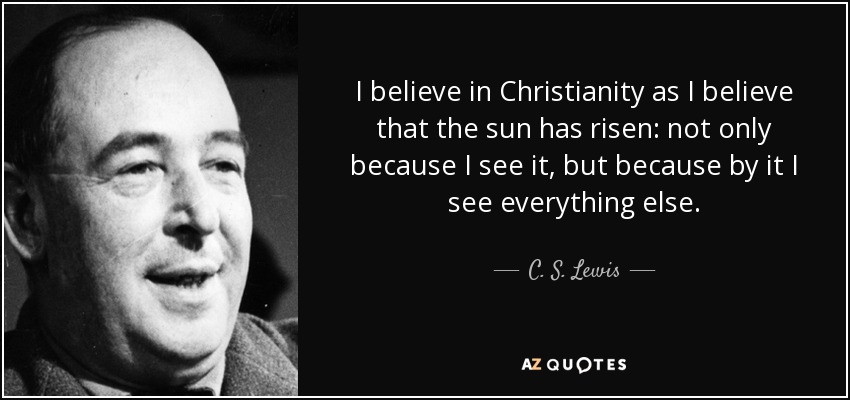
I love this quote from CS Lewis, the famous Christian author who was an atheist-turned Christian apologist. He never tried to scientifically prove the existence of God or the accuracy of the Bible. To Lewis, this is what it all comes down to:

Faith in Christ is the light that allows us to navigate through the darkness of this world. God is the light in which we can walk without stumbling. When we walk in the light together we can see the things of this world for what they are. We can more easily avoid the pitfalls and obstacles while reaching our goal – bringing heaven here on earth, reflecting God’s light for all the world to see.

John the Apostle, Doctor Who, Han Solo, and Intergenerational Discipleship

I never knew my grandparents.

I am the youngest child of two youngest children (something I coincidentally share in common with my youngest son). All of my grandparents died before I could ever really get to know them. As I get older, that reality hits a little harder. I love that my sons get to grow up knowing their grandparents.

Why?

Because it connects them to the past. A relationship with their grandparents reminds them that the world was around before them and will be here after them.

Generations fascinate me. I think there is so much we could learn from each other if we would just take a second and listen. I wish I could have had the chance to ask my grandparents what it was like to grow up in the Great Depression. Or what it was like to live through World War II. Or what church was like in the South during the Civil Rights movements of the 50s and 60s. What was is like to hear the news that President Kennedy had been shot? How did people in church respond when Martin Luther King, Jr. was assassinated? Did the moon landing rock your faith at all?

One day I hope my grandkids can ask me where I was on September 11, 2001, and how much the events of that day changed everything. I hope they can ask me about my first cell phone and smart phone, or about how the church responded to the LGBTQ revolution.

What does this have to do with anything?

In the end, all we have is our stories and our memories. Or as The Doctor used to say,

“We’re all stories in the end, just make it a good one, eh?”

I’ve heard it said recently that there are not really generations within the church. Each church is one generation of believers. I love that idea. The world wants to divide us up into generations. I’ve said it before, and I firmly believe it, that AGEISM is the most commonly accepted form of discrimination. Modern society is increasingly divided along generational lines.

It shouldn’t be that way in church. Those who are younger have much to teach us about how to be Christians in the current culture. Those who are older have much to teach us about remaining faithful to the God who never changes. Have we let the world dampen out ability to listen to each other and learn from each other?

When I read the writings of John, I hear the voice of an elderly Christian who is tenderly sharing his thoughts, experiences, and stories with his grandkids. I have no problem assuming that it was John the Apostle who composed the Gospel and Letters that bear his name along with the book of Revelation. And if that’s the case, we know from historic tradition that John was the oldest living apostle and the only one to die of old age.

So we have a letter (1 John) written by an elderly John (maybe in his 70s or 80s) and it opens like this:

That which was from the beginning, which we have heard, which we have seen with our eyes, which we have looked at and our hands have touched—this we proclaim concerning the Word of life. The life appeared; we have seen it and testify to it, and we proclaim to you the eternal life, which was with the Father and has appeared to us. We proclaim to you what we have seen and heard, so that you also may have fellowship with us. And our fellowship is with the Father and with his Son, Jesus Christ. We write this to make our joy complete.
(1 John 1:1-4)

John is writing to the next generation of believers. These were not eye-witnesses of Jesus’ ministry like John was. They did not have first-hand experiences with Jesus like John did. It reminds me of the first encounter Rey and Finn have with Han Solo aboard the Millennium Falcon in The Force Awakens. Han tells them a little bit about what he knows and has experienced. They are in awe and disbelief. He reassures this younger generation of ragtag runaways and rebels that, “It’s true. All of it.”

That’s what John is doing. Most of the original apostles, disciples, and church planters have died off. It’s nearly 60 years later. Many stories have been lost. Much teaching has been muddled or misconstrued. John looks around and sees what is becoming of this church that Jesus founded and charged them with expanding “to the ends of the earth.” So much has happened over the last 60 years that people are beginning to doubt, details are being lost, truth is getting mixed up with legend.

John looks at this new generation of Christians and reassures them, “It’s true. All of it.” He wants them to remember that he was there. He hugged Jesus. He ate with Jesus. He fished and camped and traveled and goofed around with Jesus.

John knows what Jesus’ voice sounded like. John remembers how infectious Jesus’ laughter was. John remembers the heartbreak and sorrow as Jesus wept outside Lazarus’ tomb.

John can remember like it was yesterday the moment Jesus was hanging, bloody and beaten, from the cross. He was there with Jesus’ mother when Jesus looked at the two of them and created an inseparable bond. They were family now. Mary had long since gone to be reunited with her Son. I wonder what Mary’s funeral was like? John could tell us.

John can still feel the rush of adrenaline pump through his aging veins as he recalls outrunning Peter to the tomb that morning but being too hesitant to go in. John can tell you exactly what the scars and holes in Jesus’ resurrected body looked and felt like. It was both gross and awesome.

John was there when Jesus ascended into heaven, but don’t ask him to describe it to you. He doesn’t quite have the words to explain it – and this was the guy who wrote Revelation.

“I was there. It’s true. All of it.”

But the thing I appreciate most of all in John’s letter is that he doesn’t come across as the “Old Man Yells at Cloud” type. He never uses the phrase, “back in my day.” He doesn’t complain about the current state of affairs or bemoan the loss of “the good old days.”

He’s writing this letter not simply to set the record straight, but to preserve unity and fellowship and love and joy. John doesn’t strike me as one constantly looking to the past, but as one eagerly anticipating a future filled with more believers, more faithful followers, more loving brothers and sisters, more grandkids in the faith. He doesn’t look to the future with fear and anxiety but with hope and excitement. Each day brings us closer to Christ, closer to each other, closer to the Kingdom of Heaven.

I think John is someone worth listening to. Even though he has been gone from this earth for nearly 2,000 years, his legacy lives on, and he has much to say to us next-generation disciples.

To Meme or not to Meme?

Let’s talk about memes.

I’m definitely no memetic expert (believe it or not, that’s a real thing that exists now because internet). But I am one of those darn Millennials who’s killing off all the good things your parents and grandparents tried to hard to build – like Applebee’s. So I think I can speak on the issue a little bit.

I love a good meme. A GIF or a still image with a clever joke, pun, or subtitle that gives you a quick LOL before you scroll further down on Reddit. I have friends who I count on sharing some quick chuckle memes every time I hop on the Face Books.

They make for some good “Haha! Look at this!” moments, and they can really give others a glimpse into your specific brand of humor.

Harmless. No big deal. Moving on.

Right?

Until…

2015/16 happened. As a digital native, I was flabbergasted by the sudden infiltration of political memes into my otherwise mostly peaceful habitat. My entire online ecosystem was overrun with memes about Trump or Hilary or Bernie or Pepe. I quickly and undelightedly learned which of my friends held which extreme political views.

I think there is something altogether different about political memes. Joke memes can be outrageous or over the top to spark a quick laugh. They’re created to get a gut-level emotional response. Memes seem to trigger a response that is quicker than logical thought. So if a meme has more than, say, 10 words total, you’ve lost me. Now I’m thinking too hard. Logic and reason simply get in the way of enjoying a good meme. The best memes are emotionally relatable at some level. They elicit this “it’s funny because it’s true” kind of response. And so we share them with the comment, “This is so MRN.” (me right now) And we move on IRL. (in real life)

Political memes seem to do the same thing – and that’s why they are so dangerous. If most regular memes exist to get a quick chuckle, political memes exist to get a quick outrage response. They are specifically designed to elicit an emotional response, but instead of relatable self-deprecating humor, they spark a sense of anger at some injustice or corruption or “I can’t believe what THOSE people do/say/believe.”

Political memes are, by and large, poorly photoshopped pieces of “art” created with an obvious bias that are meant to be easily disseminated and viewed on large-scale platforms for the sole purpose of increasing the US vs. THEM divide.

Another way to put it, political memes are “information, especially of a biased or misleading nature, used to promote or publicize a particular political cause or point of view.”

Which is actually the definition of PROPAGANDA.

Political memes are propaganda. Full stop.

It’s SO easy to click that “Share” button underneath a political meme you see in your timeline. And it’s a purely emotional reaction to do so. If you would give it half a moment’s thought along with a 30 second or less search on Snopes, you would probably realize that big, white block letters don’t make a statement true.

Sharing a picture with white writing on it to promote your political believes is lazy at best and dangerous at worst. All those “Pizzagate” memes lead to an actual murder!

Political memes are nothing more than propaganda, and propaganda has only ever served to deepen the divide between people. I see people sharing loads of propaganda on FB and then post about how sad it is that we’re so divided as a country. Want to start healing that rift between people? Then stop sharing that political propaganda bull crap.

[Side note: I’m not including articles, headlines, or even infographics. Those can be helpful and insightful. Memes? Not so much.]

When I see you post a political meme, I have no choice but to assume you agree 100%, not only with the message of the meme but also with the creator of the meme or the group that meme came from. Which, newsflash – a large percentage of the political memes people share come from other countries that don’t have our best interest at heart.

I’d be MUCH more interested in reading what you actually believe in your own words. If you disagree with someone/something, feel free to speak out. I’d like to hear your own thoughts, your own words, your own nuance.

Every political issue is more complex than can be accurately represented by a meme, anyway.

Finally, those of us who follow Christ should have an added interest in seeking and sharing the truth. And the truth is that Christians don’t fit into our two party system. We should represent a third way. Whenever the leaders of his day tried to suck Jesus into a political debate and get him to choose a side, he nearly always chose a third way that they never saw coming. He didn’t come to play those games. (And he didn’t always show the utmost respect for the office of the leaders, either. Remember that time he refused an audience with Herod and called him a “fox” in response?)

If political memes are only there to cause disunity and to spread misinformation, then I, as a US citizen but more importantly as a follower of Christ, want nothing to do with them.
…………………

What do you think about political memes? Are they harmful propaganda? Or are they harmless fun? Let me know in the comments, because that’s always a safe place for political discussion…