Page 14 of 70

What If PAW PATROL Was Actually Good?


Plot Synopsis:

In the very distant future along the coast of the former United States of America sits a city populated by the descendants of those who survived the great wars of the late 21st Century. The United States has dissolved. Local populations banded together to form city-states, which are mostly at peace with each other.

Leading up to, and during the great wars, corporations seized more and more power. Independent research firms, backed by government dollars, competed to become the first to create sentient human-animal hybrids. These hybrids usually retained the physique of the animal with the intelligence and communicative ability of humans. These sentient animals were given legally protected status and were trained in search-and-rescue and military operations.

Other corporations focused their research and development on multi-function vehicles (MFVs). These vehicles can transition from ground to water and air, playing a pivotal role in the great wars. Later, the remaining MFVs were de-weaponized and put to use for more civilian tasks – construction, emergency response, etc.

This city on the coast has chosen to raise a young boy with great potential to become the leader of their very own paramilitary group, specializing in search-and-rescue, emergency response, city defense, and anti-espionage. They would work in close conjunction with the mayor, the de facto commander-in-chief, of the city-state to ensure the health, safety, security, and prosperity of their citizens. She cares deeply about maintaining peace and order, but not at the cost of the citizens’ liberty.

While this city-state is working toward peace in an effort to preserve and rebuild civil society, not all power players feel the same. The mayor of a rival nearby city-state is power hungry and devious. He wants to consolidate power in the region and annex all surrounding cities under his supreme authority.

As political threats become increasingly hostile, our mayor calls upon the young man, now a preteen, to form his team and protect their city from any outside invaders or spies on the inside. She gives them full jurisdiction over all emergency and law enforcement efforts.


Together with the human-animal hybrids in this case, all dogs and the repurposed MFVs, this young man, Ryder, forms his paramilitary special ops team to protect and serve the citizens of Adventure Bay under the leadership of Mayor Goodway. Will they be able to stand against the political schemes of the rival Mayor Humdinger? Will they be able to rebuild a society to match that of centuries past?

These are the tales and adventures of Ryder and his Paw Patrol.


Dammed Faith

Faith is an interesting thing.

I find it fascinating that as we trace back human civilization – for as far back as we can see there has been some kind of faith, belief, or religious ritual. From cave paintings and burial rites to ancient temple complexes that were built while mammoths still roamed the earth, mankind has nearly always reached out for something greater.

A complete disbelief in God or the gods is a relatively new phenomenon. Religious belief has only come into question within the last few centuries – just a drop in the bucket compared to the full history of humanity. The burden today seems to be placed on those who believe to explain why rather than for those who don’t believe to explain why not.

For myself, I think of my faith in God as a river system. Belief in God is the large river cutting large swaths through the countryside. But that river had to form somewhere. Along the way, there are five smaller streams and tributaries — some larger than the others — that feed into the larger river of faith. As each of these smaller streams feeds into the others, the larger river begins to form and becomes an unstoppable force of nature.

So what are these streams, and why do they matter? I believe God reveals something of himself within each stream, and if we pay attention we will see the power and majesty of the mighty river begin to form.

CREATION
I think this is where it all starts. Who on earth can look up at the night sky illuminated by stars and galaxies and not feel simultaneously small and incredibly important? The mountains, the ocean, waterfalls, rainforests, desert sunsets, peaceful snowfall on the evergreens – for man and countless others, they all point to a larger reality. The glorious, awe-inspiring beauty and design must have an artist, an engineer, an architect behind it all.

In the beginning God created the heavens and the earth. Now the earth was formless and empty, darkness was over the surface of the deep, and the Spirit of God was hovering over the waters.
Genesis 1:1-2

The heavens declare the glory of God;
the skies proclaim the work of his hands.
Day after day they pour forth speech;
night after night they reveal knowledge.
They have no speech, they use no words;
no sound is heard from them.
Yet their voice goes out into all the earth,
their words to the ends of the world.
Psalm 19:1-4

For since the creation of the world God’s invisible qualities—his eternal power and divine nature—have been clearly seen, being understood from what has been made, so that people are without excuse.
Romans 1:20

EXPERIENCE
This one is a bit more subjective, but I believe in God because I’ve felt him. I’ve felt his presence around me. I’ve heard the call of his Spirit to pursue a life of ministry. At one of my darkest moments I felt him whisper, “I’m not through with you yet.” I have known his presence in the midst of a worship experience, speaking to me through the lyrics of the hymn Great Is Thy Faithfulness. It’s like how you can tell when someone is looking at you from across the room, you can feel their stare… Or when you think you’re alone, but suddenly you feel the presence of another person enter the room before you even hear or see them… It’s hard to describe, but you know it when you feel it. Don’t discredit your own personal experience of God’s presence.

You have searched me, Lord,
and you know me.
You know when I sit and when I rise;
you perceive my thoughts from afar.
You discern my going out and my lying down;
you are familiar with all my ways.
Where can I go from your Spirit?
Where can I flee from your presence?
If I go up to the heavens, you are there;
if I make my bed in the depths, you are there.
If I rise on the wings of the dawn,
if I settle on the far side of the sea,
even there your hand will guide me,
your right hand will hold me fast.
Psalm 139:1-3, 7-10

In the same way, the Spirit helps us in our weakness. We do not know what we ought to pray for, but the Spirit himself intercedes for us through wordless groans. And he who searches our hearts knows the mind of the Spirit, because the Spirit intercedes for God’s people in accordance with the will of God.
Romans 8:26-27

SCRIPTURE
Yes, I believe God is revealed in Scripture. Men and women throughout the centuries have had those experiences of God, encounters with the divine, and recorded them for us. God has chosen to reveal himself to us through the written word, preserved and passed down to us through the generations. We can know something of God through our personal experience and through our interactions with creation, but if we want to move from the general to the more specific — what is God actually like? — then we must seek him out within the Scriptures.

And he passed in front of Moses, proclaiming, “The Lord, the Lord, the compassionate and gracious God, slow to anger, abounding in love and faithfulness, maintaining love to thousands, and forgiving wickedness, rebellion and sin. Yet he does not leave the guilty unpunished; he punishes the children and their children for the sin of the parents to the third and fourth generation.”
Exodus 34:6-7

All Scripture is God-breathed and is useful for teaching, rebuking, correcting and training in righteousness, so that the servant of God may be thoroughly equipped for every good work.
2 Timothy 3:16-17

JESUS
I believe that Jesus is the ultimate revelation of God to humanity. This is by far the largest of the tributary system flowing into the larger river of faith in God. It’s been said that Jesus didn’t come to change God’s mind about humanity, but to change humanity’s mind about God. Do you want to know what God is like? Look at Jesus. Who does God love? Look to Jesus. How do we settle all the questions and debates about God in the Hebrew Scriptures (aka, the Old Testament)? Look to Jesus. Humanity had lost its way in fulfilling our call to be the Image of God in the world. Jesus comes and does it right.

In the beginning was the Word, and the Word was with God, and the Word was God. He was with God in the beginning. Through him all things were made; without him nothing was made that has been made. In him was life, and that life was the light of all mankind. The light shines in the darkness, and the darkness has not overcome it.
The Word became flesh and made his dwelling among us. We have seen his glory, the glory of the one and only Son, who came from the Father, full of grace and truth.
John 1:1-5, 14

The Son is the image of the invisible God, the firstborn over all creation. For in him all things were created: things in heaven and on earth, visible and invisible, whether thrones or powers or rulers or authorities; all things have been created through him and for him. He is before all things, and in him all things hold together. And he is the head of the body, the church; he is the beginning and the firstborn from among the dead, so that in everything he might have the supremacy. For God was pleased to have all his fullness dwell in him, and through him to reconcile to himself all things, whether things on earth or things in heaven, by making peace through his blood, shed on the cross.
Colossians 1:15-20

In the past God spoke to our ancestors through the prophets at many times and in various ways, but in these last days he has spoken to us by his Son, whom he appointed heir of all things, and through whom also he made the universe. The Son is the radiance of God’s glory and the exact representation of his being, sustaining all things by his powerful word. After he had provided purification for sins, he sat down at the right hand of the Majesty in heaven.
Hebrews 1:1-3

COMMUNITY

Finally, there is the community of believers. The Bible was NEVER intended to be a document about how to save individual souls for heaven. The Bible is the story of God and his people. God always has a group of people, from the first family, to the promise the all nations would be blessed through Abraham’s offspring, to the establishment of Israel as a nation. Even when Jesus comes, he calls his group of disciples who then go on to establish the church. God is revealed in community. God himself is a community of love. Our community, our gatherings, our families, our assemblies, reflect that self-giving love.

“My prayer is not for them alone. I pray also for those who will believe in me through their message, that all of them may be one, Father, just as you are in me and I am in you. May they also be in us so that the world may believe that you have sent me. I have given them the glory that you gave me, that they may be one as we are one—I in them and you in me—so that they may be brought to complete unity. Then the world will know that you sent me and have loved them even as you have loved me.”
John 17:20-23

Don’t you know that you yourselves are God’s temple and that God’s Spirit dwells in your midst?
1 Corinthians 3:16

No one has ever seen God; but if we love one another, God lives in us and his love is made complete in us.
1 John 4:12

DAMMED FAITH 

One or two of these may be explained away, but under the weight of all five, it’s hard not to see evidence for God all around us. The danger comes when we begin to dam up the streams.
When we shut ourselves inside in front of our screens instead of getting out in nature;
when we fill our schedules so full that we never have time to experience the presence of God in the silence;
when we stop diving into Scripture because it no longer seems “relevant;”
when we stop following Jesus in favor of another lord or master;
when we cut ourselves off from the community of believers because who wants to wake up early on Sunday anyway?
…Then it’s easy to see how the rushing river of faith becomes nothing more than a mere trickling drainage ditch.

Are you damming up the streams of revelation that feed into the river of faith? Maybe it’s time to release the flood gates and reconnect with God.

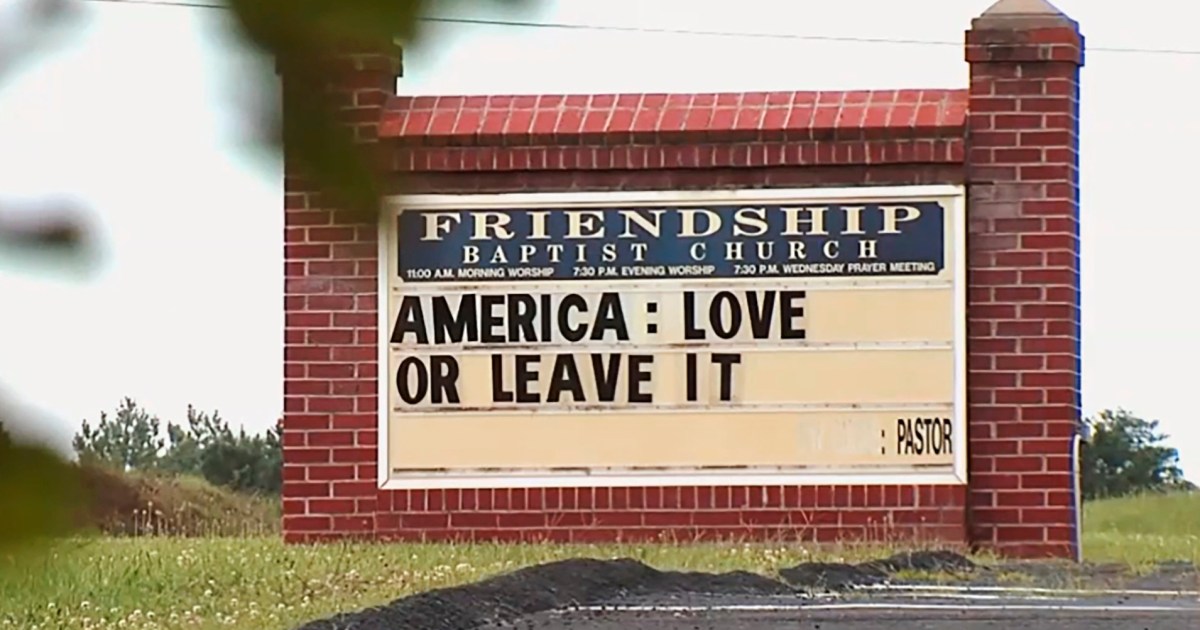
America: Love It Or…

Maybe it’s just me, but I’ve seen an uptick in heated rhetoric like this:

America: Love It or Leave It 

If you don’t like our country, then you can just leave.

This bothers me, and it always has. I remember when people said they would leave if Obama was elected president. Others said it about Hilary and Trump. It’s nothing new, really. But making the empty threat to leave the country if you don’t get your way is one thing. What’s happening now more than I’ve seen in the past is more of a threat against others. If you don’t like it, then just leave. You better love this country…or else. Why don’t you just go back to your own country.


Side note – it did make me chuckle when people said they would move to Canada or Europe if Obama was elected because he was too socialist… Um…should someone tell them?


Telling someone to leave the US if they don’t like it bothers me on many levels, both as a US citizen and as a Christian. Let’s see if I can put my thoughts and feelings into words.

IT’S AN INCREDIBLY PRIVILEGED IDEA
Americans in general are becoming less mobile than they once were. The internet and communications advancements have reduced the need to move across country for work. But when you factor in the rising cost of living in most areas, general economic insecurity, and the threat of unemployment with no guarantee of a job, moving locations within the country is cost-prohibitive to a large percentage of the population. In other words: Moving is expensive!

And that’s just within the country. How much more so to move out of the country. Not only is there an increased economic cost, but there is also the social and cultural cost of learning a new system of laws, new customs, even a new language. Let’s be realistic – leaving the country is not an option for the vast majority of citizens. Only those who move with their work and have expenses paid are able to do so. It’s a very privileged thing to assume that people CAN move in the first place.

IT’S A CALL FOR UNIFORMITY, NOT UNITY
Every single person has a different idea of how this country should be run. Not everybody is going to be happy all the time. That’s just the way life works. The question is: how do we respond when we are faced with a diversity of opinions?

If someone wants to challenge capitalism or the electoral college or the justice system, they are well within their rights to do so. We should hear them out. It’s funny how most of the people who use this “Love it or leave it” language are also the ones advocating for a “free marketplace of ideas.” The whole idea of a free market is competition that leads to innovation. If everyone only ever had all the same thoughts, opinions, and ideas, we would never be innovative or creative. We need unity through diversity – not uniformity.

THERE’S NO ROOM FOR EMPATHY
Imagine yourself as an asylum seeker in another country. You’ve never been there. You don’t know the language or the culture. You don’t know the laws. You are learning as you go. Imagine you’re able to enter the country and live there for a couple decades. You may find yourself missing home. You may find yourself wishing that some things were more like they were in your former country. You may even begin to suggest those changes or advocate for certain changes that you may think would benefit your current country. That doesn’t mean you want to go back home – this is your home now. It just means you care enough about your current country that you want to try and help make it better – according to your own opinion.

If you’ve never traveled outside the US, especially overseas, then you may have no idea what it’s like to be immersed in a foreign culture with different languages and customs. You have no idea what it’s like to be that kind of homesick. “Love it or leave it” leaves no room for empathizing with foreigners and immigrants. We can practice empathy without changing all of our values and customs. Other perspectives and worldview are not necessarily a threat.

NATION STATES ARE NOT RESTAURANTS
“If you don’t like it, then leave and go somewhere else” works when it comes to restaurants and other businesses. That’s part of capitalism and the free market. Consumer choice plays a pivotal role in our economy. If I want a chicken sandwich, I can choose Popeyes, Chick-Fil-A, Wendy’s, or a whole host of other establishments. If there is a restaurant I frequent that changes management and suffers a decline in quality and service, then YES I will be going elsewhere. We can shop around. We can be picky. We have a choice.

That’s great when it comes to businesses, but nations don’t really work that way. Yes, you can technically leave, but it’s complicated and not feasible for most people. This perspective makes citizens into consumers and nations into businesses. When that’s the case, money is the only language that matters and those without it lose their voice.

WHAT ABOUT THE PROPHETS?
Switching to a biblical perspective here, a large chunk of Scripture is composed of prophetic writings. Have you ever read the prophets? You can’t tell me those men didn’t love their nation. You can’t tell me that Isaiah didn’t love Israel or that Jeremiah didn’t love Judah. Those men loved their God and their nations so much that they couldn’t HELP but speak out on the injustices and immorality they saw. To say nothing was not an option. They spoke out against the political rulers and the religious elites. They spoke out against war, violence, bloodshed, and the horrible treatment of the poor, widows, orphans, and foreigners.

The prophets spoke out against injustice and economic power imbalances not because they hated their country, but because they wanted the country they loved to be better. They could see the trajectory of their nations and knew it could only end in disaster. They didn’t hate their country any more than a coach hates his players or a lifeguard hates young swimmers. Jesus himself wept over Jerusalem and predicted the disaster that would befall them. Does that mean he hated Jerusalem? NO! He died to save it.

THIS IS BABYLON, NOT JERUSALEM
Closely tied to my previous point, Christians often believe that the US is the world’s savior, that we are that “shining city on a hill.” Maybe we have that potential, but we aren’t there right now, folks. And if we profess to follow Christ, our allegiance is to the kingdom of God above all nations. We are “strangers and foreigners.” We are looking for “a better country, a heavenly one.” So maybe we should take a page out of Daniel and Jeremiah’s playbook.

Through Jeremiah, God wrote a letter to the Israelites in exile in Babylon. You can read it in Jeremiah 29. Basically, God tells them to get comfortable and settle down. Build houses, plant gardens, get married and have kids, and work for peace in Babylon, because if it prospers, then they would prosper. At one point Daniel read that letter. Daniel took it seriously, because he made himself indispensable to the kings and rulers of Babylon and Persia. He was a foreigner working for the prosperity of his enemy nations in an attempt to change it for the better.

America is Babylon. America is Rome. We are in exile. As foreigners and strangers, we should work for the prosperity of whatever nation we find ourselves in. So let’s stop it with all the “love it or leave it” rhetoric, and let’s work together for the peace and prosperity of our nation. Let’s work for change. Let’s seek the kingdom of heaven here. Let’s stop trying to “Make America Great Again” and start bringing about God’s will “on earth as it is in heaven.” In God’s kingdom there is room for everyone. In God’s kingdom there are people of “every nation, tribe, people, and language.”

America: If you don’t love it….then let’s work together to make a little more like heaven.

Learn Everything. Know Nothing.

I love to learn.

My oldest son gets it from me. When he was a toddler, he asked my mother-in-law, his “Nana,” to make a “little case q” out of play dough. Most kids would ask for animals or other shapes. Aiden asked for letters. He learned to read at age 3. He already knew all the sight words they would be learning before he ever set foot in his kindergarten classroom.

When I was younger my mom couldn’t bring home enough non-fiction books for me to read. Among my favorite shows were Magic School Bus and Bill Nye the Science Guy. I was a star student on our Bible Bowl team at church. When we would visit other churches, I answered questions in Bible class that the regulars didn’t know.

One time I was sent out into the hallway at school for correcting my English teacher too much.

Both of my parents have been educators their whole lives, so I guess you could say it’s in my DNA.

My interest in the Bible, Christianity, and Religion in general is a HUGE part of who I am. I love to learn. I love to be challenged. I love to see things from new and different perspectives. I love learning about and discussing religion, faith, Christianity, science, sociology, politics, etc.

This makes my task as a minister both awesome and frustrating.

On the one hand, I get paid to do what I love and what I am called to do. The church supports me and gives me the space to study, learn, grow, develop, and then teach what I’ve learned to others. I can’t see myself doing anything else. One of the best feelings in the world is to see someone finally get it.

On the other hand, it can be incredibly frustrating – like can’t fall asleep, high blood pressure, bad mood all day frustrating. Because as a minister, it’s my daily task to study and grow. I take seriously the charge Paul makes to Timothy, “Study to show yourself approved…rightly handling the Word of God.” And my job is one of the only ones to come with a warning in Scripture when James tells us that not many of us should become teachers, because we’ll receive a stricter judgment.

**WARNING** Here’s where I get preachy and soap-box-y.

The frustrating bit comes when members of the church pour water on the fire. They’ve been taught one thing when they were kids and haven’t grown or pivoted one inch in many decades. They have a very limited understanding of Scripture and are truly unwilling to be taught. They approach Scripture with the mindset of “The Bible says it. I believe it. That settles it.” They’re unwilling to do the hard work, the noble work (Acts 17) of examining the Scriptures to see if what they have been taught and are currently being taught is true.

I resonate with these words from Hebrews:

About this we have much to say that is hard to explain, since you have become dull in understanding. For though by this time you ought to be teachers, you need someone to teach you again the basic elements of the oracles of God. You need milk, not solid food; for everyone who lives on milk, being still an infant, is unskilled in the word of righteousness. But solid food is for the mature, for those whose faculties have been trained by practice to distinguish good from evil.
(Hebrews 5:11-14, NRSV)

I’m not even talking about knowing basic Bible facts. I don’t care if you know all the facts about a story if you miss the big-picture truth within that story. For instance, you may know all the details about the messy business between Abraham, Sarah, and Hagar. You may be able to tell me that Sarah put Hagar up to it. You may be able to tell me that Sarah began to get super jealous of Hagar after she had Ishmael. You may be able to tell me that Sarah made Hagar’s life a living hell until she ran away into the desert.

But you can miss the significance of a dark-skinned, African, fugitive sex-slave being the first person in all of Scripture to give God a name. God pursues Hagar and reassures her, comforts her, and she responds, “I have seen the God who sees me.” God is the God Who Sees – the minorities, the slaves, the poor, the runaways, the sex workers, the marginalized, the oppressed.

There is no one right way to read the Bible. That kind of thinking would be completely foreign to the Jewish Rabbis. They talked about “turning the diamond” of Scripture in order to see the beauty in every angle. They learned through debate and argument in community. The name “Israel” means those who wrestle with God, and that’s what the Hebrew Scriptures are – a collection of writings arguing about and wrestling with God.

Jesus comes along and settles those arguments. That doesn’t mean we’re free from the wrestling today. Each generation must do the hard work for themselves to discover the depths of Truth for their own time and place.

Can the story of the Ethiopian Eunuch inform how the church treats members of the LGBTQ community?

Can Jesus’ answer about taxes transform our political allegiances today?

Can the story of the Good Samaritan shape our understanding of social justice, civil rights, and racism?

Can the minor prophets speak to the way we view the Second Amendment?

When it’s all said and done, I want to be a part of a church where you walk through the parking lot and see a jacked-up diesel truck with a Confederate flag license plate parked next to a Prius with Pride stickers – and both owners are welcomed, both owners are challenged, and both owners meet with Jesus.

I’m tired of the church spinning its wheels. I’m tired of people who haven’t done any serious study in decades throwing water on the fire of those who are passionate about building the Kingdom in the 21st Century. I’m tired of Christians who are more informed by cable news than by the Gospels.

We need the wisdom to know what’s biblical and what’s cultural. We need the wisdom to know when to act and when to wait. But we also need the wisdom to follow the Spirit’s guidance into deeper understanding and insight. We must be willing to be made uncomfortable for the sake of the kingdom.

When I was in high school I remember getting into a discussion/debate with some of my friends. I grew up in a really conservative part of the Bible belt in very traditional churches of Christ. I raised the hypothetical to them: If a man is a faithful baptized believer who loves Jesus, serves others, and does all the Christian-y things, and he attends a church that is active and faithful except they use instruments in their worship – will that man go to hell because of it?

Because of the way we were taught and raised, my friends said yes.

That’s when I knew this was a journey I was going to have to make without them. I’m not interested in assigning people to hell. I’m not interested in a branch of Christianity that is known for what we’re against. I’m not interested in playing those Pharisee games.

I’m interested in doing the hard work, to learn, to grow, to discover, to be inspired, to dive deep. And I’m interested in holding all things loosely except for Christ.

For I decided to know nothing among you except Jesus Christ, and him crucified.
(1 Corinthians 2:2)

I want to learn everything….but know nothing….except Christ.