Page 5 of 6

Mental Health & Faith: The Path to Healing (Part 3)

This is the final installment in our three-part series on mental health truths. If you haven’t read Part 1 and Part 2, I encourage you to start there. Today, we’ll explore the final six truths about mental health and faith that can lead us toward healing.

TRUTH #13: You don’t have to be “strong enough.”

Let’s bust a common myth right now: “God won’t give you more than you can handle” is not in the Bible. Scripture says God won’t let you be tempted beyond what you can bear (1 Corinthians 10:13), meaning there’s always a way to resist sin. But this has been twisted to suggest we should always be able to handle whatever life throws at us.

Continue reading → Mental Health & Faith: The Path to Healing (Part 3)

HOPE AND ASSURANCE: Dinner at Cleopas’ House

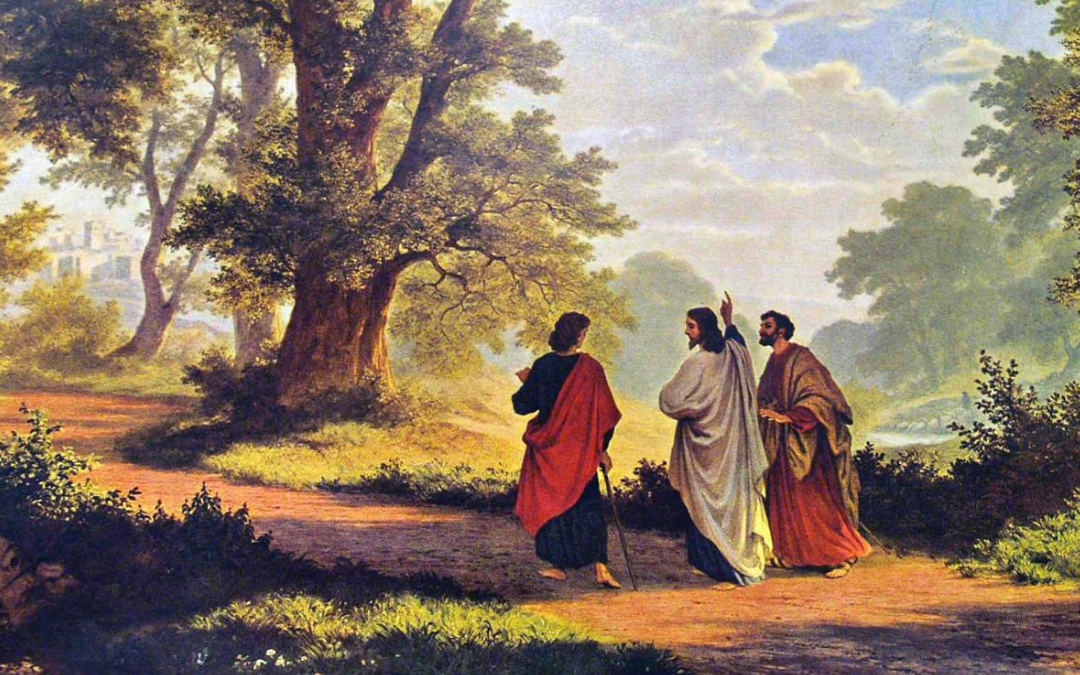
In the aftermath of Jesus’ crucifixion, two discouraged disciples left Jerusalem for the village of Emmaus. Their hopes had been crushed. The man they believed would redeem Israel had been executed by Roman authorities, and now they were making the seven-mile journey home, processing their grief and confusion.

As they walked and discussed recent events, a stranger joined them – Jesus himself, though they were prevented from recognizing him. When he asked what they were discussing, they stopped in their tracks, astonished that anyone in Jerusalem could be unaware of what had transpired.

Continue reading → HOPE AND ASSURANCE: Dinner at Cleopas’ House

SALVATION AND BELONGING: Dinner at Zacchaeus’ House

Throughout the Gospels, Jesus was known for sharing meals with people – so much so that his critics labeled him a “drunkard and a glutton” and “a friend of all the wrong people.” Luke’s Gospel, in particular, records numerous instances of Jesus eating with others, showing how breaking bread together was central to his ministry.

In Luke 19:1-10, we encounter one of the most memorable meal-sharing stories: Jesus’ encounter with Zacchaeus. As Jesus was passing through Jericho (yes, that Jericho from Joshua’s famous battle), he met a man who would forever be remembered for two things: being short and climbing a tree. Poor guy – immortalized in a children’s song as “a wee little man,” Zacchaeus’s physical stature has overshadowed his bigger story of transformation.

Continue reading → SALVATION AND BELONGING: Dinner at Zacchaeus’ House

Knowing vs. Doing: You know what to do. So do it!

The great Yogi Berra once said, “In theory, there is no difference between theory and practice – in practice, there is.”

The great Jesus Christ once said, “Why do you call me ‘Lord, Lord’ and not do what I say?”

James, the brother of Jesus, would put it this way: “Be doers of the word, not just hearers.”

I think deep down we all know the things we SHOULD be doing.

If we follow Christ we are called to love God with all our heart, soul, mind, and strength, and to love our neighbors as ourselves. Practice humility. Give to the poor. Study God’s word. Pray without ceasing. Turn the other cheek. All that stuff.

Continue reading → Knowing vs. Doing: You know what to do. So do it!

Struggle: Embrace the Suck

Working out sucks.

Eating healthy is no fun.

Keeping a good sleep schedule is just too difficult.

Getting to church every Sunday is just not gonna happen.

I’m sore. I’m tired. I just want to eat cookies and watch Netflix in bed.

Sound familiar? Like I’ve said, humans – like water and electricity – will always take the path of least resistance. Couple that with our inability to delay gratification at all (exercise will help me feel good later, but that donut will make me feel good now), and it’s no wonder the average American is more sedentary and overweight than ever.

Continue reading → Struggle: Embrace the Suck

Consistency: Are you in it for the long haul?

There’s a lot of talk going around about habits, goals, and bettering ourselves.

I’ve heard a lot of buzz about the concept of getting 1% better. If you get just 1% better every day, then but the end of the year you’ll have perfected whatever it is you’re trying to do.

The book Atomic Habits by James Clear (which is on my to-read list) encourages us to develop habits instead of setting goals. By doing so, we subtly change our own identity – how we see ourselves and present ourselves to others. You aren’t just going for runs every so often. You are a runner.

What it all comes down to is consistency. Nothing will become a habit if you aren’t consistent. You won’t reach your goals without putting in the work day in and day out. You aren’t in it for the short-term results (which you probably won’t see on a day to day basis). You’re in it for the month over month, year over year progress toward becoming the person you truly want to be.

Continue reading → Consistency: Are you in it for the long haul?

Sustaining Hope

Psalm 91:2

I will say of the Lord, “He is my refuge and my fortress, my God, in whom I trust.”

What a year it’s been. It has been almost a year to the day since we got the call informing us schools would be closed before and after spring break. We were nervous but hopeful that this would all be behind us by Easter, or by Summer, or by next school year, or by…. Yet here we are.

Continue reading → Sustaining Hope

Dunning-Kruger: A Little Knowledge Is a Dangerous Thing

Have you heard of cognitive biases?

Everyone has them. If you think you don’t, then that’s called the Blind-Spot Bias.

In some ways we couldn’t function without them. Cognitive biases are kind of like shortcuts in the brain. We take in so much information throughout the day that we have to find a quick, somewhat efficient way to make sense of it all. Add to that the fact that we are highly social beings and we desire almost above everything else to be a part of an “in group.” So we will overlook and ignore some things in order to keep our own personal beliefs and actions in line with the group to which we want to belong.

I would argue that most cognitive biases are not inherently bad, so long as we recognize them and can become more aware of when we are relying on them too heavily. But if we are aren’t self-aware, if we just kind of live on autopilot and let our cognitive biases take too much control, then what starts out as a shortcut can quickly turn into a train wreck.

As a Christian and one who pays attention to the social fabric of our world, I am simply astounded by  the types of cognitive biases I see derailing our lives and conversations, especially online. Let’s try to take a faith-informed look at some of the more common biases so we can become more aware of how they affect our lives and what we can do about it.
__________
I’M NO EXPERT, BUT…


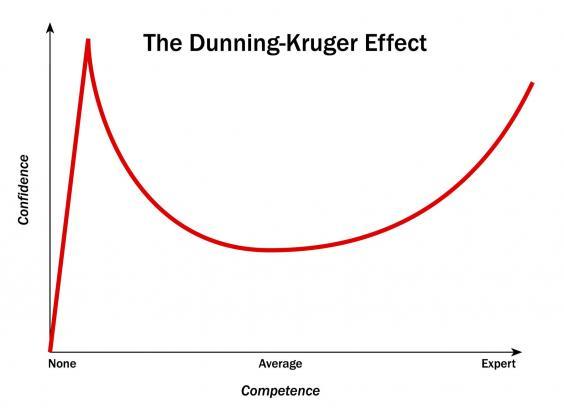
One of the more interesting cognitive biases is named the Dunning-Kruger Effect. It’s a psychological phenomenon where the less a person knows about a particular subject, the more confident they are in their perceived understanding. In other words, they know just enough about something to be dangerous with it. But if they actually put in the time and effort to thoroughly study a topic, their overall confidence decreases with more knowledge. At some point along the way, as they approach expert status, their confidence slowly climbs back up. The graph looks like this:

If you pay attention to all the different voices coming our way about this pandemic, you will see the Dunning-Kruger Effect in full swing. Those who know just a little bit are often the loudest, most confident, with the most certainty in their statements. But actual experts in the field speak with seemingly more uncertainty. They aren’t as apt to give straight-forward answers, and they readily admit that there are a lot of unknowns. Because here’s the thing about experts – ONLY EXPERTS KNOW WHAT THE UNKNOWNS ARE. And if they really are experts, they will admit where the knowledge base is unclear on any given topic.

Unfortunately, this preys on our bias towards ascribing credibility to those who sound confident in their arguments. Plenty of falsehoods are being spread from loud, confident-sounding novices, and that gets our attention.

As people of faith, we should always be somewhat skeptical of anyone claiming to have all the answers, especially if they are simply trying to out-shout the other voices. Jesus often got into arguments with the religious leaders of his day – men who knew just enough about the Scriptures to be dangerous. There is a level of humility that comes with true knowledge. If anyone thinks they have “arrived” and know all there is to know about a certain topic, then that’s when we must be on our guard.

One of the best examples of this is when Paul went through his conversion. He started off as a know-it-all Pharisee. Then the resurrected Jesus rocked his world and showed him how little he actually knew. This same Paul would go on to write, “I determined to know nothing among you except Christ and him crucified.”

When it comes to the pandemic, health and safety, or even religion, I would rather listen to the humble expert than the overconfident novice.
__________

For a quick guide to more cognitive biases, I recommend this article from Business Insider: 61 Cognitive Biases that Screw Up Everything We Do

You Can’t Go Home

Do you remember this Bon Jovi song?

Who says you can’t go home?
There’s only one place they call me one of their own
Just a hometown boy born a rolling stone
Who says you can’t go home?
Who says you can’t go back?
I been all around the world and as a matter of fact
There’s only one place left I wanna go
Who says you can’t go home?
It’s alright, it’s alright, it’s alright, it’s alright, it’s alright

I don’t know that I agree with Jon. I think there comes a point when “home” doesn’t feel like home anymore. I moved to Columbia, TN, in 1998, when I was entering 5th grade. I went away to college at Harding University in 2007. It was my home for about 9 years. It hasn’t been my home for just as long now.
It’s weird going “home.” My parents still live there. A lot of my classmates are still there. My best friends from high school are still around there. But it’s not home.
I’ve always been able to relate to the story of Jesus in Mark 6:1-6 when he goes back to Nazareth, his hometown.

Jesus left there and went to his hometown, accompanied by his disciples. When the Sabbath came, he began to teach in the synagogue, and many who heard him were amazed.
“Where did this man get these things?” they asked. “What’s this wisdom that has been given him? What are these remarkable miracles he is performing? Isn’t this the carpenter? Isn’t this Mary’s son and the brother of James, Joseph, Judas and Simon? Aren’t his sisters here with us?” And they took offense at him.
Jesus said to them, “A prophet is not without honor except in his own town, among his relatives and in his own home.” He could not do any miracles there, except lay his hands on a few sick people and heal them. He was amazed at their lack of faith.

Jesus grew up in a small working-class town. He was the son of lower-middle-class, blue collar parents. He was trained as a carpenter / construction worker. He was the older brother to all these other siblings. This is how he was known by those people back home.

I can imagine that a lot of them still remember the scandal surrounding his conception and birth. These people back home remember seeing him grow up and learn the family trade. This was a time when there wasn’t a lot of “upward mobility” or changing occupations. You did what your father/family did. But at some point Jesus left home. He left his family, his business, and his town behind. I don’t know how long he was gone, where he went, or what he did. I wish we knew, but we aren’t told. But when Jesus came back to Nazareth, everything was different – and nothing had changed.

Most young adults experience this same feeling. You go off to college, meet new people and have new experiences. You begin to see the world in a whole new way and realize that it’s a LOT bigger than you ever could have imagined from your small town bubble. You’ve grown and changed, but the people back home haven’t.

You can still drive all the backroads without thinking about it. You still have all the memories and all the feels. But it’s not home anymore. Maybe you come home and want to hang out with all of your old friends and share your college experiences with them. They sound interested at first but then move on to the same old gossip about people you don’t really know anymore.

Notice again how the people of Nazareth reacted to Jesus. They started out amazed and impressed. But that soon evolved into belittling and patronizing. Isn’t this just the carpenter? Just Mary’s son? Just the brother of James, Joses, Simon, and Judas? Where did he learn all these things? Who does he think he is?


They still see him as he was in the past. Hometowns can be that way – always looking to the past and hardly ever looking toward the future, focusing on how things were, not on how things are or could be. To them, Jesus is still just a carpenter and the illegitimate child of a scandalous relationship.

But Jesus doesn’t get sucked into that sort of thinking. He refers to himself as a prophet. And Jesus realizes a great truth – prophets tend to be least effective among their own families and towns.

Because the people of Nazareth didn’t believe in him or take him seriously, Jesus couldn’t do the same type of miracles as he had been doing elsewhere in the region. Some of the teens in our Wednesday night class made a great point – maybe faith is not the product of miracles, but miracles are the product of faith. We often think that if we could just see a miracle for ourselves, then we would believe in God. But that’s not the way it works. Some people even saw the miracles and still didn’t believe. Faith is not the result of seeing miracles. Witnessing miracles is a result of faith in Christ. Not that you’re guaranteed to see miraculous healings at the hospital if you simply believe hard enough, but rather you begin to see the everyday miracles of life and love and beauty. You will begin to realize that every healing is miraculous, every person is a walking miracle of existence.

I think this story of Jesus’ hometown tells me something about spreading the gospel. I believe it’s important to begin with your friends and family, your neighbors and your hometown. But I also believe it’s really difficult to be a minister (evangelist, prophet, pastor, etc.) among your hometown crowd. Jesus and his disciples are constantly on the move. Very rarely will the gospel call you back to your comfort zone. The man with the legion of demons in Mark 5 is the only person I can think of who was tasked with taking the gospel message back to his friends and family. Everyone else is told to go – go out into the world, go outside your comfort zone, leave the nest, venture out into the unknown. Where your family is, there is your home. And we’ve got family all across the globe.

Follow God’s call wherever he takes you.

rCQ: Questions from an atheist

/r/Christianity Questions

Recently, I came across this series of of questions asked by a Reddit user:

1) Do you agree with everything in the bible, sometimes it can be really messed up (like those quotes atheists like to bring up when they are debating with christians for example “Now therefore, kill every male among the little ones, and kill every woman who has known man intimately. But all the girls who have not known man intimately, spare for yourselves. Numbers 31:17-18”

2) Is the Bible like your law or advice for better life?

3) How often do you question your beliefs?

4) Are creationists the majority of christians?

Here are my answers:

1) It is my belief that if it can’t be said about Christ, it can’t be said about God (seeing as they are one and the same). I read about the violence of the nations in the Hebrew Scriptures in light of the cross of Christ. Jesus’ violent death at the hands of the state reveals the evil of state-sanctioned killing. So no, I don’t particularly “agree” that God truly commanded the killing of innocents. It was a shocking reality of war. I think this actually gives credence to the reliability of Scriptures. The writers certainly don’t try to sanitize or sugar coat anything. God is for sure a God of justice, but God is more so a God of grace and mercy, willing and desiring to save all who would turn to God.

2) The Bible is an argument about God. It’s a compilation of history, law, poetry, prophetic writings, letters, and biographical accounts. The Bible is a collection of 66 (or more) individual documents by at least 40 different authors/editors, written and compiled over the course of about 1500 years. It’s so much MORE than a law or book of good advice. It’s a window into how the people of God have interacted with, debated about, and sometimes literally wrestled with God. It’s the story of God and his people. The closest thing we Christians have to a “law” is maybe Matthew 5-7, the Sermon on the Mount. But it really boils down to “Love God with all your heart, soul, mind, and straight, and love your neighbor as yourself.” That is our law. That is our advice for a better life.

3) I question my beliefs all the time. Doubt is not the opposite of faith. Certainty is. Faith isn’t faith if there isn’t a degree of doubt, the idea that I could be wrong about all this. Certainty is the destroyer of faith, because as soon as your faith becomes too rigid it stops growing and evolving.

4) Young Earth Creationism stems from a demand for a 100% literal reading of Genesis 1-11. That view is dying off, and certainly isn’t as much of a stronghold as it used to be.