Jonah: Bravely Ran Away

Ok, so here’s the thing. Psychologists sometimes explain consciousness as the story we tell ourselves. We make meaning out of anything and everything. We have supporting characters and extras, protagonists and antagonists. And wouldn’t you know it? We just so happen to always be the hero in our own story. One of the best portrayals of this is in the Will Ferrel movie Stranger Than Fiction.

We are the hero in the story we tell ourselves that makes up our conscious experience of life.

Got it?

Good.

So the thing to remember about Jonah is that he is the hero in his own story. No, he may not be the “hero” in the story recorded in Scripture. But in the moment, to himself, he is definitely the good guy. Jonah is doing what he thinks is right. He/Israel is the good guy. Nineveh/Assyria is the bad guy.

Where does that put God?

There’s an interesting scene in the book of Joshua. The Hebrew nation is on the verge of entering the Promised Land after 40 years of nomadic life in the wilderness. The only thing standing in their way is the heavily fortified city of Jericho. Joshua is walking around the area one time and he’s stopped in his tracks by an Angel from God. Joshua asks if the Angel is on their side or on the side of Jericho. The Angel’s answer? “Neither.” (Joshua 5:13-15)

Is God for us or for our enemies? Neither. That’ not how this works.

Jonah thinks he’s doing the right thing by disobeying God. The call to Nineveh seems traitorous. Jonah still has this “us vs. them” mentality. God doesn’t play those games. God is not for someone if it means being against someone else. God is truly for all people, everywhere.

For God so loved the world, that he gave his only Son, that whoever believes in him should not perish but have eternal life. For God did not send his Son into the world to condemn the world, but in order that the world might be saved through him. (John 3:16-17)

The Lord is not slow to fulfill his promise as some count slowness, but is patient toward you, not wishing that any should perish, but that all should reach repentance. (2 Peter 3:9)

…but God shows his love for us in that while we were still sinners, Christ died for us. (Romans 5:8)

It’s completely counter to the message of Scripture to believe there are some people not worth saving. God gave Jonah a mission to go to the Assyrians in Nineveh. Jesus gave his disciples (including us!) a mission to go into “all the world” and take the message of God’s grace to “every nation.” All means all. Every means every.

But there’s more to it for Jonah. This is possibly the most shocking part of Jonah’s escape. God gives a chilling warning to Ezekiel (who was after Jonah, but I believe the warning would still apply to Jonah).

Once again a message came to me from the Lord: “Son of man, give your people this message: ‘When I bring an army against a country, the people of that land choose one of their own to be a watchman. When the watchman sees the enemy coming, he sounds the alarm to warn the people. Then if those who hear the alarm refuse to take action, it is their own fault if they die. They heard the alarm but ignored it, so the responsibility is theirs. If they had listened to the warning, they could have saved their lives. But if the watchman sees the enemy coming and doesn’t sound the alarm to warn the people, he is responsible for their captivity. They will die in their sins, but I will hold the watchman responsible for their deaths.’
“Now, son of man, I am making you a watchman for the people of Israel. Therefore, listen to what I say and warn them for me. If I announce that some wicked people are sure to die and you fail to tell them to change their ways, then they will die in their sins, and I will hold you responsible for their deaths. But if you warn them to repent and they don’t repent, they will die in their sins, but you will have saved yourself.” (Ezekiel 33:1-9)

Did you catch that? If you know something bad is going to happen and you don’t tell anyone – that’s on you! So often we use fear of rejection as a reason not to share the Gospel with people. But if we neglect to tell people about Jesus, then their eternal destruction is on us. If we tell them and they refuse to listen, then that’s on them.

Jonah refused to go to Nineveh and warn them of the coming destruction. In doing so, he was accepting responsibility for their demise.

If Jonah is the hero and Nineveh is the enemy, then it obviously makes sense that Jonah would do this. He’s single handedly ensuring the downfall of Israel’s greatest enemy. Way to go, Jonah!

Our task is to see the world as God see it – not as us vs. them, not as winners and losers, not as good and evil, but as God’s children. Or as Jesus would put it – the 99 sheep in the fold and the one lost sheep waiting to be found.

What do you think? Was Jonah doing the right thing for Israel? What would you do if God called you to share the Gospel with your “enemies?” Keep the conversation going in the comments, and be sure to subscribe so you never miss a post!
Jonah: World’s Worst Prophet

I may be one of the few people in the world who considers Jonah among my favorite books of the Bible. Don’t @ me. The book of Jonah has a lot of things going for it:

  1. Emphasis on God’s grace, mercy, love, and forgiveness
  2. High seas adventure
  3. Near death experiences
  4. A man swallowed by a gigantic sea creature
  5. An entire city on the verge of destruction
  6. Angry outbursts and melodrama by the overly emotional main character
  7. A protagonist that you just can’t really like, but is also super relatable
  8. Twists, reversals, and ironic situations
  9. A cliff hanger ending
There has been a lot of debate in scholarship about whether Jonah is based on a true story or if it’s merely a fictional parable. I’m not going to get into it much except to say that it has a lot of similarities to the stories of Elijah and Elisha. If it’s based on a true story, then it’s quite a remarkable tale! But if it’s not grounded in fact, it is still an amazing story that illustrates God’s love to its fullest extent and reveals our own failure to live up to God’s expectations.
If the story of Jonah is a parable, it is, in a way, THE parable of the Bible.
It begins with a pretty standard format:

Now the word of the Lord came to Jonah the son of Amittai… (Jonah 1:1)

Right from the start there are some things worth diving into. (Pun intended)
THE WORD OF YHWH
The author wants us to know that God is the main character, the main driver of the plot in this story. Nothing else would have occurred had it not been set in motion by “The Word of YHWH.” God is the main character. Jonah is just playing a supporting role in God’s story.
I can think of a couple other instances when God’s word set great things in motion. Immediately this should bring us back to Genesis 1 – the beautiful song of creation that begins our whole Bible. It is by the power of God’s word that he sets time and space into motion. “And God said…” is the driving force of creation. God’s word has power. God’s word must be obeyed – at least by nonhuman creation. That is an important distinction to keep in mind.
For Christians, this should also bring us to John 1, “In the beginning was the Word…” John wants us to know that “the Word of YHWH” took on flesh and moved into the neighborhood. His name is Jesus. Immediately, there is a solid connection between Jesus and Jonah – a connection that will be made more and more clear as the story unfolds.
JONAH, SON OF AMITTAI
What do we know about Jonah? First off, names almost always have significant meaning in the Bible. This is no exception. Jonah’s name is the Hebrew word for “dove.” He is the son of Amittai, whose name means “God is Faithful.” Jonah is a flighty prophet, here one moment and gone the next. When things get uncomfortable, he flees. But he is the son of God’s faithfulness. Where Jonah runs away, God is faithful in pursuing Jonah. God is faithful to Jonah even if Jonah is not faithful to God.
“Jonah, son of Amittai” is a good synopsis of what the story is about.
This is not the first time we encounter Jonah, either. We find him first mentioned in 2 Kings 14.

In the fifteenth year of Amaziah the son of Joash, king of Judah, Jeroboam the son of Joash, king of Israel, began to reign in Samaria, and he reigned forty-one years. And he did what was evil in the sight of the Lord. He did not depart from all the sins of Jeroboam the son of Nebat, which he made Israel to sin. He restored the border of Israel from Lebo-hamath as far as the Sea of the Arabah, according to the word of the Lord, the God of Israel, which he spoke by his servant Jonah the son of Amittai, the prophet, who was from Gath-hepher. For the Lord saw that the affliction of Israel was very bitter, for there was none left, bond or free, and there was none to help Israel. But the Lord had not said that he would blot out the name of Israel from under heaven, so he saved them by the hand of Jeroboam the son of Joash. (2 Kings 14:23-27)

Jonah was a prophet in the Norther Kingdom of Israel during the reign of Jeroboam II (ca. 750 BC).

During Jeroboam’s reign (who was an evil king, BTW) the borders of Israel were restored to the greatest extent they had ever been. Israel gain in power like it hadn’t seen in a long, long time. Israel improved its military, its economy, and everything was going well. Israel had been made great again, all thanks to the prophetic word of Jonah, son of Amittai.

So we know that Jonah worked closely with the king. We know that Jonah oversaw one of the greatest surges in nationalistic power they had ever seen. We know that Israel’s enemies were losing strength during this time. Jonah was surely swelled up with nationalistic pride and probably equated patriotism with religious fervor.

That’s why the next words in the story are so shocking:

“Arise, go to Nineveh, that great city, and call out against it, for their evil has come up before me.” (Jonah 1:2)

This was the first time God had called one of his prophets to go specifically to a gentile nation for the purpose of prophesying to/against them. Why is this important? Why Nineveh?

NINEVEH
The earliest mention of Nineveh is way back in Genesis 10. It was one of the major cities established in the Fertile Crescent along the Tigris River. Genesis claims that it was established by Nimrod as part of his kingdom. This automatically puts Nineveh in a bad light, because Nimrod was viewed as an enemy of God.

Nineveh is a very ancient city. It was an ancient city by the time the Assyrian Empire rose to power. The Assyrians were brutal. When they overthrew a city or nation, they would completely decimate its people and culture. Assyria had its eyes set on Israel for a while because Israel was a very strategic location. But during Jonah’s time the Assyrian Empire had a string of incompetent rulers and was in a period of decline and upheaval.

Nineveh was not the capital city of Assyria at that time. But it was easily representative of the Assyrian Empire in much the same way New York City, Chicago, or Los Angeles would be representative of the USA. If God wanted to send a message to the Assyrian Empire, Nineveh was as good of a place as any.

But why even bother?

God tells Jonah that their “evil has come up before me.” The phrase is similar to saying, “I’ve had it up to HERE with their evil!” YHWH had not turned a blind eye to the evils of the empire and the surrounding nations. YHWH would seize this moment of opportunity, while the empire was up against the ropes in decline, to try and reach them with his message of mercy.

And God chose Jonah to be the mouthpiece, the arbiter of grace to Israel’s enemy.

What could possibly go wrong?

God told Jonah to get up and go to Nineveh…

But Jonah rose to flee to Tarshish from the presence of the Lord. He went down to Joppa and found a ship going to Tarshish. So he paid the fare and went down into it, to go with them to Tarshish, away from the presence of the Lord. (Jonah 1:3)

Jonah, what are you doing? Running away from God? Are you crazy?

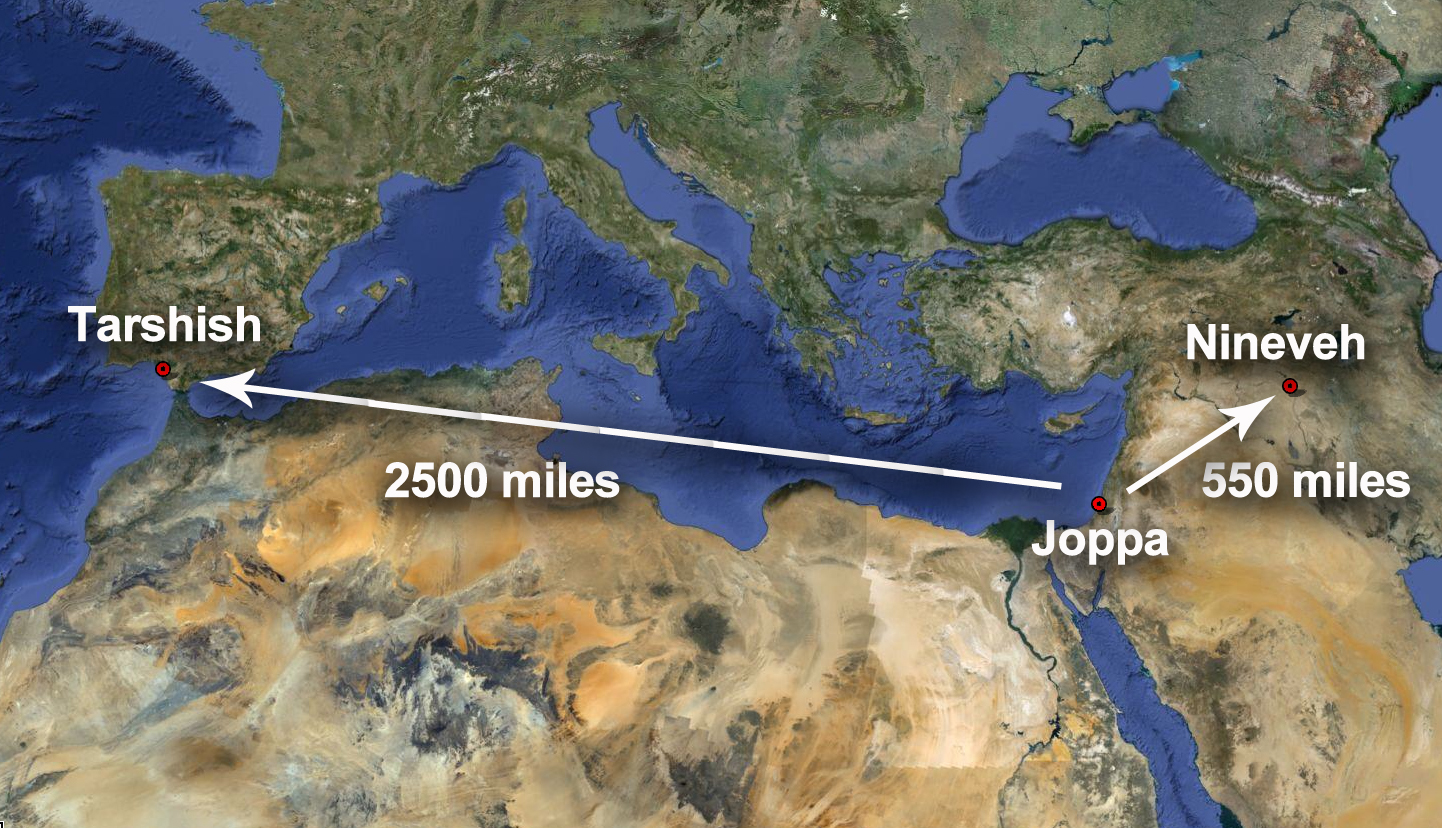
Notice a few things about this verse. Tarshish is mentioned three times. This was a purposeful, deliberate plan on Jonah’s part. He didn’t just show up and board the first boat he came across. He wanted to pick the farthest point on the map – a three year round trip by some estimates.

“From the presence of the Lord” is said twice. Jonah knew he was directly disobeying God. He was doing everything he could to get out of this trip. By why would he think God wouldn’t be in Tarshish? Because Isaiah had said as much:

I will set a sign among them. And from them I will send survivors to the nations, to Tarshish, Pul, and Lud, who draw the bow, to Tubal and Javan, to the coastlands far away, that have not heard my fame or seen my glory. (Isaiah 66:19)

God’s word and presence hadn’t been proclaimed in Tarshish. Perfect. Let’s go there!

Jonah went down to Joppa and down into the boat. This begins a downward spiral, descending into further rebellion and distance from God and closer to chaos and the grave.

And that phrase “paid the fare” is better understood as commissioning the whole ship and crew for the voyage. He wasn’t just buying a ticket for a bunk on the boat. He was financing the entire mission.

Verse three emphasizes the lengths to which Jonah was willing to go in order NOT to do what God told him to do. Nineveh was about a 550 mile, relatively easy trip across land via trade routes. Tarshish was on the Southern coast of Spain at the farthest edge of the Mediterranean Sea, risking storms, shipwrecks, pirates, disease, and more.

Jonah truly was the world’s worst prophet. I don’t like Jonah.

But then I realize that I see so much of Jonah inside me. To what lengths have I gone to avoid doing what God has called me to do? Who am I staying away from? What am I running from? What responsibilities am I shrugging off?

There’s a little bit of Jonah in all of us.