Page 43 of 81

How (Not) To "Twerk" (Or why we need more Vashtis)

This is not a post about you-know-who. She has gotten so much press and publicity that I don’t think I need to promote her by even saying her name.

This is a post about culture. Not youth culture. Not pop culture. But human culture. Other blogs I have read have pointed to the phrase in Ecclesiastes 1:9, “There is nothing new under the sun.” We’re still the same old humans living in the same old world promoting the same old sins.

Don’t believe me? Just compare the MTV Video Music Awards (and many other awards shows) to some of the parties thrown in the Bible.

Take the party of King Herod for instance. Mark 6:14-29 tells us a sad story that began with perverted, lustful entertainment and ended in the death of an innocent man. Herod had married his brother’s ex-wife, which would be taboo even today. John the Baptist called him out on his sin and was promptly thrown in prison. Fast forward to Herod’s birthday when he decided to host a huge banquet in honor of himself (not unlike many celebrities and pop stars today…). All the “celebrities” of the day were there – high officials, military commanders. and the leading men of Galilee.

And then there’s this: “When [his step-daughter] came in and danced, she pleased Herod and his dinner guests” (Mark 6:22). [Next time on Dr. Phil…] She “pleased” him so much that he made an extravagant offer – “Whatever you ask I will give you, up to half my kingdom.”

She didn’t want half the kingdom. She wanted the head of John the Baptist on a silver platter.

Unfortunately, I think we live in a world with far too many “step-daughters of Herod,” women who are more than willing to use their bodies as sexual objects to manipulate men into doing what they want. We have men who want to treat women like a piece of meat, and we have women who are more than happy to oblige. And it almost always ends in a downward spiral of sex and violence.

We don’t need any more of Herod’s step-daughters. We need more Queen Vashtis.

The book of Esther begins with a party lasting half a year. (And we have songs talking about parties that just won’t stop. Sheesh…) And of course once the party is over, the only way to end a six month festival is with a week long drinking party, right? Check out what happens.

On the seventh day, when King Xerxes was in high spirits from wine, he commanded the seven eunuchs who served him…to bring before him Queen Vashti, wearing her royal crown, in order to display her beauty to the people and nobles, for she was lovely to look at. But when the attendants delivered the king’s command, Queen Vashti refused to come. Then the king became furious and burned with anger. (Esther 1:10-12)

According to some, when it says she was summoned to come before them “wearing her royal crown,” the implication is “and not much else.” Vashti could very well have taken the road of self-promotion and paraded herself in front of a room full of drunken frat boys. But she would have had to toss out all her dignity and self-worth in the process.

Her dignity, confidence, and self-worth were more important that that royal crown. And she didn’t get her self-image was not based on what a room full of drunken idiots thought of her. Her husband knew the full extent of her beauty, and that was good enough for her. She didn’t take the attitude of, “If you got it, flaunt it.” She valued herself more than that.

I appreciate this video that my sister shared the other day. I was hesitant to watch it at first, but I figured my sister (a married mother of three) wouldn’t share anything inappropriate. It’s really worth watching, and it speaks to the great need for more Vashtis and fewer step-daughters of Herod.

[And men, I haven’t even gotten started on OUR issues. That would take many, many blog posts. If we were to treat women as human beings full of value and honor, we wouldn’t have these kinds of stories in the first place!]
To What Are You Listening?

I’m weird.

There, I said it.

One of the things that makes me weird, even among Christians is what I listen to. When I’m running in the mornings, mowing the lawn or doing the dishes you will most often find me with my ear buds in my ears connected to the iPhone in my pocket. But I’m not listening to “secular” music. I’m not even listening to “Christian” music.

I’m listening to sermons.

Some people have their audio books. I have my sermon podcasts.

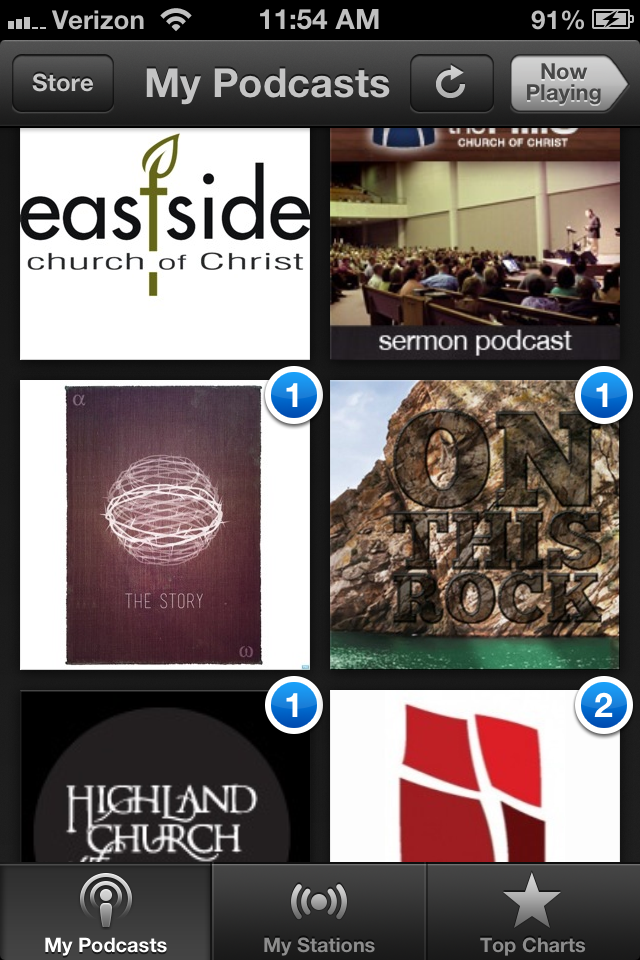
I have six churches, specifically Churches of Christ, to whose podcasts I subsccibe, and I listen to their sermons on a weekly basis. Some people can hardly suffer through one sermon a week – I enjoy listening to about 8 sermons throughout the week (including two from my own congregation of course).

These sermon podcasts have been incredibly helpful to me in my own spiritual development, especially as a young minister just starting out. I would like to pass these along to you if you are interested.

I hope you find these helpful. If you know of any other good ones, let me know!

2013 Reading List So Far

I said on Facebook last night, and I’m not ashamed to admit that I am a slow reader. I read at about or a little faster than conversational pace. I think it’s due to the fact that we didn’t find out I needed glasses until the summer after my first grade year. At the time I was leaning to read and write I couldn’t see. Somehow I managed to baffle my teachers and parents with the fact that I couldn’t see the board yet I was still doing well in school.

I envy you speed readers out there. I tried a speed reading course in high school – that was a bust.

Anyway, more for my personal satisfaction than for your pleasure I keep a running log of the books I read each year. I am currently working on numbers 21 and 22 on the year. I hope to keep up this pace and lifestyle of reading. It makes life so much more interesting.

  1. Jesus: A Theography, by Len Sweet and Frank Viola
  2. Whispers, by Dean Koontz
  3. Wild at Heart, by John Eldredge
  4. Pirate Latitudes, by Michael Crichton
  5. Watchers, by Dean Koontz
  6. Pilgrim Heart, by Darryl Tippens
  7. Pathfinder, by Orson Scott Card
  8. Ruins, by Orson Scott Card
  9. Magic Kingdom for Sale – Sold!, by Terry Brooks
  10. The Black Unicorn, by Terry Brooks
  11. After You Believe, by N.T. Wright
  12. A Game of Thrones, by George R.R. Martin
  13. Prey, by Michael Crichton
  14. A Clash of Kings, by George R.R. Martin
  15. Where Is God When It Hurts?, by Philip Yancey
  16. Scarred Faith, by Josh Ross
  17. The Hole in Our Gospel, by Richard Stearns
  18. A Storm of Swords, by George R.R. Martin
  19. Just Like Jesus, by Max Lucado
  20. The Door to December, by Dean Koontz
  21. Ender in Exile, by Orson Scott Card
  22. From Eternity to Here, by Frank Viola

Are Christians Stupid? Part Deux

If you haven’t read the first post on this issue, please do so now.

If you haven’t read the original Huffington Post article that inspired this and the previous blog, do that, too!

ARE CHRISTIANS LESS INTELLIGENT THAN NON-BELIEVERS?
The answer is yes.

Hold your horses. Hear me out. The answer is Yes, Christians are less intelligent than non-believers IF…


Think about what Paul says in 1 Corinthians 15:12-19

But if it is preached that Christ has been raised from the dead, how can some of you say that there is no resurrection of the dead? If there is no resurrection of the dead, then not even Christ has been raised. And if Christ has not been raised, our preaching is useless and so is your faith.  More than that, we are then found to be false witnesses about God, for we have testified about God that he raised Christ from the dead. But he did not raise him if in fact the dead are not raised. For if the dead are not raised, then Christ has not been raised either. And if Christ has not been raised, your faith is futile; you are still in your sins. Then those also who have fallen asleep in Christ are lost. If only for this life we have hope in Christ, we are of all people most to be pitied.

That’s seven “ifs” in 8 verses. What it basically boils down to is this: Christians are less intelligent than atheists IF there is no resurrection. It’s plain and simple. If Christ was not resurrected than our entire faith crumbles and we are “of all people most to be pitied.”

There is SO MUCH riding on whether or not Jesus of Nazareth really was not found in the tomb on that third day. My entire worldview, my whole support system, my entire career and faith system stands or crashes with the resurrection.

If there is no resurrection, then nothing matters. If there is a resurrection, then everything matters. So it’s up to each and every person to choose – am I going to live like the resurrection happened? As for me and my house, we choose the path of faith, hope, and love based on the resurrection of Jesus Christ.

DOES IT MATTER?
One thing I appreciate about the HuffPost article is right there in the headline: Does It Matter…

While I disagree that belief in a Higher Intelligence is the cause of lower intelligence, there does seem to be an underlying issue within the article as a whole. How much of a priority should “intelligence” (as defined by the “intelligence community”) be in the life of the average world citizen? Does a child in sub-Saharan Africa orphaned because of AIDS and on the brink of starvation need a lesson in quantum physics or microbiology? Does it take an astrophysicist or a brain surgeon to provide food, water, shelter, and education for this child?

How many orphanages have been opened by theoretical physicists? When people are on their death beds, do they call on all their atheist friends to remind them that the end of existence is coming and that there is nothing worth hoping for in that moment? Is work done in a chemistry lab more important than work done in a soup kitchen?

Is intelligence the highest goal for humanity?

See, intelligence is probably easier to measure and quantify than other aspects of human life. But how would we measure wisdom? What formula can be applied to predict love? How do we calculate compassion or analyze altruism?

THE HIGHER GOAL
I realize that if someone doesn’t believe in God, the Scriptures, or the resurrection, then increased education and intelligence may be the highest goal they may hope to achieve. To that person they have become their own god. Self-advancement is the only logical course of life.

However, the resurrection shows us that there is a better way. There is a higher goal. I’m not just talking about “getting to heaven when you die.” I’m talking about life in the here and now on planet earth. So what exactly might be a higher goal than mere intelligence?

Whoever pursues righteousness and love
finds life, prosperity and honor. (Proverbs 21:21)

He has shown you, O mortal, what is good.
And what does the Lord require of you?
To act justly and to love mercy
and to walk humbly with your God. (Micah 6:8)

But seek first his kingdom and his righteousness, and all these things will be given to you as well. (Matthew 6:33)

Therefore, I urge you, brothers and sisters, in view of God’s mercy, to offer your bodies as a living sacrifice, holy and pleasing to God—this is your true and proper worship. Do not conform to the pattern of this world, but be transformed by the renewing of your mind. Then you will be able to test and approve what God’s will is—his good, pleasing and perfect will. (Romans 12:1-2)

When the perishable has been clothed with the imperishable, and the mortal with immortality, then the saying that is written will come true: “Death has been swallowed up in victory.”
“Where, O death, is your victory?
Where, O death, is your sting?”
The sting of death is sin, and the power of sin is the law. But thanks be to God! He gives us the victory through our Lord Jesus Christ.
Therefore, my dear brothers and sisters, stand firm. Let nothing move you. Always give yourselves fully to the work of the Lord, because you know that your labor in the Lord is not in vain. (1 Corinthians 15:54-58)

I’ll say it again as I close. If there is no resurrection, then nothing matters. But if there IS a resurrection, the EVERYTHING matters. (Including intelligence.)

Are Christians Stupid?

A friend of mine shared an article this morning that I didn’t want to read. I wanted to just brush it off and keep scrolling. But I clicked on the link and read it. And thought about it. And thought some more. Because, contrary to seemingly popular belief, I can still think through things even though I am a Christian.

I encourage you to read the article, too. But read it with an open mind and an open heart. Really try to pay attention to what seems to be going on behind the scenes: Does It Matter That Atheists Are Smarter Than Believers?

Have you read it yet? And have you calmed down a bit? Good. Then let’s proceed. Here are some of my initial thoughts, and I’ll try to keep them succinct.

WHY WOULD THIS SURPRISE US?
Probably not the first reaction you were expecting. Hear me out. Think about the men that Jesus called to be his closest disciples. They were fishermen, blue-collar workers, a zealot or two, an accountant. They were by no means the religious or intellectual elite. Their IQs (with the exception of maybe Paul and Apollos in Acts) were probably average at best.

In fact, look at what we’re told about the apostles in Acts: When they observed the boldness of Peter and John and realized that they were uneducated and untrained men, they were amazed and recognized that they had been with Jesus (Acts 4:13).


And just look at what Paul writes to the church in Corinth. It’s pretty much a rebuttal the the above article, yet it was written nearly 2000 years ago!

For the message of the cross is foolishness to those who are perishing, but to us who are being saved it is the power of God. For it is written:
“I will destroy the wisdom of the wise;
the intelligence of the intelligent I will frustrate.”

Where is the wise person? Where is the teacher of the law? Where is the philosopher of this age? Has not God made foolish the wisdom of the world? For since in the wisdom of God the world through its wisdom did not know him, God was pleased through the foolishness of what was preached to save those who believe. Jews demand signs and Greeks look for wisdom, but we preach Christ crucified: a stumbling block to Jews and foolishness to Gentiles, but to those whom God has called, both Jews and Greeks, Christ the power of God and the wisdom of God. For the foolishness of God is wiser than human wisdom, and the weakness of God is stronger than human strength.

Brothers and sisters, think of what you were when you were called. Not many of you were wise by human standards; not many were influential; not many were of noble birth. But God chose the foolish things of the world to shame the wise; God chose the weak things of the world to shame the strong. God chose the lowly things of this world and the despised things—and the things that are not—to nullify the things that are, so that no one may boast before him. It is because of him that you are in Christ Jesus, who has become for us wisdom from God—that is, our righteousness, holiness and redemption. Therefore, as it is written: “Let the one who boasts boast in the Lord.” (1 Corinthians 1:18-31)

Intelligence and wisdom by the world’s standards has never meant a whole lot to God. It’s not how his movement spread. It was not through logic and reasoning that Christ’s followers “turned the world upside down” (Acts 17:6). Why should we be surprised if researchers have “discovered” what the Bible already claims to be true?

CORRELATION DOES NOT EQUAL CAUSATION
With all that in mind, it is important to note that just because there may be a correlation that does not mean that religious faith causes a person to be less intelligent. I have my wife to thank for the phrase “correlation does not equal causation.”

Christianity has always appealed more to those of lower social standing, the outcasts, the rejects, the nobodies. In fact, while the Christian faith seems to be declining through much of the West, it is thriving throughout Africa, South America, and Asia. The hub of Christianity tends to move away from wealth and power. Once a person becomes rich and powerful they tend to become their own god. They think there is no longer a need for the “crutch” of faith – a reality pointed out in both the above article AND in Scripture!

So does that mean that wealth, power, and intelligence cause people to lose their faith? Again, no. It has been my (and others’) experience that very few people actually “think” their way out of faith. It almost always has to do with cultural/societal factors. Many were burned by the church. Some feel their faith choked out by the pressure to “fit in” with their colleagues. But all that is the work of Satan, not academic advancement.

THE CHURCH COULD & SHOULD DO BETTER
The studies cited in the above article have all taken place mainly in the Western world over the last 100 years or so. In that context, yes, the church has lost substantial ground in the realm of academia. But it was not always so. In fact Theology used to be hailed as the “Queen of the Sciences.” The idea was that to know about creation one must know about the Creator. Sounds reminiscent of  Romans 1:20, “For since the creation of the world God’s invisible qualities – his eternal power and divine nature – have been clearly seen, being understood from what has been made, so that people are without excuse.”


And yet I look around the world, especially the Christian world, and wonder, Where are the Galileos and the Michelangelos? Where are the Newtons and the Bachs? What happened to the Pasteurs and the Leonardos?


Somewhere along the line (probably after Darwin’s theory hit it big) I think the church decided that higher learning was unimportant, at best, or evil, at worst. So we wiped our hands clean of physics, biology, chemistry, art, and music. We built our own Christian schools and universities. We focused on big-T Truths and abandoned the search for little-t truths about the universe.

I think that’s got to change. If we truly believe that God created to universe and everything in it, then there is NOTHING that we can discover that would shake our belief in him. There are still things about the universe we don’t understand. That’s to be expected. There are current theories we hold that may one day be proven false. It’s happened before and we’re still here. The face of science and academia is constantly changing, but the One who created it all never does.

“The fear of the Lord is the beginning of knowledge” (Proverbs 1:7). I think it’s time the church started acting like it.

[I have more points I could make, so this blog might get a part two sometime.]

Bold Prayer

When did we get off thinking that Christianity was supposed to be easy? Let me rephrase that. When did I get off thinking that Christianity was supposed to be easy?

I can’t think of a single time I’ve had to face any kind of suffering for my faith. I can’t think of any close friendships I’ve lost because I believe that Jesus is the Son of God. I have not been ostracized by my family because of my baptism – in fact, my dad was the one who baptized me.

I have a secure job in a (semi)comfortable office (the A/C is out, but that’s my only complaint). I get paid for teaching about Jesus. Never once have I had to fear for the safety of my wife and son because of the fact that I am a minister of the gospel.

You would think that in a nation where Christians are free to worship and practice their faith at will that they would be exuberant, on fire, passionate, and active. But really what we are seeing is a post-Christian society in most of Europe and a (pre)post-Christian society forming in the US. It would seem that where the gospel can be spread risk-free is the very place where it begins to flounder.

At my college Alma Mater we had social clubs for men and women. They were sort of a “baptized” version of fraternities and sororities. And each fall the clubs add new members. Hundreds of students spend much of their time through September and October working hard to get into these clubs. Over the years, however, the administration has set some very strict guidelines on what can and cannot be done to prospective members of these clubs. Almost any club-sanctioned activity that could possibly submit new members to physical “abuse” or public embarrassment has been banned. New members can’t even be called “pledges” anymore. They are walking on eggshells to avoid even a hint of so-called “hazing.”

My college is not alone in this respect. Universities across the nation have really cracked down on these type of activities. And the outcome has been positive…and negative.

You see, there was not much that we as a pledge class had to endure together. There was very little hardship. The blood, sweat, and tears had been wiped away. The whole process sterilized and individualized. There was never really that moment of “am I going to make it?” And because we were “saved” from these trials, many club brothers, including myself, failed to make a tight, long-lasting commitment to the group. Many went inactive over the following semesters.

There was no risk, so there was not much reward.

I think that is what happens many times in our churches. We don’t actually risk anything when we take the plunge of baptism. Sure, we may be stepping out on the tight wire above the gorge, but we’ve got a harness and a safety net beneath.

That’s what brings me to this old hymn from the 1800s, “Father, Hear the Prayer We Offer.” So often in our prayers I hear people pray for safety and comfort. I think we’ve got that down. We are all ABOUT safety and comfort, and many times we don’t need God for that. But look at the lyrics to this hymn and how different this prayer is:

Father, hear the prayer we offer:
Nor for ease that prayer shall be,
But for strength, that we may ever
Live our lives courageously.

Not forever by still waters
Would we idly, quiet stay;
But would smite the living fountains
From the rocks along our way.

Be our strength in hours of weakness,
In our wanderings be our Guide;
Through endeavor, failure, danger,
Father, be Thou at our side.

Let our path be bright or dreary,
Storm or sunshine be our share;
May our souls in hope unweary
Make Thy work our ceaseless prayer.


Is it wrong to pray for safety and deliverance? Not necessarily. Jesus prayed for “the cup” to be taken from him. But in the end he deferred to God’s will. If we think we’ve gotten into more than we can handle, maybe we need to pray for more strength, endurance, perseverance, patience, or courage.
And maybe, just maybe, we need to pray for opportunities to have our faith tested and strengthened.
Are you bold enough to pray for boldness? Are you courageous enough to pray for courage?

The Scariest Chapter in Scripture

There is some pretty scary stuff in the Bible. Have you ever really thought about what it’s going to be like when Christ comes back? People bursting out of their graves. Fire. Lightening. War horns. The skies being ripped open. Reading the imagery used by John in Revelation, by Daniel in his prophecies, and even by Jesus toward the end of his life can be frightening.

But in my opinion, the most frightening chapter in all of Scripture is Matthew 25. When I read through the stories Jesus tells in this chapter I realize that I am a foolish virgin, a wicked and lazy servant, and a goat.

TEN VIRGINS
The five foolish maidens ran out of oil while waiting on the bridegroom to come. They left the group in search of more oil. While they were away, the party started without them. They came running back, banging on the door, but their names weren’t on the guest list.

They left the group. They went searching for fulfillment somewhere else. Sound familiar?

THREE SERVANTS
A millionaire businessman goes away on a trip and entrusts his funds to his three most loyal servants. To one he gives the equivalent of about $4 million. To another he gives roughly $1.6 million. To the third he gives about $800,000. The third servant is afraid of his master so he buries $800,000 in the ground. Upon his return the master gets exactly $800,000 back from that third servant. The master calls him wicked and lazy. He takes away everything he has and kicks him out on the street.

He was afraid of his master. Why take risks? Better safe than sorry, right?

SHEEP VS. GOATS
Lastly, Jesus paints a picture of the judgment scene. Those entering life had clothed, fed, and cared for Jesus inasmuch as they clothed, fed, and cared for their needy brothers and sisters. Those entering eternal punishment turned a blind eye to the needs of their brothers and sisters, thus ignoring the needs of Jesus himself. Nothing is said about worship practices, faith, baptism, doctrines, or patterns.

The goats may have said the right things and believed the right things. The sheep DID the right things.

I desire to be a wise, good, faithful sheep. But when it really comes down to it, I’m more like a foolish, wicked, lazy goat.

I feel like Paul at the end of Romans 7: “What a wretched man I am! Who will rescue me from this body of death?”

THANKS BE TO GOD
In Matthew 25 Jesus gives us a warning. It’s a wake up call. “Be alert!” he says. “Keep watch!” he urges. It doesn’t have to be that way. We still have time. Each and every one of us still has today. This moment. He tells us these stories to warn us about the jagged rocks along the coast line, about the sharp bend in the road ahead. He doesn’t want any of us to become the foolish virgins or the wicked, lazy servant, or a goat.

And so I, like Paul, can say, “Thanks be to God, who delivers me through Jesus Christ our Lord!”

The Unknown

We are working our way through the gospels in our Wednesday night teen class. We are in the end of Matthew during the last days of Jesus’ life. In chapter 24 his disciples ask him about the end of time, the destruction of the Temple, the return of the Messiah, you know…simple matters.

God’s understanding of time is different than ours. He is not bound by the laws of time and space – he created them. He is outside of time. He is on the other side of space. An old hymn, “All Things Praise Thee,” has a line in it: Time and space are praising Thee / All things praise Thee, Lord may we.
Humans have a much different understanding of the ocean than fish do. To a fish the ocean may seem infinite, never ending, going on and on forever (see Finding Nemo). But since we are outside of the ocean we know its limits. We know the boundaries of the seas. We know the paths of ocean currents and the timing of the tides. We can enter the ocean at any point we desire and then exit again.
So I get a sense that when Jesus’ disciples ask him about the time frame in which certain things are going to happen he does his best to put it in terms they will understand. But when it comes right down to it, “But about that day or hour no one knows, not even the angels in heaven, nor the Son, but only the Father” (Mt 24:36).
When will we experience the End of Time? No one knows. This is amazing coming from Jesus, who knew exactly what was going to happen in just a day or two. No one can predict when their life will end – and thus when they will experience the end of time. But Jesus knew when it would happen to him. He knew his “time had come.” As for you and me, we just have to do the best we can with the time we have.
That’s why Jesus instructs us to “keep watch” and “be ready.” It’s not that we should drop everything we’re doing and stare up at the sky while the world passes us by. The way we keep watch, the way we can be ready for Christ to return is to be doing the will of the Father. It’s like when your parents would leave you at home for the day with a list of chores. The only way to be ready for their return is to make sure you are doing the things they left for you to do!
Jesus left us with a task – preaching the gospel of the kingdom to all the nations of the earth. We’ve been going for two thousand years now and still haven’t reached that goal. But if every Christian were to take seriously the words of Christ, we could really shake things up. And we wouldn’t have to be afraid of the end.
“If I live the life I’m given / I won’t be scared to die” – The Avett Brothers, The Once and Future Carpenter

Still Growing

…or Why I Don’t Buy Into Evolution

I’m willing to give a little wiggle room to the theory of evolution. It has its benefits. It is one way of helping us understand the world around us. And on the purely animalistic side of it, survival of the fittest seems to be the natural order of things. The slowest, sickest zebra gets eaten by the lion. That lotion kills 99.9% of bacteria, leaving the strongest 0.1% to survive and grow into incurable super bugs. I get it.

But I don’t see that happening in realm of human beings. And I don’t think it should be survival of the fittest. When that starts manifesting itself in society, weak babies are left to die in the elements and millions of people are slaughtered because they have the “wrong” genetic makeup.

So how could “survival of the fittest” have led us to evolve to the point of declaring that very idea morally wrong for humanity?

Also, if humans were still attempting to climb the evolutionary ladder, shouldn’t we be getting smarter as a species? But by all accounts we are collectively dumber than previous generations. Could we actually be devolving?

We all dream of a future for our children that is better than our current generation. Always have, always will. And yet we seem unable to make our dreams a reality, no matter how noble. We dream of a world free of poverty, oppression, and prejudice. We dream of a world rid of AIDS and cancer. We dream of a world where people work together, love each other, and promote knowledge, freedom, and democracy. We dream of a world full of MLK Juniors and Ghandis.

But what are we actually doing to get there?

I believe that Jesus of Nazareth was the wisest, most loving, most generous, and most genuine man to ever walk the earth. I believe he came to show us how to make the next generation better than the last. If we loved like he loved, if we behaved like he did, if we followed in his footsteps, then I believe we would see that dream fulfilled.

But sitting around waiting for evolution to get us there will never work. It’s not like Jesus himself was any further up the evolutionary scale than we are. In fact Scripture tells us that he was made like us in every way (Hebrews 2) and that he had no divine advantage in this life (Philippians 2). We are even reassured that Jesus was not born with any prior knowledge stored away in his infant brain. Luke tells us that “Jesus grew in wisdom and stature, and in favor with God and man.”

Jesus still had to go through childhood. He still had to mature mentally, physically, spiritually, and socially – just like each and every one of us. Children continue to face the same challenges that Jesus did – having to grow up in a corrupt, evil, fallen world. They have to learn everything they know. They have to be taught how to love – and how to hate. And yet we are living in a time when almost half of all children grow up in a broken home and society says that’s okay.

One day I have hope that we will see that dream come to fruition. I know one day that there will be no more hunger or poverty or oppression or corruption. There will be no more boundaries and people will be free to love completely. But God is in control of when that day comes, not evolution.

Until then, the responsibility lies with parents and with the church to help raise our children into the type of people needed to make the future a little bit brighter. Because God knows no one else is doing it.

We’re still growing in wisdom and stature and in favor with God and man – and I pray we never stop until that day comes.

Daddy’s Little Helper

Aiden is a really good helper. It makes him so proud to be able to help daddy do things – moving furniture, putting away dishes, digging in the garden, pushing the wheel barrow, and on and on. You should see the look on his face when I ask him to help me with something.

The other day that got me thinking about the way God works in the world. When Aiden is “helping me” move the coffee table so that we can vacuum around it, there’s no doubt that he is pushing with all the strength in his little toddler body. But is that enough? No. Not yet. So even when he “helps” me, it’s still daddy doing all the real work.

So why have him help? Because it teaches him how to do things. It gives him confidence. It helps him develop independence. There will come a day when I expect him to be able to do things all by himself.

People often question God about why he lets poverty, disease, death, and heartache run rampant throughout the world. I think it’s because God wants us to “help.” Now, is there really any miraculous healing or global change that can come about simply by our own efforts? That would be like my toddler trying to move that coffee table all by himself. We can’t do these things without God’s help. But that doesn’t mean he lets us sit back while he does everything. He urges us to help him.

Why? For all the same reasons that I encourage my own son to help me! While God may not need our help, we need to be helping him. That’s why he urges us to imitate Christ (1 Corinthians 11:1). That’s why he puts it in the hands of the church to feed the feed, to house the homeless, to take care of orphans and widows (Matthew 25:31-46; James 1:27).

Could God say the word and cure all diseases, equalize all wealth, and change the hearts and attitudes of everyone on earth? Of course! And one day he will (Revelation 21:5-3). But what would we learn from that?  What would that teach us about having compassion for others? How would that help build character? What would that do to build a sense of community? How would that unite people around a certain cause?

When Aiden helps daddy, he benefits more than I do. When we “help” God, we’re changed for the better. We reap the benefits.

Are you your father’s helper?