Page 25 of 82

FLY AND SWIM | 40 Days of Focus, Day 5

And God said, “Let the water teem with living creatures, and let birds fly above the earth across the vault of the sky.” So God created the great creatures of the sea and every living thing with which the water teems and that moves about in it, according to their kinds, and every winged bird according to its kind. And God saw that it was good. God blessed them and said, “Be fruitful and increase in number and fill the water in the seas, and let the birds increase on the earth.” And there was evening, and there was morning—the fifth day.
(Genesis 1:20-23)

On day two God separated the waters above from the waters below. Now on day five God filled the waters below with fish and the sky with birds. For the first time the Earth is inhabited by creatures that can breathe and move and mate and fight and hunt and forage and multiply and spread out and start families. There is something of free will within the order of creation.

These living creatures are the first to receive a blessing from the Creator – to be fruitful and multiply, fill the waters and the sky. God’s blessing is one of permission and encouragement to do what his creatures are made to do. There is a freedom to living within the order of creation.

Is there something special about birds and fish in particular that they would get their own “day” devoted to them?

Looking back to Genesis 1:2 again, we see that the Spirit of God was hovering over the surface of the deep. That word “hovering” is also the word for “fluttering”…you know, like a bird. Then at the baptism of Jesus, we once again see the Spirit of God descending like, wait for it… a bird.

And then who could forget the awesome passage in Isaiah:

Even youths grow tired and weary,
and young men stumble and fall;
but those who hope in the Lord
will renew their strength.
They will soar on wings like eagles;
they will run and not grow weary,
they will walk and not be faint.
(Isaiah 40:30-31)

Birds factor prominently in the story of Scripture, but what about fish?

Obviously I think about the story of Jonah in which God creates a “great fish” to swallow Jonah and save him from drowning. After three days, the fish vomited Jonah up onto dry land, and he then goes on to complete his mission to the city of Nineveh. Nineveh, coincidentally, means “house of fish.” And Jonah’s name, coincidentally, means “dove.” Crazy, right?

I think it would be hard to think about fish in the Bible without skimming through all the fish stories in the gospels. It seemed like Jesus was always around fish. His first disciples were fishermen whom he called to “fish for people.” One of his first miracles was an overwhelming catch of fish. He used fish and bread to feed close to 10,000 people all together. Then there was that odd story where Jesus told Peter to go catch a fish and inside the fish would be a coin to pay the Temple tax…that was weird. Even after the resurrection, the disciples met Jesus on the shore of Galilee as he was cooking up a fish breakfast.

There’s something unique about birds and fish. Have you ever found yourself jealous of them? Flight is one of the most often requested superpowers. Everyone wants to fly. Nearly 500 years past between the flying machine drawings of Leonardo Da Vinci in the late 1400s and the first manned airplane developed by the Wright brothers in the early 1900s. We take flight for granted now, but we’ve only been able to soar above the clouds for just over 100 years of human history. We dream of flying cars and jet packs and hover boards. We want to be able to do what the birds can do naturally.

And what about swimming? We’ve been sailing the oceans for thousands of years, but submarine technology has only been around for a couple hundred years. Even today, something like 80% of the oceans have yet to be explored thoroughly. Will we ever have our own personal submarines? Not likely. But we still want to do what the fish can do naturally.

God’s creation has a design and a purpose. Each piece of it falls neatly into place. God brings order out of chaos, and in that order there is freedom. If we try to do what birds do, we will fall off the roof and break a bone. If we try to do what fish can do, we will drown.

Birds were created to fly. Fish were created to swim. So what were you created to do?

You have made [humans] a little lower than the angels
and crowned them with glory and honor.
You made them rulers over the works of your hands;
you put everything under their feet:
all flocks and herds,
and the animals of the wild,
the birds in the sky,
and the fish in the sea,
all that swim the paths of the seas.
(Psalm 8:5-8)

__________________________

Why do you think humans have tried so hard to fly throughout the ages?

Would you rather be able to fly like a bird or swim like a fish? Why?

What significance is there in the Holy Spirit appearing in the form of a dove?

HEAVENS | 40 Days of Focus, Day 4


And God said, “Let there be lights in the vault of the sky to separate the day from the night, and let them serve as signs to mark sacred times, and days and years, and let them be lights in the vault of the sky to give light on the earth.” And it was so. God made two great lights—the greater light to govern the day and the lesser light to govern the night. He also made the stars. God set them in the vault of the sky to give light on the earth, to govern the day and the night, and to separate light from darkness. And God saw that it was good. And there was evening, and there was morning—the fourth day.
(Genesis 1:14-19)

Days one, two, and three were all about separating – light from darkness, waters above from waters below, dry land from the seas. Now we make a shift from separating to filling. Days four, five, and six fill what was separated on the first three days.

On day one, God created light and separated it from darkness. Now he fills the light and dark with the sun, moon, and stars. But notice how he doesn’t give them names. Why?

In the cultural context in which this poem reached its final form – probably in Babylonian exile – the study and worship of the heavenly bodies was very common. Most ancient cultures regarded the sun and the moon as major gods/goddesses. The stars and planets also played a role in giving “signs” from the gods. The creation song in Genesis simply regards them as “the greater light,” “the lesser light,” “…and also the stars.” The importance is placed on the Creator, not the creation. The sun and moon were set in place to “govern” under the sovereign kingship of God.

But this is not just the creation of the heavenly bodies. It’s also the creation of time itself. Their job was to give light to the earth AND to mark days, years, and sacred times. God is already building a rhythm of time into his creation. Evening, morning, days, weeks, months, years, holidays – God created the sun and moon to help keep track of it all.

Since the dawn of humanity, we’ve been staring up at the sky and wondering what it all means. Even though we know now that each point of light is a giant flaming ball of gas thousands of lightyears away, even though we know our Sun is an average-size, middle-aged star, even though we know our moon is not made of cheese… – even though we can explain it all, it still takes our breath away. We still have the same overwhelming sense of our own smallness whenever we look up.

When I consider your heavens,
the work of your fingers,
the moon and the stars,
which you have set in place,
what is mankind that you are mindful of them,
human beings that you care for them?
(Psalm 8:3-4)

The heavens declare the glory of God;
the skies proclaim the work of his hands.
Day after day they pour forth speech;
night after night they reveal knowledge.
They have no speech, they use no words;
no sound is heard from them.
Yet their voice goes out into all the earth,
their words to the ends of the world.
(Psalm 19:1-4a)

Think about how big of a deal celestial phenomena still are. There is still a ton of hype and excitement around solar and lunar eclipses, blood moons, and meteor showers. Even though we can explain it all, we continue to experience a deep emotional reaction in our core.

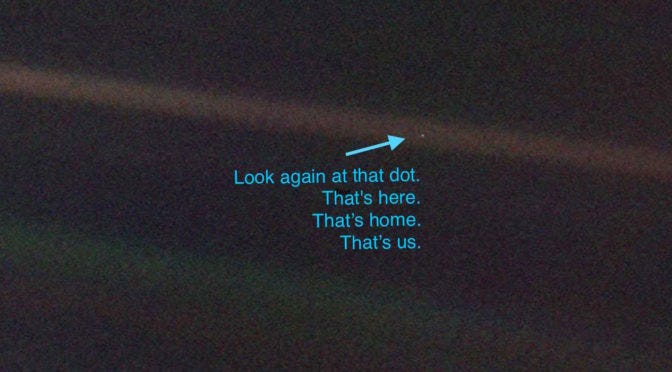
Nothing can make you feel quite so small as studying the stars and planets. We cannot wrap our minds around the size and scale of our solar system or our galaxy or our universe. I get a sinking feeling in the pit of my stomach just thinking about it. But to know God is bigger than that and he still chooses to care for you and me…that is the most shocking realization of all. To see pictures like this…

…and know that God loves all 7 billion people on that “pale blue dot” hurtling through space…I don’t even have words. Is certainly puts this verse into a whole new perspective:

For God so loved the world that he gave his one and only Son, that whoever believes in him shall not perish but have eternal life.
(John 3:16)

______________________________

Do you have a favorite constellation? What is it, and why?

When was the last time you simply looked up at the clear night sky? How did it make you feel?

The Pleiades and Orion are two constellations mentioned in the Bible. In Job 38:8 God asks, “Can you bind the chains of the Pleiades? Can you loosen Orion’s belt?” It wouldn’t be until centuries later that we discovered a little thing called gravity. With the invention of telescopes and the discovery of gravity, our understanding of the cosmos changed. It turns out the stars that make up the Pleiades constellation are gravitationally locked in place (Can you bind the chains of the Pleiades?), and the stars comprising Orion’s belt are actually drifting farther away from each other through space (Can you loosen Orion’s belt?). **MIND BLOWN**

Let No One Separate

On Wednesday one of our students, Lauren Woods, read a monologue that I had written for our class on Mark 10. It’s one thing to read and discuss what Jesus says about marriage and divorce. It’s another thing to imagine what kind of real world impact his words had – and continue to have today.

The monologue is based on Mark 10:1-12. The full script is below if you want to follow along or read it on your own.

LET NO ONE SEPARATE
Performed by Lauren Woods
Written by Daniel Lee

I remember it like it was yesterday. Every new bride is nervous in the beginning. Will he like me? Will he think I’m beautiful? Will I be able to satisfy his needs? How many children will I give him? What will our life be like? Could he ever possibly love me?
All these questions and doubts were swirling through my mind throughout the entire wedding ceremony. He seemed a nice enough man. My father had made all the arrangements with his family. He was ten years older than me. I was barely a woman – only thirteen. He had completed his training in rabbinical school. He was an expert in the Law, set to join the sect of the Pharisees. This was a BIG deal for my family.
Would I bring honor on my family through this marriage? Or would I be a shameful disappointment of a wife? Hope and fear battled within me as we were pronounced husband and wife.
Life started out like a dream. He was gentle and caring. He treated me respectfully. I did my best to tend to the household duties while he was away with the other rabbis and teachers of the law. He took his study and research very seriously. He also took our marriage seriously. He was a good man.
But one year had passed and I had not yet conceived a child. Another year passed, and then another. He was growing resentful and even angry at times. He began treating me more harshly. I couldn’t focus under all the pressure, so I began to burn the food and became more accident-prone around the house.
My worst fears came true when he first uttered the phrase, “I divorce thee.” My cheeks flushed. Tears ran down my face. I ran off to my living quarters and sobbed into my bedding. I had to do better. If he said this twice more, that would be the end.
The next day when he returned home I tried to make everything perfect. Dinner was set. The meal hot and ready when he walked across the threshold. His face softened as he reclined at the table. The tension was released, and I let out a sigh of relief. But in a moment of lapsed concentration I accidently knocked over his wine glass right onto his newest cloak.
“I divorce thee!” he shouted, swiping all the remaining dished off the table and onto the floor. He stormed out of the house and back into the market place leaving me to clean up the mess.
I had never felt more alone and scared in my life. If I messed up one more time, he could send me back to my father, bringing disgrace upon me and my entire family. What if my father refused to take me back? I would have to resort to begging…or worse.
The next morning my husband was gone before I even woke up. No note or explanation of where he had gone or what he was doing. I spent most of the morning doing the household duties through a steady stream of tears. Noon came and went. It was time to prepare his dinner. It had to be even better than before.
I made all his favorite dishes. I pulled out the best wine. Everything was perfect, an attempt to cover over my own imperfections.
I heard his voice and his footsteps as he approached. My whole body was tense as I held back more tears. I was on the verge of shaking or collapsing. This could be my last night in this house. This could be my last night as a married woman.
As he entered the doorway, I was taken aback. His whole demeanor had changed. He did not look angry or the least bit irritated. He had a charming smile across his face – the same smile he bore as he pushed back my veil for the first time. His features were softer, and there were tears forming around his eyes.
I started to direct him to the table for his meal, but he stopped me before I could say a word.
“My bride. My wife,” he said. “I…. I love you.”
I nearly fainted. He had never uttered those words. I don’t have any friends whose husbands had said that, either.
Both of us now had wet cheeks from the streams flowing from our eyes. I was stunned, unable to move. He moved first, though, sweeping in and grabbing me into his arms.
“I love you,” he whispered before his kissed me.
He set me back down and I repeated the words back to him, trembling, “I…love you, too.”
After a moment, he let go of our embrace and reclined at the table, inviting me to recline and eat with him – another first.
As he began sipping his wine and tearing off a piece of bread – which he handed to me – he broke the silence.
“I met the most amazing teacher today. You may have heard of him. The call him Rabbi Yeshua of Nazareth. My colleagues and I were in a heated discussion about marriage and divorce. I promise, I was not the one who brought it up, nor did I contribute much to the discussion. My mind was swimming. I did not want to divorce you, but it was all I knew to do. This is how I was taught. I can still hear my father’s voice, ‘The wife belongs to her husband, and he can do with her as he wishes. If she doesn’t please you, get rid of her and find a new one.’ Now I know he was completely wrong.
“In the middle of our discussion, Rabbi Yeshua came near. We wanted to test him, to see what side of the debate he was on. So, we asked him, ‘Is it lawful for a man to divorce his wife?’
“He answered by asking us what Moses said. We all knew. That was an easy one. The Law of Moses does permit a man to divorce his wife by giving her a divorce certificate. But then he said the only reason Moses permitted this was because our ancestors’ hearts were hard. He pointed us back to Genesis. When God created humankind, he created male and female. It was God who joined the first two humans together, and it is God who joins us together still today. If God has joined us together, then who are we to cause a separation?
“Rabbi Yeshua really challenged the way I thought about our marriage. It’s not just a social or economic arrangement. It’s a covenant between you, me, and God. I’ve been concerned about myself and what you can give me. But Yeshua says we should all serve each other and take care of one another – and love one another.
“So, I’m sorry about this…” He reached into his cloak and pulled out the certificate of divorce. “I already had the papers drawn up before Rabbi Yeshua came.”
Then he did the unthinkable. He tore that certificate to pieces right in front of me and tossed the remnants into the fire.
“Never again,” he said, “will I think of separating what God has joined. It’s you and me together for life, and death alone can separate us. I love you.”
The rest of the night was a blur. We still have no children, but he treats me like a queen. We do not have a perfect marriage – I don’t believe there is such a thing. But I no longer have to live with the fear that he might grow tired of me and send me away.
Not long after he met Rabbi Yeshua, the Romans arrest and crucified that great teacher. There are some who say he was raised from the dead. We did not see him, but we believe. There was never a teacher like him. We believe he is the Messiah, the Son of God. We have begun to meet weekly with the believers to pray and share a meal. Rabbi Yeshua showed us what love is, and now we try to show that to others.
I thank and praise God for Rabbi Yeshua, for saving my marriage, for saving me, for saving my husband, and for changing the way we see the world.

NATURE | 40 Days of Focus, Day 3


And God said, “Let the water under the sky be gathered to one place, and let dry ground appear.” And it was so. God called the dry ground “land,” and the gathered waters he called “seas.” And God saw that it was good.
Then God said, “Let the land produce vegetation: seed-bearing plants and trees on the land that bear fruit with seed in it, according to their various kinds.” And it was so. The land produced vegetation: plants bearing seed according to their kinds and trees bearing fruit with seed in it according to their kinds. And God saw that it was good. And there was evening, and there was morning—the third day.
(Genesis 1:9-13)

Out of the waters came the dry land, and that land produced vegetation. I wish I could have been there to see it. I’m constantly in awe at the sheer diversity of plant life and vegetation on this planet. My boys were watching The Magic School Bus the other day on Netflix, and the students in the cartoon were learning about how trees communicate with each other through releasing different compounds and molecules into the air. Nature is absolutely stunning.

I love finding out new things, so here is a “Did you know?” list about nature.
  • There are more trees on the earth than stars in the Milky Way Galaxy
  • The Amazon rainforest produces half of the world’s oxygen supply
  • Caffeine serves the function of a pesticide inside the coffee tree
  • The tallest tree ever recorded was an Australian eucalyptus in 1872, measuring 435 feet tall
  • Bamboo stalks can grow up to 35 inches in one day
  • California Redwoods are the largest living organisms on the planet
  • Ginko is the oldest living tree species – dating back 250 million years
  • There are over 300,000 identified plant species, and that number continues to grow

God doesn’t do anything halfway. Our planet didn’t have to be beautiful. Think about it – beauty is not a necessity for life, just look inside the boys’ locker room. Beauty is not essential, but it’s woven into the fabric of creation, and we get to witness and enjoy it. Take time to notice the yellow blooms of the early daffodils beaming brightly above the frost-covered ground. Notice the vibrant hues and the soft greens of the first leaves sprouting on the trees. Notice the flowers that will ultimately transform into apples and tomatoes. Notice the warm reds and oranges of a late-autumn sunset over the trees. Notice the strong evergreen branches draped in snow.

There are some who believe that God created everything in the world solely for the benefit of humans. I don’t necessarily ascribe to that notion. I think God made non-human creation for his own sake. The world is not ours to conquer and bend to our will. Nature is intended to point us toward God and his will.

For since the creation of the world God’s invisible qualities—his eternal power and divine nature—have been clearly seen, being understood from what has been made, so that people are without excuse.
(Romans 1:20)

We should feel a sense of connection with the Creator when we are exploring his creation. But it does make me feel good to know there are parts of this planet that are still a complete mystery to us. Because it’s not about us – it’s all about God. We get to join with the rest of nature in praising and worshiping God.

Praise the Lord from the earth,
you great sea creatures and all ocean depths,
lightning and hail, snow and clouds,
stormy winds that do his bidding,
you mountains and all hills,
fruit trees and all cedars,
wild animals and all cattle,
small creatures and flying birds,
kings of the earth and all nations,
you princes and all rulers on earth,
young men and women,
old men and children.
(Psalm 148:7-12)

We bring honor and glory to God when we fulfill our purpose as humans (which we’ll get to on day 6). In the same way, the land and vegetation brings honor and glory to God when it is doing what it was created to do. That’s one of the reasons I believe God’s people should care about the environment. Pollution, deforestation, and global warming make it harder for creation to bring glory to its Creator.

We are intimately and inextricably connected to nature. We are made out of the “dust of the ground.” We breathe the oxygen produced by trees as they scrub the toxic Carbon Dioxide from our atmosphere. We eat the fruit, nuts, seeds, and vegetables produced from the plants around us. We need nature, but nature doesn’t necessarily need us. Make no mistake – nature was here long before we came on the scene, and nature will be here long after our time.

And if we don’t carry out our business in giving praise and glory to God, then nature will carry on without us.

When he came near the place where the road goes down the Mount of Olives, the whole crowd of disciples began joyfully to praise God in loud voices for all the miracles they had seen:
“Blessed is the king who comes in the name of the Lord!”
“Peace in heaven and glory in the highest!”
Some of the Pharisees in the crowd said to Jesus, “Teacher, rebuke your disciples!”
“I tell you,” he replied, “if they keep quiet, the stones will cry out.”
(Luke 19:37-40)

Now get outside and go take a walk in the woods. Join the trees in praising God.

____________________________

Have you ever felt a connection to God while being out in nature? What was that experience like?

When was the last time you simply stopped and took in the beauty of creation around you? Why do you think we don’t do that very often?

If you could actually hear the trees and the mountains and the flowers praising God, what do you think they would say?

Spend some time in prayer, thanking and praising God for his creation and the beauty of nature all around us.

WATER | 40 Days of Focus, Day 2


And God said, “Let there be a vault between the waters to separate water from water.” So God made the vault and separated the water under the vault from the water above it. And it was so. God called the vault “sky.” And there was evening, and there was morning—the second day.
(Genesis 1:6-8)

Liquid water is such an interesting substance. Without the presence of Dihydrogen Monoxide in liquid state, there can be no life as we know it. But too much at any given moment can be fatal.

Humanity has a strange relationship to water. We need it to live, but we can’t control it. We can’t make it rain or stop raining. We can barely do anything to hold back raging rivers or flood waters. Drowning is still among the leading causes of accidental deaths. Tsunamis, hurricanes, and flash floods continue to wreak havoc across the globe, wiping out entire villages and devastating national economies.

Is it any wonder why the ancients equated water with chaos?

If you back up to Genesis 1:2 we see this in action:

Now the earth was formless and empty, darkness was over the surface of the deep, and the Spirit of God was hovering over the waters.

That’s the language of chaos. Many creation myths from the ancient world featured chaos in some form. They often claim the world as we know it is simply a byproduct of the chaos with no real meaning or purpose. Come to think of it, those ancient creation myths are not too far off from modern physicists.

But in our Bibles God controls the waters and brings order out of chaos. Think about all the times water plays a role in the stories of Scripture. The flood. Baby Moses on the Nile River. The parting of the Red Sea. Water flowing from the rock in the wilderness. The parting of the Jordan River. The storm on the Mediterranean Sea in the story of Jonah. The 3-year drought in the time of Elijah. The times when Jesus calmed the storm and walked across the water.

To many ancient peoples, the waters were associated with chaos and the abyss, or the realm of demonic spirits. But every step of the way throughout the Bible we see that God is in control of the uncontrollable. I love what God says in the book of Job:

“Who shut up the sea behind doors
when it burst forth from the womb,
when I made the clouds its garment
and wrapped it in thick darkness,
when I fixed limits for it
and set its doors and bars in place,
when I said, ‘This far you may come and no farther;
here is where your proud waves halt’?”
(Job 38:8-11)

He goes on to speak about snow and hail and rain, reminding us humans that we are completely helpless in the face of weather phenomena.

Water is a source of both life and death.

I can’t help but connect this to another event involving water: baptism. Baptism as a holy sacrament has been practiced for centuries. It predates Christianity. Baptism was actually practiced by the Jews in the Second Temple period. If you go to Jerusalem today you can still see the remains of ancient baptistries around the Temple complex. They would go down into the water, immerse themselves, and come out of the water ceremonially cleansed.

Jesus and his followers brought a different understanding of baptism. In Christian baptism we do not immerse ourselves. We allow another to lower us down into the water. We submit our lives into their hands. It takes a certain degree of trust. This immersion represents a death and burial beneath the flood waters. We are then raised up out of the water into a new life, a new creation, a new humanity, a new kingdom.

Or don’t you know that all of us who were baptized into Christ Jesus were baptized into his death? We were therefore buried with him through baptism into death in order that, just as Christ was raised from the dead through the glory of the Father, we too may live a new life.
(Romans 6:3-4)

Water is the source of both life and death. Water is both good and necessary and dangerous and beyond our control – just like God. Submitting ourselves to the waters of baptism connects us with this ancient story of destruction and creation, of fear and wonder, of death and new life.

Jesus answered, “Everyone who drinks this water will be thirsty again, but whoever drinks the water I give them will never thirst. Indeed, the water I give them will become in them a spring of water welling up to eternal life.”
(John 4:13-14)

 __________________________________
Have you ever stopped in awe and wonder at the sight of the ocean, a river, or a waterfall? What is so awesome and inspiring about those locations?

In the Chronicles of Narnia, CS Lewis says about Aslan (representing God) that he is “not safe, but he’s good.” How does this challenge the way we understand God?

Have you been baptized? What led you to that decision? Do you remember going under the water? What was that like? How did you feel when you were lifted back up?

LIGHT | 40 Days of Focus, Day 1


And God said, “Let there be light,” and there was light. God saw that the light was good, and he separated the light from the darkness. God called the light “day,” and the darkness he called “night.” And there was evening, and there was morning—the first day.
(Genesis 1:3-5)

Light is one of the most common themes in all of Scripture. If you think about it, Light vs. Dark is one of the most common themes in all of literature and entertainment. Countless stories have been told throughout the generation of Light triumphing over Darkness – from Beowulf to Star Wars, from The Lord of the Rings to Mean Girls, from Harry Potter to The Princess Bride. Light represents good, and dark represents evil.

But I want you to notice something in the passage above. On the opening day of Creation, God created Light and separated it from the Darkness. Here’s an interesting thing to keep in mind – God still put the darkness to use. We need darkness in our lives. Our bodies survive on a natural rhythm of light and darkness. It’s how we are able to produce melatonin which helps us fall asleep. Many animals are nocturnal and would not survive in complete light. I love what David says about light and darkness in Psalm 139.

If I say, “Surely the darkness will hide me
and the light become night around me,”
even the darkness will not be dark to you;
the night will shine like the day,
for darkness is as light to you.

The natural state of the universe is darkness. Without nearby light sources, like our sun, space is completely black and devoid of light. But that’s not the case if you look back far enough in time. When scientists pointed their radio satellites into the darkest part of the visible sky, they accidentally found light. In the earliest days of our universe’s existence, everything was full of energy and light. The whole universe glowed brightly with what astronomers now call the “Cosmic Microwave Background Radiation.”

Let there be light, indeed.

When we look at the night sky, what looks like complete darkness can actually be filled with light if we look hard enough – just like the human heart. Even in the most corrupt, most evil of people, I believe there is still a spark of light waiting to be ignited. Otherwise, Jesus could not have said this to a huge crowd of complete strangers:

“You are the light of the world. A town built on a hill cannot be hidden. Neither do people light a lamp and put it under a bowl. Instead they put it on its stand, and it gives light to everyone in the house. In the same way, let your light shine before others, that they may see your good deeds and glorify your Father in heaven.”
(Matthew 5:14-16)

But how can we be the “light of the world” when we know how much darkness resides within us? Simply put, we can’t. On our own we try to hide our light out of shame for our darkness. Thank God he doesn’t leave us on our own.

This is the message we have heard from him and declare to you: God is light; in him there is no darkness at all. If we claim to have fellowship with him and yet walk in the darkness, we lie and do not live out the truth. But if we walk in the light, as he is in the light, we have fellowship with one another, and the blood of Jesus, his Son, purifies us from all sin.
(1 John 1:5-7)

On day one God created light, but he also left the darkness. There may still be darkness within us, but the closer we walk with God the brighter the light shines forth. As we embark on this journey over these forty days, I pray that you will learn to walk in the light and overcome the darkness. As the saying goes, it’s always darkest before the dawn. That’s just how it was on that Good Friday so long ago when Christ was crucified and sealed in a tomb. The world seemed darker than ever before, but a new day would dawn with the resurrection.

_________________________________

Do you remember being afraid of the dark? Why do you think that happens?

In what ways do you see darkness in the world and in your life?

Are there specific areas of your life in which you may be afraid to shine a light? Is there anything you are worried that the light might reveal?

How can you be the “light of the world” in your family? in your workplace? in your school? in your community? online?

REVIEW | Inspired: Slaying Giants, Walking on Water, and Loving the Bible Again

Inspired: Slaying Giants, Walking on Water, and Loving the Bible Again
Inspired: Slaying Giants, Walking on Water, and Loving the Bible Again by Rachel Held Evans
My rating: 4 of 5 stars

Overall I enjoyed this book. As a person in full-time ministry and a Bible nerd, it’s rare for a book written on a popular level to keep my attention and interest. Many popular level books are great for the lay person, the average church goer, or the new Christian. With Rachel Held Evans’ latest, she hits all the right notes for me.

Her style is imaginative and informative. She takes liberties while also trying to stay true to the text. I found her creative retellings of the stories compelling. Evans will definitely go against the grain of traditional, fundamental, and literalist readings of Scripture – but in my opinion, that’s a good thing. We often try to make the Bible do and say things it was never meant to do or say.

I’ve been following RHE on Twitter for a while now, and while she was in the process of writing this book she talked about the importance of diversity in her research. She quotes and cites an array of scholars, pastors, theologians, authors, activists, and rabbis – men and women, caucasian and people of color. It’s fascinating to hear how different Jewish rabbis interpret a text compared to Evangelical pastors. The Bible truly is like a diamond that you must turn in order to see all the beauty of the colors hidden inside.

Each chapter handles a different section of Scripture – from creation and the Law to the conquest narratives, the Psalms, the Prophets, the Gospels, and the Letters. She paints a beautiful overview of what the Bible is and what it does. She also shares heartbreaking stories of how the Scriptures have been mishandled, misapplied, and misunderstood. At best, this can lead to illformed theology. At worst this can lead to a complete derailment of people’s faith and even atrocities like slavery and genocide.

In short, what we think about the Bible matters.

When I was growing up we did something called “Sword Drills.” The Bible teacher would call out a verse and all the kids would try to be the first to find it in their Bibles. The first one would read the verse out loud and get a piece of candy. That’s fine, except for the notion of using our Bibles as swords. The Bible was never intended to cut other people down. It was never intended to be weaponized against people. Yes, the Bible (namely, the Word of God) is compared to a sword twice. Once in Ephesians 6 and once in Hebrews 4. In Ephesians the sword is wielded against the spiritual forces of darkness in the world – not against other people. And in Hebrews the Word of God is a sword that cuts deep, dividing joint and marrow, soul and spirit – of you, not other people.

RHE knows almost as well as anyone what it feels like to have the Bible weaponized against her. And her book, Inspired, will hopefully put an end to that kind of mentality for her readers. Although chances are…if you’re reading Rachel Held Evans, you probably aren’t the kind of person who would do that anyway.

When I’m reading a work of nonfiction, I always try to ask, “Who is this for?” I believe Inspired is for those who have fallen out of love with the Bible. It’s for long-time Christians who are bored with it or who are beginning to question everything they’ve been taught. It’s for skeptics who are intrigued by Jesus but don’t know what to do with the Bible. It’s for pastors and teachers of Scripture who want a fresh look at an ancient story. It’s for Bible nerds and Bible critics and the Biblically apathetic. But it’s not for anyone who is content with the status quo of their faith, who are fine with being spoon-fed a portion of Scripture once a week at church without questioning what they’re being taught.

If you’re ready to fall back in love with the Bible and see it in a whole new ancient way, then give this book a chance. Rachel Held Evans has really upped her game with this one.

View all my reviews

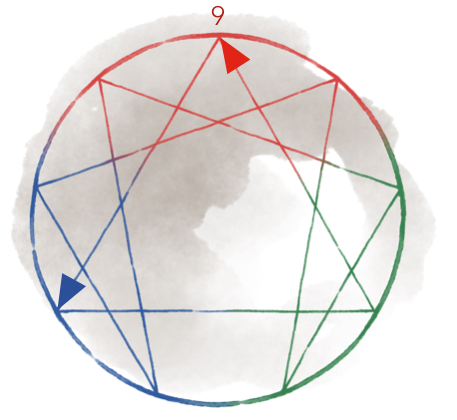
Biblical Enneagram Types: NINES

The Peacemaker


Enneagram Type Nines are typically known as the Peacemakers. Nines have the uncanny ability to see everyone’s point of view at once and can join in either side of a debate. However, they usually choose to withdraw from the debate altogether because they want to avoid conflict and anything that might upset their calm.

Nines sit atop the Enneagram for a reason. It’s not unusual for a Nine to have difficulty finding their type since they can relate to so many other numbers. They can understand the drive of the Three, the desire to be helpful of a Two, the skepticism of a Six, and the protectiveness of an Eight all at once.

This can be a good thing or a very bad thing. Healthy Nines make excellent mediators, able to bring two conflicting sides to the table and find common ground between them. Unhealthy Nines, however, can be crippled by the conflicting viewpoints and simply shut down, withdrawing into themselves and their own little world. If a Nine doesn’t want to be moved, then they can become the most stubborn Type on the Enneagram. But if a Nine truly doesn’t have strong opinions, then they are usually happy to go with the flow.

They can be peacemakers or conflict-avoiders. They can be laid back and easy-going, or they can be an immovable stick in the mud. They can be assertive and fight for a just cause, or they can be masters of sarcasm and passive aggressiveness. They can be aloof or welcoming.

Nines often defer decisions to the group or to the one in authority. As kids, Nines picked up on the message that their presence doesn’t matter very much, so they learned to fade into the background and keep their anger in check lest they rock the boat. Nines come into their own when they learn to pair their ability to see all points of view with an assertiveness to act on what they know to be right.

Healthy Nines can be a blessing to everyone around them.

FATHER ABRAHAM HAD MANY SONS…

Funny how we never talk about Zimran, Jokshan, Medan, Midian, Ishbak, and Shuah (Genesis 26:1). But whatever.

I believe that the “Father of the Faith” was a Nine: Abraham.

God called Abraham (then known as Abram) to leave the place of his fathers and travel to a distant land. God promised that he would bless Abram with offspring too numerable to count. It’s a beautiful promise, really.

The Lord had said to Abram, “Go from your country, your people and your father’s household to the land I will show you.
“I will make you into a great nation,
and I will bless you;
I will make your name great,
and you will be a blessing.
I will bless those who bless you,
and whoever curses you I will curse;
and all peoples on earth
will be blessed through you.”
(Genesis 12:1-3)

I don’t know how well any other Enneagram type would handle a promise like this. A Three would let that go directly to his head as his ego inflated to the size of a hot air balloon. A Four would probably try to hide from the responsibility – You’ve got the wrong guy, God. A Seven would be almost TOO eager for the task. A One would likely get caught up in all the details of exactly how and when God’s plan would come about. But Abram simply trusted and went.

The very next story in Genesis 12 is about Abram traveling to Egypt. While there, he fears that Pharaoh would have him killed in order to take his wife, Sarai. So in order to avoid that conflict Abram told the Egyptians that Sarai was his sister. They still took her, but they let him live. God had to step in and punish Pharaoh and his court because of Abram’s lie. A very similar thing happened in Genesis 20. Nines often think they are doing what’s best if they avoid conflict, but that often only makes the situation worse.

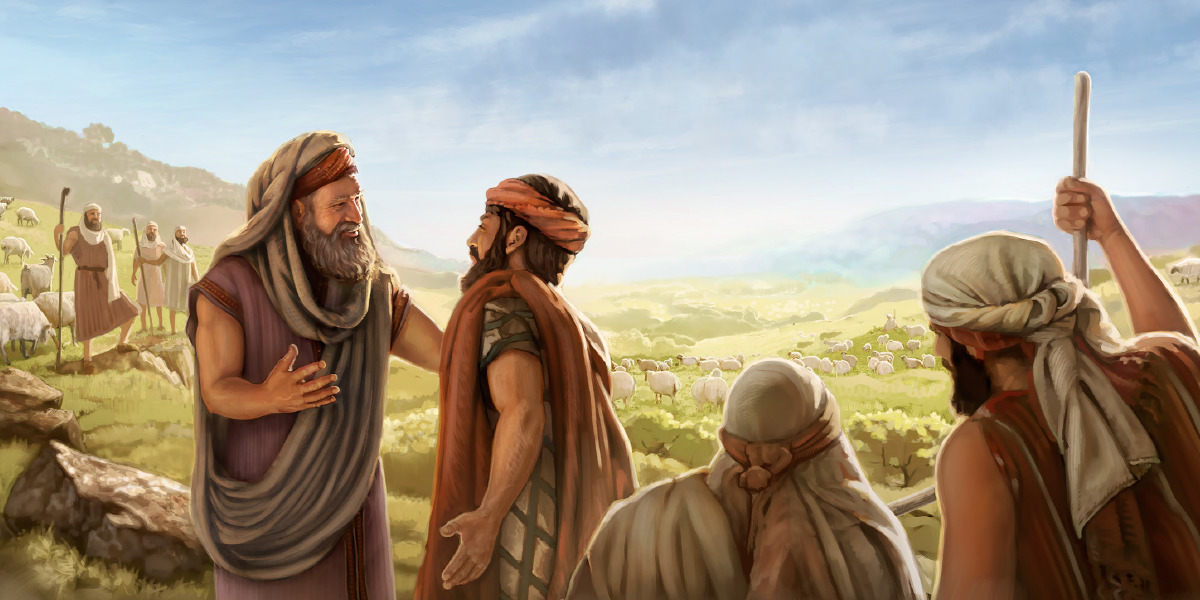
Then there’s the time when Abram’s and Lot’s (his nephew) herds and flocks were getting too big. They knew they couldn’t stay together, so they decided to part ways. Abram would go one direction, Lot the other. Abram let Lot have the first pick. Nines share some commonalities with Twos, for instance putting other people’s needs and desires above their own.

When Sarai grew tired of waiting for God to act on his promise of a son, she urged Abram to take her handmaid, Hagar, and use her as a surrogate. This is yet another instance when Abram avoided a potential conflict and everyone was worse off because of it. Hagar bore a son named Ishmael, and Sarai grew jealous and eventually sent them both away to make it on their own in the wilderness. Abram just let it happen.

God changed Abram and Sarai’s names to Abraham and Sarah. Soon after that God sent his angels to investigate the cities of Sodom and Gomorrah – where Lot and his family settled down. The report was NOT good, to say the least. God sent word to Abraham that he planned to destroy the cities and the inhabitants. But Abraham took on the role of mediator and began to bargain and negotiate with God on behalf of the cities. The cities were full of evil, but Abraham still saw something worth saving in them.

Finally, Abraham and Sarah were blessed with a son of their own – Isaac. God fulfilled the promise he made to them so long ago. I think only a Nine could have been as patient as Abraham. But then…God called Abraham to sacrifice Isaac upon an altar. Some theologians and rabbis over the years have insisted that Abraham should have argued with God on behalf of Isaac like he did on behalf of Sodom and Gomorrah. I’m not sure. Maybe this is another instance of Abraham simply going along in order to avoid one more conflict. Or maybe Abraham had learned by this point to fully trust that God was in control of the situation. He sounds confident when he tells his men, “We will go up and worship, and then we will come back down.”

Abraham ended up outliving Sarah. One of the most amazing little lines jumps out to me every time I read about Abraham’s death.

Then Abraham breathed his last and died at a good old age, an old man and full of years; and he was gathered to his people. His sons Isaac and Ishmael buried him in the cave of Machpelah near Mamre, in the field of Ephron son of Zohar the Hittite, the field Abraham had bought from the Hittites. There Abraham was buried with his wife Sarah.
(Genesis 26:8-10)

Nines have a way of bringing people together. Even in his death Abraham was able to bring Isaac and Ishmael together again. I don’t know that they ever settled their differences, but they were together for a time because of their father. I think that’s a very touching detail that we often overlook.

Abraham was compliant and stubborn. Abraham was a pushover and he stood up for his beliefs. Abraham shied away from conflicts and he got into arguments with God Almighty. Abraham acted in his own self-interest and he became the one through whom all nations would be blessed. Abraham was self-absorbed and concerned about making everyone else happy.

Nines often live in the tension between action and inaction. When pressed with a choice, they choose not to choose – which is still a choice! Nines must learn to move, to act, to decide, to fight. Deciding not to choose is almost never the right decision.

Nines, we see you, we love you, we need you. God created you with a gift to see everyone’s perspective. But don’t lose your own perspective while looking at everyone else’s. God created you to live your life. God has blessed you so that you can be a blessing to all people.

Response: "The Problem with Those 9 Personality Types"

I love the Complexly production company and the work they do producing free, informative, entertaining content with the purpose of educating the general public on a broad range of issues. They produce the YouTube channels “SciShow” and the spin offs “SciShow Space” and “SciShow Psych.” I’m a subscriber and regular viewer of these channels. I really dig what they’re trying to do.

On February 21, though, they released a video challenging the claims of the Enneagram. You know I can’t just let that one slide. Haha

I watched it yesterday, and I actually agree with most of what’s said. However, I don’t think they quite understand what the Enneagram system does and what it’s really about. Here’s the video. Watch it, and then I’ll give some comments on it below.

First of all, the scenario she opened with is not what the Enneagram is about. You should NEVER use someone’s Type to shame them or call them out on something. I’ve failed in this before, and it’s never a good idea. Don’t ever say “you’re such an Eight” or “you’re being so Four right now” as an insult or jibe at someone. Just don’t.

Brit Garner, the host, then goes on to point out that the Enneagram doesn’t have much scientific support or validation behind it. And she’s completely right. No Enneagram expert or teacher or book would ever make that sort of claim. The Enneagram is not science. I lead with that almost every time I talk about it. Some may view that as a weakness and a reason to be skeptical. I understand that 100%. The Enneagram is more of an art than a science. It comes out of a longstanding wisdom tradition and has been used among various religions and cultures throughout the centuries.

Just because something isn’t scientific doesn’t mean it’s not True. Science does not have the corner market on truth. Wisdom and science shouldn’t compete with each other but should inform each other. I think that’s what the Enneagram does well. I think that’s one of its strengths.

Garner claims that the purpose of the Enneagram is to “encourage [people] to become the best version of their personality type.” Not exactly. Our personality type consists of all the walls and defenses that we have built up over a lifetime. We have different ways of surviving in the world that comprise what we call a “false self.” Most Enneagram teachers will emphasize the truth that you are not your type. Your type is a false self. The Enneagram helps expose that false self so we can actually shed those masks and defense mechanisms, tear down the walls, and become our True Self, a more whole, integrated person. The purpose of the Enneagram is NOT to become the best version of your type.

The “fundamental flaw” in the system, she says, is that each type can be relatable for almost everyone. Again, most experts will tell you that we have a little bit of each type within us. I’m dominant in Type Three, but I also relate well to types One and Five. I see a lot of myself in those other types. I’m also influenced by my Two wing and my lines to Six and Nine. The Enneagram recognizes and affirms the complexity within each individual person. Every one of us contains elements of all Nine, but we are only Dominant in one type.

She also points out the very real problem that we can get different results based on the tests we take. I agree 100% that this is a problem. That’s why YOU DON’T RELY ON A TEST TO FIND YOUR ENNEAGRAM TYPE. Did I say that strongly enough? Haha

Tests are one of the least effective ways to discover your type. Every Enneagram expert will tell you that. It’s a journey of self-discovery. A test can help, but it should not be your go-to.

Then Garner points to the “Barnum Effect” in relation to the fact that people can relate to each of the types. On a mere surface level explanation of the Types, I can see how that might be the case. Sometimes the basic introductions do come across as vague generalities that can apply to almost everyone. That’s why you must go deeper. The real strength of the Enneagram lies in its ability to reveal your dark, hidden areas, or your “shadow side.” You know you’ve hit your Enneagram type, not when you feel good and agree with it, but when it punches you in the gut and you feel like hiding. I can remember the moment reading through the types when I got to Type Three. My jaw dropped. I got a sinking feeling in my stomach. I felt nervous and vulnerable. These people were openly describing parts of me that I wanted to keep hidden at all costs. I didn’t get that feeling from any other number.

The Enneagram does NOT rely on the Barnum effect. You just have to go deeper.

Finally, she expressed the fact that the Enneagram relies on “self-validation” as a weakness to the system. Again, the Enneagram never claims to be a scientific system or a grand unifying theory of personality. It is a tool for personal self-discovery and transformation. I cannot name anyone else’s type, because your type is determined by inward motivation, not outward behavior. Only YOU can know why you do what you do. Only YOU can validate your Type and know it to be true. No one can do it for you. No therapist or standardized test can do it for you. If you cannot be brutally honest with yourself, then you are not ready to learn the Enneagram.

If you want a scientific blueprint of personality, by all means explore “The Big Five.” That’s a lot more scientifically accurate than the Enneagram or the Myers-Briggs. But my question is…so what? The Big Five Personality Inventory can map your personality across five scientifically validated traits. But then what? What’s the point in learning your personality traits just for the sake of knowing?

The wisdom of the Enneagram sets you on a journey, a trajectory of transformation. I love what Suzanne Stabile says: “The Enneagram does not put you in a box. It shows you what box you’re already in, and it shows you how to get out.”

That Time Jesus Called a Woman a Dog

No, that’s not a click-bait title. That’s what actually happened in one of the stranger stories in Mark. Check it out:

Jesus left that place and went to the vicinity of Tyre. He entered a house and did not want anyone to know it; yet he could not keep his presence secret. In fact, as soon as she heard about him, a woman whose little daughter was possessed by an impure spirit came and fell at his feet. The woman was a Greek, born in Syrian Phoenicia. She begged Jesus to drive the demon out of her daughter.
“First let the children eat all they want,” he told her, “for it is not right to take the children’s bread and toss it to the dogs.”
(Mark 7:24-27)

Some things to note about this woman: 1) She was not a Jew – strike one. Jews intentionally separated themselves from the rest of the nations, being unwilling to even speak or dine with them. 2) She was a woman – strike two. Women simply did not have the same rights as men in that culture. They ate separately, worshiped separately, worked separately. It was frowned upon for a woman to even speak to a man who was not a direct relative. 3) She was the mother of a demon-possessed daughter – strike three. You know some people would have blamed her for her daughter’s predicament. We do it all the time. In another story, the disciples asked Jesus if the parents of a blind man had sinned.

But she has one thing going for her – she has nothing left to lose. The worst that Jesus could do is say no, right?

Wrong. In a strange turn of events, Jesus unexpectedly adds insult to injury. Read his response again, but read it with disgust, disdain, and pretentiousness in the voice of Jesus.

“First let the children eat all they want, for it is not right to take the children’s bread and toss it to the dogs.”

What is Jesus doing? This bothers me. It has for a long time. Jesus looks at the desperate woman who’s only concern is that her daughter be made well. This reminds me of many others in the gospels. Many desperate parents came to Jesus and asked the exact same thing. Why would he help them, but then turn around and degrade this woman, shrugging off her request?

Like I mentioned, this was a Gentile woman whose daughter was possessed. Jesus is surrounded by his followers. His disciples and those traveling with him were from a culture that looked down on people like her. The Jews were God’s chosen people, his special possession – and nobody else was. They lived in a very divided, segregated world. It was all Us vs. Them. If you’re not for us, then you’re against us. You’re either one of us, or you’re dead to us. Samaritans, tax collectors, prostitutes, Roman soldiers, Gentiles in general – they’re all dogs.

So what was Jesus doing? I think he was simply saying what everyone around him was thinking. No one else would give this woman the time of day. She would be written off and ignored. If Jesus hadn’t been around, we would never know this woman’s story. He engaged her by first revealing the racist, uncaring, calloused hearts of those around him. It’s shocking that he would say something like that. But it’s a little less shocking that we would think something like that.

And that’s the problem.

So many of us have racism and hatred in our hearts, but we would never dare speak it out loud. We think things that we would never say directly to someone’s face. I think Jesus, in this story, calls that out. Jesus is showing us that having those thoughts in our hearts is just as bad as saying it out loud. In some ways it could even be worse. At least if we say it out loud we give the other person an opportunity to respond. Whereas if we keep those hateful thoughts to ourselves it just sits and stews. We may not be outwardly aggressive, but we are more likely to ignore the needs of those we secretly hate.

To Jesus, anger and hatred are just another way of committing murder. We are purposefully denying the Image of God within the other person. We cannot love others and Christ loved us if we harbor hatred, racism, and prejudice in our hearts.

If this encounter took place today, I could imagine the woman storming off and finding the nearest news station. Suddenly her offense at Jesus’ words would be fed into the outrage amplification machine, known as social media, to be disseminated across the country in a matter of hours. I can see the click-bait headline now: Racist Rabbi refuses request of desperate mother in possible hate crime.


But look at her response. I’m still blown away by it.

“Lord,” she replied, “even the dogs under the table eat the children’s crumbs.”
(Mark 7:28)

First of all, make note that she is the one and only person in the entire gospel of Mark to address Jesus as “Lord.” Secondly, she is the first person in Mark’s gospel to actually understand on of Jesus’ parables on her own. The story Jesus tells about throwing the children’s bread to the dogs is the way most people around Jesus would have viewed the situation. But this woman refuses to live in that story. She is choosing a different story.

She accepts her place as a dog within the story. That word, however, can have two different connotations. When Jesus uses it, he’s implying the dogs around the house that clean up the scraps. They’re basically living garbage disposals. They aren’t pets, they’re scavengers that happen to hang out around your house. The way the woman uses that word, though, is more like a lap dog, a beloved pet, that hangs out under the table hoping to clean up the crumbs that fall.

I can attest to this. My dogs learned quickly that the place to be during meals is right next to our sons’ chairs. They’re almost guaranteed to get something if they hang out by the kids.

This woman reframes the story. She accepts that she is not one of the children of Israel. She may be a dog, but she’s not an unwanted stray. She’s a beloved pet, one of the family. She’s not asking to take what the children have. All she wants is a crumb from the table.

Wow.

Then he told her, “For such a reply, you may go; the demon has left your daughter.”
She went home and found her child lying on the bed, and the demon gone.
(Mark 7:29-30)

What a powerful story. I picture Jesus’ whole demeanor changing from harsh and bitter to loving and compassionate. I imagine the disciples were all sitting their thinking, “What just happened?” You know they don’t get it. They probably don’t have a clue what Jesus and this woman just did or how powerful that moment was.

It’s fitting that the very next story is about Jesus healing a deaf man. He cried out to heaven “Be opened!” I think he wanted to cry out the same thing for his disciples’ hearts. We may hear, but never really understand. This woman heard and understood.

May we be opened to the message of her story.