Page 31 of 82

Alexa, Share My Halloween Playlist

Do you have access to Amazon Prime Music?

Do you love Halloween as much as I do?

Here’s a fun playlist of Halloween (and Halloween-inspired) songs for your costume party or for playing in the car while taking the kids to Trunk-Or-Treat this weekend.

If you don’t have Amazon Music, I’m sure you could make a similar (or better) playlist using Spotify, Apple Music, or whatever service you prefer.

What songs would you add to this playlist? Let me know in the comments below!

3 Benefits of the Enneagram

If you’ve been paying attention to Christian books, podcasts, Twitter, and YouTube, then I’m sure you’ve at least heard of something called the Enneagram. You may be familiar with it, or you may have no idea what that term means. I’m no expert, and I’ll direct you to some helpful resources in a coming post. But for now, I want to mention just three key ways my life has improved because of this tool called the Enneagram (inn-ē-uh-gram).

1) The Enneagram has introduced me to myself.

At its most basic, the Enneagram is a personality typing system. You may have taken some kind of personality assessment before, like the Meyers-Briggs (I’m an ENFJ, whatever that means). The Enneagram spells out nine different personality types represented by a number along a circular figure. Each number represents a different way of viewing and interacting with the world.

You may wonder what’s the big deal. But it’s more than just picking a number or taking a test online. As you’re reading through the descriptions of the numbers, there will come a point when you feel like you’ve been punched in the gut. You’ll get a sinking feeling in your stomach because suddenly you feel exposed for all the world to see. The Enneagram knows your deepest fears, shortcomings, and desires. The Enneagram knows how you react in stress and how you react in security. It reveals healthy and unhealthy patterns of behavior that creep up in your life.

I remember having that experience. I identify as a dominant Type THREE, sometimes called the Performer or Achiever. In times of stress, according to the Enneagram, I take on the unhealthy characteristics of a Type NINE, the Peacemaker. As I read the description of what that looked like, my jaw dropped. I think I got goosebumps. I felt nervous – in my bedroom alone reading this to myself. The way it described a THREE in stress was exactly what I found myself doing when I was going through times of “disintegration,” frustration, and stress.

It was like I was finally seeing myself clearly in the mirror for the first time. Warts and all. It isn’t a fun process. You may not like what you learn about yourself. But somehow you will know it’s all true.

2) The Enneagram has given me a new language.

I’ve never really been good at emotions and feelings. Chalk that up to being a THREE, I guess. But the Enneagram has given me a whole new vocabulary with which to communicate more clearly about my feelings.

Katelyn and I have been married for almost ten and a half years. We dated four and a half years before that. We’ve known each other for over fifteen years, and it’s just been in the last couple of years that we have really started to understand each other. She has learned things about me that I didn’t even know how to tell her – because I didn’t have the language for it. I’ve learned things about her that I never really would have known otherwise. We have been able to connect on a deeper level than ever because of the Enneagram.

Not only that, but it has helped me in my ministry. I work with teenagers full time. They are growing and developing their personalities at breakneck speed. They don’t know what’s going on inside them. But in listening to their stories and hearing how they describe themselves, their fears, their desires, their insecurities, I am better able to connect with them. The more knowledge I gain of the other eight types, the better I am to connect with people where they are and truly begin to understand what they’re going through and how they see the world.

3) The Enneagram has taught me what it means to love God with all my heart, soul, mind, and strength, and to love my neighbor as myself.

The Nine types of the Enneagram have been called “The Nine Faces of God.” Each type reveals something of God’s own nature. Each type is also a path toward transformation in Christ. It’s not just a way of being, it’s a way of becoming who we were made to be. The Enneagram reveals the defense mechanisms we put in place to keep God and people at a distance. It also shows us what it looks like to break down those walls and allow ourselves to be fully known and loved.

The Enneagram is teaching me what it looks like to love God with my whole self, not just my intellect, not just my instincts, not just my emotions, but all of it. The Enneagram urges us to integrate head, heart, and hands. True worship and spiritual transformation is a process that includes thinking, feeling, and doing. Each of us is dominant in one area and regressive in another. Our task to to lean into the areas of weakness to become a fully integrated worshiper of God.

Through learning the Enneagram and confronting my “shadow side,” I am brought to a place of self-love and self-acceptance. Out of that place of inward health, I am better able to show love, grace, and forgiveness toward others. In other words, the Enneagram is a tool for developing empathy.

Jesus said the greatest command in Scripture is to love God with all you have and to love your neighbor as yourself. I have not found a more practical tool for learning how to love than the Enneagram.

Are you familiar with the Enneagram? What’s your Type? How has knowing the Enneagram helped you? Let me know in the comments below.

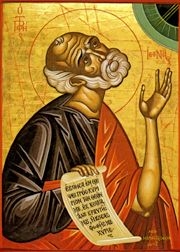
Jonah: World’s Worst Prophet

I may be one of the few people in the world who considers Jonah among my favorite books of the Bible. Don’t @ me. The book of Jonah has a lot of things going for it:

  1. Emphasis on God’s grace, mercy, love, and forgiveness
  2. High seas adventure
  3. Near death experiences
  4. A man swallowed by a gigantic sea creature
  5. An entire city on the verge of destruction
  6. Angry outbursts and melodrama by the overly emotional main character
  7. A protagonist that you just can’t really like, but is also super relatable
  8. Twists, reversals, and ironic situations
  9. A cliff hanger ending
There has been a lot of debate in scholarship about whether Jonah is based on a true story or if it’s merely a fictional parable. I’m not going to get into it much except to say that it has a lot of similarities to the stories of Elijah and Elisha. If it’s based on a true story, then it’s quite a remarkable tale! But if it’s not grounded in fact, it is still an amazing story that illustrates God’s love to its fullest extent and reveals our own failure to live up to God’s expectations.
If the story of Jonah is a parable, it is, in a way, THE parable of the Bible.
It begins with a pretty standard format:

Now the word of the Lord came to Jonah the son of Amittai… (Jonah 1:1)

Right from the start there are some things worth diving into. (Pun intended)
THE WORD OF YHWH
The author wants us to know that God is the main character, the main driver of the plot in this story. Nothing else would have occurred had it not been set in motion by “The Word of YHWH.” God is the main character. Jonah is just playing a supporting role in God’s story.
I can think of a couple other instances when God’s word set great things in motion. Immediately this should bring us back to Genesis 1 – the beautiful song of creation that begins our whole Bible. It is by the power of God’s word that he sets time and space into motion. “And God said…” is the driving force of creation. God’s word has power. God’s word must be obeyed – at least by nonhuman creation. That is an important distinction to keep in mind.
For Christians, this should also bring us to John 1, “In the beginning was the Word…” John wants us to know that “the Word of YHWH” took on flesh and moved into the neighborhood. His name is Jesus. Immediately, there is a solid connection between Jesus and Jonah – a connection that will be made more and more clear as the story unfolds.
JONAH, SON OF AMITTAI
What do we know about Jonah? First off, names almost always have significant meaning in the Bible. This is no exception. Jonah’s name is the Hebrew word for “dove.” He is the son of Amittai, whose name means “God is Faithful.” Jonah is a flighty prophet, here one moment and gone the next. When things get uncomfortable, he flees. But he is the son of God’s faithfulness. Where Jonah runs away, God is faithful in pursuing Jonah. God is faithful to Jonah even if Jonah is not faithful to God.
“Jonah, son of Amittai” is a good synopsis of what the story is about.
This is not the first time we encounter Jonah, either. We find him first mentioned in 2 Kings 14.

In the fifteenth year of Amaziah the son of Joash, king of Judah, Jeroboam the son of Joash, king of Israel, began to reign in Samaria, and he reigned forty-one years. And he did what was evil in the sight of the Lord. He did not depart from all the sins of Jeroboam the son of Nebat, which he made Israel to sin. He restored the border of Israel from Lebo-hamath as far as the Sea of the Arabah, according to the word of the Lord, the God of Israel, which he spoke by his servant Jonah the son of Amittai, the prophet, who was from Gath-hepher. For the Lord saw that the affliction of Israel was very bitter, for there was none left, bond or free, and there was none to help Israel. But the Lord had not said that he would blot out the name of Israel from under heaven, so he saved them by the hand of Jeroboam the son of Joash. (2 Kings 14:23-27)

Jonah was a prophet in the Norther Kingdom of Israel during the reign of Jeroboam II (ca. 750 BC).

During Jeroboam’s reign (who was an evil king, BTW) the borders of Israel were restored to the greatest extent they had ever been. Israel gain in power like it hadn’t seen in a long, long time. Israel improved its military, its economy, and everything was going well. Israel had been made great again, all thanks to the prophetic word of Jonah, son of Amittai.

So we know that Jonah worked closely with the king. We know that Jonah oversaw one of the greatest surges in nationalistic power they had ever seen. We know that Israel’s enemies were losing strength during this time. Jonah was surely swelled up with nationalistic pride and probably equated patriotism with religious fervor.

That’s why the next words in the story are so shocking:

“Arise, go to Nineveh, that great city, and call out against it, for their evil has come up before me.” (Jonah 1:2)

This was the first time God had called one of his prophets to go specifically to a gentile nation for the purpose of prophesying to/against them. Why is this important? Why Nineveh?

NINEVEH
The earliest mention of Nineveh is way back in Genesis 10. It was one of the major cities established in the Fertile Crescent along the Tigris River. Genesis claims that it was established by Nimrod as part of his kingdom. This automatically puts Nineveh in a bad light, because Nimrod was viewed as an enemy of God.

Nineveh is a very ancient city. It was an ancient city by the time the Assyrian Empire rose to power. The Assyrians were brutal. When they overthrew a city or nation, they would completely decimate its people and culture. Assyria had its eyes set on Israel for a while because Israel was a very strategic location. But during Jonah’s time the Assyrian Empire had a string of incompetent rulers and was in a period of decline and upheaval.

Nineveh was not the capital city of Assyria at that time. But it was easily representative of the Assyrian Empire in much the same way New York City, Chicago, or Los Angeles would be representative of the USA. If God wanted to send a message to the Assyrian Empire, Nineveh was as good of a place as any.

But why even bother?

God tells Jonah that their “evil has come up before me.” The phrase is similar to saying, “I’ve had it up to HERE with their evil!” YHWH had not turned a blind eye to the evils of the empire and the surrounding nations. YHWH would seize this moment of opportunity, while the empire was up against the ropes in decline, to try and reach them with his message of mercy.

And God chose Jonah to be the mouthpiece, the arbiter of grace to Israel’s enemy.

What could possibly go wrong?

God told Jonah to get up and go to Nineveh…

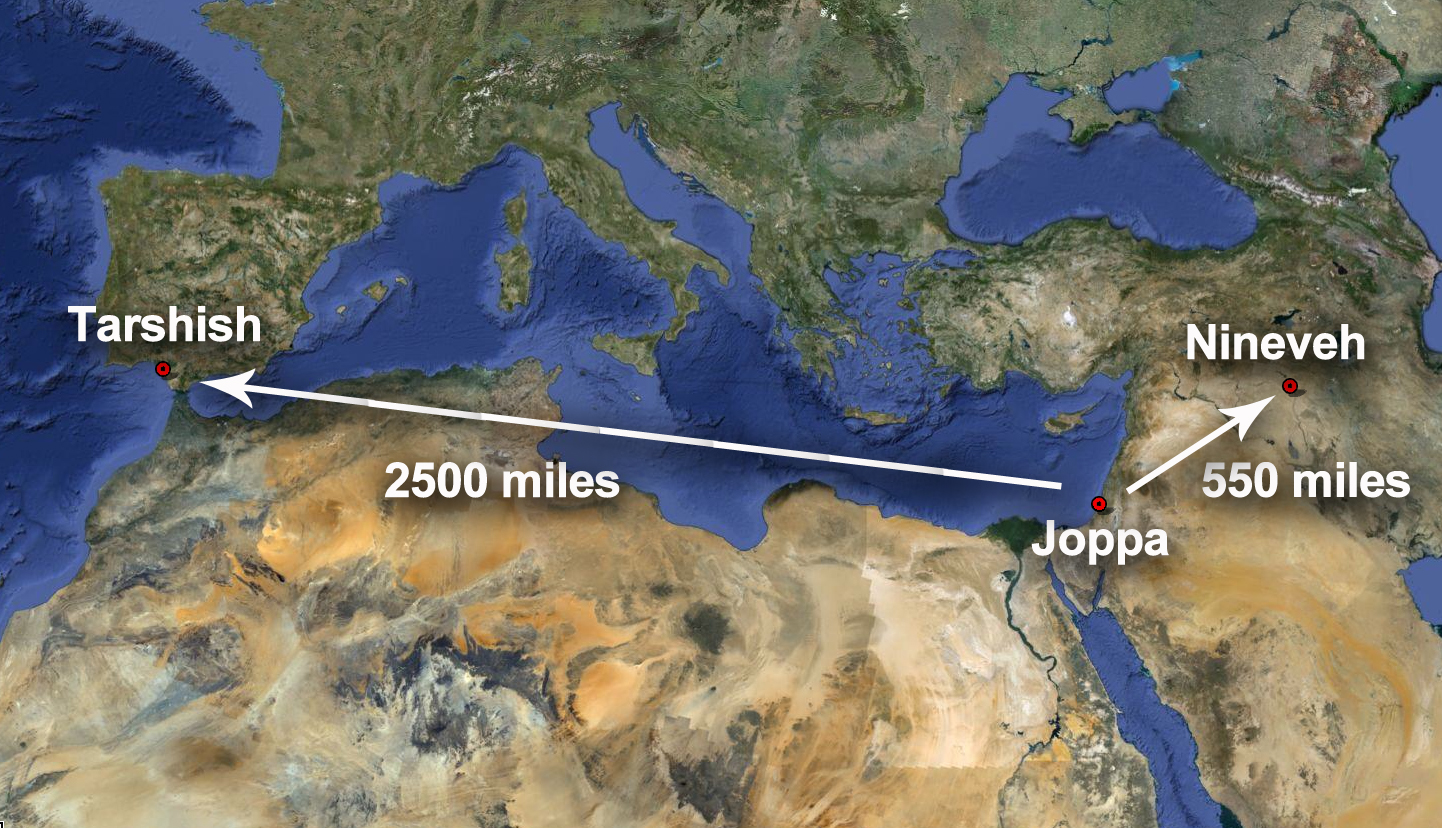
But Jonah rose to flee to Tarshish from the presence of the Lord. He went down to Joppa and found a ship going to Tarshish. So he paid the fare and went down into it, to go with them to Tarshish, away from the presence of the Lord. (Jonah 1:3)

Jonah, what are you doing? Running away from God? Are you crazy?

Notice a few things about this verse. Tarshish is mentioned three times. This was a purposeful, deliberate plan on Jonah’s part. He didn’t just show up and board the first boat he came across. He wanted to pick the farthest point on the map – a three year round trip by some estimates.

“From the presence of the Lord” is said twice. Jonah knew he was directly disobeying God. He was doing everything he could to get out of this trip. By why would he think God wouldn’t be in Tarshish? Because Isaiah had said as much:

I will set a sign among them. And from them I will send survivors to the nations, to Tarshish, Pul, and Lud, who draw the bow, to Tubal and Javan, to the coastlands far away, that have not heard my fame or seen my glory. (Isaiah 66:19)

God’s word and presence hadn’t been proclaimed in Tarshish. Perfect. Let’s go there!

Jonah went down to Joppa and down into the boat. This begins a downward spiral, descending into further rebellion and distance from God and closer to chaos and the grave.

And that phrase “paid the fare” is better understood as commissioning the whole ship and crew for the voyage. He wasn’t just buying a ticket for a bunk on the boat. He was financing the entire mission.

Verse three emphasizes the lengths to which Jonah was willing to go in order NOT to do what God told him to do. Nineveh was about a 550 mile, relatively easy trip across land via trade routes. Tarshish was on the Southern coast of Spain at the farthest edge of the Mediterranean Sea, risking storms, shipwrecks, pirates, disease, and more.

Jonah truly was the world’s worst prophet. I don’t like Jonah.

But then I realize that I see so much of Jonah inside me. To what lengths have I gone to avoid doing what God has called me to do? Who am I staying away from? What am I running from? What responsibilities am I shrugging off?

There’s a little bit of Jonah in all of us.

6 Reasons Christians Should Care About Climate Change

Recently the Intergovernmental Panel on Climate Change (IPCC) released its latest report on the state of global climate change. Things are not looking good to say the least. You can easily look up the report and read it for yourself. At the rate we’re going, we have about 12 years to come together as a global community and turn things around.

It’s almost time to hit the panic button.

Mike McHargue released an episode of his podcast “Ask Science Mike” this week discussing the report and what we can/should do about it. I highly recommend giving it a listen (begin at about the 5:38 mark). It’s upsetting to me that we could be experiencing the catastrophic effects of global warming within our lifetime. We’re not just talking about the distant future of our grandchildren’s grandchildren. We are talking about a couple of decades from now.

When I was younger I remember hearing people in the church shrug off the warnings of global warming. I would hear things like, “The climate has changed before. It’s a completely natural part of Earth’s cycles.” Or “who are we to think that humans could cause such a thing as this?” Or worse, “God said he would never destroy the Earth again, so there’s nothing we can do to destroy it.”

There are still climate change deniers, but I think it’s time we all got more serious about this. Caring for the environment should not be a partisan issue. Reducing our energy consumption and carbon footprint should not be viewed as a bad thing. Even if you don’t believe that human activity (eg. burning fossil fuels and stripping rainforests to make pasture land for livestock) is driving climate change, I still think there are plenty of reasons to start taking better care of our planet.

I’m no Captain Planet, but here are six key reasons I believe Christians should care about the environment.

1) We are created in the Image of God.

Our Scriptures begin with the story of creation (Genesis 1, 2). Genesis 1 is a beautiful song depicting God’s work in breathtaking poetic language. God creates light, then oceans and atmosphere, then dry land and vegetation, then birds and fish, then land animals. Last of all God created humans:

Then God said, “Let us make mankind in our image, in our likeness, so that they may rule over the fish in the sea and the birds in the sky, over the livestock and all the wild animals, and over all the creatures that move along the ground.”
So God created mankind in his own image,
in the image of God he created them;
male and female he created them. (Genesis 1:26-27)

Men and women – ALL homo sapiens – are created in the Image of God. This is one of the foundational truths of the Bible. If we don’t have that as our starting point, then nothing else really matters. The Image of God is a loaded term. We could write entire volumes of books on what the term means and its implications. But suffice it to say that human beings are God’s representatives to the rest of creation.

Humans were endowed with certain cognitive, physical, and social capabilities that (as far as we know) are unprecedented in the known universe. Humans have survived not because we are the most well evolved species on the planet, but because we have a language, fine motor skills, and social cooperation. A lone human will not survive for long. But get 20 or 30 of us together and we can create our own society.

As God’s image bearers, we have some of the divine spirit in us, too. We have the ability to show love and compassion, forgiveness and mercy. We share in God’s creative work, too. We see the world not just as it is but as it could be. Humans can help tame the chaos. Humans can help bring order and flourishing for all the codependent ecosystems.

Since humans are created in God’s image and likeness, then our first inclination should be to do the things God would do. That includes, but is certainly not limited to, caring for the rest of non-human creation on this planet.

2) God placed humans in charge of tending and caring for the Earth.

Closely connected with the first point is this: we bear the divine image and are given a divine vocation.

God blessed them and said to them, “Be fruitful and increase in number; fill the earth and subdue it. Rule over the fish in the sea and the birds in the sky and over every living creature that moves on the ground.” (Genesis 1:28)

This is where a lot of people have gotten tripped up over the centuries. What does it meant to “subdue” and “rule over”? I believe many men have taken that to mean the Earth is ours to do with as we please. Some think this means that the Earth and everything in it was made for humanity to use, to exploit, to take advantage of for our own personal gains.

But this is kingly language. Humanity is “ruling over” the Earth is God’s vassal governors. Yes, there are parts of this world that I am glad to have brought under our control. But what do we do once we have brought about order and submission? I don’t believe the answer is to run roughshod over creation. We should instead do everything within our power to make creation come alive and flourish to the glory of God. After all, creation itself is supposed to reveal something of God to us – namely God’s divine nature and eternal power (Romans 1:20).

Would nonhuman creation call us benevolent rulers or maniacal tyrants?

3) Our actions impact more than just ourselves.

What comes to mind when you think of the word “sin”? The Bible is littered with lists of sins – those actions and attitudes that are contrary to God’s way of life for his people. But take a look at one of those lists – any list. Think about anything we would consider to be a sin.

Is there a sin that affects only you and no one/nothing else in any way?

Any sin you can think of has an impact greater than the one committing the sin. That’s why it’s such a big deal to God. God is community and love within Godself. God creates out of communal love for the purpose of communal love. That’s why God said, “It is not good for the man to be alone. I will make a helper suitable for him” (Genesis 2:18).

When the first humans sinned by eating the fruit from the “Tree of the Knowledge of Good and Evil” (Genesis 3), God plainly laid out the consequences to their action. They did not die immediately, but they were separated 1) from God, 2) from each other, and 3) from the rest of creation. Sin drove a wedge between all these relationships.

Hear this: our sin of greed has caused potentially irreparable harm to the rest of creation.

For the creation waits in eager expectation for the children of God to be revealed. For the creation was subjected to frustration, not by its own choice, but by the will of the one who subjected it, in hope that the creation itself will be liberated from its bondage to decay and brought into the freedom and glory of the children of God. (Romans 8:19-21)

Our sin of greed has made matters exponentially worse since the industrial revolution. Our desire for more – more money, more power, more things, more comfort, more convenience – has had devastating effects on the rest of creation. I can only imagine that creation is crying out more than ever, is more frustrated than ever at being subject to bondage.

We must be willing to take responsibility for our own actions and begin living in such a way as to reduce the harmful impacts of our own greed and evil desires.

4) It’s more economical.

Ok, so maybe you’re not convinced by the science or the theology. But everyone should be able to get behind the economics of sustainability. And no, I’m not talking about going out and buying a Prius. In fact, the more economical thing to do is to keep your vehicles as long as possible, keep them well maintained, and drive more efficiently.

Come on. Who wouldn’t want to pay less for gas? Who wouldn’t want to see a smaller electricity or water bill? Who wouldn’t want to support local farmers and merchants rather than gigantic, unsustainable mega-corporations?

We live in a consumeristic society. The real challenge is to consume less and create/contribute more. This is called stewardship. There’s a whole case for stewardship to be made in Scripture. Basically, everything belongs to God. The blessings we have come from God and are meant to be used to bless others.

Every good and perfect gift is from above, coming down from the Father of the heavenly lights, who does not change like shifting shadows. (James 1:17)

Honor the Lord with your wealth,
    with the firstfruits of all your crops (Proverbs 3:9)

We have a say as consumers. We vote with our dollars. Companies pay attention to market trends. If we are spending more of our money on locally-sourced, sustainable, and/or fair trade products, then producers and manufacturers will take note. If we invest more into green companies who are working to develop more efficient forms of energy at lower costs, then we will all benefit in the long run.

Renewable energy and sustainable products just make more economic sense. We must be better stewards of the blessings God has given us.

5) It’s a justice thing.

This should be a really big wake-up call for Christians globally. According to all predictions that I’ve seen, those who are less well off are going to be the most impacted by climate change. Not everyone can afford to move. Not everyone can keep up with the predicted rise in food and energy costs. In extreme weather events, those with poorer housing and shelter are going to be the least able to survive. We must be preparing for a humanitarian crisis unlike anything we’ve ever seen. Climate change has the potential to produce more refugees globally than we could possibly support.

When economies collapse, it will be “the least of these” who suffer the most. When hurricanes gain unprecedented strength, it will be “the least of these” who are swallowed in the storm surge. When wild fires rage and crops fail and sea levels rise, it will be “the least of these” who will experience the greatest impact.

“Then he will say to those on his left, ‘Depart from me, you who are cursed, into the eternal fire prepared for the devil and his angels. For I was hungry and you gave me nothing to eat, I was thirsty and you gave me nothing to drink, I was a stranger and you did not invite me in, I needed clothes and you did not clothe me, I was sick and in prison and you did not look after me.’
“They also will answer, ‘Lord, when did we see you hungry or thirsty or a stranger or needing clothes or sick or in prison, and did not help you?’
“He will reply, ‘Truly I tell you, whatever you did not do for one of the least of these, you did not do for me.’” (Matthew 25:41-45)

Instead of preparing to help the countless numbers of refugees men and women God’s Image Bearers who will be negatively affected by climate change, we are severely cutting down on the number of refugees we will allow into this country. We are building a wall along our souther border with Mexico to prevent people from entering the US. We are scaling back the amount of global aide and support given to developing nations. We have pulled out of the Paris Climate Agreement. We have alienated our closest allies and buddied up with tyrannical dictators. We have beefed up our military spending while making cuts to social security and healthcare.

Remember – we will be judged by how we treated “the least of these.”

6) The Kingdom of God promotes flourishing of all people and all creation.

This isn’t heaven yet. Not by a long shot. But that shouldn’t stop us from trying to make this world a little more like heaven.

One of the key differentiators between the Kingdom of Heaven and the Kingdoms of the World is abundance versus scarcity. God’s kingdom is one of abundance. In God’s kingdom everyone has enough, everyone has clothes, food, shelter. Everyone’s needs are taken care of. Everyone is given the chance to flourish and thrive and reach their fullest potential.

The Kingdoms of this World live on a scarcity mindset. The fear is that there is not enough for everyone. There won’t be enough food or water or luxuries, so we have to forcibly take and/or protect what’s ours.

This will only get worse with climate change. Resources will become more scarce. Water sources will dry up. Fossil fuel reserves will become depleted. Useable farmland could all but vanish. Extinctions could occur on widespread scales along the entire food chain. Scarcity will be the new norm.

Jesus said, “The thief comes only to steal and kill and destroy; I have come that they may have life, and have it to the full” (John 10:10). Scarcity defines the kingdoms, empires, and nations of this world. Abundance defines the kingdom of heaven.

Think about everything Jesus did in order to prove this very point. He healed the sick, blind, lame, and deaf. He preached to the poor and outcasts. He caused a miraculous catch of fish – so much that it nearly sank the boats. He took a few loaves of bread and some fish and multiplied them into enough food to feed thousands.

Jesus came to preach a kingdom of abundance, not so that we could greedily hoard it all, but so that we could all share what we have and provide for each other out of that abundance.

This is exactly what the early Christians did:

All the believers were one in heart and mind. No one claimed that any of their possessions was their own, but they shared everything they had. With great power the apostles continued to testify to the resurrection of the Lord Jesus. And God’s grace was so powerfully at work in them all that there were no needy persons among them. For from time to time those who owned land or houses sold them, brought the money from the sales and put it at the apostles’ feet, and it was distributed to anyone who had need. (Acts 4:32-35)

In the coming decades it will be increasingly important that God’s people live out of a place of abundance – sharing what we have, giving to those in need, not taking more than we need. The fear of scarcity has no place in the kingdom of heaven. But if we want to prevent widespread scarcity of resources (necessities, not just luxuries), then we need to take this as seriously as the early church did. We must redefine “enough.” We must reprioritize our wants and our needs. We must celebrate and become good stewards of the blessings we have from God in Christ. And we must be willing to share with those in need.

I’m not perfect at any of this. In fact, I’ve gotten lazier about these things in the last few years. But it’s up to each one of us to make little changes that will make a big impact.

MARANATHA

That’s an ancient word/phrase meaning “Lord, come quickly.” It could mean we want Christ to return and for the kingdom of heaven to be fully realized as promised at the end of Revelation. Or it could mean that we need God to act in a big way, to show up and put everything to right.

As we proceed into a potentially ominous future, I believe this prayer is critical for God’s people. It reminds us who is ultimately in charge. It reminds us that this isn’t heaven yet. It reminds us of the hope we have in Christ Jesus that one day all will be made new.

Maranatha.

No More Idols

I’ve never worshiped an idol. I’ve never bowed down to a statue or offered sacrifices to a foreign god. I’ve never set up a shrine to anyone or anything. I’ve never carved or chiseled an image to represent a deity.

But I’m an idolater.

And so are you, probably.

I’m starting a new series on Wednesday nights with our teens called “No More Idols.” Over the next couple of months we’re going to be rethinking idolatry, reevaluating our lives, and purging any idol worship we may find.

Why?

This seems like a weird topic for 2018. Idolatry is such a churchy word, and idol worship seems so foreign or even primitive to our sophisticated, Western, enlightened minds.

Here’s why:

They worshiped their idols, which became a snare to them. (Psalm 106:36)

If you’ve ever seen the Road Runner and Wile E. Coyote, you are practically an expert in snares. A snare is a trap. For a trap to work, there has to be some bait – something that is appealing, alluring, desirable. The animal is lured into the trap by the bait, and when the moment is right the trap springs, catching the animal inside the cage or in its grip. Sure, the animal gets what it wants, but at the cost of its life.

Idolatry is a trap.

Do you know how to catch a monkey? This real life metaphor, popularized by Robert Pirsig’s book Zen and the Art of Motorcycle Maintenance, has been spread widely over the last few decades. It’s called the South Indian Monkey Trap. We think monkeys are cute and would make great pets. But in some parts of the world, monkeys are pests. They are a nuisance to have around. So they must be trapped and removed. But how?

The trap is incredibly simple – just a hollowed out coconut or gourd with a small prize inside, like rice, fruit, or something shiny. A small hole in the side allows the monkey to slip its hand inside and grab hold of the object. But once the hand is in a fist shape, it cannot be pulled back out the hole. The monkey must either let go of its treasure or remain trapped.

Idolatry is a trap.

But before we get too far ahead of ourselves, we must all understand what we’re talking about and why it matters.

So what is an idol?

At its most basic, an idol is “an image or representation of a god used as an object of worship.” We find idols in nearly every ancient culture and civilization – from the Egyptians to the Greeks to the Mayans. We find them today among the Hindus, the Buddhists (although Buddha is not a god who is worshiped), the Sikhs (their holy book is revered to nearly divine status), and a few others.

An idol is a statue, carving, engraving, painting, etc. that is revered and worshiped as a representation of the divine.

What’s the big deal, though?

Let’s take a quick refresher course on the first two of the Ten Commandments:

And God spoke all these words:
“I am the Lord your God, who brought you out of Egypt, out of the land of slavery.
“You shall have no other gods before me.
“You shall not make for yourself an image in the form of anything in heaven above or on the earth beneath or in the waters below. You shall not bow down to them or worship them; for I, the Lord your God, am a jealous God, punishing the children for the sin of the parents to the third and fourth generation of those who hate me, but showing love to a thousand generations of those who love me and keep my commandments.” (Exodus 20:1-6)

The first two commandments are 1) You shall have no other gods before me, and 2) You shall not make for yourself an image to bow down to and worship.

Remember that God is giving these commands to a newly freed Hebrew people. They have been living as slaves in Egypt for the past several generations. The only religion they have known and practiced would have involved the Egyptian pantheon. The ancient Egyptians had dozens, if not hundreds of gods. They had major temples built to Osiris, Isis, Horus, Thot, Hathor, Set, and more. The Hebrews would have been all too familiar with idol worship and polytheism (the worship of multiple gods).

Then YHWH shows up, sends Moses to deliver them, and brings them to the base of this mountain to set the record straight. YHWH is your God, your only God, and YHWH will not be depicted by any image of a created thing. This would have been completely revolutionary to them. One God? No idols? Okay, we’ll give it a try… (they would soon fail at all of that, but we’ll get to that later).

God begins his story with his people by prohibiting idol worship. And the New Testament ends with the same instruction!

Among the latest writings of the New Testament are the letters from John. First John ends abruptly with this instruction:

Dear children, keep yourselves from idols. (1 John 5:21)

Why? Because idolatry is a trap.

An idol is…

  • anything that takes the place of God.
  • that which promises greatly, takes everything, and gives nothing.
  • anything apart from God to which we cry out, “save me!”
Let’s do a little activity! Take a look at the expertly made bracket. We all love brackets, right? You will see 32 items, and we’re trying to find what is most important to us. For each pairing, ask yourself which of these two is more important in my life? Be real. Be honest.
What was your winner? Was it family? Friends? Significant other? Career? Video games?
What decision was the hardest for you to make? Did you have to choose between money and your friends? Did you have to choose between church and video games? Did you have to choose between your family and your significant other?
Here’s the point. Every time we say “Yes” to something, we are automatically saying “No” to something else. For every yes, there is a corresponding no. You may have to say yes to sports and no to drugs. You may have to say yes to your career and no to taking vacations.
Most of these things are not bad in and of themselves. The fact is that you cannot say yes to everything. Life is full of choices like this. You must learn to say yes and no wisely.
What’s going to benefit you and others the most? What’s the best use of your time and resources? What is going to be the most fulfilling, most life giving choice? What are you going to regret NOT doing at the end of your life?
Idolatry is a trap because it promises that which it can never offer. Idols necessarily overpromise and underdeliver. They give you just enough to keep you trapped, giving you the illusion of getting what you want – like the monkey in the coconut trap.
But when you say yes to God and no to idols, you are set free from those traps and cycles (we’ll look at these more in the coming weeks). Through Christ’s death we are set free from the bondage of sin and death. Idols may promise the world, but the world is only God’s to give – and it’s already promised to the meek (Matthew 5).
Idolatry is alive and well in America.
Take a look at the most important things in your life – those things that made it to the semifinals in your bracket. Could one or more of these be taking over as an idol in your life? Ask yourselves these questions:
  • how might this idol pull you away from God?
  • what do people sacrifice in worship to this idol?
  • what does this idol promise that it can’t actually deliver?
The life worth living is one in which we say Yes to God and no to idols. What God has promised, God will deliver.

Discipleship Training | LOVE

For this very reason, make every effort to add to your faith goodness; and to goodness, knowledge; and to knowledge, self-control; and to self-control, perseverance; and to perseverance, godliness; and to godliness, mutual affection; and to mutual affection, love. (2 Peter 1:5-7)

The life of a disciple should be one of virtue and integrity. It’s also a lifelong process. There will never be a point in our lives when we have “arrived” as the perfect disciple. Just like health and fitness is a lifestyle, so is following Christ. We will never be perfect, but as we follow Christ we are in the process of being perfected, being made complete.

And we will never be complete without love.

Love (agape in the Greek) appears in every list of Christian virtues and Spiritual gifts. You could say that love is THE virtue and THE main gift of the Spirit.

It is unfortunate that the English language only has the one word for love. It becomes so overused that it loses significant meaning. Greek (and Aramaic and Hebrew) has multiple words denoting different types of love. Last time we looked at the word philadelphia, or brotherly/familial love. Peter ends this list of virtues with agape.

So what’s the difference? Check out this video that does a great job explaining it:

Agape love is a love which gives without expectation of receiving anything in return. Another way to define it is “unconditional love.” It’s a love that cannot be earned but is freely given. It’s a love that is more concerned with the well-being of the other. It’s a love that has no prerequisites, no stipulations, no conditions, no strings attached.

ONE LOVE, OR TWO?

As mentioned in the video, Jesus tells us that the greatest commands in Scripture are 1) Love (agape) the Lord your God with all your heart, soul, mind, and strength; and 2) Love (agape) your neighbor as yourself. The question is – are these two different loves or one same love?

If love of God and love of neighbor are two separate loves, then love for God must inherently trump love for neighbor. Love of God involves obedience to God’s commands. So if there are situations in which showing love to a neighbor would border on violating God’s commands, then we must defer to love of God over and against love of neighbor. This is one of the points Jesus is trying to make when he tells the story of the Good Samaritan. The priest and the Levite pass by the beaten man because stopping to help might make them “unclean.” The chose not to help a man in need in order to keep themselves from violating God’s commands about cleanliness.

If love of God and love of neighbor are two separate loves, then we can use “obedience to God” as a way of justifying everything from war to slavery to racism to genocide. Don’t believe me? Read a history book. We can use our religious piety and devotion as an excuse for our own prejudice and even violence towards our fellow man. See: Jonah

But if love of God and love of neighbor are one and the same love, then we show that we love God by the way we love our neighbors. The Samaritan showed that he loved God by having mercy on the beaten man along the road. The earliest Christians showed their love for God by sharing all things in common, providing for each others’ needs, and inviting all different types of people into the church.

“Two loves” would allow us to discriminate against the homeless, or immigrants, or drug addicts, or alcoholics, or LGBTQ+, or people of color, or those of a different political party – all under the guise of devotion to God. “One love” does not give us that option.

This is love: not that we loved God, but that he loved us and sent his Son as an atoning sacrifice for our sins. Dear friends, since God so loved us, we also ought to love one another. No one has ever seen God; but if we love one another, God lives in us and his love is made complete in us. (1 John 4:10-12)

If it’s two loves we would expect that sentence to go, “Since God so loved us, we also ought to love God.” But that’s not how it works. “Since God so loved us, we also ought to love one another.” God is most fully known when we love one another.

It’s all one love.

LEARNING HOW TO LOVE

As we think about what it means to love, we can’t help but take a good look at 1 Corinthians 13, “The Love Chapter.” Let’s really take a look at what Paul is telling us here.

If I speak in the tongues of men or of angels, but do not have love, I am only a resounding gong or a clanging cymbal. If I have the gift of prophecy and can fathom all mysteries and all knowledge, and if I have a faith that can move mountains, but do not have love, I am nothing. If I give all I possess to the poor and give over my body to hardship that I may boast, but do not have love, I gain nothing. (1 Corinthians 13:1-3)

Think about Paul’s early life. He was known as Saul back then. He was an up and coming star of Judaism. He was training to be a Rabbi while studying at the best schools under the best teachers. Saul was a Hebrew-speaking Jew (a rarity in his day), a Pharisee, a passionate lawyer in training. He was a “Two-Love” kind of guy. He allowed his religious zeal and love for God to justify committing atrocities against the followers of Christ (literally “wreaked havoc” on them). Saul was as religious as they come. But he knew nothing about love until the resurrected Christ knocked him on his back and blinded him for three days.

Now the missionary formerly known as Saul is writing to Christians in Corinth. He’s trying to help them understand a lesson he wished he had learned earlier in life – religious observance and zeal mean nothing apart from loving your neighbor.

Love is patient, love is kind. It does not envy, it does not boast, it is not proud. It does not dishonor others, it is not self-seeking, it is not easily angered, it keeps no record of wrongs. Love does not delight in evil but rejoices with the truth. It always protects, always trusts, always hopes, always perseveres. (1 Corinthians 13:4-7)

When we love others, we are reflecting the nature of God back to the rest of creation. Humans were created to bear God’s image and likeness. The way Paul describes love is also a beautiful description of God – God is patient. God is kind. God does not envy, does not boast, is not proud. God does not dishonor others, is not self-seeking, is not easily angered, keeps no records of wrongs. God does not delight in evil but rejoices with the truth. God always protects, always trusts, always hopes, always perseveres.

The real challenge is putting our name in the place of love. I know for Paul, none of these things could be said about his earlier life as Saul. Saul was not patient or kind. Saul definitely kept records of wrongs. Saul was easily angered and was totally self-seeking. But when he encountered Christ all that changed.

Can you do it? Can you put your name in the blank? I am patient, I am kind. I do not envy, I do not boast, I am not proud. I do not dishonor others, I am not self-seeking, I am not easily angered, I keep no records of wrongs. I do not delight in evil, but rejoice with the truth. I always protect, always trust, always hope, always persevere.

How challenging is that?

Love never fails. But where there are prophecies, they will cease; where there are tongues, they will be stilled; where there is knowledge, it will pass away. For we know in part and we prophesy in part, but when completeness comes, what is in part disappears. When I was a child, I talked like a child, I thought like a child, I reasoned like a child. When I became a man, I put the ways of childhood behind me. For now we see only a reflection as in a mirror; then we shall see face to face. Now I know in part; then I shall know fully, even as I am fully known. (1 Corinthians 13:8-12)

The beautiful thing about love is that it sees the world not as it is but as it could be. Love requires imagination. Love sees that history is on the move. This whole thing is going somewhere. There is a progression. And I believe that even with as evil as the world can seem at times, we are globally more compassionate than we’ve ever been as a species. We’re more concerned with justice and equality. We’re more concerned with ending violence and promoting peace, education, health, and welfare than ever before.

Are things perfect? Absolutely not! Will they ever be perfect? Not in this world. But there is hope of progress. We can move from children to adults, from seeing dimly to seeing more clearly, from knowing in part to knowing fully. That’s called the kingdom of heaven – or “completeness” as Paul puts it.

Love never gives up on making this world a bit more like heaven.

And now these three remain: faith, hope and love. But the greatest of these is love. (1 Corinthians 13:13)

The three greatest virtues are faith, hope, and love. But what makes love the greatest? Follow Paul’s reasoning and progression. He’s moving our attention from the temporary things of this world to the eternal nature of the kingdom of God. That’s the ultimate goal. Faith serves us in this life by keeping us connected to God. Hope serves us in this life to reassure us that “the kingdom of heaven is near.” When heaven arrives, when “completeness comes,” then our hopes will become reality and our faith will become sight. But love continues forever. Love serves us in this life and in the life to come. Love spans the “already-but-not-yet” of the kingdom of heaven.

LOVE IN ACTION

So what does it look like to be a people of love? What does it mean to have love be the defining characteristic of our lives? I don’t have all the answers, but I’ll leave you will a couple of passages to seriously consider.

This is how we know what love is: Jesus Christ laid down his life for us. And we ought to lay down our lives for our brothers and sisters. If anyone has material possessions and sees a brother or sister in need but has no pity on them, how can the love of God be in that person? Dear children, let us not love with words or speech but with actions and in truth. (1 John 3:16-18)

“When the Son of Man comes in his glory, and all the angels with him, he will sit on his glorious throne. All the nations will be gathered before him, and he will separate the people one from another as a shepherd separates the sheep from the goats. He will put the sheep on his right and the goats on his left.

“Then the King will say to those on his right, ‘Come, you who are blessed by my Father; take your inheritance, the kingdom prepared for you since the creation of the world. For I was hungry and you gave me something to eat, I was thirsty and you gave me something to drink, I was a stranger and you invited me in, I needed clothes and you clothed me, I was sick and you looked after me, I was in prison and you came to visit me.’

“Then the righteous will answer him, ‘Lord, when did we see you hungry and feed you, or thirsty and give you something to drink? When did we see you a stranger and invite you in, or needing clothes and clothe you? When did we see you sick or in prison and go to visit you?’

“The King will reply, ‘Truly I tell you, whatever you did for one of the least of these brothers and sisters of mine, you did for me.’” (Matthew 25:31-40)

Discipleship Training | LOYALTY

For this very reason, make every effort to add to your faith goodness; and to goodness, knowledge; and to knowledge, self-control; and to self-control, perseverance; and to perseverance, godliness; and to godliness, mutual affection; and to mutual affection, love. (2 Peter 1:5-7)

Have you ever been a part of a team? I’m assuming most of us have played team sports at some point in our lives. Think about those teams you’ve been on. How would you answer this question: What do you like most about being on a team?
I asked that very question to the teens last night, and here are some of their responses:

“I love the family aspect it brings to everyone on the team.” 

“Your teammates will always be there for you when you need them.” 

“Working together toward a common goal…friendships…lifelong memories.”

When teams are functioning at their best, they can be a source of encouragement, friendships, and inspiration. A team collectively is better than the sum of its parts. A team can and should feel like family.

But what about when it doesn’t work that way? I asked the teens what they liked LEAST about being on a team. Here are some of their responses:

“Having to deal with difficult people.” 

“Having to deal with people who do not work and people who think they are better than you.” 

“The people who are mean and bossy, but I guess I have to like them.”

Yep. We’ve all been there! The best part about being on a team is the people. The worst part about being on a team is….the people. Isn’t that interesting?

But that’s life. Throughout the course of your life you will form some amazing relationships that are life-giving and comforting. But you will also have people around you who just suck all the joy out of the room. Learning to deal with difficult people is part of growing up.

I wanted to take this a step further, so I asked the teens what they liked most about the Church. Check out their answers:

“I like the community aspect, and I love all the awesome people who are there no matter what.” 

“I have a place where I don’t feel stressed.” 

“The relationships and the love from everyone.” 

“Potlucks.”

That’s what church should be about! (By the way, I didn’t give them any prompting for these questions.)

When the church is functioning as we should, this should be a group of people who love and accept each other, who have each other’s back no matter what. This should be a place where everyone belongs and feels welcomed.

But we know it’s not always that way. I also asked them what they liked least about the church. Their answers were telling:

“Feeling judgment from some people.” 

“The illusion that we have to show up perfect.” 

“People who act one way in church and different out in the world.”

Like with teams so it is with church. The best part of church is the people. The worst part of church is…the people.

PEOPLE ARE THE WORST/BEST

There’s a saying that all preachers will understand: “Ministry would be great if it weren’t for all the people.” We say that tongue-in-cheek because we know that’s impossible. The church is not a building. The church is people. And if you think that getting along with everyone in the church is difficult, congratulations – you’re normal. If everyone always got along in the church, then we wouldn’t have most of our New Testament! Most of Paul’s letters were written to churches who were going through some internal conflict among their members. Much of the book of Acts is about integrating the Gentiles into this way of being Christ followers.

People are the worst. But people are also pretty great.

That’s why Peter includes this next virtue in the list: MUTUAL AFFECTION.

That’s really just one word in the Greek, and it’s one we’ve all heard – philadelphia. This word means “love of brother or sister,” or more generally “the affection one has for family members.” The New Testament authors used this word to describe “the love that Christians have for one another in the Body of Christ.”

Think of it this way. If godliness = loyalty and devotion to God, then philadelphia = loyalty and devotion to each other.

But aren’t we supposed to love everyone? Yes, but that’s the next virtue. Let’s not skip over the importance of this one. Mutual affection is specifically about the love we have within the community of believers.

WHEN YOU’RE HERE, YOU’RE FAMILY

One of the primary ways this God-centered community is described is as a family. From the very beginning God has been forming a global family connected by faith in him and love for each other. Don’t believe me? Let’s take a quick journey through the Bible from beginning to end.

Genesis 1:26-28 //  Then God said, “Let us make mankind in our image, in our likeness, so that they may rule over the fish in the sea and the birds in the sky, over the livestock and all the wild animals, and over all the creatures that move along the ground.”
So God created mankind in his own image,
    in the image of God he created them;
    male and female he created them.
God blessed them and said to them, “Be fruitful and increase in number; fill the earth and subdue it. Rule over the fish in the sea and the birds in the sky and over every living creature that moves on the ground.”

From the very beginning the Scriptures are clear. All humans are created in the image of God. All humans share a common ancestry. All humans are part of one global family. But as the story goes on we see sin, violence, and division take root in the world. Humans grew apart. Civilizations cropped up and went to war against each other. It’s in the midst of this downward spiral that God begins again with a man named Abram.

Genesis 12:1-3 // The Lord had said to Abram, “Go from your country, your people and your father’s household to the land I will show you.
“I will make you into a great nation,
    and I will bless you;
I will make your name great,
    and you will be a blessing.
I will bless those who bless you,
    and whoever curses you I will curse;
and all peoples on earth
    will be blessed through you.”

Abram would go on to be renamed Abraham and eventually become known as the Father of the Faith. From Abraham comes the nation of Israel, God’s chosen people who would be one special family. I think this gives a really good picture of what Israel was supposed to be:

Psalm 113:7-9 // He raises the poor from the dust
    and lifts the needy from the ash heap;
he seats them with princes,
    with the princes of his people.
He settles the childless woman in her home
    as a happy mother of children.
Praise the Lord.

Among God’s people all his children are equals. The poor and the princes are on level ground before God. The childless woman becomes a mother to dozens. The orphans have parents. We are all family, all equal in value and love. But as we know, things don’t always go as planned. By the time Jesus comes on the scene, the Jews are rife with divisions and prejudice. There’s one instance when Jesus’ own family shows up while he’s preaching and tries to stop him and bring him home. Check out his response:

Mark 3:31-35 // Then Jesus’ mother and brothers arrived. Standing outside, they sent someone in to call him. A crowd was sitting around him, and they told him, “Your mother and brothers are outside looking for you.”
“Who are my mother and my brothers?” he asked.
Then he looked at those seated in a circle around him and said, “Here are my mother and my brothers! Whoever does God’s will is my brother and sister and mother.”

Jesus redefines family. He challenges us to place a stronger loyalty on the family of believers than our own flesh and blood family. The community of faith should be a higher priority in our lives than most of us are willing to make it. But if we follow Jesus, we have a new family now, and we need to reprioritize. Don’t believe me? It keeps going:

John 1:11-13 // He came to that which was his own, but his own did not receive him. Yet to all who did receive him, to those who believed in his name, he gave the right to become children of God— children born not of natural descent, nor of human decision or a husband’s will, but born of God.

Romans 8:14-17 // For those who are led by the Spirit of God are the children of God. The Spirit you received does not make you slaves, so that you live in fear again; rather, the Spirit you received brought about your adoption to sonship. And by him we cry, “Abba, Father.” The Spirit himself testifies with our spirit that we are God’s children. Now if we are children, then we are heirs—heirs of God and co-heirs with Christ, if indeed we share in his sufferings in order that we may also share in his glory.

1 Timothy 5:1-2 // Do not rebuke an older man harshly, but exhort him as if he were your father. Treat younger men as brothers, older women as mothers, and younger women as sisters, with absolute purity.

I could go on and on. Scriptures are packed full of familial language. That’s why we can’t be a Christian and not be part of the church. When you follow Christ, you are automatically added to this community of faith, this family, that stretches across the globe. Not everybody is going to look like you, talk like you, think like you, dress like you, worship like you, vote like you, or whatever else you may think is important. The only thing you may have in common with other Christians is your belief in Jesus – and that’s enough. That’s kind of the whole point. That’s where this is all headed!

Revelation 7:9-10 // After this I looked, and there before me was a great multitude that no one could count, from every nation, tribe, people and language, standing before the throne and before the Lamb. They were wearing white robes and were holding palm branches in their hands. And they cried out in a loud voice:
“Salvation belongs to our God,
who sits on the throne,
and to the Lamb.”

DISCIPLESHIP IS A TEAM SPORT

So if we’re all one big family, how then should we treat each other? Just as we started by talking about teams, I think we can learn a lesson about becoming a family from one of the greatest sports movies ever, Remember the Titans.

Discipleship is a team sport. Faith in God was never meant to be a solo endeavor. God had always intended for people to form a community centered on faith. So often, though, we have the same bad attitude as Julius and others in Remember the Titans and focus only on ourselves. We are concerned about our “personal relationship with Jesus Christ” (a phrase that is nowhere in Scripture), and we think that church is optional.

If you want to play soccer, you need a team. If you want to play basketball, you need a team. If you want to play football, you need a team. If you want to follow Christ, you need a team. Discipleship is a team sport! Church is not optional.

Just as the best and worst thing about teams is the people, so it is with church. The best and worst part about church is the people. And guess what? You’re one of the people. You’re not always the easiest to get along with, either. You can also be judgmental and hypocritical. But that doesn’t mean we don’t need you.

This is why philadelphia/brotherly love/mutual affection/family loyalty is so important. The greatest witness to God’s love for the world is our love for each other.

BROTHERS DON’T SHAKE HANDS. BROTHERS GOTTA HUG!

So I asked the teens last night what we can do to make the church feel more like a family. Here are some of their responses:

“Love people where they are, not where you think they should be.”

“Make an effort to know people better.” 

“Be honest.”

“Put past things in the past and move on to better everyone around you.”

“Support and help anyone in need of help.”

“Try to be here as much as possible so no one thinks you’ve given up on them.”

“Love and support everyone.”

“Talk more and be you.”

Church is not somewhere you go. Church is a family you belong to. Don’t go to church, be the church. These teens are exactly right in their ideas of making the church feel more like a family. This sounds like a group I want to be a part of. This feels like family.

I’ll leave you with a two more passages. May we be “doers of the word and not merely hearers.”

Colossians 3:12-15 // Since God chose you to be the holy people he loves, you must clothe yourselves with tenderhearted mercy, kindness, humility, gentleness, and patience. Make allowance for each other’s faults, and forgive anyone who offends you. Remember, the Lord forgave you, so you must forgive others. Above all, clothe yourselves with love, which binds us all together in perfect harmony. And let the peace that comes from Christ rule in your hearts. For as members of one body you are called to live in peace. And always be thankful.

Romans 12:9-18 // Don’t just pretend to love others. Really love them. Hate what is wrong. Hold tightly to what is good. Love each other with genuine affection, and take delight in honoring each other. Never be lazy, but work hard and serve the Lord enthusiastically. Rejoice in our confident hope. Be patient in trouble, and keep on praying. When God’s people are in need, be ready to help them. Always be eager to practice hospitality.
Bless those who persecute you. Don’t curse them; pray that God will bless them. Be happy with those who are happy, and weep with those who weep. Live in harmony with each other. Don’t be too proud to enjoy the company of ordinary people. And don’t think you know it all!
Never pay back evil with more evil. Do things in such a way that everyone can see you are honorable. Do all that you can to live in peace with everyone. 

Discipleship Training | GODLINESS

For this very reason, make every effort to add to your faith goodness; and to goodness, knowledge; and to knowledge, self-control; and to self-control, perseverance; and to perseverance, godliness; and to godliness, mutual affection; and to mutual affection, love. (2 Peter 1:5-7)

So far we have taken a look at Faith, Goodness, Knowledge, Self-Control, and Perseverance. Which of these virtues has been most difficult for you?

For most people, the whole self-control and perseverance bit is really tricky. That’s ok. Keep with it. I want to remind you that Peter is not really laying out a linear process. It’s not like you have to master one virtue before you can move on to the next. In developing the other virtues, you will find it easier to make significant progress in the virtues that give you the most difficulty.

Let me illustrate what I mean. I have been going to the gym regularly for a couple of years now. I am still TERRIBLE when it comes to pull-ups. I try, but I can only do about 3 or 4 in a row. So should I just give up? No. I should focus on other exercises that are going to help strengthen the muscles needed to perform pull-ups (triceps, traps, forearms, core, etc.). As I strengthen my whole body, I will become stronger in areas where I was once weak.

If you’re struggling with self-control, for instance, then keep working at it. But also keep working at goodness and faith and godliness and love. All these will work together to help strengthen your willpower to do the right thing.

This brings us to this week’s virtue: GODLINESS.


UNDERSTANING GODLINESS


That’s a really church-y word. When was the last time you and your friends talked about godliness? When was the last time you heard someone described as godly? Have you ever added godliness to a list of character traits you look for in a potential boyfriend/girlfriend?

So what does Peter mean when he tells us to add godliness to our perseverance? I think it’s helpful to talk about more common words that mean a similar thing to more religious words. In this case, a helpful stand in for “godliness” could be “devotion.”

We use the word “devoted” quite a bit more, and that’s a concept we are more familiar with. We know what it means to be devoted, committed, loyal, all-in. Think about everything we can be devoted to:

  • Career
  • Family
  • Money
  • Country
  • Significant others
  • Sports
  • Hobbies
When you are devoted to someone or something, that means there is nothing else as important to you than that thing or person. You show you are devoted to your girlfriend by proposing marriage to her. When that happens, there are supposed to be no other significant women in your life. She’s it.
When you are devoted to your country, you do everything you can to help your country prosper and thrive. You don’t really care about other countries. Your own nation takes precedent over everything else.
But there is almost no stronger loyalty and devotion than that of sports fans.

DIE-HARD OR BANDWAGON?

Seriously, I’ve seen research that basically shows how a guy can lose his faith, quit his job, leave his wife and kids, move across the country, but he will still be a Cubs fan until the day he dies. There’s just something about fan loyalty that intrigues me – probably because I wish people were as devoted to God as they are to the Hoosiers. This video does a good job exploring this concept. (Please mind the language.)
The Wikipedia article on Fan Loyalty goes on to describe some key factors in the strength of devotion to a specific team:
  • Entertainment Value
    • The entertainment value that a fan derives from spectating motivates him/her to remain a loyal fan. Entertainment value of team sports is also valuable to communities in general.
  • Authenticity
    • This is described by Passikoff as “the acceptance of the game as real and meaningful”.
  • Fan Bonding
    • Fan bonding is where a fan bonds with the players, identifying with them as individuals, and bonds with the team.
  • Team History and Tradition
    • Shank gives the Cincinnati Reds, all-professional baseball’s oldest team, as an example of a team where a long team history and tradition is a motivator for fans in the Cincinnati area.
  • Group Affiliation
    • Fans receive personal validation of their support for a team from being surrounded by a group of fans who also support the same team.
This all makes sense. I’ve seen and experienced all these things.

So what does this have to do with 2 Peter?

At it’s most basic level, godliness could be defined as “devotion to God.” Google defines godliness as “the quality of being devoutly religious; piety.”
Christians should be devoted to God to a greater extent than fans are devoted to their teams. That should go without saying. But that is rarely the case. I’m not going to get into the whole Sports Vs. Church debate right now. That’s a whole other set of blog posts and articles and books. But I want to use Fan Loyalty as an example of what Godliness means in the life of a Christian.

NO BANDWAGON CHRISTIANS

Are you a godly person? You may not know how to answer that. But are you devoted to God? Or better yet, are you more devoted to God than you are to anyone or anything else? Anything less is idolatry. That’s why I think the apostles made such a big deal about it in their writings.

Paul especially emphasizes the need for godliness in his first letter to Timothy, a young pastor in Ephesus. Look at how much Paul tells Timothy about godliness:

I urge, then, first of all, that petitions, prayers, intercession and thanksgiving be made for all people— for kings and all those in authority, that we may live peaceful and quiet lives in all godliness and holiness. (2:1-2)

Beyond all question, the mystery from which true godliness springs is great: He appeared in the flesh, was vindicated by the Spirit, was seen by angels, was preached among the nations, was believed on in the world, was taken up in glory. (3:16)

For physical training is of some value, but godliness has value for all things, holding promise for both the present life and the life to come. (4:8)

They have an unhealthy interest in controversies and quarrels about words that result in envy, strife, malicious talk, evil suspicions and constant friction between people of corrupt mind, who have been robbed of the truth and who think that godliness is a means to financial gain.
But godliness with contentment is great gain. For we brought nothing into the world, and we can take nothing out of it. But if we have food and clothing, we will be content with that.
(6:4-8)

But you, man of God, flee from all this, and pursue righteousness, godliness, faith, love, endurance and gentleness. (6:11)

Live a godly life. Godliness is a natural product of the gospel at work in your life. Godliness is more beneficial than physical training because it will last into eternity. You want to be successful? Pair your godliness with contentment and you’ll have all you ever needed. Pursue godliness.

You begin to think that maybe Paul is serious about this whole godliness thing.

FROM BANDWAGON TO DIE-HARD

So what can we do to develop godliness in our own lives? How can we become more devoted to God?

I think it’s impossible to do apart from the community of believers. I think godliness can only be developed in the context of the church. So let’s take a quick look back at those factors at play in fan loyalty and see how they might apply to godliness.

  • Experiential value
    • The experiences may be entertaining, but entertainment will ultimately leave you unfulfilled. Think about all the experiences you get to have because you are a part of a church – weekly worship gatherings, church camp, retreats, youth rallies, mission trips, service projects, and on and on. Most of all, you get to experience the power of God at work in his people. How awesome is that?!
  • Authenticity
    • I’ll be the first to admit that the church can be one of the least authentic places. But we can change that. We can make it a place of genuine community. Junior high and high school are full in fake people and inauthentic relationships. When you’re devoted to God, you get to be a part of a community that truly cares. You get to be a part of something real, something that matters.
  • Christian bonding
    • You get to make genuine connections with men and women of all generations, all socioeconomic statuses, all education levels, all different career paths, and so on. It doesn’t matter if you’re black, white, latino, male, female, young, old, rich, poor. We are all bonded together through Christ.
  • Church history and tradition
    • The Green Bay Packers just started their 100th season as a professional football team. That’s impressive. Colleges around the country have rich traditions surrounding their sporting events. That’s cool. But when you join a church, you are embracing a tradition that reaches back thousands of years. Countless millions of men and women across the globe throughout the centuries have been participating in the same exact rituals and traditions as we do today – communion, preaching, singing, reading of Scripture, baptism, etc.
  • Group affiliation
    • You know that you belong to something bigger than yourself. And you know that no matter where you go in the world you can find a community of believers who worship the same God and love the same Jesus and are filled with the same Holy Spirit. You have bothers and sisters, a bona fide family, across the globe.
Kinda makes team loyalty look a little silly in comparison.
So what are you devoted to? On a scale of 1 to 10, where is your relationship to God and his church? Would you consider yourself a godly person? A devoted follower of Christ? Committed to the community of believers?
Maybe you need to add a bit more godliness to your life. Rework your priorities this week.

Discipleship Training | ENDURANCE

For this very reason, make every effort to add to your faith goodness; and to goodness, knowledge; and to knowledge, self-control; and to self-control, perseverance; and to perseverance, godliness; and to godliness, mutual affection; and to mutual affection, love. (2 Peter 1:5-7)

By now you are hopefully beginning to see a progression to the virtues Peter lays out for us. Faith is the starting point. Then your faith should make you a better, more virtuous person. As you begin the transformation process, you should strive to learn more and more about God, the Bible, and what Jesus’ ministry was all about. In gaining more knowledge, you will probably find there are areas of your life that don’t line up with the way God calls you to live – so you need to exercise and develop more self-control to withstand the temptations that come your way.

It’s also important to note that this is the same process Peter had to go through. If you track Peter’s progression through the Gospels (especially Mark and Luke) and into the book of Acts, you will see Peter transform slowly over time. He began as a “sinful” fisherman, not knowledgeable or super holy. He had his share of missteps along the way (getting called “Satan” by Jesus, and the whole denial episode). But by the middle of Acts we see Peter taking on a whole new perspective of love and acceptance, finally becoming the man Jesus saw him to be.

If Peter’s life tells us anything it’s that there is hope for any one of us. You may find this journey difficult. Good! That means you’re on the right path.

This brings us to this week’s virtue: PERSEVERANCE or ENDURANCE (it could be translated either way).


WHAT IS ENDURANCE/PERSEVERANCE?

Google defines ENDURANCE as: the fact or power of enduring an unpleasant or difficult process or situation without giving way.

And PERSEVERANCE is defined as: steadfastness in doing something despite difficulty or delay in achieving success.

What do those two definitions have in common? Difficulties.

We do ourselves a major disservice when we think that life is supposed to be easy. Where did we ever come up with the idea that life is fair? It’s not. We may want it to be (most of the time), but life rarely works out the way we plan or the way we want.

We have been sold the lie of the easy life. We live in a microwave, fast food, fast fashion, instant access society. We’re like little Veruca Salt from Willy Wonka and the Chocolate Factory: “I want it now!”

Or maybe we want a life free from pain. Got an ache? There’s a pill for that. Is a relationship getting difficult? Just bail. Feeling bored? Here’s an endless stream of movies and tv shows.

It reminds me of the conversation between Buttercup and Westley (though she thinks he’s still the Dread Pirate Roberts) in The Princess Bride. At one point she shouts to him, “You mock my pain!” Westley replies, “Life is pain, highness. Anyone who says differently is selling something.”

EMBRACE THE SUCK

Endurance is all about reaching the end no matter what. When the road gets difficult, keep going. When your body is aching, keep going. When life is terrible, keep going.

Don’t tell me you can’t do it. Think about this: You have survived your worst day ever. You have already experienced the worst day of you life up to this point, and you’re still here. You made it through that, whatever that may be, so I know you can make it through whatever is yet to come. Every time you’ve made it through a difficult time you have gotten stronger because of it.

Don’t tell me you can’t do it.

Maybe you’re just needing a little extra guidance to develop more endurance so that you can persevere through the hard times. Check out this video:

They give a lot of great advice for running and training for obstacle courses. But there are some things they talk about that are applicable to so many areas of life.

  • “Getting started is the hardest part.” You’ve decided you want to make a change. You come up with a plan and say that tomorrow is the day. Then tomorrow comes and….nope. Sometimes taking that first step is all you really need to get going.
  • “Be patient with yourself.” You’re not going to develop endurance overnight. It takes time. It takes effort. It takes failure. Oliver Goldsmith said, “Success consists of getting up just one more time than you fall.” You’re going to make mistakes, that’s just part of it. Be patient with yourself.
  • “Embrace the suck.” Training for endurance competitions is terrible. Embrace it. Getting through high school can be terrible. Embrace it. Embrace the suffering, because that means you are growing. Don’t fight it. Don’t avoid it. Embrace it.
  • “Build grit.” Become a person of resilience and tenacity. Do we try to be people full of grit? Maybe when it comes to sports. But what about in our faith? our relationships? our academics?
Endurance is great to develop for athletics, but what about our faith? Why do we need to add perseverance to the list? What good does endurance do for us spiritually?
Oh, so much.
BUILDING SPIRITUAL GRIT
Check out what Jesus says in Mark 8:34-38:

“Whoever wants to be my disciple must deny themselves and take up their cross and follow me. For whoever wants to save their life will lose it, but whoever loses their life for me and for the gospel will save it. What good is it for someone to gain the whole world, yet forfeit their soul? Or what can anyone give in exchange for their soul? If anyone is ashamed of me and my words in this adulterous and sinful generation, the Son of Man will be ashamed of them when he comes in his Father’s glory with the holy angels.”

Jesus wasn’t speaking in metaphor here. He would soon take up a literal cross and walk to his death. He is calling his followers to do the same. Discipleship is about following Jesus even if it means facing death. Discipleship is not for the weak-willed or fainthearted. Discipleship is not for the people who are always looking for the easy way out, the loopholes, the exceptions, the workarounds. You’re either all in or not at all.

Jesus never said it would be easy, but he promises that it will be worth it. Anything in life worth having is worth working for. The best things in life don’t always come easy, but that makes them that much more valuable. A life of faith is no different.

Paul knew this, too. Paul had traveled all around the Roman world planting churches and telling countless numbers about Jesus. It was hardly ever easy for him. In fact he lists out his hardships with painstaking detail in 2 Corinthians 11. He knew it wouldn’t be easy, but he knew it would be worth it. Paul was also a sports guy. Check out what he tells the Corinthian church about living a life of faith:

Do you not know that in a race all the runners run, but only one gets the prize? Run in such a way as to get the prize. Everyone who competes in the games goes into strict training. They do it to get a crown that will not last, but we do it to get a crown that will last forever. Therefore I do not run like someone running aimlessly; I do not fight like a boxer beating the air. No, I strike a blow to my body and make it my slave so that after I have preached to others, I myself will not be disqualified for the prize. (1 Corinthians 9:24-27)

Run to win. There are rules to follow. There are difficulties to overcome. It’s going to take self-control and discipline and training. But run to win. We’re not competing for a laurel wreath crown or even a gold medal. We’re “competing” for the ultimate goal of eternal life with Christ. There’s no point in running the race if you’re not in it to win.

Paul would later write these words (some of his last words) to his younger protege Timothy:

For I am already being poured out like a drink offering, and the time for my departure is near. I have fought the good fight, I have finished the race, I have kept the faith. Now there is in store for me the crown of righteousness, which the Lord, the righteous Judge, will award to me on that day—and not only to me, but also to all who have longed for his appearing. (2 Timothy 4:6-8)

I hope you can say the same at the end of your life looking back. Paul had grit. Paul knew what it meant to endure. Paul knew it wouldn’t be easy, but it would be worth it.

James, the brother of Jesus, also had some important words to say about suffering.

Consider it pure joy, my brothers and sisters, whenever you face trials of many kinds, because you know that the testing of your faith produces perseverance. Let perseverance finish its work so that you may be mature and complete, not lacking anything. (James 1:2-4)

Another way of putting it: Embrace the suck. When life is hard, know that it’s helping you develop perseverance. When your faith is tested that means you’re doing something right. I know I’ve had a good workout when I’m really sore the next day. I know that means I’m getting stronger. So when life throws trials and hardships your way, embrace the suck. Count it a joy. You can know you are becoming better for it.

Back to Paul for a moment. He makes one of the greatest statements about endurance and perseverance in 2 Corinthians 4:8-9:

We are hard pressed on every side, but not crushed; perplexed, but not in despair; persecuted, but not abandoned; struck down, but not destroyed.

The walls may feel like they’re closing in on us, but we will not be crushed. We may be confused and disoriented, but we don’t have to despair and give up. People may be talking bad about us, insulting us, and making our lives miserable, but we will never be abandoned by God. We may feel like the world has knocked us down time and time again, but the world will not destroy us.

And everyone said, AMEN!

LOOKING BACK, LOOKING AHEAD

One thing that helps me when I’m feeling anxiety or despair is to look back on my life. I take note of all the times God has gotten us through whatever it was. And we know with confidence that God has not let us down yet, and God will not let us down now. He got us through that, so he will get us through this.

I can’t talk about perseverance without thinking about the book of Hebrews. In chapter 11 we read what is commonly known as the “Hall of Faith.” The last few verses of 11 and the first few verses of chapter 12 are a powerful summary of what it means to endure.

And what more shall I say? I do not have time to tell about Gideon, Barak, Samson and Jephthah, about David and Samuel and the prophets, who through faith conquered kingdoms, administered justice, and gained what was promised; who shut the mouths of lions, quenched the fury of the flames, and escaped the edge of the sword; whose weakness was turned to strength; and who became powerful in battle and routed foreign armies. Women received back their dead, raised to life again. There were others who were tortured, refusing to be released so that they might gain an even better resurrection. Some faced jeers and flogging, and even chains and imprisonment. They were put to death by stoning; they were sawed in two; they were killed by the sword. They went about in sheepskins and goatskins, destitute, persecuted and mistreated—the world was not worthy of them. They wandered in deserts and mountains, living in caves and in holes in the ground.
These were all commended for their faith, yet none of them received what had been promised, since God had planned something better for us so that only together with us would they be made perfect.
Therefore, since we are surrounded by such a great cloud of witnesses, let us throw off everything that hinders and the sin that so easily entangles. And let us run with perseverance the race marked out for us, fixing our eyes on Jesus, the pioneer and perfecter of faith. For the joy set before him he endured the cross, scorning its shame, and sat down at the right hand of the throne of God. Consider him who endured such opposition from sinners, so that you will not grow weary and lose heart.
(Hebrews 11:32 – 12:3)

Fix your eyes on Jesus. He is our ultimate example of endurance. He will guide us through whatever it is we are facing in life.

Keep going. Don’t give up. Embrace the suck. Follow Christ.

I will leave you with this video from Kid President. It’s an oldie but a goodie.

Discipleship Training | SELF-CONTROL

For this very reason, make every effort to add to your faith goodness; and to goodness, knowledge; and to knowledge, self-control; and to self-control, perseverance; and to perseverance, godliness; and to godliness, mutual affection; and to mutual affection, love. (2 Peter 1:5-7)

So far in this series we have taken a look at faith, goodness, and knowledge. You believe in God the Father, Jesus Christ the Son, and the Holy Spirit. You are changing your attitudes and behaviors to be good and do good. You are growing in your knowledge of God and the Holy Scriptures.

Well done! Keep it up!

Now get ready for a real challenge: Self-Control.


Why is self-control (or willpower) so difficult?

I can think of a few reasons. One reason is that we tend to take the easy way out. We go with the path of least resistance. It’s easier to stay home than it is to go work out. It’s easier to throw a frozen pizza in the oven than cook a nutritious meal. It’s easier to sleep in on Sunday than it is to get up and go to worship. Humans are prone to take the path of least resistance. We don’t like challenges. We like things to be simple, easy, uncomplicated. This leads to complacency or even apathy, not success and health.

Another reason self-control is so difficult is that we are masters at coming up with excuses. We tend to blame others for our bad choices or reactions. We claim that someone “made us” do something or say something that we know we shouldn’t. But there is no one who has full control over you. Every choice you make comes from the inside.

The last big reason that I’ll mention (there are many more reasons!) is related to the first point. Self-control is also about habits. Humans are great at forming habits – particularly bad habits. Habits serve us well much of the time. They allow us to act without conscious decision making. There are certain behaviors that become hardwired into our brain, which frees up a lot of extra brain power to be devoted to other processes. Here’s a great video explaining the power of habits:

Why is self-control so important?

But I also believe that self-control is one of the most underrated virtues in our society these days. Even though study after study has shown the importance of self-control, willpower, and delayed gratification in achieving success, society tends to place an emphasis on “telling it like it is” and reacting rather than responding. Self-control is not fun or entertaining. But it’s important for many reasons. Let’s look at some scriptures:

Better a patient person than a warrior, one with self-control than one who takes a city. (Proverbs 16:32)
Like a city whose walls are broken through is a person who lacks self-control. (Proverbs 25:28)

Self-control goes hand in hand with wisdom and maturity. It’s about keeping your eye on the long-term success rather than instant gratification. It’s about leaning to say YES to the right things and saying NO to everything else. It’s about judging what and whom to let into your life.

But the fruit of the Spirit is love, joy, peace, forbearance, kindness, goodness, faithfulness, gentleness and self-control. Against such things there is no law. (Galatians 5:22-23)

Self-control is also a fruit of the Spirit, evidence that the Spirit of God is dwelling inside you. When you follow Christ, God gives you his Spirit to guide you and strengthen you. Paul says that the fruit of the Spirit in your life include all these virtues – including self-control. The Spirit in your life should be evident in your ability to control your emotions, your reactions, your patterns of behavior, your attitude, etc.

Does that mean it will always be easy as you follow Christ? Nope!

Just see if any of this sounds familiar:

But I need something more! For if I know the law but still can’t keep it, and if the power of sin within me keeps sabotaging my best intentions, I obviously need help! I realize that I don’t have what it takes. I can will it, but I can’t do it. I decide to do good, but I don’t really do it; I decide not to do bad, but then I do it anyway. My decisions, such as they are, don’t result in actions. Something has gone wrong deep within me and gets the better of me every time.
It happens so regularly that it’s predictable. The moment I decide to do good, sin is there to trip me up. I truly delight in God’s commands, but it’s pretty obvious that not all of me joins in that delight. Parts of me covertly rebel, and just when I least expect it, they take charge.
I’ve tried everything and nothing helps. I’m at the end of my rope. Is there no one who can do anything for me? Isn’t that the real question?
The answer, thank God, is that Jesus Christ can and does. He acted to set things right in this life of contradictions where I want to serve God with all my heart and mind, but am pulled by the influence of sin to do something totally different.
(Romans 7:17-25 | The Message)

You want to do good, but you don’t. You try not to fall back into your bad habits, but you find yourself stuck in the same cycles and patterns again and again. It happens to everyone. We all know what it’s like. But thank God for what he has done through Christ Jesus and the Holy Spirit.

6 steps to building self-control

So how can we add and increase our level of self-control? After doing some research, it’s interesting how well the studies line up with principles we see in Scripture. Here are six steps you can take to increase your self-control/willpower.

Step 0: Be Brutally Honest

Ok, before we begin, we must be painfully honest with ourselves and with God. God already knows whatever it is you are struggling with. But often we are unaware of our own blindspots or bad habits. Or we claim that it’s not really that bad. Let’s take the blinders off and see ourselves, flaws and all.

What is at least one area in your life that you need more self-control over? I’m pretty sure everyone has at least one thing – lying, cheating, sneaking out, watching porn, overeating, gossiping, arguing, going to far with your boyfriend/girlfriend, phone addiction, video game addiction, anger, the list goes on. Name it. That’s the starting point for taking control over it. Until you name it, that thing actually has control over you.

Step 1: Pray About It

When Jesus was teaching his disciples to pray, he gave them what’s known as The Lord’s Prayer. The final couplet in that prayer is this:

And lead us not into temptation, but deliver us from evil. (Matthew 6:13)

What is that temptation in your life? Pray about it. What evil is trying to drag you away from God? Pray about it. Let God know that you are aware of the evil and temptation around you. Realize that in following him, God will not lead you astray. God is the good shepherd (Psalm 23) and will guide you where you need to go.

Step 2: Out of Sight, Out of Mind

You may be familiar with “The Marshmallow Test.” It was an experiment to test self-control, willpower, and delayed gratification among children. The experimenters would leave a child alone in a room for several minutes with a large marshmallow on the table. If the child did not eat the marshmallow, then they would receive TWO marshmallows when the experimenter returned.

The children who had the hardest time with it were those who stared at the marshmallow the whole time. They couldn’t look away. They kept their eyes on the marshmallow and ultimately gave into temptation. The children who faired the best were those who looked away or found some way to keep themselves otherwise preoccupied.

Look at what Paul tell Timothy, a young preacher:

Flee the evil desires of youth and pursue righteousness, faith, love and peace, along with those who call on the Lord out of a pure heart. (2 Timothy 2:2)

Many times we want to know where the line is so we can get as close to it without crossing it. But if we want to get serious about developing self-control, then we should be concerned about turning our backs on the line and going the other way. “Flee” from whatever temptation is holding you back.

Are your friends constantly dragging you down? You can find new friends. Is that ice cream just too tempting in the evenings? Stop buying ice cream to keep in the house. Do you find yourself looking at inappropriate websites at night alone in your room? Don’t use your computer behind closed doors. Are you Snapchatting at all hours of the night when you should be sleeping? Turn your phone off and put it in a drawer in the kitchen.

Take control of your surroundings. Make things easier on yourself!

Step 3: Remove AND Replace

Addiction counselors will emphasize this need. It’s not enough just to cut something bad out of your life. You have to replace it with something better, more positive, or at least not as destructive. A lot of former smokers become constant gum-chewers. Breaking a habit becomes more effective if it’s replaced with another habit.

Paul was even aware of this:

Anyone who has been stealing must steal no longer, but must work, doing something useful with their own hands, that they may have something to share with those in need. (Ephesians 4:28)
Do not get drunk on wine, which leads to debauchery. Instead, be filled with the Spirit (Ephesians 5:18)

Don’t just stop stealing – find something positive to do with your hands. Don’t just stop getting drunk – fill your life with the Holy Spirit. Remove AND replace. Stop looking at porn and start reading more books. Stop eating all that junk food and start drinking herbal tea in the evenings. Stop hanging out with those bad influences and start spending more time with your fellow Christians. Stop gossiping and start encouraging. Stop spending hours on your phone and start spending more time talking with your family.

Step 4: Plan Ahead

Temptations are going to come. That’s a fact of life. You will find yourself in situations where your self-control and willpower are put to the test. So have a plan. As the saying goes, “Failing to plan is planning to fail.”

I can’t help but think of the conversation God has with Cain in Genesis 4. Cain had become jealous and angry at his brother Able. Cain would then go on to murder Able, but it’s interesting to see what advice God gives Cain before that fateful act:

If you do what is right, will you not be accepted? But if you do not do what is right, sin is crouching at your door; it desires to have you, but you must rule over it. (Genesis 4:7)

Cain failed to gain control over his anger and his actions. God tried to get Cain to change his plans, but he didn’t. Temptation reared its ugly head, and Cain totally gave in to the sin.

It doesn’t have to be that way for you. Make if/then plans. For example, if they bring out alcohol at the party, then I will leave immediately. If my sibling is mean to me, then I will go to mom and dad rather than fighting back. If I’ve had a stressful day, then I will get some exercise or release in some way other than those websites.

Step 5: Accountability

This is one we may have the hardest time with. We don’t want anyone else to know what our struggles are! We don’t want to tell, because we may feel judged or looked down on. But I can guarantee you that your closest friends will understand. They may be going through the same kind of situation.

The reason Alcoholics Anonymous is so effective is that they have a group to open up with and they have an older sponsor who is able to walk them through the process of recovery. Being answerable to someone else is an important step in overcoming bad behaviors.

Brothers and sisters, if someone is caught in a sin, you who live by the Spirit should restore that person gently. But watch yourselves, or you also may be tempted. Carry each other’s burdens, and in this way you will fulfill the law of Christ. (Galatians 6:1-2)

This is what the church is for. This is why we need each other. We can keep each other in check and on the right path. We can help each other when we mess up. That’s what love is all about.

But there are also Apps you can get to help you, too. If you’re needing help with nutrition and exercise, MyFitnessPal is a great free app to help get things under control. If you need help managing your screen time and phone usage, Moment (iOS) and Digital Detach (Android) are two good options to track and limit your screen time. If you want to get in the habit of reading your Bible and praying more, the YouVersion Bible App has tons of great resources and can send you notifications throughout your day. Whatever your struggle, there’s probably an app for that.

But don’t rely on Apps alone. You need to have other trusted friends and mentors in your life. And if things are serious enough, don’t be afraid to seek professional help. There are some problems that are two big for and app or even for your best friend. Mental health professionals are a great resource in overcoming addictions, eating disorders, or other self-destructive patterns.

Step 6: Practice

Think of your willpower as a muscle. The more you use it, the stronger it grows. The less you exercise it, the more atrophied it becomes.

Practice self-control by beginning with the little things. I’m not going to have dessert after dinner. I’m only going to play one hour of video games. I’m going to spend 30 more minutes studying and 30 minutes less on my phone. Begin with small goals and work your way up.

Is temptation still going to be there? Yes. Are you still going to mess up? Yes! So have some grace with yourself. Learn from your mistakes and move forward. I love what Paul says:

No temptation has overtaken you except what is common to mankind. And God is faithful; he will not let you be tempted beyond what you can bear. But when you are tempted, he will also provide a way out so that you can endure it. (1 Corinthians 10:13)

Your temptation and struggle is not unique to you. Others have been there and done that. But God is faithful (one of my favorite lines in the whole Bible). When it comes to temptation there is always a way out. Always. There is always a power button. There is always another channel to watch. There is always a ride home. There is always the possibility of saying NO. If we are praying for God to “lead us not into temptation,” then we have to keep our eyes open for the way out.

It may not be easy at first, but it will be worth it. The more you practice, the stronger your willpower can become.

This is a lot to take in. It can seem really overwhelming to start. But remember that you are not alone in your journey and your struggle. If you add self-control to your life, you will find joy and success in the long term. Which we will pick up with next week when we look at PERSEVERANCE.