Page 4 of 4

Jonah: World’s Worst Prophet

I may be one of the few people in the world who considers Jonah among my favorite books of the Bible. Don’t @ me. The book of Jonah has a lot of things going for it:

  1. Emphasis on God’s grace, mercy, love, and forgiveness
  2. High seas adventure
  3. Near death experiences
  4. A man swallowed by a gigantic sea creature
  5. An entire city on the verge of destruction
  6. Angry outbursts and melodrama by the overly emotional main character
  7. A protagonist that you just can’t really like, but is also super relatable
  8. Twists, reversals, and ironic situations
  9. A cliff hanger ending
There has been a lot of debate in scholarship about whether Jonah is based on a true story or if it’s merely a fictional parable. I’m not going to get into it much except to say that it has a lot of similarities to the stories of Elijah and Elisha. If it’s based on a true story, then it’s quite a remarkable tale! But if it’s not grounded in fact, it is still an amazing story that illustrates God’s love to its fullest extent and reveals our own failure to live up to God’s expectations.
If the story of Jonah is a parable, it is, in a way, THE parable of the Bible.
It begins with a pretty standard format:

Now the word of the Lord came to Jonah the son of Amittai… (Jonah 1:1)

Right from the start there are some things worth diving into. (Pun intended)
THE WORD OF YHWH
The author wants us to know that God is the main character, the main driver of the plot in this story. Nothing else would have occurred had it not been set in motion by “The Word of YHWH.” God is the main character. Jonah is just playing a supporting role in God’s story.
I can think of a couple other instances when God’s word set great things in motion. Immediately this should bring us back to Genesis 1 – the beautiful song of creation that begins our whole Bible. It is by the power of God’s word that he sets time and space into motion. “And God said…” is the driving force of creation. God’s word has power. God’s word must be obeyed – at least by nonhuman creation. That is an important distinction to keep in mind.
For Christians, this should also bring us to John 1, “In the beginning was the Word…” John wants us to know that “the Word of YHWH” took on flesh and moved into the neighborhood. His name is Jesus. Immediately, there is a solid connection between Jesus and Jonah – a connection that will be made more and more clear as the story unfolds.
JONAH, SON OF AMITTAI
What do we know about Jonah? First off, names almost always have significant meaning in the Bible. This is no exception. Jonah’s name is the Hebrew word for “dove.” He is the son of Amittai, whose name means “God is Faithful.” Jonah is a flighty prophet, here one moment and gone the next. When things get uncomfortable, he flees. But he is the son of God’s faithfulness. Where Jonah runs away, God is faithful in pursuing Jonah. God is faithful to Jonah even if Jonah is not faithful to God.
“Jonah, son of Amittai” is a good synopsis of what the story is about.
This is not the first time we encounter Jonah, either. We find him first mentioned in 2 Kings 14.

In the fifteenth year of Amaziah the son of Joash, king of Judah, Jeroboam the son of Joash, king of Israel, began to reign in Samaria, and he reigned forty-one years. And he did what was evil in the sight of the Lord. He did not depart from all the sins of Jeroboam the son of Nebat, which he made Israel to sin. He restored the border of Israel from Lebo-hamath as far as the Sea of the Arabah, according to the word of the Lord, the God of Israel, which he spoke by his servant Jonah the son of Amittai, the prophet, who was from Gath-hepher. For the Lord saw that the affliction of Israel was very bitter, for there was none left, bond or free, and there was none to help Israel. But the Lord had not said that he would blot out the name of Israel from under heaven, so he saved them by the hand of Jeroboam the son of Joash. (2 Kings 14:23-27)

Jonah was a prophet in the Norther Kingdom of Israel during the reign of Jeroboam II (ca. 750 BC).

During Jeroboam’s reign (who was an evil king, BTW) the borders of Israel were restored to the greatest extent they had ever been. Israel gain in power like it hadn’t seen in a long, long time. Israel improved its military, its economy, and everything was going well. Israel had been made great again, all thanks to the prophetic word of Jonah, son of Amittai.

So we know that Jonah worked closely with the king. We know that Jonah oversaw one of the greatest surges in nationalistic power they had ever seen. We know that Israel’s enemies were losing strength during this time. Jonah was surely swelled up with nationalistic pride and probably equated patriotism with religious fervor.

That’s why the next words in the story are so shocking:

“Arise, go to Nineveh, that great city, and call out against it, for their evil has come up before me.” (Jonah 1:2)

This was the first time God had called one of his prophets to go specifically to a gentile nation for the purpose of prophesying to/against them. Why is this important? Why Nineveh?

NINEVEH
The earliest mention of Nineveh is way back in Genesis 10. It was one of the major cities established in the Fertile Crescent along the Tigris River. Genesis claims that it was established by Nimrod as part of his kingdom. This automatically puts Nineveh in a bad light, because Nimrod was viewed as an enemy of God.

Nineveh is a very ancient city. It was an ancient city by the time the Assyrian Empire rose to power. The Assyrians were brutal. When they overthrew a city or nation, they would completely decimate its people and culture. Assyria had its eyes set on Israel for a while because Israel was a very strategic location. But during Jonah’s time the Assyrian Empire had a string of incompetent rulers and was in a period of decline and upheaval.

Nineveh was not the capital city of Assyria at that time. But it was easily representative of the Assyrian Empire in much the same way New York City, Chicago, or Los Angeles would be representative of the USA. If God wanted to send a message to the Assyrian Empire, Nineveh was as good of a place as any.

But why even bother?

God tells Jonah that their “evil has come up before me.” The phrase is similar to saying, “I’ve had it up to HERE with their evil!” YHWH had not turned a blind eye to the evils of the empire and the surrounding nations. YHWH would seize this moment of opportunity, while the empire was up against the ropes in decline, to try and reach them with his message of mercy.

And God chose Jonah to be the mouthpiece, the arbiter of grace to Israel’s enemy.

What could possibly go wrong?

God told Jonah to get up and go to Nineveh…

But Jonah rose to flee to Tarshish from the presence of the Lord. He went down to Joppa and found a ship going to Tarshish. So he paid the fare and went down into it, to go with them to Tarshish, away from the presence of the Lord. (Jonah 1:3)

Jonah, what are you doing? Running away from God? Are you crazy?

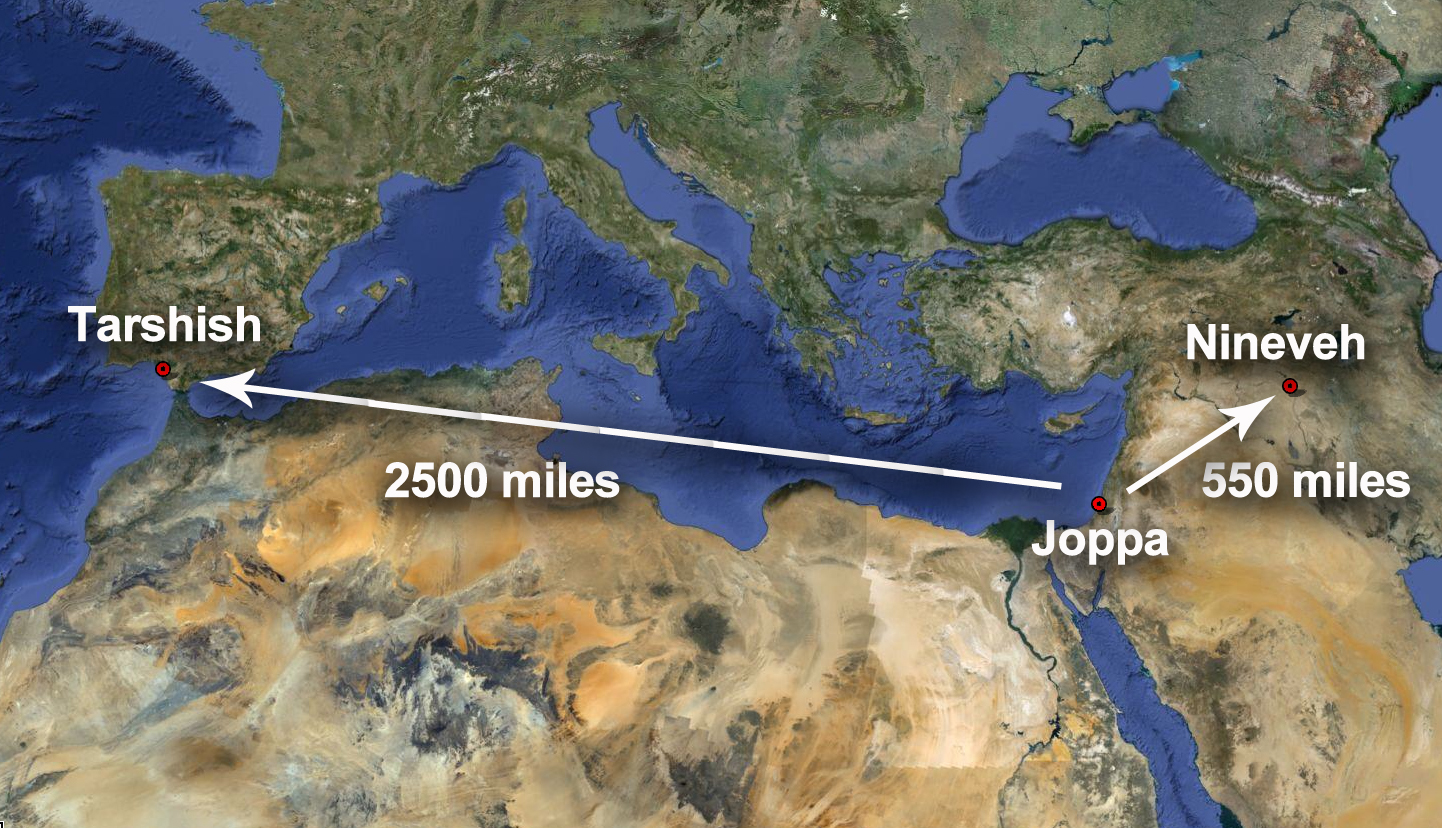
Notice a few things about this verse. Tarshish is mentioned three times. This was a purposeful, deliberate plan on Jonah’s part. He didn’t just show up and board the first boat he came across. He wanted to pick the farthest point on the map – a three year round trip by some estimates.

“From the presence of the Lord” is said twice. Jonah knew he was directly disobeying God. He was doing everything he could to get out of this trip. By why would he think God wouldn’t be in Tarshish? Because Isaiah had said as much:

I will set a sign among them. And from them I will send survivors to the nations, to Tarshish, Pul, and Lud, who draw the bow, to Tubal and Javan, to the coastlands far away, that have not heard my fame or seen my glory. (Isaiah 66:19)

God’s word and presence hadn’t been proclaimed in Tarshish. Perfect. Let’s go there!

Jonah went down to Joppa and down into the boat. This begins a downward spiral, descending into further rebellion and distance from God and closer to chaos and the grave.

And that phrase “paid the fare” is better understood as commissioning the whole ship and crew for the voyage. He wasn’t just buying a ticket for a bunk on the boat. He was financing the entire mission.

Verse three emphasizes the lengths to which Jonah was willing to go in order NOT to do what God told him to do. Nineveh was about a 550 mile, relatively easy trip across land via trade routes. Tarshish was on the Southern coast of Spain at the farthest edge of the Mediterranean Sea, risking storms, shipwrecks, pirates, disease, and more.

Jonah truly was the world’s worst prophet. I don’t like Jonah.

But then I realize that I see so much of Jonah inside me. To what lengths have I gone to avoid doing what God has called me to do? Who am I staying away from? What am I running from? What responsibilities am I shrugging off?

There’s a little bit of Jonah in all of us.

(De)Constructive Criticism

[Seeing as I am a new, young minister, I am going to be studying a bit deeper into Paul’s pastoral letters — 1 & 2 Timothy, Titus. I’ll be sharing some of my thoughts throughout the study]

1 Timothy 1:3-7

When I was in 8th grade, I had an English teacher who was brand new to the school. She was also new to the type of English curriculum we were used to — the good ol’ Shirley Method. To make matters worse, she had somehow lost the teacher’s manual (I think it was actually stolen…). So the entire year she was following along in a student book without the answer keys…and she was often wrong…and I often pointed it out.

Yes, my little brainiac, smarter-than-the-teacher, 8th grade self would correct the teacher often. So often, in fact, that she sent me out into the hall for correcting her! Ha.

As I got older I was not as quick to point out the mistakes made by my teachers, and when I did, I was much more polite and considerate. My concern became less about showing how smart I was and more about making sure my classmates were not “lead astray” or confused by a teacher who misspoke.

When Paul writes to Timothy, the first instruction is to correct anyone who is teaching false doctrines or who is focusing too heavily on myths and genealogies. The term “false doctrine” can be a dangerous one to throw around, and we need to make sure that we use the phrase with the same understanding as Paul and the apostles. But the fact remains that Timothy is given the task of correcting the shortcomings of some teachers.

I don’t think these are “bad” men. I don’t think they are purposefully trying to lead people astray. Paul even says that they want to be teachers. They just don’t know enough about what they are teaching. James gives a warning along these lines in James 3, when he warns that not many people should become teachers for they will be subject to a stricter judgment.

That’s scary to me as a youth minister. Teaching is one thing I do the most!

So what if you are sitting in your Sunday morning class and you notice the teacher talking about something that is incorrect, misinformed, or confusing? What if a teacher is beginning to cause debates, arguments, and unrest among the students?

Correct them. Go to them and discuss your concerns. Study with them more on the topic. Do something!

But the goal is not to make yourself look better. It’s not to show how much you know and how little the teacher actually knows.

The goal is LOVE.

“The goal of this command is love, which comes from a pure heart and a good conscience and a sincere faith” (vs 5).

That’s tough stuff. It’s not easy to keep a pure heart, a good conscience, and a sincere faith when confronting someone with whom you disagree. But that’s what is necessary if love is to be the ultimate goal in all we do.

Blinded

“I can’t see anything.”

“You’re suffering from hibernation sickness. You’re eyesight will return soon.”

“Where am I?”

“Jabba’s palace.”

“Who are you?”

“Someone who loves you very much.”

Han and Leia share a kiss, and live happily ever after. It’s not every day that the damsel rescues the knight in distress.

Anyway, Han spends the next several scenes in a state of near-blindness. I feel his pain. The same thing happens to me when I stumble to the bathroom at 2 am and flip the light switch. It’s painful to go from several hours of darkness to instant light. How much more pain must Han have felt after such a long time frozen in carbonite?

I can across this passage this morning which I have read many times, yet I noticed something new this time. 1 John 2:10-11 says, “Whoever loves his brother abides in the light and in him there is no cause for stumbling. But whoever hates his brother is in the darkness and walks in the darkness, and does not know where he is going because the darkness has blinded his eyes.”

The verdict is still out on whether or not someone can actually go blind from being in utter darkness for extended periods of time. Some say yes, you can go blind from darkness after several weeks because the muscles in and around the eyes would atrophy and the rods and cones would eventually die out. Others say no, there is no evidence that eyesight will be completely lost but it will take a while for the eyes to adjust back–like Han Solo.

Regardless, I feel like we have all experienced “blindness” from the dark. The movie is over and some idiot flips the light switch without giving the proper warning. Your mom turns on your lights to wake you up for school and the only logical response is to pull the covers up over your head to protect your eyes from the pain of the light. You get up to use the restroom at 2 am and miss because you have been blinded by the darkness.

I think you get my point. John is saying the same thing here about those who hate their fellow man. He says they are living in darkness and just stumble around. Even when they try to come out of that darkness and show love, they don’t know where they are going because they have been blinded.

Coming out of the darkness and into the light is a painful process, and it takes some time to adjust for most people. But instead of turning the lights out again quickly to avoid the pain, John is urging us to live in the light.

That means adjusting to the light. Living in love. Saying no to hate and malice while saying yes to compassion and mercy. By living a life of love, we will clearly see where we are going. No more stumbling around or pulling the covers over our heads.

And who know. When you come out of the darkness and into the light, you may just find someone who loves you very much.

Jesus Knows Me

I saw this wooden wall plaque on Etsy. I think it is so cool. We talk all the time about how Jesus loves us, but it seems so philosophical. This twist of the familiar children’s song reminds me that to be loved is to be known.

Jesus knows me personally, intimately. And I love that.

Reflections on "Jesus Manifesto"


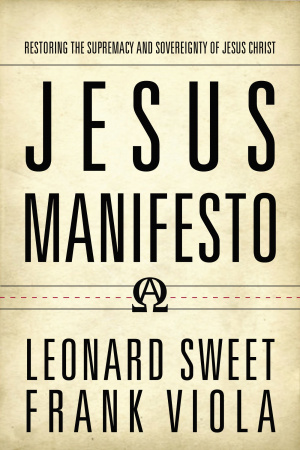
I recently finished reading an excellent book coauthored by Len Sweet (The Gospel According to Starbucks, Soul Tsunami) and Frank Viola (Pagan Christianity, Reimagining the Church). There have been throughout the centuries many pendulum swings of Christological thought. It seems that many theologians and scholars are content to take up arms in the debate between the “Jesus of History” and the “Christ of Faith.” Leaning too much to any one extreme, however, misses the richness and beauty of the God-Man that we worship. Sweet and Viola have done an outstanding job of refocusing the reader’s mind and heart onto the true awesomeness of Jesus the Christ. At the same time, they tackle the tough questions about living as the body of Christ on the earth. I thought I’d start back writing again with some reflections on various parts of the book.


Introduction:

I think this paragraph helps to set the stage for the rest of the book:
“So what is Christianity? It is Christ. Nothing more. Nothing less. Christianity is not an ideology or a philosophy. Neither is it a new type of morality, social ethic, or worldview. Christianity is the ‘good news’ that beauty, truth, and goodness are found in a person. And true humanity and community are founded on and experienced by connection to that person.”
Wow. What a statement. As I think back to my world religions class, I am still blown away by all the competing faiths, belief systems, moralities, and worldviews swirling around our culture today. It’s very easy to take a broad, sweeping view of all the religions and to think that Christianity has nothing unique to offer. It seems like all the major religions have their sacred texts, their god/gods/spirits, their earthly leaders/founders, their own code of ethics, their own belief about the afterlife, etc. It’s so easy to get caught up in the similarities blurring the lines that we lose focus on the truly unique nature of our faith.
Christ is what makes our faith as unique today as it was in first century Palestine. Yes, we believe in the Bible as the word of God, but the Word became flesh. Yes, we have a certain morality for which we strive, but all of that morality was fulfilled in Christ. Yes, we have a way of viewing the world around us, but we see the world as God sees the world. Yes, we believe in an afterlife, but we believe in eternal life here and now.
In Christ we find more than a list of rules and regulations. He gives us more than instructions on how to get to heaven. In Christ we find truth, beauty, community, acceptance, and a love that out-loves all other love that we could ever know. Christianity is Christ! When it becomes about “Christ and,” then we have lost our true focus. We have forgotten our first love.
I’ll leave you with this final quote:
“[W]e cannot properly love him if we haven’t caught sight of how incredibly glorious he is. But once we do–once we catch a sighting of Jesus Christ in all his glory–we will gladly exchange our dusty rites, Christian-speak, and pop-culture church-building tactics for the joy of becoming a walking, breathing ‘Jesus Manifesto.'”