Page 17 of 70

SABBATH | 40 Days of Focus, Day 11


“Remember the Sabbath day by keeping it holy.Six days you shall labor and do all your work, but the seventh day is a sabbath to the Lord your God. On it you shall not do any work, neither you, nor your son or daughter, nor your male or female servant, nor your animals, nor any foreigner residing in your towns. For in six days the Lord made the heavens and the earth, the sea, and all that is in them, but he rested on the seventh day. Therefore the Lord blessed the Sabbath day and made it holy.”
(Exodus 20:8-11)

Sometimes I think we forget just how revolutionary the Bible is/was. Remember that this was a nation of former slaves. How many holidays do slaves get? Zero. How many days off in a week did they get? Zero. To live was to work.

For God to take this nation of former slaves and then REQUIRE one day of complete rest from work EACH WEEK was truly foundational in granting them a new identity. They aren’t slaves anymore, and to prove it, God says stop working.

The whole notion of Sabbath is closely tied to God’s own rest after his creative work in Genesis.

By the seventh day God had finished the work he had been doing; so on the seventh day he rested from all his work. Then God blessed the seventh day and made it holy, because on it he rested from all the work of creating that he had done.
(Genesis 2:2-3)

Only recently have a significant number of people around the globe been able to enjoy one or two days off during the week. Some countries and companies are even testing out a four-day work-week model, and it seems to be going well. I think, it turns out, that humans weren’t designed to work nonstop, seven days a week. People need rest. People need a break. God knew this from the beginning, and so he prioritized it for his new nation.

Sabbath is a GOOD thing. The benefits of rest and relaxation are attested to time and time again for increasing productivity and creativity. We are more efficient and effective when we are well rested and not overly burdened.

So why was Jesus always fighting against the Sabbath?

Seven different times in the gospels we find Jesus performing miracles (mostly healings) on the Sabbath. This upset the religious leaders to no end. In fact, this is one of the main reasons they wanted to kill him. I think this one verse reveals a lot about their hearts.

Indignant because Jesus had healed on the Sabbath, the synagogue leader said to the people, “There are six days for work. So come and be healed on those days, not on the Sabbath.”
(Luke 13:14)

Jesus wasn’t against Sabbath as a practice and an idea. In fact, he was very much in favor of finding times of rest and disconnecting from the high-speed demands of life. Over and again we see him slipping away from the crowds to be alone with God. His problem with Sabbath was that the religious leaders were making it more of a burden than a release of burdens. Sabbath was made to be enjoyed, but they were sucking all the joy out of it with their rules.

It’s like taking your kids to the playground and threatening them to have fun or else they’re going to be punished. Or like, this is completely true, the sign I saw at one playground listing a bunch of rules, one of which was “No Running.” Srsly???


Simply put, Jesus didn’t play those games.

Then he said to them, “The Sabbath was made for man, not man for the Sabbath. So the Son of Man is Lord even of the Sabbath.”
(Mark 2:27-28)

We weren’t made to follow an extreme no-work regime, either. Man was not created solely to follow the Sabbath laws. Rather, God created the Sabbath to be a relief to us. The problem came from all the rules and restrictions around the Sabbath, making it more of a burden.

When rest is burdensome, we’ve gotten pretty far offtrack.

Our rest is not found in observing a bunch of rules, regulations, and guidelines. Rest is found in following Jesus.

“Come to me, all you who are weary and burdened, and I will give you rest. Take my yoke upon you and learn from me, for I am gentle and humble in heart, and you will find rest for your souls. For my yoke is easy and my burden is light.”
(Matthew 11:28-30)

Sabbath can come whenever, wherever while following Jesus. Or as Augustine said:

“You have made us for yourself, O Lord, and our heart is restless until it rests in you.”

_________________________________

Is the practice of Sabbath important in your life? How do you make rest and time with God a priority in your life?


Why do you think our churches don’t teach and encourage Sabbath that much?


Jesus said the Sabbath was intended to bring life and healing. What steps can you take this week to find times of rest that bring life and healing and joy?

NAME | 40 Days of Focus, Day 10


“You shall not misuse the name of the Lord your God, for the Lord will not hold anyone guiltless who misuses his name.”
(Exodus 20:7)

Your name is the loudest, most important word in your vocabulary. From before you were born, you were probably addressed by name. Your parents chose a name that was important and meaningful to them in some regard. When someone needs you, they call your name. You want people to know your name and call you by name. If they don’t know your name, especially after some time knowing you, or they get your name wrong, it can leave you feeling insulted or demeaned.

It can be frustrating to hear your name too much, however. When someone says your name just to say it, that almost feels like an affront, an abuse of your identity.
“Daniel. Daniel. Daniel. Daniel. Daniel. Daniel…” WHAT?!

Or worse, when someone ascribes some actions or beliefs to you, associating your name with something you would never do or think or condone, it can leave you feeling utterly betrayed.
“Daniel thinks it’s no big deal for people to use the express checkout lane with a cart full of groceries.” I NEVER SAID THAT!

Your name is sacred to you. You don’t want people using your name “in vain” or flippantly. You also don’t want people abusing your name by associating it with something without your consent.

So why do we do that with God’s name?

The Jews took this command so seriously that we don’t even know the true covenantal name of God. They chose not to insert the vowels in the name YHWH, so the literal pronunciation is lost to history. They also would replace the name YHWH with Adonai (or LORD) when reading from the sacred texts so as not to misuse God’s name. Even today, many Jews will write G-d so as not to break this third commandment.

And here we are shouting “Oh my God” at every little thing. When your best friend shows up with a new hair cut, “Oh my God! I love it.” When your plastic Walmart bag breaks, “Oh my God.” When someone is driving too slowly in the left lane, “Oh my God, hurry up!” When your boyfriend proposes, “Oh my God!” When your waitress spills the water, “Oh my God.” When the Property Brothers finish their renovation project on your new, overpriced fixer upper, “Oh my God!” When the ref misses an obvious pass interference call that causes your team to lose the game and miss the Super Bowl, “Oh my God!” When you open a container of spoiled mashed potatoes that has spent three weeks in the back of the fridge…

You get the point. Stop using the name of God as an explicit, a curse, or an exclamation. Find something else to say.

But this command goes deeper than that. If this is where we stop, then we miss the more important prohibition in this command. To misuse God’s name also means to use it incorrectly – slapping God’s name on something in order to gain support or power. When we use God’s name to advance our own career, agenda, ideas, or merchandise, we are breaking the third commandment.

There’s a weird story in 1 Kings 13 where God sent a prophet to King Jeroboam and then told him to leave without staying to eat. The prophet left, but while he was on his way another “old prophet” caught up with him and lied to him. “I too am a prophet, as you are. And an angel said to me by the word of the Lord: ‘Bring him back with you to your house so that he may eat bread and drink water.’” The first prophet went home with the guy and later was killed by a lion. Sometimes people use the name of God to add authority to their ideas. We must be discerning and realize when someone is trying to pull one over on us.

There was another time when the Israelites were at war with the Philistines. They decided to bring the Ark of the Covenant out to the battle to prove that God was on their side. They were misusing the name of God. The Philistines won the battle and captured the Ark.

But probably my favorite cautionary tale against breaking this command is in Acts 19. These Jewish guys were going around driving out demons and using the names of Jesus and Paul in order to add some authority to their business. The story that follows is hilarious.

Some Jews who went around driving out evil spirits tried to invoke the name of the Lord Jesus over those who were demon-possessed. They would say, “In the name of the Jesus whom Paul preaches, I command you to come out.” Seven sons of Sceva, a Jewish chief priest, were doing this. One day the evil spirit answered them, “Jesus I know, and Paul I know about, but who are you?” Then the man who had the evil spirit jumped on them and overpowered them all. He gave them such a beating that they ran out of the house naked and bleeding.
(Acts 19:13-16)

The name of God is to be kept holy (see the Lord’s Prayer). That means we should honor and revere the names of God the Father, Jesus Christ His Son, and the Holy Spirit. We should not use them flippantly as expletives or exclamations. And neither should we use them as a way of promoting our own agendas, beliefs, politics, or businesses.

When a band can’t make it in the main stream so they sign with a Christian label just to sell more albums and show tickets, they’re using God’s name in vain.

When a politician has no previous religious affiliation suddenly begins quoting the Bible in order to appeal to his faith-based voters, he’s using God’s name in vain.

When a country claims to be a Christian nation but repeatedly and systemically abuses minorities, immigrants, and the poor, that country is using God’s name in vain.

When a business capitalizes on a Christian market for their t-shirts, hats, bracelets, bumper stickers, coasters, breath mints, and cheesy paintings, they are using God’s name in vain.

When a political party uses religious rhetoric and Scripture to convince people that “real Christians would never vote for those other guys,” then they are using God’s name in vain.

When we allow ourselves to be convinced that God’s will can only be carried out through government intervention, then we are using God’s name in vain.

There is only one name that can save – and it’s not Washington, DC. It’s not Trump or AOC. It’s not Republican or Democrat. It’s not anything under heaven except one name.

Salvation is found in no one else, for there is no other name under heaven given to mankind by which we must be saved.
(Acts 4:12)

_______________________________

Why do you think it’s so easy for us to exclaim “Oh my God” on a regular basis? Does this bother you? Do you even notice it anymore?


What do you think about the lengths the Jews would go in order not to misuse God’s name? What would people think if we showed that same level of respect?


What specific ways do you see people misusing God’s name in business, politics, etc?

IDOLS | 40 Days of Focus, Day 9


“You shall not make for yourself an image in the form of anything in heaven above or on the earth beneath or in the waters below. You shall not bow down to them or worship them; for I, the Lord your God, am a jealous God, punishing the children for the sin of the parents to the third and fourth generation of those who hate me, but showing love to a thousand generations of those who love me and keep my commandments.”
(Exodus 20:4-6)

The second of the 10 Commandments is a prohibition against crafting an image of a created thing in order to bow down to or worship it. Remember, the Hebrew people have just spent many generations in the land of Egypt which was overrun with idols and images. They were everywhere! If you go to Egypt even today and look at the ancient ruins, there are temples and idols and statues and carvings everywhere you look. They depict the pharaohs and the gods, retelling their collective stories in which they found their identity.

Some pharaohs ramped it up to eleven, like Ramses II who loved him some Ramses II. He built statues and shrines to himself right alongside those of Ra and Osiris and Horus.

“Stop doing that,” God says.

The question is, why?


I think there are many reasons God would give this command, but let’s look at two. First, it’s a little ridiculous to worship the Creator by ascribing to him an image of a created thing. Second, we already have an image of God walking around – human beings. We’ll get to that more in a moment.

I mentioned Isaiah yesterday. I want to draw your attention to what he actually says about the lunacy of idol worship. It’s a longer passage, but well worth it.

The blacksmith takes a tool
and works with it in the coals;
he shapes an idol with hammers,
he forges it with the might of his arm.
He gets hungry and loses his strength;
he drinks no water and grows faint.
The carpenter measures with a line
and makes an outline with a marker;
he roughs it out with chisels
and marks it with compasses.
He shapes it in human form,
human form in all its glory,
that it may dwell in a shrine.
He cut down cedars,
or perhaps took a cypress or oak.
He let it grow among the trees of the forest,
or planted a pine, and the rain made it grow.
It is used as fuel for burning;
some of it he takes and warms himself,
he kindles a fire and bakes bread.
But he also fashions a god and worships it;
he makes an idol and bows down to it.
Half of the wood he burns in the fire;
over it he prepares his meal,
he roasts his meat and eats his fill.
He also warms himself and says,
“Ah! I am warm; I see the fire.”
From the rest he makes a god, his idol;
he bows down to it and worships.
He prays to it and says,
“Save me! You are my god!”
They know nothing, they understand nothing;
their eyes are plastered over so they cannot see,
and their minds closed so they cannot understand.
No one stops to think,
no one has the knowledge or understanding to say,
“Half of it I used for fuel;
I even baked bread over its coals,
I roasted meat and I ate.
Shall I make a detestable thing from what is left?
Shall I bow down to a block of wood?”
Such a person feeds on ashes; a deluded heart misleads him;
he cannot save himself, or say,
“Is not this thing in my right hand a lie?”
(Isaiah 44:12-20)

God, the Creator of everything, cannot be contained within or represented by anything we humans can make. God made cows – how are you going to represent him as a cow? God made the sun – how are you going to represent him as the sun? There certainly are things about God’s nature that we can learn from his creation (Romans 1), but any created image will fall short in fully representing God’s power and glory.

But it’s really difficult for us humans to focus on what we can’t see. We often need something on which to fix our gaze. That’s one of the attractions and also the dangers of idol worship. I heard a quote recently, but I cannot remember who originally wrote/said it: “The soul takes the shape of that which has its attention.” We are an increasingly image-based culture. We communicate through emoji, gifs, and memes. We don’t call or send text messages, we SnapChat and post to Instagram Stories. We don’t read books, we wait for the movie. We don’t read magazine articles, we watch YouTube videos.

Gathering around the TV to stream Netflix does not look much different in practice from gathering around the household shrine and telling the stories of the gods. Going to the movies does not look much different in practice than making a pilgrimage to the temple.

Living in an increasingly post-text, more image-based society leads us to think more strongly that “seeing is believing.” You can’t believe or know or experience that which you can’t see. So we create our own gods and form our new religions around celebrities, sports teams, and superheroes.

God says, “Stop it.”

For we live by faith, not by sight.
(2 Corinthians 5:7)

Second, God already has micro-images of himself walking around. Remember on Day Six God created mankind “in his image and likeness.” That makes me think about the time Jesus was at the Temple and some of the religious leaders wanted to trap him. They asked about paying taxes to Caesar. Jesus’ response is brilliant.

“Show me the coin used for paying the tax.” They brought him a denarius, and he asked them, “Whose image is this? And whose inscription?”
“Caesar’s,” they replied.
Then he said to them, “So give back to Caesar what is Caesar’s, and to God what is God’s.”
(Matthew 22:19-21)

First of all, they weren’t supposed to have that kind of coin in the Temple because of this Command Number Two. But then Jesus asked about the image and inscription. If Caesar wants to put his image and inscription on a coin to mark it as his, then give it back to him. But God has placed his image and inscription upon each person. You are not your own. So give the coin to Caesar, but give your life to God.

We don’t need to create images to bow down to and worship as a representation of God. God has already done that work for us! Not that we worship human beings, but we see each other and know God is present among us. John words it WAY better than I can.

Dear friends, since God so loved us, we also ought to love one another. No one has ever seen God; but if we love one another, God lives in us and his love is made complete in us.
(1 John 4:11-12)

If the soul takes the shape of that which holds its attention, then let us set our attention on love. May the love we have for one another be the image of God among us. And may we together in love fix our eyes on Jesus, the ultimate representation of God with us.

The Son is the radiance of God’s glory and the exact representation of his being, sustaining all things by his powerful word. After he had provided purification for sins, he sat down at the right hand of the Majesty in heaven.
(Hebrews 1:3)

Do I think it’s wrong to have paintings, sculptures, and images adorning our church buildings? No. Art can certainly direct us toward God and connect with us on an emotional level. But we must always remember that the created thing is not to be worshiped or revered as “divine.”

______________________________________

Why do you think the visual arts are so effective at connecting with us emotionally?


Does your church building utilize art to draw people’s attention to God? Or is your worship space more bland and bare? Why? How effective is it?


Why do you think humans are so prone to worship a created thing rather than their unseen Creator?

ONE | 40 Days of Focus, Day 8


And God spoke all these words:
“I am the Lord your God, who brought you out of Egypt, out of the land of slavery.
“You shall have no other gods before me.”
(Exodus 20:1-3)

A quick summary of what happened after the creation accounts in Genesis: God made man and woman, placed them in a perfect garden, and gave them one rule – don’t eat from the Tree of the Knowledge of Good and Evil. A serpent showed up and convinced them otherwise. They ate, they got expelled, their oldest son killed his younger brother – you know…typical family stuff. Things got worse until God sent a flood to wipe the slate clean and begin again with Noah and his family.

Then God called Abraham who would become the father of a great nation and through whom all the peoples of the world would be blessed. Miraculously Abraham and Sarah were able to have a baby boy in their old age. They named him Isaac. Isaac had twin sons named Jacob and Esau. Jacob tricked Esau out of his blessing and birthright – you know…typical family stuff.

Jacob wrestled with God and had his name changed to Israel. He also had 12 sons, one of whom was named Joseph. The other brothers hated Joseph and sold him to slave traders going to Egypt. One thing led to another and Joseph found himself as Pharaoh’s right-hand man. When famine struck, the rest of Joseph’s family eventually made the move to Egypt, the only land with any food left. And then they just kind of…stayed. For a long time.

Image result for genesis bible

A new dynasty arose in Egypt who did not appreciate the contribution of this family of outsiders, known now as the Hebrews. The new Pharaoh ended up enslaving the population until God rose up a leader named Moses to free his people and lead them into their own homeland to fulfill a promise God made to Abraham.

Are you with me so far?

By some accounts, the people of Israel had spent nearly 400 years in Egypt, speaking their language, sharing their customs, learning about (and possibly worshiping) their gods. Now God must turn this ragamuffin smattering of tribes into a holy nation, a kingdom of priests. God took Moses up onto Mount Sinai and gave him a set of laws by which to establish these newly freed slaves as one nation under God.

Image result for moses with ten commandments

What’s the absolute most important thing for them to know? What’s number one on the list? What is going to be “pinned” to the top forever? Read it again with their history in mind:

“I am the Lord your God, who brought you out of Egypt, out of the land of slavery.
“You shall have no other gods before me.”

It’s almost like a formal introduction. “Hello, my name is YHWH. I am your God. Nice to meet you.” But think about it. These people have grown up knowing Ra and Horus and Isis and Osiris and Set and Hathor. Which one of these gods freed us from slavery? None of the above. Odds are they had mostly forgotten the God of Abraham, Isaac, and Jacob from their collective memory.

When I was growing up, I learned that the first of the 10 Commandments was “You shall have no other gods before me.” But that’s not what the Jews would say. The first commandment is “I am YHWH your God.” The no other gods clause flows from that declaration.

Also, I find it interesting that God doesn’t say “there are no other gods except me.” That would have been simply unbelievable to these people. Of course there are other gods! YHWH is just one among many. The Egyptians have their gods. We have our God. It’s not until much later that the prophets make the case against the existence of other gods (see Isaiah 44).

Here’s the reality – there are other gods. Anything we place in front of God becomes our god. Anything apart from God to which we cry out “save me!” becomes our idol.

What does that look like for us today? We so easily turn things into modern-day idols – celebrities, government & politicians, bank accounts, stock portfolios, social media profile, academics, sports, food. Our new gods are named “Life, Liberty, and the Pursuit of Happiness.” Jesus put it this way:

But seek first his kingdom and his righteousness, and all these things will be given to you as well.
(Matthew 6:33)

We get it wrong when we talk about “priorities.” There can really be only one priority – everything else is secondary or tertiary. If God is not your priority, your number one, then whatever else is in that spot is your idol.

How would you fill in this blank?
“I am the LORD your God who ____________________________.”

The Hebrew people needed to know and remember that it was YHWH who delivered them, not some other god or deity. They did not do it themselves. It wasn’t the Egyptian government’s idea to set all the slaves free. It was only God. He delivered them from slavery and brought them out of Egypt. When they forget that – and how forgetful we humans are! – they always fall into temptation and sin. Always. Remember who God is and what he has done.

May we know God today as our God. May we always remember what God has done for us – life, breath, joy, resilience, health, material blessings, family, friends, forgiveness, salvation, freedom.

Every good and perfect gift is from above, coming down from the Father of the heavenly lights, who does not change like shifting shadows.
(James 1:17)

And may we never place any other god before God. May nothing in all creation take his place at the top.

The heavens praise your wonders, Lord,
your faithfulness too, in the assembly of the holy ones.
For who in the skies above can compare with the Lord?
Who is like the Lord among the heavenly beings?
In the council of the holy ones God is greatly feared;
he is more awesome than all who surround him.
Who is like you, Lord God Almighty?
You, Lord, are mighty, and your faithfulness surrounds you.
(Psalm 89:5-8)

___________________________________

What other “gods” feature most prominently in your life? What “gods” are in the most competition with YHWH for priority in your life?

Why is it important to remember what God had done for us? How often do you share those stories with others? What’s your favorite story about what God has done for you?

 What happens when we forget God and what he has done for us? (See Exodus 32)

REST | 40 Days of Focus, Day 7


Thus the heavens and the earth were completed in all their vast array.
By the seventh day God had finished the work he had been doing; so on the seventh day he rested from all his work. Then God blessed the seventh day and made it holy, because on it he rested from all the work of creating that he had done.
(Genesis 2:1-3)

When was the last time you rested? Like, really rested?

I’m sure we’ve all seen the statistics and research about how Americans are among the most overworked people in the world. Americans on average work longer hours per week than their European counterparts, and they receive fewer paid holidays. We have no guaranteed maternity leave, while other countries insist on granting mothers and fathers paid family leave while their children are young.

We go on fewer vacations, take fewer sick and personal days, and we work more overtime than we should. We buy into the lie that busyness equals productivity. But that couldn’t be further from the truth.

I’m seeing more and more studies that show the importance of rest, time off, and brain-breaks throughout the day. Something as simple as a 10-15 minute break to walk around the office or around the block can actually help spur creativity and productivity. If we don’t take breaks and if we don’t find time to rest and disconnect, then we are in danger of burnout.

I saw this video the other week on one of the YouTube channels I follow. It speaks to this very idea, but not in a Christian or religious way – so mind some of the language. But his points are spot on.

I think God knew that we needed rest. He created us, after all. I think he would be a pretty good judge of what we need. But here’s the thing about God – he never calls us to do something he is unwilling to do himself. God calls us to rest (as we’ll see in the 10 Commandments), so God sets the precedent by resting.

I’ve been hearing a lot lately about how good breaks and rest can be for our minds. I’m terrible about this, but when was the last time you did chores without listening to music or a podcast? When was the last time you exercised without your earbuds in? When was the last time you drove somewhere in silence? When was the last time you just let your mind wander freely? For me it’s almost never.

But I want to get better about it.

We are creative beings. Part of what it means to be made in the image of God is that we carry on his creative work. We can add value and beauty to the world around us unlike any other creature. We care about art and design and color and architecture and texture and lighting and ambience and aesthetic. God does, too. We get to participate in his creativity, but not to the point of losing ourselves in the work.

God rested. Rest does not equal laziness just like busyness does not equal productivity. We think people are either busy or they’re lazy. But so often we end up staying busy with things that don’t matter – and that can be as bad or worse than laziness.

God rested, and it was a holy, intentional rest. The seventh day was set aside, it was different than the other days. Again, we’ll talk more about Sabbath specifically in a few days. But God knows the importance of holy moments, holy spaces, holy days and times. We were not created to go 100% seven days a week. We were created to live in a rhythm of life – evening, morning, work, rest, worship, create, feast, celebrate, get busy, relax.

Don’t buy into the lie that you have to work harder than God. There’s a time for work and a time to rest.

____________________________
Do you think God is still working and creating today? Or did he completely stop after Day Seven?

Have you ever felt burnt out? What was that like? What led to that experience? What did you learn from it?

Why do you think society places such an emphasis on being and staying busy? In what ways might that busyness be hurting our physical health? our families? our churches?

Look at your daily schedule. Mark out some times to rest, to take breaks, to enjoy nature, and to disconnect from social media and the demands of your electronic devices.

IMAGE | 40 Days of Focus, Day 6


And God said, “Let the land produce living creatures according to their kinds: the livestock, the creatures that move along the ground, and the wild animals, each according to its kind.” And it was so. God made the wild animals according to their kinds, the livestock according to their kinds, and all the creatures that move along the ground according to their kinds. And God saw that it was good.
(Genesis 1:24-25)

Day Four (sun, moon, and stars) was about filling Day 1 (light and dark). Day 5 (fish and birds) was about filling Day 2 (waters and sky). Finally, Day 6 (land animals) is about filling Day 3 (land and vegetation).

One thing I find interesting about Days 5 and 6 is that God uses creation to do the creating. “Let the waters teem with life” and “let the land produce living creatures.” Life comes from non-life. That’s a statement that has sparked a lot of scientific debate over the years. Scientists are still trying to discover just how that happened. Why is there life instead of non-life? I have no idea when it comes to the nuts and bolts of it, but it does seem that wherever God is, there is life. Once everything was in place on this planet, life was virtually inevitable.

Or as we see in Jurassic Park, “Life finds a way.”

People often wonder about the seeming conflict between science and faith. Do we take Genesis 1 literally? If so, then what about evolution? What about dinosaurs?

Frankly, that’s not what the creation song is about. It’s not interested in the science of creation. It’s not even written with a scientific worldview in mind. It predates the scientific method. One more time for people in the back: Genesis is not about science. Science is concerned with discovering the how. Genesis is more interested in the who and why. The God of the Bible creates out of love and community, and his creation is imbibed with a sense of purpose and order – and it was good.

The writer of Genesis 1 depicts three basic groups of animals – domesticated livestock, wild untamed beasts, and reptiles. Add those to fish and birds, and that’s basically the way the ancients understood the natural world.

But then…

God said, “Let us make mankind in our image, in our likeness, so that they may rule over the fish in the sea and the birds in the sky, over the livestock and all the wild animals, and over all the creatures that move along the ground.”
So God created mankind in his own image,
in the image of God he created them;
male and female he created them.

God blessed them and said to them, “Be fruitful and increase in number; fill the earth and subdue it. Rule over the fish in the sea and the birds in the sky and over every living creature that moves on the ground.”
Then God said, “I give you every seed-bearing plant on the face of the whole earth and every tree that has fruit with seed in it. They will be yours for food. And to all the beasts of the earth and all the birds in the sky and all the creatures that move along the ground—everything that has the breath of life in it—I give every green plant for food.” And it was so.
God saw all that he had made, and it was very good. And there was evening, and there was morning—the sixth day.
(Genesis 1:26-31)

Another question scientists try to answer is What separates humans from animals? Technically, human beings are mammals, and we’re closely related on a DNA level to primates like chimpanzees and bonobos. But as far as we know, human beings are the only sentient, self-aware, conscious beings in the entire universe. Some would say that we’re no different than the non-human animals. I think the fact that we can make those kind of assertions proves that we are different.

Where does consciousness come from? Where does our sense of love and community and justice come from? Where does our morality come from?

I believe it has something to do with the very Image and Likeness of God embedded into each and every homo sapien on the planet. There is a little bit of God’s own nature inside each one of us. Forgetting or ignoring that fact has led to some of the greatest atrocities in history – persecution, genocide, hate crimes, slavery, human trafficking. When we dismiss the Imago Dei inside our brother or sister, we dehumanize them. Only when we dehumanize them in our minds can we justify violent actions against them.

Every living creature has the “breath of life” in it, but only humans bear the likeness of God. Thus we are his ambassadors and co-rulers. We are tasked with the creative process, ruling over and tending to the rest of creation just as God would do.

This is why, I believe, that Jesus says the greatest command in Scripture is to love the Lord your God with all your heart, soul, mind, and strength – AND – to love your neighbor as yourself. Or as John would put it:

Whoever claims to love God yet hates a brother or sister is a liar. For whoever does not love their brother and sister, whom they have seen, cannot love God, whom they have not seen.
(1 John 4:20)

Love for God and love for others cannot be separated because God has created us in his own image. Or as Victor Hugo would write in his famous novel Les Miserables, “To love another person is to see the face of God.”

God saw all that he had made, and it was very good.

 ________________________________

How would the world be different if we all acknowledged the Image of God in each other human being we encountered every day?

Why is it so difficult to remember that all people are created in God’s likeness?

What are some specific ways we can live out the mission God gave us?

FLY AND SWIM | 40 Days of Focus, Day 5

And God said, “Let the water teem with living creatures, and let birds fly above the earth across the vault of the sky.” So God created the great creatures of the sea and every living thing with which the water teems and that moves about in it, according to their kinds, and every winged bird according to its kind. And God saw that it was good. God blessed them and said, “Be fruitful and increase in number and fill the water in the seas, and let the birds increase on the earth.” And there was evening, and there was morning—the fifth day.
(Genesis 1:20-23)

On day two God separated the waters above from the waters below. Now on day five God filled the waters below with fish and the sky with birds. For the first time the Earth is inhabited by creatures that can breathe and move and mate and fight and hunt and forage and multiply and spread out and start families. There is something of free will within the order of creation.

These living creatures are the first to receive a blessing from the Creator – to be fruitful and multiply, fill the waters and the sky. God’s blessing is one of permission and encouragement to do what his creatures are made to do. There is a freedom to living within the order of creation.

Is there something special about birds and fish in particular that they would get their own “day” devoted to them?

Looking back to Genesis 1:2 again, we see that the Spirit of God was hovering over the surface of the deep. That word “hovering” is also the word for “fluttering”…you know, like a bird. Then at the baptism of Jesus, we once again see the Spirit of God descending like, wait for it… a bird.

And then who could forget the awesome passage in Isaiah:

Even youths grow tired and weary,
and young men stumble and fall;
but those who hope in the Lord
will renew their strength.
They will soar on wings like eagles;
they will run and not grow weary,
they will walk and not be faint.
(Isaiah 40:30-31)

Birds factor prominently in the story of Scripture, but what about fish?

Obviously I think about the story of Jonah in which God creates a “great fish” to swallow Jonah and save him from drowning. After three days, the fish vomited Jonah up onto dry land, and he then goes on to complete his mission to the city of Nineveh. Nineveh, coincidentally, means “house of fish.” And Jonah’s name, coincidentally, means “dove.” Crazy, right?

I think it would be hard to think about fish in the Bible without skimming through all the fish stories in the gospels. It seemed like Jesus was always around fish. His first disciples were fishermen whom he called to “fish for people.” One of his first miracles was an overwhelming catch of fish. He used fish and bread to feed close to 10,000 people all together. Then there was that odd story where Jesus told Peter to go catch a fish and inside the fish would be a coin to pay the Temple tax…that was weird. Even after the resurrection, the disciples met Jesus on the shore of Galilee as he was cooking up a fish breakfast.

There’s something unique about birds and fish. Have you ever found yourself jealous of them? Flight is one of the most often requested superpowers. Everyone wants to fly. Nearly 500 years past between the flying machine drawings of Leonardo Da Vinci in the late 1400s and the first manned airplane developed by the Wright brothers in the early 1900s. We take flight for granted now, but we’ve only been able to soar above the clouds for just over 100 years of human history. We dream of flying cars and jet packs and hover boards. We want to be able to do what the birds can do naturally.

And what about swimming? We’ve been sailing the oceans for thousands of years, but submarine technology has only been around for a couple hundred years. Even today, something like 80% of the oceans have yet to be explored thoroughly. Will we ever have our own personal submarines? Not likely. But we still want to do what the fish can do naturally.

God’s creation has a design and a purpose. Each piece of it falls neatly into place. God brings order out of chaos, and in that order there is freedom. If we try to do what birds do, we will fall off the roof and break a bone. If we try to do what fish can do, we will drown.

Birds were created to fly. Fish were created to swim. So what were you created to do?

You have made [humans] a little lower than the angels
and crowned them with glory and honor.
You made them rulers over the works of your hands;
you put everything under their feet:
all flocks and herds,
and the animals of the wild,
the birds in the sky,
and the fish in the sea,
all that swim the paths of the seas.
(Psalm 8:5-8)

__________________________

Why do you think humans have tried so hard to fly throughout the ages?

Would you rather be able to fly like a bird or swim like a fish? Why?

What significance is there in the Holy Spirit appearing in the form of a dove?

HEAVENS | 40 Days of Focus, Day 4


And God said, “Let there be lights in the vault of the sky to separate the day from the night, and let them serve as signs to mark sacred times, and days and years, and let them be lights in the vault of the sky to give light on the earth.” And it was so. God made two great lights—the greater light to govern the day and the lesser light to govern the night. He also made the stars. God set them in the vault of the sky to give light on the earth, to govern the day and the night, and to separate light from darkness. And God saw that it was good. And there was evening, and there was morning—the fourth day.
(Genesis 1:14-19)

Days one, two, and three were all about separating – light from darkness, waters above from waters below, dry land from the seas. Now we make a shift from separating to filling. Days four, five, and six fill what was separated on the first three days.

On day one, God created light and separated it from darkness. Now he fills the light and dark with the sun, moon, and stars. But notice how he doesn’t give them names. Why?

In the cultural context in which this poem reached its final form – probably in Babylonian exile – the study and worship of the heavenly bodies was very common. Most ancient cultures regarded the sun and the moon as major gods/goddesses. The stars and planets also played a role in giving “signs” from the gods. The creation song in Genesis simply regards them as “the greater light,” “the lesser light,” “…and also the stars.” The importance is placed on the Creator, not the creation. The sun and moon were set in place to “govern” under the sovereign kingship of God.

But this is not just the creation of the heavenly bodies. It’s also the creation of time itself. Their job was to give light to the earth AND to mark days, years, and sacred times. God is already building a rhythm of time into his creation. Evening, morning, days, weeks, months, years, holidays – God created the sun and moon to help keep track of it all.

Since the dawn of humanity, we’ve been staring up at the sky and wondering what it all means. Even though we know now that each point of light is a giant flaming ball of gas thousands of lightyears away, even though we know our Sun is an average-size, middle-aged star, even though we know our moon is not made of cheese… – even though we can explain it all, it still takes our breath away. We still have the same overwhelming sense of our own smallness whenever we look up.

When I consider your heavens,
the work of your fingers,
the moon and the stars,
which you have set in place,
what is mankind that you are mindful of them,
human beings that you care for them?
(Psalm 8:3-4)

The heavens declare the glory of God;
the skies proclaim the work of his hands.
Day after day they pour forth speech;
night after night they reveal knowledge.
They have no speech, they use no words;
no sound is heard from them.
Yet their voice goes out into all the earth,
their words to the ends of the world.
(Psalm 19:1-4a)

Think about how big of a deal celestial phenomena still are. There is still a ton of hype and excitement around solar and lunar eclipses, blood moons, and meteor showers. Even though we can explain it all, we continue to experience a deep emotional reaction in our core.

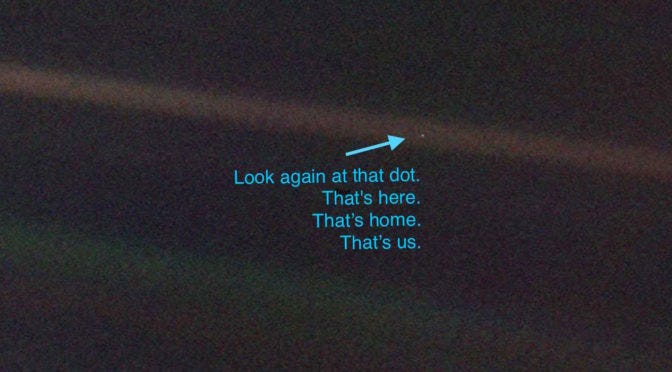
Nothing can make you feel quite so small as studying the stars and planets. We cannot wrap our minds around the size and scale of our solar system or our galaxy or our universe. I get a sinking feeling in the pit of my stomach just thinking about it. But to know God is bigger than that and he still chooses to care for you and me…that is the most shocking realization of all. To see pictures like this…

…and know that God loves all 7 billion people on that “pale blue dot” hurtling through space…I don’t even have words. Is certainly puts this verse into a whole new perspective:

For God so loved the world that he gave his one and only Son, that whoever believes in him shall not perish but have eternal life.
(John 3:16)

______________________________

Do you have a favorite constellation? What is it, and why?

When was the last time you simply looked up at the clear night sky? How did it make you feel?

The Pleiades and Orion are two constellations mentioned in the Bible. In Job 38:8 God asks, “Can you bind the chains of the Pleiades? Can you loosen Orion’s belt?” It wouldn’t be until centuries later that we discovered a little thing called gravity. With the invention of telescopes and the discovery of gravity, our understanding of the cosmos changed. It turns out the stars that make up the Pleiades constellation are gravitationally locked in place (Can you bind the chains of the Pleiades?), and the stars comprising Orion’s belt are actually drifting farther away from each other through space (Can you loosen Orion’s belt?). **MIND BLOWN**

Let No One Separate

On Wednesday one of our students, Lauren Woods, read a monologue that I had written for our class on Mark 10. It’s one thing to read and discuss what Jesus says about marriage and divorce. It’s another thing to imagine what kind of real world impact his words had – and continue to have today.

The monologue is based on Mark 10:1-12. The full script is below if you want to follow along or read it on your own.

LET NO ONE SEPARATE
Performed by Lauren Woods
Written by Daniel Lee

I remember it like it was yesterday. Every new bride is nervous in the beginning. Will he like me? Will he think I’m beautiful? Will I be able to satisfy his needs? How many children will I give him? What will our life be like? Could he ever possibly love me?
All these questions and doubts were swirling through my mind throughout the entire wedding ceremony. He seemed a nice enough man. My father had made all the arrangements with his family. He was ten years older than me. I was barely a woman – only thirteen. He had completed his training in rabbinical school. He was an expert in the Law, set to join the sect of the Pharisees. This was a BIG deal for my family.
Would I bring honor on my family through this marriage? Or would I be a shameful disappointment of a wife? Hope and fear battled within me as we were pronounced husband and wife.
Life started out like a dream. He was gentle and caring. He treated me respectfully. I did my best to tend to the household duties while he was away with the other rabbis and teachers of the law. He took his study and research very seriously. He also took our marriage seriously. He was a good man.
But one year had passed and I had not yet conceived a child. Another year passed, and then another. He was growing resentful and even angry at times. He began treating me more harshly. I couldn’t focus under all the pressure, so I began to burn the food and became more accident-prone around the house.
My worst fears came true when he first uttered the phrase, “I divorce thee.” My cheeks flushed. Tears ran down my face. I ran off to my living quarters and sobbed into my bedding. I had to do better. If he said this twice more, that would be the end.
The next day when he returned home I tried to make everything perfect. Dinner was set. The meal hot and ready when he walked across the threshold. His face softened as he reclined at the table. The tension was released, and I let out a sigh of relief. But in a moment of lapsed concentration I accidently knocked over his wine glass right onto his newest cloak.
“I divorce thee!” he shouted, swiping all the remaining dished off the table and onto the floor. He stormed out of the house and back into the market place leaving me to clean up the mess.
I had never felt more alone and scared in my life. If I messed up one more time, he could send me back to my father, bringing disgrace upon me and my entire family. What if my father refused to take me back? I would have to resort to begging…or worse.
The next morning my husband was gone before I even woke up. No note or explanation of where he had gone or what he was doing. I spent most of the morning doing the household duties through a steady stream of tears. Noon came and went. It was time to prepare his dinner. It had to be even better than before.
I made all his favorite dishes. I pulled out the best wine. Everything was perfect, an attempt to cover over my own imperfections.
I heard his voice and his footsteps as he approached. My whole body was tense as I held back more tears. I was on the verge of shaking or collapsing. This could be my last night in this house. This could be my last night as a married woman.
As he entered the doorway, I was taken aback. His whole demeanor had changed. He did not look angry or the least bit irritated. He had a charming smile across his face – the same smile he bore as he pushed back my veil for the first time. His features were softer, and there were tears forming around his eyes.
I started to direct him to the table for his meal, but he stopped me before I could say a word.
“My bride. My wife,” he said. “I…. I love you.”
I nearly fainted. He had never uttered those words. I don’t have any friends whose husbands had said that, either.
Both of us now had wet cheeks from the streams flowing from our eyes. I was stunned, unable to move. He moved first, though, sweeping in and grabbing me into his arms.
“I love you,” he whispered before his kissed me.
He set me back down and I repeated the words back to him, trembling, “I…love you, too.”
After a moment, he let go of our embrace and reclined at the table, inviting me to recline and eat with him – another first.
As he began sipping his wine and tearing off a piece of bread – which he handed to me – he broke the silence.
“I met the most amazing teacher today. You may have heard of him. The call him Rabbi Yeshua of Nazareth. My colleagues and I were in a heated discussion about marriage and divorce. I promise, I was not the one who brought it up, nor did I contribute much to the discussion. My mind was swimming. I did not want to divorce you, but it was all I knew to do. This is how I was taught. I can still hear my father’s voice, ‘The wife belongs to her husband, and he can do with her as he wishes. If she doesn’t please you, get rid of her and find a new one.’ Now I know he was completely wrong.
“In the middle of our discussion, Rabbi Yeshua came near. We wanted to test him, to see what side of the debate he was on. So, we asked him, ‘Is it lawful for a man to divorce his wife?’
“He answered by asking us what Moses said. We all knew. That was an easy one. The Law of Moses does permit a man to divorce his wife by giving her a divorce certificate. But then he said the only reason Moses permitted this was because our ancestors’ hearts were hard. He pointed us back to Genesis. When God created humankind, he created male and female. It was God who joined the first two humans together, and it is God who joins us together still today. If God has joined us together, then who are we to cause a separation?
“Rabbi Yeshua really challenged the way I thought about our marriage. It’s not just a social or economic arrangement. It’s a covenant between you, me, and God. I’ve been concerned about myself and what you can give me. But Yeshua says we should all serve each other and take care of one another – and love one another.
“So, I’m sorry about this…” He reached into his cloak and pulled out the certificate of divorce. “I already had the papers drawn up before Rabbi Yeshua came.”
Then he did the unthinkable. He tore that certificate to pieces right in front of me and tossed the remnants into the fire.
“Never again,” he said, “will I think of separating what God has joined. It’s you and me together for life, and death alone can separate us. I love you.”
The rest of the night was a blur. We still have no children, but he treats me like a queen. We do not have a perfect marriage – I don’t believe there is such a thing. But I no longer have to live with the fear that he might grow tired of me and send me away.
Not long after he met Rabbi Yeshua, the Romans arrest and crucified that great teacher. There are some who say he was raised from the dead. We did not see him, but we believe. There was never a teacher like him. We believe he is the Messiah, the Son of God. We have begun to meet weekly with the believers to pray and share a meal. Rabbi Yeshua showed us what love is, and now we try to show that to others.
I thank and praise God for Rabbi Yeshua, for saving my marriage, for saving me, for saving my husband, and for changing the way we see the world.

NATURE | 40 Days of Focus, Day 3


And God said, “Let the water under the sky be gathered to one place, and let dry ground appear.” And it was so. God called the dry ground “land,” and the gathered waters he called “seas.” And God saw that it was good.
Then God said, “Let the land produce vegetation: seed-bearing plants and trees on the land that bear fruit with seed in it, according to their various kinds.” And it was so. The land produced vegetation: plants bearing seed according to their kinds and trees bearing fruit with seed in it according to their kinds. And God saw that it was good. And there was evening, and there was morning—the third day.
(Genesis 1:9-13)

Out of the waters came the dry land, and that land produced vegetation. I wish I could have been there to see it. I’m constantly in awe at the sheer diversity of plant life and vegetation on this planet. My boys were watching The Magic School Bus the other day on Netflix, and the students in the cartoon were learning about how trees communicate with each other through releasing different compounds and molecules into the air. Nature is absolutely stunning.

I love finding out new things, so here is a “Did you know?” list about nature.
  • There are more trees on the earth than stars in the Milky Way Galaxy
  • The Amazon rainforest produces half of the world’s oxygen supply
  • Caffeine serves the function of a pesticide inside the coffee tree
  • The tallest tree ever recorded was an Australian eucalyptus in 1872, measuring 435 feet tall
  • Bamboo stalks can grow up to 35 inches in one day
  • California Redwoods are the largest living organisms on the planet
  • Ginko is the oldest living tree species – dating back 250 million years
  • There are over 300,000 identified plant species, and that number continues to grow

God doesn’t do anything halfway. Our planet didn’t have to be beautiful. Think about it – beauty is not a necessity for life, just look inside the boys’ locker room. Beauty is not essential, but it’s woven into the fabric of creation, and we get to witness and enjoy it. Take time to notice the yellow blooms of the early daffodils beaming brightly above the frost-covered ground. Notice the vibrant hues and the soft greens of the first leaves sprouting on the trees. Notice the flowers that will ultimately transform into apples and tomatoes. Notice the warm reds and oranges of a late-autumn sunset over the trees. Notice the strong evergreen branches draped in snow.

There are some who believe that God created everything in the world solely for the benefit of humans. I don’t necessarily ascribe to that notion. I think God made non-human creation for his own sake. The world is not ours to conquer and bend to our will. Nature is intended to point us toward God and his will.

For since the creation of the world God’s invisible qualities—his eternal power and divine nature—have been clearly seen, being understood from what has been made, so that people are without excuse.
(Romans 1:20)

We should feel a sense of connection with the Creator when we are exploring his creation. But it does make me feel good to know there are parts of this planet that are still a complete mystery to us. Because it’s not about us – it’s all about God. We get to join with the rest of nature in praising and worshiping God.

Praise the Lord from the earth,
you great sea creatures and all ocean depths,
lightning and hail, snow and clouds,
stormy winds that do his bidding,
you mountains and all hills,
fruit trees and all cedars,
wild animals and all cattle,
small creatures and flying birds,
kings of the earth and all nations,
you princes and all rulers on earth,
young men and women,
old men and children.
(Psalm 148:7-12)

We bring honor and glory to God when we fulfill our purpose as humans (which we’ll get to on day 6). In the same way, the land and vegetation brings honor and glory to God when it is doing what it was created to do. That’s one of the reasons I believe God’s people should care about the environment. Pollution, deforestation, and global warming make it harder for creation to bring glory to its Creator.

We are intimately and inextricably connected to nature. We are made out of the “dust of the ground.” We breathe the oxygen produced by trees as they scrub the toxic Carbon Dioxide from our atmosphere. We eat the fruit, nuts, seeds, and vegetables produced from the plants around us. We need nature, but nature doesn’t necessarily need us. Make no mistake – nature was here long before we came on the scene, and nature will be here long after our time.

And if we don’t carry out our business in giving praise and glory to God, then nature will carry on without us.

When he came near the place where the road goes down the Mount of Olives, the whole crowd of disciples began joyfully to praise God in loud voices for all the miracles they had seen:
“Blessed is the king who comes in the name of the Lord!”
“Peace in heaven and glory in the highest!”
Some of the Pharisees in the crowd said to Jesus, “Teacher, rebuke your disciples!”
“I tell you,” he replied, “if they keep quiet, the stones will cry out.”
(Luke 19:37-40)

Now get outside and go take a walk in the woods. Join the trees in praising God.

____________________________

Have you ever felt a connection to God while being out in nature? What was that experience like?

When was the last time you simply stopped and took in the beauty of creation around you? Why do you think we don’t do that very often?

If you could actually hear the trees and the mountains and the flowers praising God, what do you think they would say?

Spend some time in prayer, thanking and praising God for his creation and the beauty of nature all around us.