Page 16 of 82

Four Things Our Churches Need to Bring Into the Future
As churches across the country and around the world wrestle with the question of opening up their in-person worship gatherings, I think we all need to take some time and ask ourselves three questions.

  1. What are some things that we need to leave in the past?
  2. What are some things from the past that are worth bringing into the future?
  3. What are some new things we need to focus on or implement?

There is value in remembering and honoring the past. There is a legacy of faithful men and women on whose shoulders we are now standing. We each can look back and think – if it weren’t for this person / these people, then I wouldn’t be where I am today in my journey of faith. Last time we looked at beliefs, attitudes, and behaviors that we need to leave behind in the past. Today I want to think for a bit about what from the past is worth bringing into the future.

TL;DR – 1) family, 2) serious Bible study, 3) confession/forgiveness, and 4) big-T Tradition

WHEN YOU’RE HERE, YOU’RE FAMILY
Olive Garden had such a good slogan. I really hope that we can carry this into the future of our churches. Jesus redefined family when he said, “Whoever does the will of my Father is my brother and sister and mother.” People have been in varying degrees of isolation and separation for a long time. I think people are going to be starved, not just for human contact and socializing, but for belonging and love. When someone is a part of our church, they are family. Period. Families are there for each other through thick and thin. We laugh together and cry together. For too many people, church is something they do once a week. But church is a family we belong to, no matter what.

BE LIKE THE BEREANS
I’ll be completely honest with you. I’m disheartened at the decrease in biblical literacy over the last few decades. It’s not just in society as a whole, but specifically in the church. Committed church members can’t list the 10 Commandments, the books of the Bible, the apostles. They don’t bother memorizing Scripture. They have to reference their table of contents when turning to any given book in the Bible. This may seen trivial, but there is a reason we have the Scriptures – “so that the man of God may be complete, not lacking anything.” They are there to help us “correct, instruct, and train in righteousness.” We are told that “[God’s] divine power has given us everything we need for life and godliness.” I don’t think we need to deify or idolize Scripture, but neither do we need to shrug it off as unimportant. We need to follow the example of the Bereans in Acts 17 who “searched the Scriptures daily” to see if what Paul told them was true. We should be doing the same to see if what our preachers and teachers are telling us what is true – or our TV talking heads and politicians and Facebook “friends” for that matter.

WARTS AND ALL
We need to wrestle seriously with the mistakes of the past. We need to own them and make restitution for them. The church has not always been blameless. Every local church has a checkered past, and the church universal has committed atrocities under the banner of Christ. I think we should know our history, warts and all. The world is looking for people to be genuine. They are looking for authentic disciples. They aren’t going to listen to anybody who pretends to be holier and more righteous than others. But if we confess our sins and truly face down the muddied past (crusades, support of slavery, pro-segregation, oppression of women, etc.), then we can move into the future to really reach the world with the love of God. Paul did this all the time. He recounted his conversion story to whomever needed to hear it. He would own his sin and his past mistakes, holding himself up not necessarily as one to follow (although he did that once or twice in his letters – but even then it was “follow me as I follow Christ”), but as an example of how great the grace of God was to sinners – even sinners like him. We are not perfect, but we are forgiven. As as we own our own failures and accept the forgiveness of God through Christ, we can then offer that same hope and grace to the world around us.

TRADITION!
Ok, hear me out. I think there is a difference between big-T Tradition and little-t traditions. I’m good with Tradition in that it gives us roots, keeps us grounded, and reminds us that we are a part of something bigger and older than ourselves. That Tradition of the church is to be honored and celebrated. So much in our lives right now is temporary, single use, throw away – even relationships. People are less committed to family or jobs or colleges or civic clubs than they were a few generations ago. And while little-t traditions (“this is the way we’ve always done it because reasons”) can be a big turn off for many younger people, I think that big-T Tradition can be a major draw. We don’t have to pretend like we’re reinventing the wheel here. Just because our own local church may be autonomous doesn’t mean we should be disconnected from the larger Christian Tradition that spans two millennia and encircles the globe.
________________

So what do you think? What are some things from the past that are worth bringing into the future of the church? What is good and worth holding on to? Let me know in the comments and feel free to share this with others.

Previous Posts in this Series:
ARE YOU SURE YOU WANT TO RESTORE THE CHURCH TO ITS FACTORY DEFAULT SETTINGS?
FIVE THINGS OUR CHURCHES NEED TO LEAVE BEHIND

Five Things Our Churches Need to Leave Behind

As I begin this post, I want to make one thing clear. Our churches are not re-opening. I’ve been guilty of using that phrase, too, but I don’t think we should talk like that anymore. It belies a sense of location-based organization, like a business or school or restaurant. But as the classic AVB song reminds us, U Can’t Go 2 Church – ’cause the church is you. I pray that our churches haven’t closed. We’ve just been scattered for a bit.

So when we come back together as a body for that all-so-important one to one and a half hour worship gathering on Sunday mornings, what is that going to look like? It’s going to be different for sure in the immediate future, what with social distancing, sanitation guidelines, etc. But I’m not talking about that. When the dust settles and the real threat is over, what will it look like?

I think there are things that we need to bring with us into the future. I think there are some new things that we need to implement or improve. And I also think there are some things that need to be left behind – which is the topic of today’s post.

Here are five things I think need to stay in the past.

1) “We’ve never done it that way before.”
This phrase can kill a church faster than just about anything. We get comfortable with the way things are. It’s like the opening line of the Full House theme song: “Whatever happened to predictability?” Well, guess what? Things are anything but predictable right now. Yes, we need some form of consistency. But the “habit” is “meeting together” (Hebrews 10:25). There doesn’t have to be a set form or order to our worship. God doesn’t want two songs, a prayer, a song, communion, song, scripture, sermon, song, prayer. God wants your heart that continually seeks after him. The attitude that resists change might very well be fighting against the work of the Holy Spirit among God’s people.

2) Replace the mirrors with windows.
I’m getting tired of the inward-focus of many churches and church goers. We care about attendance numbers and contribution. We care about paying utilities and mortgages. But how many of us are intentional about getting out and serving our community? We show up to worship just to look in the mirror at ourselves when we should be looking out the windows to the world in need. Let’s be more outwardly focused as we come back together. If nothing else, this pandemic has exposed some serious needs in our world that are not being filled by the government or the free market. Church, it’s our time to shine and to show that we exist for those outside our walls.

3) My personal micro kingdom
I’m a minister in a Church of Christ. There are maybe half a dozen or more other Churches of Christ in my county. Do you know how many of them work together with us on anything? Zero. I’ve been here for five and a half years. Only one other Church of Christ minister has had any contact with me. And yes, part of that is on me for not reaching out to them either. I need to get better about that! But we get so caught up in building our own little micro kingdoms and are unwilling to partner with fellow Christians in serving our communities. God’s kingdom should not be divided. We are all one church. Let’s start acting like it.

4) Strong opinions about “disputable matters”
I don’t think it’s wrong to have convictions. However, some of us have a stronger opinion about politics than we do about serving the poor. Some of us have stronger opinions about gender roles than we do about spreading the gospel to every nation. Some of us will find any and every reason to leave a church family because of something that really doesn’t matter in the long run. Love covers a multitude of sins. Do you want to be “right” or do you want to restore the relationship? Which is more important to Jesus? Maybe it’s time we started holding our opinions more loosely for the sake of preserving the body of Christ.

5) Us vs. Them, Martyrdom Complex, and Culture Wars
This is specifically for Christians in the US that I know and have seen on social media. We are not being persecuted because of a Starbucks Cup. We are not being persecuted because of stay-at-home orders. We are not being persecuted. Period. The main stream media is not your enemy. Hollywood is not your enemy. We have one enemy. By engaging in this endless “culture war” and crying “martyr” every time a show mocks our faith or a law is passed we don’t agree with, we are taking up our swords to defend the name of Jesus just like Peter tried. But Jesus healed his enemies, too. Jesus prayed for their forgiveness as he was nailed to the cross. He warned us that the world was going to hate us because they wouldn’t understand us. But he also told us that they would know we are his disciples by our LOVE, not by our bumper stickers, our virtue signaling, or our Christian subculture.
________________

So what do you think? What would you add to the list of things that need to stay in the past as we come back together? Did any of these hit close to home? Let me know in the comments, and feel free to share this article with others.

The New Testament in Four Parts

Have you ever read the Bible straight through? Congratulations! I hear your room in heaven will have a little more square footage.

For some people, that is your thing. I’m happy for you! I really am.

Full disclosure, I’ve read through the entire Bible once. And yes, I still consider myself a Christian. You see, I think there is a problem for modern readers. The Bible isn’t laid out or organized in a way that makes sense to us. I understand that the Hebrew Bible is actually arranged differently from the Christian “Old Testament.” It’s still not in chronological order or anything.

I’m not writing today about the Hebrew Scriptures, though. I want to focus on the New Testament canon. Sometimes it can be difficult to even read through the Gospels, much less the sustained sequence of Paul’s letters. Each Gospel was written for a different purpose, occasion, and audience. Each of the four was written by a different author with a slightly different agenda and worldview.

Does that make them contradictory and thus null and void as a document on which to base our faith? Um, no. Quite the opposite. It shows that these stories were important enough to be written down and distributed by real people to real people in real places facing real challenges.

Based on this, I think it would be interesting to take a context- and purpose-oriented approach to reading and studying the books of the New Testament. I propose the following order so we can see the story of the Gospel and its impact across first century Rome unfold and evolve as a movement. This would not necessarily be the same as a chronological reading, but more categorical.

Let’s just get on to the list and you’ll probably see what I mean.

PART 1
Writings for a Jewish Audience

The Gospel according to Matthew
James
Jude
Hebrews

PART 2
Peter and the early spread of the church

The Gospel According to Mark
Acts chapters 1-12
1 Thessalonians
2 Thessalonians
Galatians
1 Peter
2 Peter

PART 3
Paul, the nations, and the development of the church

The Gospel According to Luke
Acts chapters 13-28
1 Corinthians
Philippians
Philemon
2 Corinthians
Romans
Ephesians
Colossians
1 Timothy
Titus
2 Timothy

PART 4
John and the victory of God’s love

The Gospel according to John
1 John
2 John
3 John
Revelation

I’m certain I’m not the first one to organize the New Testament books this way, but let me explain a little.

So beginning with Matthew, it is obvious that the Christian movement started out among the Jews. Matthew emphasizes the Jewishness of Jesus more than the other gospel accounts. Jesus is a traveling Rabbi who is also the new Moses, the new Elisha, and the son of David. I follow up Matthew with James, which is written to Jewish Christians scattered throughout the Empire and reads very much like the Sermon on the Mount/Jewish Wisdom Literature. Then comes Jude, a short enigmatic letter filled with Jewish insider language and references. James and Jude are also the brothers of Jesus who would become pillars in the Jewish church around Jerusalem and Antioch. This section ends with Hebrews (author unknown), which is a transcript of an early sermon to predominately Jewish Christ-followers.

Part two focuses in on Peter, Jesus’ closest friend and de facto leader of the apostles. The gospel according to Mark, according to early church tradition, is really a collection of Peter’s stories. John Mark is the scribe for Peter’s memoirs. Keeping the focus on Peter, we move on to the book of Acts, specifically the first 12 chapters in which Peter is the main player. We are also introduced to Paul as he begins his missionary journeys, but those will feature more prominently in part three. Part 2 continues with the earliest of Paul’s letters to the churches in Thessalonica and Galatia (where Paul and Peter got into a pretty public argument). We wrap up with the two letters attributed to Peter which were relatively late.

Part three features Paul and his work among the gentiles. We go back and start with the gospel according to Luke, who emphasizes Jesus’ ministry among the foreigners and the outcasts of society. Then we pick up the last two-thirds of Acts which recounts Paul’s missionary journeys in detail. Then we move on to a somewhat chronological reading of Paul’s other letters to the churches and ministers. Here we get to see Paul’s passion come through, his theology evolve, and the church develop.

Finally, part four highlights the writings of John. (I’m not going to argue here whether these were all written by the same John. In my opinion, they are all similar enough to be grouped together regardless.) John was the latest New Testament writer, composing his gospel and letters as late as the early 90s. John’s gospel is quite different from the other three to say the least. 1 John is a natural overflow of John’s gospel. Second and Third John contain little nuggets of wisdom and insight for church leaders. And then there’s Revelation, which is a fitting ending to the Christian Scriptures, revealing where this is all heading and reassuring us that no matter what – God wins.
________________

If you find this reading and study order helpful or interesting, feel free to share it with others. I truly believe the words of the writer of Hebrews: “The Word of God is living and active…” This may be one way for it to come alive for me and for you.

Are You Sure You Want to Restore the Church to Its Factory Default Settings?


Do not say, “Why were the old days better than these?”
For it is not wise to ask such questions.
Ecclesiastes 7:10

But one thing I do: Forgetting what is behind and straining toward what is ahead, I press on toward the goal to win the prize for which God has called me heavenward in Christ Jesus.
Philippians 3:13-14

As churches across the nation prepare to open back up (or have already opened as is the case for some), one thing I think church leaders need to be intentional about is leading the church into the future. There are going to be far too many members who just want to “get back to normal,” as if “normal” was a good state to be in. We can’t go back, and we must not foster an unhealthy nostalgia for the past. Not everything was bad, but I’m sure it was far from perfect.

There is no going back. There is only the present and the future. So the questions I’m wrestling with, (and am inviting you to tag-team with me) are:

  1. What are some things that need to stay in the past?
  2. What are some good things from the past that need to be brought into the future?
  3. What are some NEW things our churches should embrace moving forward?

Maybe it’s because I’m a dreaded Millennial who is out to kill everything from napkins to fabric softener to Applebee’s, but I’ve never been a fan of “the good old days” talk. It’s all well and good to remember the past fondly, but we must not get stuck there. As it says in Ecclesiastes, it’s unwise to sugar coat the past and think it was so much better than the present. It seems like too many Christians serve the God who was, not the God who is and who is to come. We must celebrate what God has done for us in the past, yes. But we also must learn from our past failures. We should recognize that God is moving and working in the present, and he is surely there in the future.

As A.W. Tozer once wrote, “God is always contemporary.” And as Jesus said, “God is not the God of the dead but of the living.” In God’s reality, past, present, and future are all under his control and jurisdiction.

The church has a beautiful and broken past. But the cool thing is we get to be a part of God’s future.

This is the perfect time to ask ourselves: what practices, ministries, and traditions are worth leaving in the past? Every ministry has a shelf-life. Every church practice has evolved over time. Is there something that needs to be revised? Edited? Updated? Do we need to hit the factory reset button on some practices? Do we need to move some programs to the recycle bin?

Therefore, since we are surrounded by such a great cloud of witnesses, let us throw off everything that hinders and the sin that so easily entangles. And let us run with perseverance the race marked out for us, fixing our eyes on Jesus, the pioneer and perfecter of faith.
(Hebrews 12:1-2)

Fatal Spelling Errors: Some Thoughts on Gun Violence

Any time there is a shooting of an innocent person or people in this county, we always hear the same talking points. There are those who claim guns are the problem and want to use the emotional momentum to spur on the debate over gun control policies. Then there are those who want to shut down all the discussion and accuse the other side of “politicizing” the tragedy.

After all, “guns don’t kill people.” It’s not a gun problem, it’s a heart problem. (Says the only country in the industrialized world with this level of gun violence.)

One common “argument” I hear, read, and mostly see in memes goes something like this: If guns kill people, then this pencil misspelled the word and this spoon made me fat.

I get it. We want the human responsibility to take front and center. A gun, after all, is just a tool. Well, a weapon actually. Its only function is to harm, maim, or kill. If it’s a tool, then it is a tool made for violence and destruction.

But let’s think about those analogies a little more seriously.

Yes, pencils are not to blame for misspelling words. I’ve misspelled plenty of words just in typing this. I’m thankful for spell check (most of the time). It’s not the pencil’s or the keyboard’s fault. It’s human error and mistakes. If I misspell a word, that’s on me.

Kind of.

See, I was taught how to spell. I was instructed for YEARS on how to spell correctly. And even then I cannot for the life of me spell license right on the first try. Even then, it autocorrected for me.

What if….every time I misspelled a word there were a non-zero chance of someone being fatally wounded? What if I had to spell license correctly (I did it!) or else someone could get injured, necessitating a trip to the ER? If that were the case, then I would hope and pray we would be smart enough not to let someone write anything with a pencil unless they were 100% accurate in their spelling.

If misspelling words had a real world chance of killing people, you know there would be people misspelling words on purpose in order to cause others harm. And so we as a society shouldn’t ban pencils altogether; after all, there are plenty of cases in which they are needed. But we should make absolutely sure no one has a pencil unless they were trained, and then we should keep tabs on those who do have them in order to make sure they aren’t negligent in their handling of the pencils and written words.

And yeah, spoons don’t make you fat. But if there were a legitimate chance you could kill yourself by overeating at a meal, then it would behoove your family to remove all eating utensils unless you were closely monitored.

Yes, I have the 2nd Amendment guaranteeing my right to bear arms in order to keep and maintain a well-regulated militia. But as a Christian I am a citizen of a kingdom whose ideals transcend violence and bloodshed. I follow a teacher who told his followers to put down their weapons. I serve a God who gave us a vision of a future in which weapons of war were smelted, beaten, transformed into tools of creation.

I 100% agree we have a heart problem. But that doesn’t mean we don’t also have a gun problem. It isn’t a corrupt heart that leads police officers to gun down innocent citizens in their homes at night. It isn’t a corrupt heart that leads a child to accidentally shoot himself or a family member.

It is a heart problem that caused Peter to swing a sword in defense of his rabbi. If there is corruption and evil in my heart, the last thing I need in my hand is one of the most violent weapons in human history.

Is Ignorance Bliss?

The more I learn about cognitive biases and see them in myself and others, the more frustrated I get when others just go on blindly following the faulty “logic” in their brains. How could they NOT KNOW? How could they not WANT to know? It’s hard for me to put myself into the shoes of someone else who doesn’t know what I know.

And that’s called the “curse of knowledge” bias. It’s like once you see something and you can’t unsee it (like a “face” in your favorite chair), but then you show it to someone else and they just can’t see it. They don’t have your perspective, and you can’t see how they can’t see it!

Or like those Magic Eye 3D Images from back in the day? If you looked “through” them, or crossed your eyes, or took your gaze ever so slightly out of focus, a 3D image would suddenly pop out of an otherwise abstract, staticky looking page. But once you see it, you can’t unsee it. And you can’t really remember a time not seeing it, and you get frustrated at other people who just can’t see it.

This bias leads us to judge and look down on others for their ignorance, even though they’ve never been taught. It’s like that teacher in high school who was a math genius but had a hard time actually teaching the basics of Algebra to 13 year olds. And where there is judgment, there is no room for empathy.

But, oh how many times I’ve seen those “Um, actually….” arguments in the comments section. Look, we all appreciate someone who wants to help us learn, but the “curse of knowledge” bias destroys any empathy for those who don’t know what we know even when it’s not their fault. I think we can learn from each other and help each other stay informed, but not when our “conversations” are seasoned with sarcasm, disdain, contempt, and a major superiority complex.

Jesus said that whoever wants to be his disciple must become like a little child. He told us to develop faith like a child. But children don’t know anything! Have you ever spent time around a four year old? They know nothing. But they’re always asking and trying to find out more. Can you imagine being like a little child? Can you imagine having to admit that you don’t know everything and don’t have all the answers?

It’s like Yoda once said, “You must unlearn what you have learned.” We are all children in a way. None of us will ever know all there is to know. We all have different skill sets and knowledge bases. We’ve all been exposed to different forms of education and instruction. You know some things I don’t know, and I might know some things you don’t. So let’s all try to develop empathy for one another and give each other grace.
__________

For a quick guide to more cognitive biases, I recommend this article from Business Insider: 61 Cognitive Biases that Screw Up Everything We Do

REVIEW: Re/entry, by Josh Ross

Reentry: How Pain, Roots, and Rhythm Guide Us from Darkness to LightReentry: How Pain, Roots, and Rhythm Guide Us from Darkness to Light by Josh  Ross
My rating: 5 of 5 stars

When I started reading REENTRY, I was preparing for a Wednesday night youth group class series about mental health issues. I wanted to be hope-filled in my approach to teaching these students about the different disorders, symptoms, treatments, etc. Little did I know just how relevant this book would be for the year 2020.

Though it was published in 2017 and prominently features a trip to Barrow, Alaska, that Josh made in 2014, the lessons he learned and shared are more timely now. Everyone is in the same situation. We are currently in the midst of a global pandemic with now clear end in sight. But we know we will get through this. The question is, what do we do once we’re on the other side of this thing?

Josh learned that for the citizens of Barrow, the months of darkness are not the hardest part of the year. The greater challenge is when the sun comes back over the horizon, the light returns, but nothing changes. It’s still as cold and bleak as ever.

For people recovering from addiction or mental illness, for those coming off a spiritual high, for those who have just gone through the valley of the shadow of death, reentry can be more challenging than we realize. Josh learned from the people of Barrow the importance of roots and rhythm.

We need to be firmly established and rooted. For God’s people, those roots should be in the love of God in Christ, the Word of God, and the community of believers. This gives us the firm foundation on which to stand as we get our bearings upon reentry. But we also need rhythm in our lives. Josh points to the rhythm of Jesus’ ministry: solitude, community, ministry, repeat. Most of us have been stuck in the solitude section for months now. We are ready to be back in community. But we also need to use our time of solitude with God and encouragement from the community to propel us into action for God’s kingdom.

This book really has me thinking about what the church is going to look like in the coming months as we reenter society. As our states reopen and people venture out into the world again, what role is the church going to play? What things are worth leaving behind and what is worth bringing with us into the future? How can we help our church members develop the roots and rhythm they need in their own lives?

This is an excellent, relatable, timely book that would be well worth it for anyone involved in church leadership and ministry.

View all my reviews

I’m Safe Because Reasons

It’s nearly certain that by now (May 13, 2020) you know someone who has contracted COVID-19. You’ve seen the numbers and the statistics. Millions have tested positive, tens of thousands have died – but that all happens to someone else.

The Optimism Bias causes us to believe that even though bad things happen to other people, we are somehow safe or protected from the risk for some reason. Our house would never get hit with a tornado. I’m a safe driver, I would never get into a fatal car accident. My child would never get cancer.

We underestimate the risk we face for certain negative outcomes and therefore fail to prepare or take necessary precautions – like forgetting to buckle up, or neglecting to change the batteries in our smoke detectors, or….not wearing a CDC-recommended face covering while in public during the pandemic.

I am the first to admit that we shouldn’t live our lives in fear of what could or might happen. It can be absolutely crippling to let our worry and anxiety limit our freedom. HOWEVER, that doesn’t mean we shouldn’t be prepared for negative events to catch us off guard.

Sometimes Christians can be the worst about this. Churches refused to suspend their in-person worship assemblies. Christians ranting and raving about their religious freedoms being trampled by the state due to the stay-at-home orders. I get it. We want to show that our faith is bigger than our fear. But whose responsibility is it if someone gets fatally sick after attending an ill-advised choir practice (like what happened a while back)? We should prepare. We should have plans in place and take the necessary actions to save lives. Just when we think we’re untouchable, that’s when the worst can happen.

“Whoever thinks he stands must take heed lest he fall.” God never promised us a life free from struggle or disaster or tragedy. But we are promised that his presence would go with us into the storm. Faith in God doesn’t make us immune from COVID-19 or cancer or car wrecks. “Drink a little wine for your stomach,” Paul advised a young Timothy who was struggling with digestive issues. Why? Because his ministry couldn’t continue if he didn’t take the necessary precautions.

Sometimes God calls us to lay down our lives for our faith. Sometimes God calls us to protect the weak, the innocent, the oppressed, and those most at risk.

__________
For a quick guide to more cognitive biases, I recommend this article from Business Insider: 61 Cognitive Biases that Screw Up Everything We Do

Great Minds Think….Differently

Echo! echo… echo… echo…
That’s exactly what our social media feeds have become. We are living in online, self-made echo chambers. We have the freedom to choose who we see and what voices we listen to. But that’s not always a good thing.
Don’t get me wrong. I’m rarely more satisfied than when I hit that “unfollow” button on Facebook or Twitter. But I intentionally try to remain open to voices that challenge me and think differently than me. Many of the problems I see online stem from the fact that we are just used to everyone thinking and believing the same things we do. So when someone states an opinion or shares an article that we disagree with, we take it upon ourselves to shut down the opposing voices.
If everyone would just think like me, then the world would be much better off!
We read books by authors who think like us. We watch 24hr cable news that we agree with politically. We rid social media feeds of any so-called “friends” who would dare to hold a differing opinion. We believe that we are rational beings, and we think __X___, therefore anyone who disagrees is either ignorant, irrational, or evil.
When we surround ourselves only with voices we already agree with, or when we go searching out information in order to prove our pre-conceived notions, while ignoring any information to the contrary that might challenge our beliefs and opinions – that’s called Confirmation Bias.
I’m not saying we should keep toxic people in our lives. I have unfollowed many people whose posts do nothing but raise my blood pressure and make me think not good thoughts about them. So I would rather just not be exposed to that stuff and preserve the actual relationship. HOWEVER, from a biblical perspective, we must remember a few things.
One of the most famous Proverbs says, “As iron sharpens iron, so one man sharpens another.” There is no growth without some conflict or resistance. Where two people agree on everything, one of them is unnecessary. We should seek out other voices and perspectives, even if we don’t agree with them. Maybe it will reveal an area in our own lives that we need to change. Maybe it will hone our arguments for why we believe what we believe. At the very least it will help to promote empathy and understanding.
This is exactly what the early church struggled with. Nearly every book in the New Testament deals in some way with bring together groups that varied widely to say the least. Jews and Gentiles, slaves and free men, Roman citizens and non citizens, men and women, merchants and laborers, poor and wealthy. Diversity truly was the strength of the early church. It’s what made the rest of the world take notice and scratch their heads in disbelief. You can’t tell me they always got along and never disagreed about anything. They most certainly did. But in the best cases, those disagreements led to a stronger community as a whole.
As Christians, we should be willing to see any side of an issue and seek to understand and empathize. Exposure to new ideas and differing beliefs is not a bad thing. If all Truth is God’s Truth, then what do we have to fear? Let’s be intentional about getting outside of our echo chambers and fight against our confirmation bias.
__________

For a quick guide to more cognitive biases, I recommend this article from Business Insider: 61 Cognitive Biases that Screw Up Everything We Do

Dunning-Kruger: A Little Knowledge Is a Dangerous Thing

Have you heard of cognitive biases?

Everyone has them. If you think you don’t, then that’s called the Blind-Spot Bias.

In some ways we couldn’t function without them. Cognitive biases are kind of like shortcuts in the brain. We take in so much information throughout the day that we have to find a quick, somewhat efficient way to make sense of it all. Add to that the fact that we are highly social beings and we desire almost above everything else to be a part of an “in group.” So we will overlook and ignore some things in order to keep our own personal beliefs and actions in line with the group to which we want to belong.

I would argue that most cognitive biases are not inherently bad, so long as we recognize them and can become more aware of when we are relying on them too heavily. But if we are aren’t self-aware, if we just kind of live on autopilot and let our cognitive biases take too much control, then what starts out as a shortcut can quickly turn into a train wreck.

As a Christian and one who pays attention to the social fabric of our world, I am simply astounded by  the types of cognitive biases I see derailing our lives and conversations, especially online. Let’s try to take a faith-informed look at some of the more common biases so we can become more aware of how they affect our lives and what we can do about it.
__________
I’M NO EXPERT, BUT…


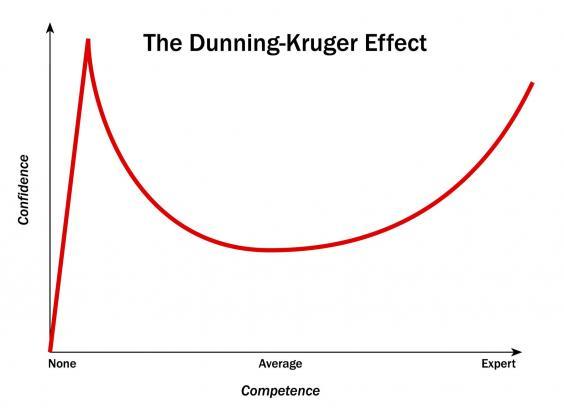
One of the more interesting cognitive biases is named the Dunning-Kruger Effect. It’s a psychological phenomenon where the less a person knows about a particular subject, the more confident they are in their perceived understanding. In other words, they know just enough about something to be dangerous with it. But if they actually put in the time and effort to thoroughly study a topic, their overall confidence decreases with more knowledge. At some point along the way, as they approach expert status, their confidence slowly climbs back up. The graph looks like this:

If you pay attention to all the different voices coming our way about this pandemic, you will see the Dunning-Kruger Effect in full swing. Those who know just a little bit are often the loudest, most confident, with the most certainty in their statements. But actual experts in the field speak with seemingly more uncertainty. They aren’t as apt to give straight-forward answers, and they readily admit that there are a lot of unknowns. Because here’s the thing about experts – ONLY EXPERTS KNOW WHAT THE UNKNOWNS ARE. And if they really are experts, they will admit where the knowledge base is unclear on any given topic.

Unfortunately, this preys on our bias towards ascribing credibility to those who sound confident in their arguments. Plenty of falsehoods are being spread from loud, confident-sounding novices, and that gets our attention.

As people of faith, we should always be somewhat skeptical of anyone claiming to have all the answers, especially if they are simply trying to out-shout the other voices. Jesus often got into arguments with the religious leaders of his day – men who knew just enough about the Scriptures to be dangerous. There is a level of humility that comes with true knowledge. If anyone thinks they have “arrived” and know all there is to know about a certain topic, then that’s when we must be on our guard.

One of the best examples of this is when Paul went through his conversion. He started off as a know-it-all Pharisee. Then the resurrected Jesus rocked his world and showed him how little he actually knew. This same Paul would go on to write, “I determined to know nothing among you except Christ and him crucified.”

When it comes to the pandemic, health and safety, or even religion, I would rather listen to the humble expert than the overconfident novice.
__________

For a quick guide to more cognitive biases, I recommend this article from Business Insider: 61 Cognitive Biases that Screw Up Everything We Do